Editor's note: The Utah Museum of Fine Arts provided
source material to Resource Library for the following article. If
you have questions or comments regarding the source material, please contact
the Utah Museum of Fine Arts directly through either this phone number or
web address:
-
Revisiting Utah's Past:
The Transformed Landscape
December 22, 2006 - August 12,
2007
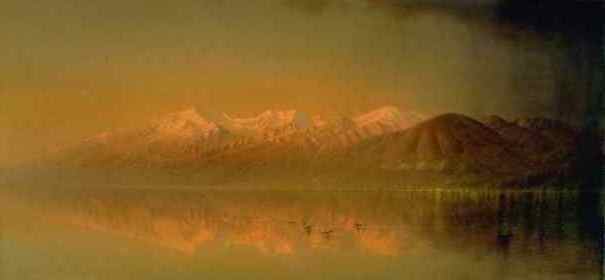
(above: Gilbert Davis Munger
(1837-1903), American, The Wasatch Mountains and Great Salt Lake in
the Foreground, 1877, Oil on canvas. Friends of the Art Museum and
Mr. Kenneth Nebenzahl. Museum #1977.022)
Ever wonder what Salt
Lake Valley looked like to those intrepid pioneers and early settlers? Or
how Park City appeared in the 1920s? As we look to the future of Utah with
such development projects as Downtown Rising and the creation of Utah's
tallest building, consider taking the time to revisit Utah's unique past.
The Transformed Landscape,
an exhibition on view December 22, 2006 through August 12, 2007 at the UMFA,
examines how early settlers transformed the undeveloped Utah Territory into
a cultured environment. In addition to several panoramic views of the Salt
Lake Valley by prominent local nineteenth-century artists, visitors will
be able to see paintings of pioneer homes, industrial subjects, and illustrations
and photographs of the area with familiar, identifiable buildings. Of particular
historic interest is The Utah Territorial Prison (1886) by
Francis M. Treseder, a painting from the Museum's permanent collection.
Waldo Park Midgley's Second South and Main (1905), another painting
from the UMFA's collection, offers a glimpse of an early stage in Salt Lake
City's developing "downtown" area, with horse drawn carriages,
street lamps, and store fronts.
As a wide range of architectural structures claimed more
space in the Salt Lake valley, artists explored ways to interpret how the
human presence altered an undisturbed natural landscape. In addition to
private homes, the growing society required new devotional, entertainment,
and civic spaces, either as separate structures or as one multi-functional
building. Artists, therefore, were compelled to incorporate the geometric
shapes of buildings into the organic forms of nature without compromising
the artistic integrity of either. As the population grew in numbers and
diversity, the landscape was transformed by architectural structures that
landscape painters could not ignore.
The problems and benefits of progress we face today are
similar to those the early Utah settlers faced. Come see how Utah's early
artists depicted the transformation of the area's undeveloped desert wilderness
to an urban metropolis.
"Revisiting Utah's Past" is dedicated to the
memory of John L. (Jack) Jarman and Helen Brown Jarman, who generously supported
the Museum's exhibitions program and the expansion of its collections.
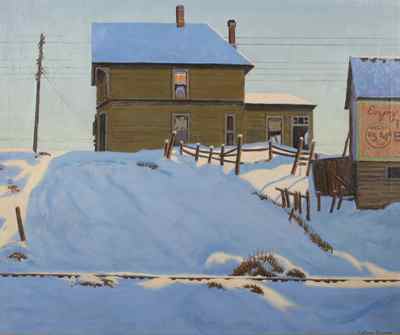
(above: LeConte Stewart (1891-1990), American, Smith's
House, 1937, Oil on canvas. Gift of Kay H. Blood. Museum #2001.16/2)
Wall panel and label texts for the exhibition
-
The Transformed Landscape
-
- Opening Panel:
-
- The Transformed Environment is an examination
of how differing purposes and ideologies of the Salt Lake Valley's early
settlers shaped the character of the built environment of the region. Mormon
pioneers shared a collective goal to establish an organized social refuge
based on the concept of the City of Zion, designed by the church's founder
Joseph Smith in Independence, Missouri in 1833. In contrast, the diverse
groups of miners and merchants, who were among the early arrivals to the
area, had no common belief system and no plans to build a utopian metropolis
in the wilderness. Indeed, non-Mormon settlers founded communities more
like those of the American Frontier outside Territorial Utah.
-
- Mormon communities were designed to support their social,
political, and religious practices. Each community was laid out in a square
grid pattern that allowed ample room for each family to have a home, orchard,
and garden. In addition, public structures included spaces for devotional,
civic, and religious activities that took place either in separate structures
or in one multi-functional building. In contrast to the Mormon goal to
develop a theocracy based on an agrarian culture, non-Mormon immigrants
responded enthusiastically to the economic promise of the abundance of
coal, silver, copper, and other minerals in the area. Mormon agrarian purpose
combined with non-Mormon business enterprise to create a unique society
that changed the landscape from undeveloped desert wilderness to a rapidly
developing urban metropolis. As a variety of domestic and public buildings
affirmed human presence in the area, landscape artists were compelled to
incorporate the geometric shapes of buildings into organic forms of nature
to create visual documents of the area's growth.
-
- The paintings and drawings in this exhibition are the
works of Utah's pioneering artists, dating from the 1850s through the 1930s.
Their interpretations of a changing landscape offer a glimpse of the Salt
Lake Valley's emerging culture with images that add an important dimension
to the history of American art. The works are visual records of a place
that changed rapidly from uncultivated wilderness to built urban environment.
Early settlers included Mormon refugees in search of isolation and peace,
and non-Mormon merchants, federal officials, miners, and railroad employees
who actively established contacts beyond Utah. These diverse groups re-shaped
the region's character as they built homes, shops, mills, and other structures
to support their needs. As wilderness was transformed into a built environment,
artists made subjective responses to the changes with images that capture
the character, quality, and purposes of early buildings.
-
-
- Painting near opening panel:
-
- Henry Lavender Adolphus Culmer (1854-1914) American born
in England
- View of the Salt Lake Valley
- On loan from private owners
- Museum #2006.46.1
-
- Some of Salt Lake City's existing prominent buildings
can be identified in H.L.A.Culmer's expansive view from an east bench location.
Culmer painted the drama of the changing environment as buildings inevitably
claimed more and more of the valley. Culmer's careful observation of natural
forms is evident in the View of the Salt Lake Valley in which the
growth of the city seems almost secondary to the meticulously rendered
details of the undeveloped areas.
-
- Gilbert Davis Munger (1837-1903), American
- The Wasatch Mountains and Great Salt Lake in the Foreground, 1877
- Oil on canvas
- Friends of the Art Museum and Mr. Kenneth Nebenzahl
- Museum #1977.022
-
- Munger label:
-
- In 1867 the United States Congress funded a geological
and geographical exploration to be led by Clarence King. The exploration's
purpose was to complete a scientific survey of the topography and natural
resources along the fortieth parallel of latitude that included the route
of the Central and Union Pacific railroads. As the guest artist with the
1869 Survey, Gilbert Davis Munger hoped to discover scenic wonders in unexplored
regions of the country that would insure his professional standing as a
landscape painter. By sharing ideas with the survey's team of photographers,
he developed new standards of representational fidelity and topographical
accuracy. Munger's numerous sketches of Utah's landscapes were later translated
into large scale landscape paintings of the region add to the record of
the nation's geological history.
-
- Albert Bierstadt (1830-1902), American born in Germany
- Near Salt Lake City, 1859
- 27 _" x 24 _"
- MOA
-
- Bierstadt label:
-
- Central to any discussion of nineteenth-century survey
expeditions, the art market, and the important contribution of photography
to both, is Albert Bierstadt who almost single-handedly defined the Western
American landscape tradition. Born in Germany and raised in Massachusetts,
he studied painting with Emanuel Leutze, another German-American, who introduced
him to sketching on-site in Germany's Harz Mountains and the Swiss Alps.
This experience formed his understanding of landscape, and transferred
readily to the grand-scale paintings of the American West for which he
is known. In a letter published in The Crayon in 1859, Bierstadt
wrote:
-
- "The (Rocky) Mountains are very fine, as seen from
the plains, they resemble the Bernese Alps, one of the finest ranges in
Europe...They are of granite formation, the same as Swiss mountains."
-
- Bierstadt's panoramic views of Western landscapes dominated
by formidable mountains supported the concept of Manifest Destiny, the
nineteenth century phrase that implied the inevitability of the Union's
continued territorial expansion to the west and south. By the time he painted
Near Salt Lake City, the Indian camps, symbolic of wilderness, that
are visible in many of his earlier works have been displaced by white settlements.
Responding to public curiosity about the country's remote territories,
Bierstadt painted landscapes that were intended to convey the sublime qualities
of sparsely settled western regions. Near Salt Lake City is small
compared to the large landscapes for which he is known but it is no less
comprehensive. With characteristic attention to detail, Bierstadt depicts
a determined settlement sandwiched between a background of a formidable
mountain range and a detailed representation of undeveloped foreground.
-
-
- Panel I: 16" x 20"
-
-
Personal Refuge
-
- Map of SLC 1870 -- showing
Plat of SLC P0 251 #47: Courtesy of the J. Willard Marriott Library's Photo
Archives department
-
- Mormons who settled the Salt Lake Valley in the mid nineteenth-century
founded communities based on Mormon Church Founder Joseph Smith's original
Plat of the City of Zion. Although the semi-arid landscape adjoining
the Wasatch Range required some modification, the plan remained generally
faithful to Smith's original design. Communities were laid out in square
grid patterns that allowed space for each family to have a home, garden
and an orchard. Public squares were designated for churches, schools, and
civic building, while factories and farms were located beyond town boundaries.
-
- The large number of separate homes affirmed Mormon emphasis
on family as the central unit of a society. As the developing economy allowed
for better living standards, homes reflected individual tastes as well
as the particular requirements of Mormon society. Although plural marriage
did not produce a special style, it required separate quarters for each
wife. Brigham Young's Lion House was an architectural solution to the problem
of housing several families.
-
-
-
- Brigham Young's Compound: Photo courtesy of the Utah
State Historical Society
-
-
- Danquart Anthon Weggeland
(1827-1918), American, born in Norway
- Old Salt Lake, 1868
- MOA
-
- Danquart Anthon Weggeland (1827-1918), American, born
in Norway
- North State Street (Brigham
Young's back yard), 1868
- UAC
-
- Panel II: 16" x 20"
-
-
Domestic Architecture
-
- Great Salt Lake City -- Photo 979.21 courtesy of the
Utah State Historical Society
-
- Early domestic structures reflected necessity rather
than aesthetic or religious aspirations. Tents, wagon boxes, and hillside
dugouts provided shelter for the first arrivals to the Salt Lake Valley.
Logs and adobe were available building materials for the earliest homes,
but as lumber was also needed for fuel, fences, and furniture, most homes
were of adobe brick. Although these structures provided adequate shelter,
there are reports of invading insects and rattlesnakes, and the dirt floors
were a formidable housekeeping challenge.
-
- "As Mormon communal villages became secure from
Indian attacks, the greatest expanses of sagebrush were broken at long
intervals by a lone adobe house and root cellar surrounded by patches of
plowed earth and the green of winter wheat. An irrigation stream flowed
by, lined with row of Mormon poplars as windbreaks. With desperate innovation,
or they would have starved, the settlers became America's irrigation pioneers,
and set the laws and rules for all peoples living 'under the ditch.'"
- Papanikolas, Helen, The Peoples of Utah, Utah:
Utah State Historical Society, 1981
- While most early homes were modest in scale and constructed
of locally quarried stone, materials for Territorial Utah's most impressive
homes included fired brick, granite, and wood, affirmed business success
rather than agrarian enterprise or ecclesiastical standing. Many of Utah's
personal fortunes of the late nineteenth-century, amassed by non-Mormons,
affirmed business success rather than agrarian enterprise of ecclesiastical
standing, and were the outcomes of mining and commerce.
-
- .Elaborate homes were designed by commissioned architects
who were aware of prevailing national architectural conventions, surface
textures and appropriate materials. An example is the Kearns mansion, built
in 1902 by Thomas Kearns, owner of Park City's Silver King Mine. Designed
by Carl M. Newhausen and constructed of limestone quarried in Sanpete County,
the home was donated to the State of Utah by Jennie Kearns after her husband's
death on condition that it serve as the official residence of the State's
governors.
-
-
- Kearns Mansion: Photo courtesy of the Utah State Historical
Society
-
-
- Painting near Panel II
-
-
- Danquart Anthon Weggeland
(1827-1918), American, Norwegian born
- Early Days in Salt Lake Valley or
Pioneer Home
- 16 _" x 19 _"
- On loan from the Springville Museum of Art, Springville,
Utah
-
- Herman H. Haag (1871-1895), American
- First Building in Utah
- On loan from the Museum of Church History and Art
-
- Haag label:
-
- Born in Stuttgart, Germany, Herman Haag immigrated to
Salt Lake City where he became one of James T. Harwood's painting students.
In 1889 he joined Harwood in Paris for study at the Académie Julian
where he won an award for composition. When Haag returned to Utah in the
early 1890s he was appointed to the faculty of the Art Department, University
of Utah where he taught from 1893-1894. Tragically his early death cut
short a promising career as a gifted painter and teacher.
-
- Carl Christian Anton Christensen (1831-1912), American,
Danish born
- Home Sweet Home, 1875
- Oil on panel
- Gift of Mr. and Mrs. Joseph Palmer
- Museum #1991.069.009
-
- Christensen label:
-
- Carl C. A. Christensen arrived in the Salt Lake valley
in 1857 from Denmark. He entered the Territory "with the Danish flag
flying from his cart and his trousers flapping in tatters around his legs."
He left briefly to study painting with Philip Barlag in Denmark and, after
his return to Utah, concentrated primarily on paintings of the local landscape.
From 1869 until 1890 he painted monumental narrative scenes, each 8 by
12 feet, depicting scenes of Mormon history. These were attached in sequence
on a roller as a continuous scroll, 3000 feet long, with which he traveled
throughout the settlements telling an illustrated story of Mormonism. He
is also known for his carefully crafted genre paintings of an idealized
view of pioneering life, such as this painting of his home in Ephraim,
Utah that portrays an idealized version of pioneer life.
-
-
- Florence Ware (1891-1971, American
- Untitled (Landscape)
- Oil on canvas board
- Gift of Mr. and Mrs. Joseph J. Palmer
- Museum #1991.069.026
-
- Daughter of Walter E. Ware, one of Utah's leading architects,
Florence Ware studied art at the University of Utah and the Chicago Art
Institute. One of the few artists in Utah to receive a Federal Art Project
commission during the 1930s, her government sponsored murals in Kingsbury
Hall are evidence of her high level of technical skill as well as her strong
sense of pattern and design. Her sensitively painted views of local subjects
demonstrate the depth of her understanding of the conventions that govern
landscape painting. This painting is an example of Ware's ability to reveal
the characteristics of a local scene in small, intimate scale and with
controlled color relationships.
-
- LeConte Stewart (1891-1990), American
- Smith's House, 1937
- Oil on canvas
- Gift of Kay H. Blood
- Museum #2001.16/2
-
- LeConte Stewart never studied in Europe and consciously
avoided modernist tendencies to abstract and distort forms and colors.
His work records the qualities of Utah's changing landscape now altered
by the effects of mechanization and industrialization. Painted in 1937,
Smith's House is a straightforward painting of an abandoned Victorian-style
house. Railroad tracks in the foreground parallel electrical power lines
above the house. One of the New Deal programs of the 1930s was to bring
electrical power to rural communities, thereby creating jobs and stabilizing
local economies. But even that optimistic sign doesn't change the feeling
of desolation and loneliness the painting conveys. As with most of Stewart's
paintings, there are no people pictured; his landscapes are uninhabited
and most of his houses appear unoccupied. Stewart found endless inspiration
in the Utah's material emptiness during the 1920s and 1930s.
-
- Panel III: 16" x 20"
-
-
An Organized Community
-
-
- Plat of the City of Zion: Photo 910 27774 Courtesy
of the Utah State Historical Society.
-
- Utah's early immigrants represented different reasons
for settling the region. Mormon pioneers wanted a secluded, uninhabited
space in which they could establish organized towns based on Joseph Smith's
design for the City of Zion. In contrast, the diverse groups of non-Mormon
settlers, shared no common belief system, and none had plans for a utopian
metropolis in the wilderness. Ethnic groups formed enclaves with their
own churches, lodges, and meeting places.
-
- While Mormons envisioned a religious settlement based
on agriculture, most non-Mormon immigrants were drawn to the area by the
economic potential of abundant coal, silver, gold, copper and other mineral
resources. The disparate purposes of the two main groups of early arrivals
combined to create the unique economic and cultural environment. As civic,
devotional, and domestic buildings competed for attention with the surrounding
mountains, artists confronted the problem of incorporating geometric architectural
shapes into the organic forms of nature without compromising the integrity
of either.
-
-
-
- Bird's Eye View of Salt Lake City 1870: Photo 910
17851 courtesy of the Utah State Historical Society
-
-
- Danquart Anthon Weggeland
(1827-1918), American, Norwegian born
- Manti Temple, 1884
- Gift of Mr. and Mrs. Joseph J. Palmer
- Oil on panel
- Museum # 1991.069.027
-
- Label:
-
- Religious buildings were the costliest and most complex
structures built by early settlers. The Salt Lake Temple, a Gothic Revival
design by Truman O. Angell and William Folsom, was begun in 1853 and completed
forty years later. While completion of the Salt Lake Temple lagged, smaller
temples were completed by the late 1880s in St. George, Logan, and Manti,
shown in this painting.
-
- The Cathedral Church of St. Mark, designed by Richard
Upjohn, Jr., was completed in 1871, and the Cathedral of the Madeleine,
designed by Karl Neuhausen and Bernard Mecklenburg in the Romanesque Revival
style was begun in 1899 and completed in 1909.
-
- Panel IV: 16" x 20"
-
-
Economic Beginnings
-
-
- Inside the Blacksmith's Shop: Photo P0061 courtesy
of the J. Willard Marriott Library, University of Utah
-
- Utah's economy developed in stages, beginning with agriculture,
then mining, and finally supported by manufacturing in the late nineteenth
century. Mormon settlers shared an ideology in favor of a balanced economy
supported primarily by agriculture, but they acknowledged the need to establish
systems for resource development, trade, and manufacturing.
-
- The Mormon plan for a self-sustaining society included
local manufacturing that provided markets for Utah's agricultural products.
The Department of Public Work established in 1850, supported such industries
as a sugar factory, machine shop, foundry, and nail factory. Small local
establishments provided the community's basic needs: sawmills, gristmills,
tanneries, and carpenter shops, all designed as cooperative programs. Cooperative
light industries, including tanneries, textile mills, tin shops, and broom
factories, produced goods for the local population.
-
- James T. Harwood (1860-1940), American
- Old Blacksmith Shop, City
Creek Canyon
- Oil on canvas
- On loan courtesy of the Museum of Church History and
Art
-
- Label:
-
- In 1852 John Taylor brought machinery, sugar beet seeds,
and experienced workers from Europe to manufacture beet sugar. The plant
failed to produce sugar, and Brigham Young assumed control of the company.
He first established a factory at Temple Square, then on a church farm
four miles south of the city known since as Sugar House. The three-story
adobe factory, completed in 1855, processed more than 22,000 sugar beets
into molasses that proved unpalatable. An infestation of the sugar beet
crops of 1855 and 1856 by grasshoppers forced the factory to close.
-
- Danquart Anthon Weggeland (1827-1918), American, Norwegian
born
- Sugar Factory at Sugarhouse
- Oil on canvas
- On loan courtesy of the Museum of Church History and
Ar
-
- Sugar Factory at Sugarhouse: Photo Courtesy of the
Utah State Historical Society
-
- Art near Panel V:
- Albert Mugleston (1885-1965), American
- Big Cottonwood Paper Mill
- On loan courtesy of the Museum of Church History and
Art
-
-
- The Old Paper Mill at Big Cottonwood Canyon: Photo
P0110#61 Courtesy Photo Archives, J. Willard Marriott Library, University
of Utah
-
- Orson D. Campbell (1876-1933),
American
- The Old Mill, 1929
- Oil on panel
- Gift of Henry and Salome Oberhansley
- Museum #1985.025.005
-
- Bent Franklin Larsen
- Sawmill Provo Canyon
- Oil on canvas
- Gift of William Patrick
- Museum # 1971.040.002.001
-
- James T. Harwood (1860-1940), American
- Old Blacksmith Shop (date)
(from State Street and North Temple)
- On loan courtesy of the Museum of Church History and
Art
-
- This crudely constructed utilitarian building shows clear
evidence of the artist's ability to render closely observed effects of
light and climate. Harwood's instruction at the Académie Julian
and the Ecole des Beaux Arts in Paris
- enabled him to develop a high level of technical skill
and a sharp sense of literal accuracy. The Old Blacksmith Shop is
placed, somewhat improbably, in a sunlit landscape that reminds viewers
that Harwood's training combined rigorous academic studio instruction with
the freedom of plein-air (on-site) painting.
-
- LeConte Stewart (1891-1990), American
- The Green Front, 1935
- Oil on canvas
- University of Utah Collection
- Museum # X.037
-
- Waldo Park Midgley (1888-1986), American
- Second South and Main, 1905
- Oil on panel
- Purchased with funds from Friends of the Art Museum
- Museum #1984.091
- Danquart Anthon Weggeland (1827-1918), American, Norwegian
born
- Armstrong Ranch, Mountain Dell,
ca. 1890
- Oil on canvas
- Loaned by a private collector
-
- Francis Horspool (1871-1951), American
- Wells Fargo Stage Station at Willow Springs, 1939
- Oil on canvas
- Purchased with funds from Friends of the Art Museum
- Museum #1978.487
-
-
- Panel VI: 16" x 20":
-
Camp Douglas
Fort Douglas Photo 623-3004 Courtesy
of the Utah State Historical Society
-
-
- Camp Douglas, at Salt lake City, recently reinforced
by United States Troops: Photo of lithograph courtesy of the Utah State
Historical Society
-
- In May of 1862 the Third Regiment of the California Infantry
was sent to Great Salt Lake in the Utah Territory ostensibly to protect
the overland mail route from attacks by hostile Indians. The 750 troops
of the Regiment were under the command of Colonel Patrick E. Connor who
had fought with the Texas Volunteers in the War with Mexico. Then, as a
civilian, he moved to Stockton, California to establish a construction
business. When President Abraham Lincoln asked California to raise five
infantry regiments and one cavalry unit, Connor enlisted, accepted a commission
as Colonel of the Third Regiment, and recruited many of his troops from
the gold mining camps in the Stockton area.
-