Editor's note: The Frist Center for the Visual Arts provided source material to Resource Library for the following article or essay. If you have questions or comments regarding the source material, please contact the Frist Center for the Visual Arts directly through either this phone number or web address:
Brushed with Light: Masters of American Watercolor from the Brooklyn Museum
May 4 - July 22, 2007
The Frist Center for the Visual Arts is the inaugural venue for Brushed with Light: Masters of American Watercolor from the Brooklyn Museum opening Friday, May 4, 2007. Featuring 82 vibrant watercolors, Brushed with Light demonstrates the evolution of this important artistic medium, and the development of landscape imagery in American art from the late 18th century to 1945. The exhibition continues at the Frist Center through July 22, 2007.
This chronological survey of American watercolors begins with precisely painted scenes from late 18th-century New England and concludes with urban images from the mid-20th century. The majority of the works, however, were created by many of America's foremost artists of the late 19th century, including Winslow Homer, John La Farge, Thomas Moran, William Trost Richards and John Singer Sargent. Also included in the exhibition are early 20th-century works by John Marin -- acknowledged for bridging naturalist landscape visions of earlier artists with modernist trends in American art -- as well as Milton Avery, Arthur Dove, Marguerite Zorach and American Scene painters Edward Hopper and Thomas Hart Benton.
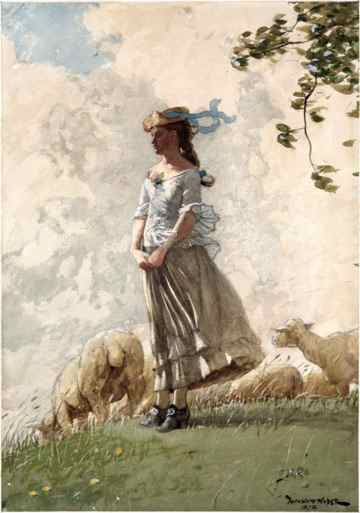
"We are pleased to present our first exhibition devoted to watercolors, a wonderful medium familiar to many amateur and professional artists working in Middle Tennessee," says Katie Delmez, associate curator at the Frist Center. "The Brooklyn Museum has an outstanding collection of American watercolors, and Brushed with Light features iconic works by true masters of the medium, including Fresh Air by Winslow Homer and In a Levantine Port by John Singer Sargent."
In the United States, the art of landscape painting and the practice of watercolor debuted and matured in tandem. Over the course of 150 years, as the idea and experience of the American landscape became more complex and varied, images of the country's landscape were also transformed-from the documentary to the evocative, and on to the abstract and newly realistic. Watercolor practice also evolved, as artists mastered and then moved beyond painstakingly detailed execution toward the freedom of Impressionist-inspired styles and modernist innovation. Artists actively sought and found innovative ways to use the transparency of watercolor paints, and to infuse their outdoor subjects with a new and vibrant brilliance.
The status of the art of watercolor also evolved over the course of the 19th century. Although the medium was regarded as distinctly secondary to oil painting around 1800, artists and their American audience, following Britain's lead, gradually came to view finished works in watercolor as objects worthy of exhibition and collecting. By the early 20th century, the medium was accepted as an important and technically challenging one. Brushed with Light offers a survey of diverse and compelling watercolors depicting the ever-changing American scene.
Highlights from Brushed with Light include:
Organizers and Sponsors
Brushed with Light: Masters of American Watercolor from the Brooklyn Museum has been organized by the Brooklyn Museum.
Exhibition Itinerary
Selected Related Programs
(above: Winslow Homer, American, 1836-1910 , Fresh Air, 1878, Watercolor with opaque white highlights over charcoal on cream, moderately thick, rough-textured wove paper; 20 1/16 x 14 inches. Collection of the Brooklyn Museum: Dick S. Ramsay Fund, 41.1087)
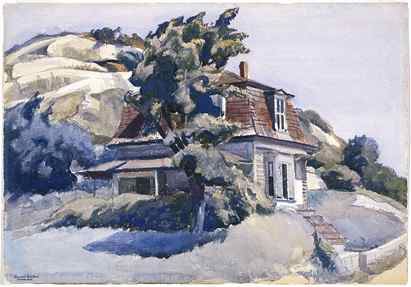
(above: Edward Hopper, American, 1882-1967, House at Riverdale, 1928, Watercolor with graphite sketch on white, medium weight, roughly textured wove paper; 13 7/8 x 19 7/8 inches. Collection of the Brooklyn Museum: Bequest of Anita Steckler, 2003.1)

(above: John Singer Sargent, American, 1856-1925, Zuleika, ca. 1906. Transparent watercolor with touches of opaque watercolor over graphite on off-white, thick, rough-textured wove paper; 10 x 13 15/16 inches. Collection of the Brooklyn Museum: Purchased by Special Subscription, 09.847)
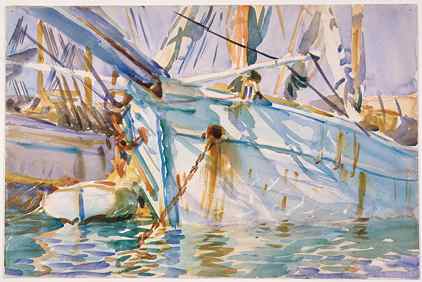
(above: John Singer Sargent, American, 1856-1925, In
a Levantine Port, ca. 1905-1906, Transparent watercolor with touches
of opaque watercolor over graphite on off-white, thick, rough-textured wove
paper; 12 1/16 x 18 1/8 inches. Collection of the Brooklyn Museum: Purchased
by Special Subscription, 09.825)
Read more articles and essays concerning this institutional source by visiting the sub-index page for the Frist Center for the Visual Arts in Resource Library.
Visit the Table of Contents for Resource Library for thousands of articles and essays on American art.
Copyright 2007 Traditional Fine Arts Organization, Inc., an Arizona nonprofit corporation. All rights reserved.