Editor's note: The Addison Gallery of American
Art, Andover, MA provided source material to Resource Library for
the following article or essay. If you have questions or comments regarding
the source material, please contact the Addison Gallery of American Art
directly through either this phone number or web address:
William Wegman: Funney/Strange
April 7 - July 31, 2007
The Addison Gallery
of American Art is presenting William Wegman: Funney/Strange, an
exhibition exploring forty-years of the artist's works in all media. The
first retrospective of Wegman's work in over fifteen years, the exhibition
includes more than 200 works, among them his signature 20 x 24 Polaroids,
as well as early black and white and altered photographs, paintings, drawings,
collages, artists books, videos, and film. William Wegman: Funney/Strange
will be on view from April 7 through July 31, 2007.
Underlying all of William Wegman's work is the light humor
of "funny" mediating the darker human comedy of "strange."
His career has never been static or predictable, yet it is woven of enduring
threads of interests that engaged him at the beginning and compel him still.
Coming of age in the 1960s, Wegman was an early exponent of conceptual art
and a pioneering maker of video. He continues to be a video artist and conceptual
thinker at the same time that he is an adventurous painter, prolific writer,
and masterful photographer who is able to navigate between art that amuses
and surprises and art that challenges and transforms.
Born in Holyoke, Massachusetts in 1943, Wegman received
a BFA from the Massachusetts College of Art in Boston and an MFA from the
University of Illinois, Urbana-Champaign. In Illinois and later in Wisconsin,
he began to experiment with a wide range of media-film, kinetic sculpture,
installation, and performance. While teaching at California State College
in Long Beach in the 1970s, Wegman developed what was to be his mature artistic
voice expressed in his signature media of photography, video, and text.
It was in California that he acquired his canine muse Man Ray and began
to include the dog in both photographs and video. By the fall of 1972 he
moved to New York where he has remained ever since, applying his quirky
and unpredictable imagination and expansive artistic appetite to a career
that has been far-ranging, all-embracing, and provocative.
Beloved by the general public and held in critical esteem
within the international art world, Wegman fascinates both for much the
same reasons: his smart, gently subversive humor that destabilizes the familiar
to reveal life's essential oddity. Throughout his career, he has moved seamlessly
among various media, from conceptual works to commissioned magazine shots,
from video work to television segments made for Sesame Street and
Saturday Night Live; from artist's books to children's books, from
photographic "landscapes" employing his dogs to his most recent
tour de force cycle of paintings that incorporate scenic postcards with
drawing, collage, and paint. This exhibition will bring together classic
Wegman images with rarely exhibited material and surprising new work to
reveal the full range and savvy voice of this remarkable artist's production.
The exhibition has been guest curated by Trevor Fairbrother,
an independent scholar who has worked on wide range of topics, from Andy
Warhol to John Singer Sargent. He has served as a curator of American painting
and of contemporary art at the Museum of Fine Arts, Boston, and as Deputy
Director for Art at the Seattle Art Museum. An extensive catalogue, written
by scholar and critic Joan Simon and published by Yale University Press
in association with the Addison Gallery of American Art, accompanies the
exhibition.
Related events
The Addison Gallery is presenting a series of free, public
programs in conjunction with William Wegman: Funney/Strange, including:
- Sunday April 29, 1:00 PM Director/artist dialogue with
Brian Allen the Addison Gallery's Mary Stripp and R. Crosby Kemper Director,
artist William Wegman and Exhibition Curator Trevor Faribrother. Kemper
Auditorium, Phillips Academy. Seating is limited and available on a first-come
basis.
-
- Wednesday, May 16, 12PM Lunch Talk -- Bring a bag lunch
and join Addison Gallery staff for a tour of the exhibition.
For more details on programs and events, please visit www.addisongallery.org
Wall panel texts from the exhibition
- Exhibition titles and introduction
-
-
- William Wegman: Funney/Strange
-
- Born in Holyoke, Massachusetts, in 1943, Wegman entered
the Massachusetts College of Art in Boston in 1961. Although painting had
been his first love, study for an MFA at the University of Illinois, Urbana-Champaign,
immersed him in the unfettered experimentation of Sixties counterculture.
During his time as an art instructor in Wisconsin and California (1967-71),
Wegman explored video, installation, and the merging of sculpture, happening,
and performance. Since 1972 he has lived and worked in New York City.
-
- Wegman had his creative breakthrough when his photographs
took on the exploratory attitude of Conceptual Art. He had been using a
camera to document his ephemeral performances and installations; then,
in 1970, he staged scenarios that he knew would yield quizzical photographs.
On first impression these pictures are deadpan, but scrutiny reveals them
to be visually and intellectually mischievous.
-
- William Wegman Funney/Strange surveys Wegman's lively
contributions to a wide variety of media, including video, drawing, painting,
collage, and photography. His art is full of playful ideas, regardless
of the form it takes. Wegman's instinct for the ambiguous and the absurd
tempts us to see the world from different perspectives: inverted, fractured,
and in flux.
-
- The exhibition was organized by the Addison Gallery of
American Art, Phillips Academy, Andover, Massachusetts, with guest curator
Trevor Fairbrother.
-
- Generous support for this exhibition and the accompanying
publication authored by Joan Simon was provided by The Henry Luce Foundation.
-
- Wegman has an exceptional ability to subvert the "normal."
In Funney/Strange, a drawing from 1982, he juxtaposed two images that are
similar but different and then messed with the spelling and meanings of
the word "funny." Finding the place where funny/humorous can
flip into funny/peculiar is a key impulse for him.
-
- The works gathered on this wall offer an informal portrait
of Wegman's abiding curiosity about the mind: how we rely on our senses;
how we switch between verbal and visual communication; how words and pictures
can stimulate our need to imagine and wonder.
-
-
- [Drawings and Altered Photographs]
-
- After winning critical acclaim for his black-and-white
photographs and short video works, Wegman began to exhibit drawings. "What
a relief," he wrote, "to gaze upon a blank sheet of paper and
make a few lines with a pencil and not have to worry about lighting or
electronic feedback."
-
- Wegman has long admired the formulaic images and diagrams
used to illustrate encyclopedias, handbooks, and instruction manuals. His
drawings often recall the simple and magically direct power of that variety
of popular illustration. The works in the "Altered Photographs"
series present a mock-diagrammatic drawing on top of one of his photographs.
They force two worlds to collide: the photograph shows one reality and
the ink drawing poses a second scenario. Wegman's fusion of two types of
picture thwarts our ability to make simple readings.
-
-
- [Polaroids]
-
- Wegman has been making large Polaroids since 1979. He
was among the first artists invited to experiment with the "room-size"
camera that Polaroid built to make giant "instant" photographs
with an unprecedented degree of clarity and detail. Wegman's 24-by-20-inch
Polaroids allowed him to translate his love of verbal and visual play into
theatrical and narrative realms.
-
- In scale, sharpness, and strong color these works confront
the allure of glossy advertising and Hollywood movies. Writing in 1983
the critic Sanford Schwartz made this comment on their appeal: "Enamel-dense
and satiny, Wegman's generally dark blues, reds, and greens have a once
hot, now cooled-off lustrousness; they're like the colors of cars at night
in the tropics."
-
-
- [Paintings]
-
- Wegman's paintings from the 1980s and 1990s have a deft
and whimsical touch. Some coax images out of mere drips and stains. Others
mix boldly brushed passages with carefully detailed vignettes. The incidents
and accidents that abound on the surfaces of his paintings trigger the
imagination. Wegman has observed, "When I was a boy, my room had pirate
wallpaper, and the registration of the printing was off, so that the pirate's
face wasn't in the pirate's head outline. I can still recall the hours
I spent studying the problem of the pirates climbing the sky and not the
ladder. My paintings are a lot like that-everything is familiar but not
quite in the right place."
-
- In his latest paintings Wegman attaches postcards to
the picture surface. Each printed card is a visual "given" that
he must weave into the larger field of brushstrokes. He constructs exhilarating
counterpoints as he swoops from the world within each card to the complexity
of the overall composition.
-
-
- [Video]
-
- In an essay about his early videotapes Wegman wrote,
"The belief that I could reach an audience without being there somehow
appealed to me. I was also interested in expanding the range of subject
matter in my work; to deal with things that really meant something to me,
the kinds of things you tend to catch yourself thinking about whether you're
supposed to or not. [I shot] brief vignettes involving studio and familiar
household props. They are unassuming and straightforward in set and lighting,
with clear and definite beginnings, middles, and ends."
-
- The directness and infectious humor of Wegman's videos
in the 1970s led to commissions from NBC's Saturday Night Live and memorable
contributions to PBS's Sesame Street. In turn these successes have inspired
such popular commercial products as the fifteen-second videos that had
their debut on Nokia cell phones in 2004.
-
-
- [Early Photographs]
-
- Staged black-and-white photographs were a crucial part
of Wegman's early pursuits. He mimicked the nondescript settings and inane
aspect of photographs taken for documentary or scientific purposes. The
pictures surprise us with their ambiguous or inexplicable fragments of
information. For example, the two photographs that comprise Milk/Floor
are similar on first glance, but then their compositions become very different:
the same dog seems to drink from the same puddle of milk, but the floor
boards are running in different directions.
-
- Wegman has also explored word play to great effect. Madam
I'm Adam is a diptych that pays homage to the palindrome (a phrase that
reads the same both forward and backward). While the photographs are extremely
close in appearance, careful comparison reveals that one of them is printed
from a flopped negative.
-
-
- [Maine]
-
- Wegman has spent many summers in the Rangeley Lakes Region
of Maine. The local woods, mountains, and lakes invite rest and play; in
addition they are a great inspiration. In his intriguing unbound book,
Field Guide to North America and to Other Regions, Wegman pays tribute
to rural Maine while alluding to a global crisis: the depletion of natural
resources. The book's mammoth pages interweave stories, statistics, field
notes, recipes, and armchair philosophy with watercolors, drawings, and
photographs of nature.
-
- Maine is also the summer home of the artist's dogs, and
he savors the opportunity to depict them outdoors. As in the studio photographs
and videos, the weimaraners are his foils: trusting and faithful, they
act out the fun, folly, and adventure of the America's vacation mythology.
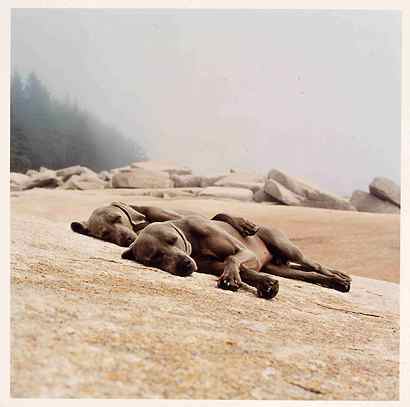
(above: ©William Wegman (born Holyoke, MA, Dec 2, 1943),
Washed Up, 2002, Chromogenic print, 14 x 11 inches (35.56 cm x 27.94
cm). Private collection)
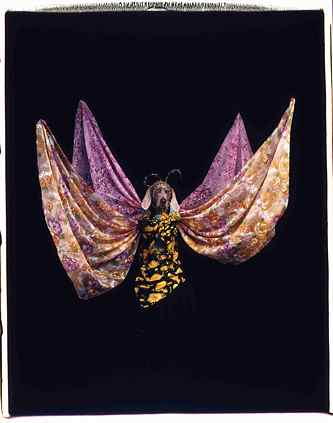
(above: ©William Wegman (born Holyoke, MA, Dec 2, 1943),
Midsummer Night's Dream, 1999, Polaroid, 24 x 20 inches (60.96 cm
x 50.8 cm). Private collection)
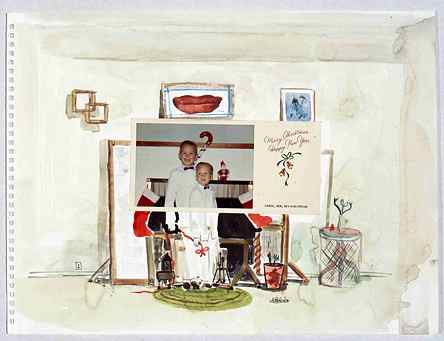
(above: ©William Wegman (born Holyoke, MA, Dec 2, 1943),
Bob and Ray, 1996, Gouache and greeting card on paper, 12 x 16 inches
(30.48 cm x 40.64 cm). Private collection)
Read more articles and essays concerning this institutional
source by visiting the sub-index page for the Addison
Gallery of American Art at Phillips Academy in Resource
Library.
Visit the Table
of Contents for Resource Library for thousands
of articles and essays on American art.
Copyright 2007 Traditional Fine Arts Organization, Inc., an Arizona nonprofit corporation. All rights
reserved..