Editor's note: The
Albany Institute of History and Art provided source material to Resource
Library for the following article or essay. If you have questions or
comments regarding the source material, please contact the Albany Institute
of History and Art directly through either this phone number or web address:
Luminosity: Paintings by
Stephen Hannock
June 16 - September 2, 2007
The Albany Institute
of History & Art is presenting the exhibition Luminosity: Paintings
by Stephen Hannock. The exhibition will showcase 20 paintings by, Stephen
Hannock, including self-portraits, landscapes and four major works described
by the artist as "Vistas with Text." The exhibition also includes
sketchbooks, photographs and two short films related to Hannock's work.
One of the country's foremost neo-romantic painters, Hannock
was born and raised in Albany, and attended the Albany Academy. He went
on to study art at Smith College with Leonard Baskin (with whom he apprenticed
with from 1972-75), and received his B.A. from Hampshire College. In the
beginning of his artistic career, Hannock experimented with Day-Glo paints,
which required dark rooms and black lights to bring out the colors. He then
began to experiment with phosphorous paints on canvas with external black
lighting, and exhibited two paintings at the Albany Institute in 1982.
Hannock's style of painting was changed by an accident
in the early 1980s, when he attempted to remove a sky on a canvas with an
electric sander. The result of the rough treatment to the canvas had a surprising
effect on the quality of light emanating from the work. The surface of the
painting glowed with an inherent luminosity and soon became the artist's
trademark style.
To achieve a luminous look, Hannock has mastered and manipulated
the use of electric sanders to polish in between the many layers of oil
paint and resin to create a smooth surface infused with light and depth.
His paintings are multi layered in meaning as well. In his more recent larger
paintings, which the artist refers to as "Vistas with Text," Hannock
includes written commentaries or diaries embedded in the painting. Hannock
describes these paintings "as woven fabrics of light combined with
the recounting of anecdotes of people's adventures celebrating the history
of the times."
Hannock's work is represented in many private and public
collections including the Metropolitan Museum of Art, New York City, National
Gallery of Art, Washington, D.C., Museum of Fine Arts, Boston, the National
Museum of American Art, Washington D.C; Smith College Museum of Art, Worcester
Art Museum, MA; Museum of Fine Art, Houston, TX; and the Albany Institute
of History & Art. In 1998 Hannock won the Academy Award for "Special
Effects" in the motion picture, What Dreams May Come. For the
film, Hannock created more than 100 paintings that were used by the special
effects team to create computer-generated images of heaven and hell.
Recognizing Hannock's interest in Hudson River School artists
Thomas Cole and Frederic Church, John Kensett, and George Inness, the Albany
Institute is installing its collection of Hudson River School paintings
in the adjacent galleries. Several examples of Hannock's work will also
be on view during the summer at Olana State Historic Site in Hudson, New
York and the Berkshire Museum in Pittsfield, MA. Hannock divides his time
between his studios in Williamstown, MA and New York City.
Wall text for the exhibition
-
- This summer, the Albany Institute is pleased to present
an exhibition of works by Albany-born artist Stephen Hannock, one of this
country's foremost contemporary American neo-romantic painters. Luminosity:
Paintings by Stephen Hannock, features 20 paintings including self-portraits,
landscapes and four major works with what the artist calls "Vistas
with Text." Also included are sketchbooks, photographs and two short
films related to Hannock's work. The exhibition opens on Saturday June
16 and continues through Sunday, September 2. A reception will be held
on Thursday, June 21, from 5:30-7:30pm, and Mr. Hannock will give a gallery
talk on his work on Thursday July 19 at 6:00.
-
- Stephen Hannock was born and raised in Albany and graduated
from the Albany Academy where he played goalie for the ice hockey team.
He continued to play hockey at Bowdoin College in Maine, however, after
spending a semester at Smith College studying art with Leonard Baskin (apprenticeship
from 1972-75) Hannock never returned to Bowdoin or ice hockey again. He
did, however, continue his study of art at Hampshire College (BA) and utilized
his athletic abilities as one of the world's top ten freestyle Frisbee
players during the late 1970s.
-
- From the beginning of his artistic career Hannock was
interested in light. He has experimented with it on many levels over the
years beginning with Day-Glo paints, which required dark rooms and black
lights to bring out to colors. Next he used phosphorus paints on canvas
with external black lighting. He exhibited two of these paintings at the
Albany Institute in the 1982. Hannock moved to New York City in 1984 and
his first New York show included his phosphorescent paintings with external
black-light lighting. Hannock's style of painting changed quite by accident
in 1986 when he decided to remove a sky on a canvas he did not like with
an electric sander. The result of this rather rough treatment to the canvas
had a surprising effect on the quality of light emanating from the work.
The surface of the painting glowed with an inherent luminosity and the
laborious process of paint layering, sanding and polishing has become the
artist's signature style.
- Today, his carefully crafted landscape paintings are
renowned for their magnificent luminous qualities using his signature process
of polished painted surfaces. To achieve his pure iridescent reflections
of light from the surface of his painting, Hannock has mastered and manipulated
the use of electric sanders to polish in between the many layers of oil
paint and resin to create a smooth surface infused with light and depth.
His paintings are multi layered in meaning as well. In his more recent
larger paintings, which the artist refers to as "Vistas with Text,"
Hannock includes written commentaries or diaries, embedded in the painting.
Hannock describes these paintings "as woven fabrics of light combined
with the recounting of anecdotes of peoples' adventures celebrating the
history of the times." See The RiverKeeper)
-
- Luminous is the word most often used to describe Hannock's
landscape paintings. Hannock himself calls them "lightscapes."
According to Hannock, "I use the topography of the landscape to hang
the light on." These landscapes are suggestive of real places but
are not literal interpretations. He paints with the intention of creating
mood and "imaginary realism" is a term frequently applied to
his landscapes. Hannock does not work directly from nature, nor does he
work from photographs, however, he makes numerous sketches, often on envelopes,
to help him "recall the rhythm of the land and the spilling of light."
Although inspired by Hudson River School artists Thomas Cole and Frederic
Church, his imagery also reflects the work of J.M.W. Turner, George Inness,
John Frederick Kensett, Fitz Hugh Lane and Albert Pinkham Ryder, Hannock.
-
- Recognizing Hannock's interest in Hudson River School
artists Thomas Cole and Frederic Church, John Kensett, and George Inness,
the Albany Institute is installing its collection of Hudson River School
paintings in the adjacent galleries. Several examples of Hannock's work
will also be on view during the summer at Olana State Historic Site in
Hudson, New York and the Berkshire Museum in Pittsfield, MA. Hannock divides
his time between his studios in Williamstown, MA and New York City.
-
- Hannock's work is represented in many private collections
and public collections including the Metropolitan Museum of Art, New York
City, National Gallery of Art, Washington, D.C., Museum of Fine Arts, Boston,
The National Museum of American Art, Washington, D.C.; Smith College Museum
of Art, Worcester Art Museum, MA; Museum of Fine Art, Houston, TX, and
the Albany Institute of History & Art. n 1998 Hannock won an Academy
Award for "Special Effects" in the motion picture, What Dreams
May Come. For the film, Hannock created over 50 paintings that were
used by the special effects team to create computer-generated images of
heaven and hell. Actor Robin Williams plays a man who dies and wakes up
in heaven and must find his way to hell to rescue his wife, Annabella Sciora,
a painter and art conservator.
-
-
- [SIDEBAR]
-
- Nocturne for the River Keeper, Green Light
-
- Hannock painted this work especially for the Albany Institute
of History & Art in 2001 and donated it to the museum in honor of museum
philanthropists Matthew & Phoebe Bender. The painting is part of Hannock's
nocturnal "River Keeper Series". In this painting Hannock has
included a diary which is inscribed in the lower edge of the painting,
and appears visually to contribute to the sense of the mist rising off
the water at the end of the day. According to the diary (see transcription
below), this view is just south of Garrison, New York looking west across
the Hudson River to West Point.
-
- The title of the painting pays tribute to the first Hudson
River Keeper, Tom Whyatt, who held this position for two and one half years
beginning in 1973. Since 1980, John Cronin has carried on the tradition.
The job of the River Keeper is to patrol the one hundred and fifty-four
mile long river for illegal dumping, chemical spills and other potential
problems and to maintain a general awareness on the general health of the
flora and fauna living in the river through the cycle of seasons.
-
-
- The following is a transcription of the diary:
-
- As the Hudson winds through Garrison the land forms
take on some spectacular events. The buildings of West Point contribute
to the activity as well, rising out of the water and up the cliffs in an
almost pyrotechnic fashion. No wonder the players in the 1800's were /
blown away by this activity, add to this the light events that happen at
dawn and dusk and it's no surprise to find God hiding under every leaf.
After spending so many years on the Connecticut River, I am really struck
by how much grander the scale is. This particular location / is south of
Garrison and across the river from West Point. It struck me as a quiet,
almost poetic passage of the river just before the pyrotechnics start.
Of course I changed a few things to strengthen the composition, I'm sure
Barbara Novak won't mind, but it's / pretty much left alone. Meg and Jerry
live in Cold Spring, just North of Garrison; Meg was my Main Girl at Smith.
She and Jerry became clothing design partners and got married in New York,
only then I moved down to the city from Northhampton in the mid 80's. /
They gave me my first studio, 8' by 12' and two of the walls were curtains,
pretty small but I did get a lot of work done (thankfully Edie Vonnegut
gave me her apartment so at least I had a place to sleep), but Meg, Jerry,
Hank and Lucky got a great Funky house on Old Main / Street in Cold Spring.
If you were to walk right down Main Street to the riverbank you'd see a
view quite similar to this. Not too tough to take, actually a wonderful
contrast to their place in Michigan. The sleeping Bear Dunes are practically
/ study versions of the Catskills growing out of Lake Michigan. Bridget
and Georgia and I went to visit those guys last summer in Michigan. Jerry
says that the dunes are actually the giant bear from Wisconsin who slept
on the / shores of Lake Michigan wailing for her cubs who took the form
of the small islands off the banks. And the light in the summer, being
so far north and on the west edge of the time zones the twilight / lasts
until 10:00 pm.
-
- I'm pretty sure this painting is going to wind up
in the Albany Institute of History and Art. Before my hockey days at the
Academy, my mom took me to drawing classes there. That would / be fun to
do a full circle kind of thing. My folks would get a huge kick out of that.
As well, it would be appropriate to acknowledge Matthew and Phoebe Bender
for their huge donation to the Institute. Museums are the cultural heartbeat
of a community, without the support for the museumsthe communities can't
have much of a pulse / I haven't been back since the early '80's after
my tour from Harvard & Williams. This should be fun. According to Tammis
a lot has changed, Mr. Kennedy would agree.
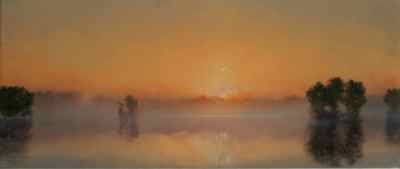
(above: Stephen Hannock (b. 1951), Flooded River, Horizontal
Light, 2005, ht. 54 inches w. 72 iinches. collection of
the artist)
Editor's note: Resource Library readers may also
enjoy:
Read more articles and essays concerning this institutional
source by visiting the sub-index page for the Albany
Institute of History and Art in Resource
Library.
Visit the Table
of Contents for Resource Library for thousands
of articles and essays on American art.
© Copyright 2007 Traditional Fine Arts Organization, Inc., an Arizona nonprofit corporation. All rights
reserved.