Editor's note: The Shelburne Museum provided source material to Resource Library for the following article. If you have questions or comments regarding the source material, please contact the Shelburne Museum directly through either this phone number or web address:
Ogden Pleissner: On the Water
May 20 - October 28, 2007
The special exhibition Ogden Pleissner: On the River is on view May 20 through October 28, 2007. The exhibit contains twenty-one watercolors by the great sporting artist that celebrate the beauty of streams, rivers, and lakes and the pleasures of hunting and fishing on them.
In a 1983 interview Pleissner said, "I go places that I would never go if I weren't carrying a fowling piece or a fishing rod. I've seen things and experienced things that are interesting and great fun and paintable."
The exhibition is on view in the Museum's Pleissner Gallery, which also includes a recreation of the artist's Manchester, Vermont studio.
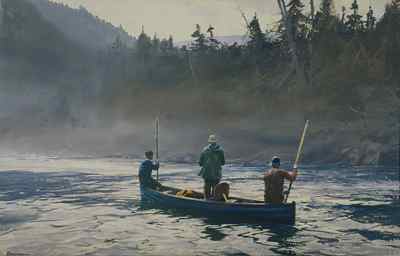
(above: Ogden Minton Pleissner (American, 1905-1983), Blue Boat on the Saint Anne, 1958, Watercolor on paper. Gift of the Pleissner Estate, 1986, 27.22.3-195, 1986-26.162)
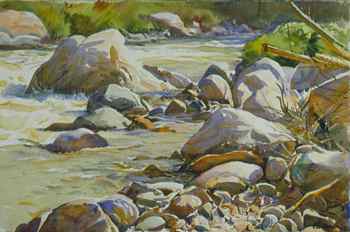
(above: Ogden Minton Pleissner (American, 1905-1983), Stream, Watercolor on paper. Gift of the Pleissner Estate, 1985, 27.2.3-36)
Wall labels from the exhibition
Ogden Pleissner: On the Water
In 1983 Ogden Pleissner said: "I've done quite a few sporting pictures because I have always loved to fish and shoot, but I am not one that specializes in sporting subjects...the rest is pure landscape painting." His sporting pictures, however, are most widely known because Pleissner's love of fishing and shooting breathe life into the compositions. Pleissner traveled extensively throughout his life and it seems wherever he went he brought his paintbrush, his fly rod, and his shotgun. In a 1983 interview with his biographer, Peter Bergh, Pleissner said: "I go places that I would never go if I weren't carrying a fowling piece or a fishing rod. I've seen things and experienced things that are interesting and great fun and paintable. I would never see these things if I didn't have a shotgun in the crook of my arm or my fly rod in hand." His images find their inspiration in a sportsman's sensitivity and enthusiasm toward the landscape, the water, the fish, and the fowl.
Pleissner used these small sketches to practice his technique. He looked to them for reference when painting finished watercolors. In creating so many thorough and focused studies Pleissner familiarized himself in paint with the environment in which he fished. Pleissner's biographer, Peter Bergh said: "Great sporting artists are great artists who...have committed to memory every detail of habitat." Pleissner advanced his artistry by acquainting himself with the angler's domain. Note the realistic motion of the water in Rocky Stream and The Pool and the skilled rendering of the atmosphere in Calm River and Been River.
At age 16, Pleissner spent the first of 17 summers in Dubois, Wyoming, on the eastern edge of the Wind River Mountains. It was there that he first handled a fly rod. Inspired by the pristine landscape and untouched waters, he said in a 1983 interview: "My tastes were so jaded because the trout out there were three or four pounds and you could get them on a dry fly or any technique you wanted to use. There were lots of fish and beautiful streams.I like wilder fishing, and the West was pure then bur maybe now it has all changed." On the Wind River depicts an angler negotiating the wild, rocky terrain that inspired Pleissner's vision of western landscapes.
In a 1983 interview, Pleissner said: "You can say that a picture has a sense of place, but in a painting...to me it's the mood conveyed that counts." Sketches, such as these, in their rapid, loose style constitute the rudiments of Pleissner's completed works; created on site, his sketches capture the spirit of the places he visited and painted.
Pleissner's scenes of fishing in the Northeast differ greatly from those of the West. His western scenes depend on a scarcity of civilization while those of New England maintain an awareness of mankind. As he said to Peter Bergh in 1983: "I usually have some figures or something there to show where man has trod." The covered bridge in Beaverkill Bridge, a definitive mark of the Northeast's civilization, fulfills this desire.
In his shooting pictures, especially those that found their inspiration on the water, Pleissner approached his subjects from the same point of view as he did his fishing pictures. Each composition is derived form his extensive knowledge of the surrounding habitat-in this case both natural and man-made-as well as the birds' habits, appearances, and movements. In Duck Shooting, Pleissner realistically depicts the reedy marshes, the awkward flight of the two ducks, and their synthetic counterparts, the decoys that remain floating lightly on the water.
Often it is the serene coexistence of the man-made and the natural that creates the quiescent atmosphere of Pleissner's works. In these three sketches the blinds created as camouflage appear to be a natural part of the marshes. In Decoys and The Blind it is difficult to discern what is the marsh and what is man's addition to it.
Editor's note: RL readers may also enjoy the following:
Read more articles and essays concerning this institutional source by visiting the sub-index page for the Shelburne Museum in Resource Library.
Visit the Table of Contents for Resource Library for thousands of articles and essays on American art.
Copyright 2007 Traditional Fine Arts Organization, Inc., an Arizona nonprofit corporation. All rights reserved.