Editor's note: The National Academy Museum and
School of Fine Arts provided source material to Resource Library for
the following article or essay. If you have questions or comments regarding
the source material, please contact the The National Academy Museum and
School of Fine Arts directly through either this phone number or web address:
-
American Impressions: Selections
from the Permanent Collection
July 5, 2007 - January 6, 2008
Featuring 32 masterworks
of American Impressionism from collection of the National Academy Museum
complemented by 3 loans from the Berkshire Museum in Massachusetts, this
presentation offers a fresh perspective on this celebrated moment in American
art. Exploring the landscape from coast to coast under varying effects of
light and atmosphere, the works on view include paintings by such celebrated
figures as George Bellows (1882-1925), William Merritt Chase (1849-1916),
Thomas Wilmer Dewing (1851-1938), Lilian Westcott Hale (1881-1963), Childe
Hassam (1859-1935), John La Farge (1835-1910), John Singer Sargent (1836-1925),
and Henry Ossawa Tanner (1859-1937).
The rise of American Impressionism signaled a new cosmopolitanism
in the nation's art following the end of the Civil War in 1865. Fleeting
effects of light and atmosphere compelled new admiration among artists and
patrons, and major figures such as William Merritt Chase taught the style
to new generations of artists in American academies, even as their expatriate
colleagues such as John Singer Sargent enhanced the standing of American
art abroad and worked directly with their French peers. Collectively, they
established a climate for art in America that would flourish into the new
century.
Begun in 1825, the National Academy of Design in New York
(known today as the National Academy Museum and School of Fine Arts) was
a venerated institution by the later nineteenth century.
Younger artists working in an Impressionist style were
initially met with reluctance from more established artists, but within
two decades they too were elected to the Academy's leadership. Virtually
every major American Impressionist was elected to membership in the Academy
and their presentation of key examples of their work to the collection,
documents their admiration for the institution and its mission to promote
American art.
Just as newcomers to the Academy will find accomplished
works on display by well-known masters, more seasoned visitors will discover
an array of distinguished examples by figures such as John Folinsbee (1892-1972),
Birge Harrison (1854-1929), Aldro Hibbard (1886-1972), Walter Launt Palmer
(1854-1932), Chauncey Ryder (1868-1949), and Robert Spencer (1879-1931)
that will deepen their appreciation for the period. American Impressions
provides a fresh, new look at an enduring popular style.
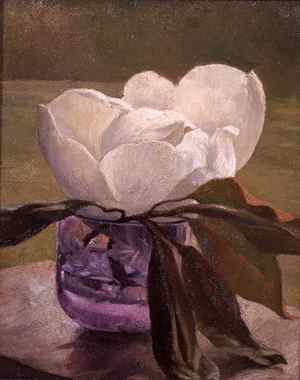
(above: John La Farge (1835-1910), Magnolia,1860,
Oil on panel, 16 x 11 ? inches. Collection of the Berkshire Museum, Pittsfield
Massachusetts, Gift of Mrs. Ruth I. Derby, William B. Long, and Mrs. Higginson
Nash)
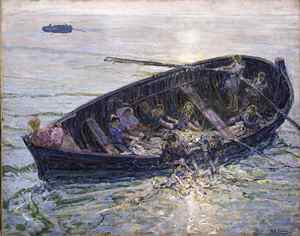
(above: Henry Ossawa Tanner (1859-1937), Miraculous Haul
of Fishes, ca. 1913-14, Oil on canvas, 38 x 47 ? inches. National Academy
Museum,NA Diploma Presentation)
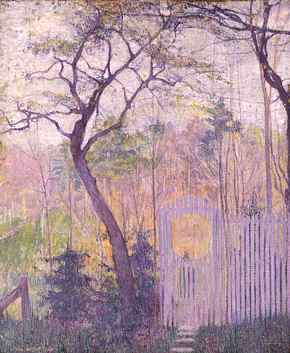
(above: Lilian Westcott Hale (1881-1963), An Old Cherry
Tree, ca. 1920, Oil on canvas, 30 x 25 inches. National Academy Museum,
NA Diploma Presentation)
Label texts from the exhibition
- Walter Launt Palmer (1854-1932)
- ANA 1887, NA 1897
-
- End of the Shower
-
- 1894
- Oil on canvas
-
- When first exhibited at the Society of American Artists exhibition
in 1894, End of the Shower attracted critical praise as "a
brilliant and telling realization of blinding light, and breathing air
in which a clump autumn trees stands in a haze of sunlight shot through
with glinting shafts of rain." Despite its success, the work marked
a transition in Palmer's art, as he focused thereafter almost entirely
on winter scenes.
-
- NA Diploma Presentation
-
-
- Robert Blum (1857-1903)
- ANA 1888, NA 1893
-
- Two Idlers
-
- 1888-89
- Oil on canvas
-
- Leisure was among both French and American Impressionism's most popular
themes. The outward serenity of Blum's Two Idlers is deceptive,
however. The work's intricate composition and dynamic brushwork render
it an exceptional illustration of the artist's technical powers.
-
- NA Diploma Presentation
-
-
- John White Alexander (1856-1915)
- ANA 1901, NA 1902, PNAD 1909-15
-
- Young Girl
-
- ca. 1902
- Oil on canvas
-
- During his later career, portraitist John White Alexander increasingly
explored the formal, decorative qualities of his art under the influence
of Impressionism and later symbolism. In this work, which the artist called
a "symphony of color," Alexander turned his figure in profile,
raised her arm, and used a high-backed chair to accentuate her fluid form
and contours, rather than document her likeness.
-
- NA Diploma Presentation
-
-
- Birge Harrison (1854-1929)
- ANA 1902, NA 1910
-
- The Hidden Moon
-
- ca. 1907
- Oil on canvas
-
- Landscapist Birge Harrison was drawn to the more evocative, poetic
tonalities of the night sky rather than to the radiant daylight often associated
with Impressionism. Nevertheless, he also deeply admired Claude Monet (1840-1926),
Alfred Sisley (1839-1899), Camille Pissarro (1830-1903), and the other
"leaders" of the movement that he preferred to dub "Luminarism"
for its practitioners' dedicated study of light. For Harrison, the sky
supplied nature's moods and "a vast sky always lends nobility to a
picture." His Hidden Moon bears only the slightest suggestion
of earth below, as the artist believed "a mere line of land is often
sufficient."
-
- NA Diploma Presentation
-
-
- John La Farge (1835-1910)
- ANA 1863, NA 1869
-
- Magnolia
-
- 1860
- Oil on panel
-
- La Farge's early still lifes, such as these two related depictions
of a cut magnolia flower in a glass bowl, offer perspective on his enduring
interests in the qualities of light, color, and translucency that characterize
much of his art, particularly his later work in stained glass.
-
- Collection of the Berkshire Museum, Pittsfield Massachusetts, Gift
of Mrs. Ruth I. Derby, William B. Long, and Mrs. Higginson Nash
-
-
- John La Farge (1835-1910)
- ANA 1863, NA 1869
-
- Magnolia Blossom
-
- ca. 1860
- Oil on composition board
-
- This work is believed to be a study for the Magnolia in the
collection of the Berkshire Museum, on view beside it.
-
- NA Diploma Presentation
-
-
- Dorothy Ochtman (1892-1971)
- ANA 1929, NA 1957
-
- A Corner of the Studio
-
- 1928
- Oil on canvas
-
- Dorothy Ochtman's portrait of her father, the Impressionist landscapist
Leonard Ochtman, NA (18541934), in his Greenwich, Connecticut studio
offers an intimate glimpse of the artist at work. The steep, climbing perspective
of the floor, open space, and decorative interior portray the sitter in
terms sympathetic to his own aesthetic.
-
- Bequest of Dorothy Ochtman Del Mar
-
-
- Robert Spencer (1879-1931)
- ANA 1914, NA 1920
-
- Across the River
-
- ca. 1916
- Oil on canvas
-
- Robert Spencer began his artistic career as a student in the National
Academy of Design's school before switching to the New York School of Art
to work with leading American Impressionist William Merritt Chase, NA (1849-1916).
Spencer lived for much of his career in New Hope, Pennsylvania and exhibited
with the New Hope Group of artists working in an Impressionist style. Spencer
shared his particular interest in working-class life and industrial architecture,
including the mills along the Delaware River, with his New Hope colleagues
including John Folinsbee, NA (18921972).
-
- NA Diploma Presentation
-
-
- Gifford Beal (1879-1956)
- ANA 1908, NA 1914
-
- The Mall-Central Park
-
- 1913
- Oil on canvas
-
- Beal's view of Central Park follows the example of his mentor William
Merritt Chase, NA (1849-1916). In this idyllic vision of urban life, sunlight
filtered through the stately trees casts patterns on the ground while well-dressed
children play along the edge of the fountain in the foreground. Beal owed
the immediacy of his aesthetic to Chase, who had instructed him that "it
takes two to paint a picture, one to do the painting and the other to stand
by with an axe to stop it at the right moment," lest it become overworked.
-
- NA Diploma Presentation
-
-
- Douglas Volk (1856-1925)
- ANA 1898, NA 1899
-
- Little Marion
-
- ca. 1895
- Oil on canvas
-
- Volk became a well-known teacher of art in New York after his own training
in Paris during the mid-1870s and helped expand awareness of Impressionism
in America. This intimate depiction of the artist's daughter Marion absorbed
in play illustrates the nuance of his Impressionist palette in the array
of tones that compose her dress.
-
- NA Diploma Presentation
John Singer Sargent (1836-1925)
- ANA 1891, NA 1897
-
- Claude Monet
-
- ca. 1887
- Oil on canvas
-
- Universally recognized as the leading exponent of French Impressionism,
Claude Monet (18401926) owed his early recognition in England to his
friend, the American expatriate John Singer Sargent. This modest portrait
is believed to date from Sargent's first visit to Monet's home in the Paris
suburb of Giverny, the moment at which Monet's influence on Sargent was
at its peak.
-
- NA Diploma Presentation
-
-
- John Folinsbee (1892-1972)
- ANA 1919, NA 1928
-
- The Canal at Trenton
-
- ca. 1924
- Oil on canvas
-
- As one of the Pennsylvania Impressionists of the New Hope art colony,
John Folinsbee was directly influenced by the industrial landscapes of
neighboring towns and cities, including Trenton, New Jersey. Despite its
Impressionistic handling and attention to atmosphere, the subdued, contemplative
tenor of The Canal at Trenton also suggests the more expressionist
aspect of his later work in the 1930s.
-
- NA Diploma Presentation
-
-
- Chauncey Ryder (1868-1949)
- ANA 1913, NA 1920
-
- Phantom Lake
-
- undated
- Oil on canvas
-
- Phantom Lake is aptly titled for a representative work by Chauncey
Ryder, as it suggests the distinctive balance that he struck between reality
and imagination. The stand of pines in the foreground of Phantom Lake
creates a pattern on the surface of the canvas reminiscent of Claude
Monet's late series of cypresses, a subject that Ryder treated as well.
-
- NA Diploma Presentation
-
-
- William Merritt Chase (1849-1916)
- ANA 1888, NA 1890
-
- Still Life
-
- undated
- Oil on canvas
-
- A legendary teacher, Chase influenced generations of young American
artists with his Impressionist style. Although less recognized today than
his landscapes, Chase's still lifes share this dexterity of paint handling
and eloquent suggestion of light playing across different shapes and materials,
in this case metal, ceramic, and polished wood.
-
- Bequest of Nicholas Markatos
-
-
- Henry Ossawa Tanner (1859-1937)
- ANA 1904, NA 1927
-
- Miraculous Haul of Fishes
-
- ca. 1913-14
- Oil on canvas
-
- The son of a minister, Henry Ossawa Tanner often depicted biblical
subjects during his mature career, including this one showing the bountiful
rewards offered to Christ's disciples. In this work, the Impressionist
light reflecting off both the water and the fish adopts religious overtones
in its association with divine benevolence.
-
- NA Diploma Presentation
-
-
- Frank Benson (1862-1951)
- ANA 1897, NA 1905
-
- Portrait of a Child Sewing
-
- 1897
- Oil on canvas
-
- Frank Benson did not become an Impressionist until well after his return
to the United States from his studies in Paris at the Académie Julian
in 188385. Portrait of a Child Sewing documents his late maturity
with its active brushwork, light palette, dissolution of the figure, and
leisure subject. Along with fellow modernists including William Merritt
Chase, NA (1849-1916) and Childe Hassam, NA (1859-1935), Benson founded
the Ten American Painters in 1897, the same year in which he created this
work, in order to ensure a venue for the exhibition of their progressive
aesthetics.
-
- NA Diploma Presentation
-
-
- Thomas Wilmer Dewing (1851-1938)
- ANA 1887, NA 1888
-
- The White Dress
-
- 1921
- Oil on canvas
-
- Dewing's interior for The White Dress is a remarkable example
of his abstract sensibility. His use of flattened space inspired by Japanese
aesthetics is of interest not only for its broad, open color planes of
wall and floor, but also for its inclusion of what is likely one of Dewing's
own outdoor scenes on the wall behind the figures. Dewing's reputation
was largely based on his renderings of women in hazy, tonal landscapes,
and this work offers a rare self-reflective meditation.
-
- Collection of the Berkshire Museum, Pittsfield, Massachusetts, Gift
of Louise Crane
-
-
- Childe Hassam (18591935)
- ANA 1902, NA 1906
-
- The Jewel Box, Old Lyme
-
- 1906
- Oil on canvas
-
- Later in life, Childe Hassam focused particular attention on rural
New England areas such as Old Lyme, Connecticut, which provided tranquil,
rustic scenes well-suited to his luminous aesthetic. The autumn foliage
of The Jewel Box offers a kaleidoscopic array of color and light
that the artist captured with individual brushstrokes. Hassam is believed
to have been unsatisfied with the original title of this work, The Pines,
renaming it ten years later more poetically, The Jewel Box, Old Lyme.
-
- NA Diploma Presentation
-
-
- George Bellows (1882-1925)
- ANA 1909, NA 1913
-
- Three Rollers
-
- 1911
- Oil on canvas
-
- Although George Bellows' reputation was based primarily on his urban
genre scenes, particularly his boxing subjects, he also created a distinguished
series of landscape compositions based on his trip to Maine's Monhegan
Island in the summer of 1911 that includes his powerful Three Rollers.
Bellows devoted himself to rendering the vitality and energy that he found
in nature with an immediacy and feeling for his medium that his colleague
Guy Pène du Bois (1884-1958) traced to the influence of French modernism
pioneer Edouard Manet (1832-1883).
-
- NA Diploma Presentation
-
-
- William Merritt Chase (1849-1916)
- ANA 1888, NA 1889
-
- Thomas Wilmer Dewing
-
- 1887
- Oil on canvas
-