Editor's note: The Ruth Chandler Williamson Gallery
at Scripps College provided source material to Resource Library for
the following article or essay. If you have questions or comments regarding
the source material, please contact the Williamson Gallery directly through
either this phone number or web address:
Millard Sheets: The Scripps
Years, 1932-1955
September 1 - October 14 2007
The Ruth Chandler
Williamson Gallery at Scripps College is pleased to present the exhibition
Millard Sheets: The Scripps Years on view from September 1 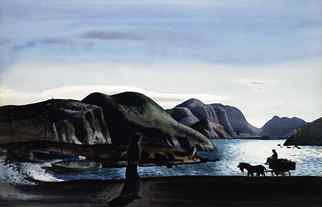 to October 14 2007.
The exhibition features paintings and works on paper by
artist Millard Sheets (1907-1989), who in the 1930s emerged as a leader
of the "California Style" of watercolor painting and in the next
two decades expanded his artistic processes to oil, acrylic and mosaic design.
(right: Millard Sheets, Driftwood, 1937, 20th c, 19 1/8 x
29 1/4 inches (48.58 cm x 74.3 cm). Scripps College, Gift of General and
Mrs. Edward Clinton Young. Painting. Watercolor on Paper)
The Scripps exhibition is co-curated by gallery director
Mary MacNaughton and collection manager Kirk Delman, in collaboration with
art historian Janet Blake, who is an expert on Sheets's art. The exhibition
focuses on Sheets's dual role as an artist and educator during the years
he taught at Scripps, from 1932-1955. During that time, in addition to teaching,
Sheets traveled extensively around the world. The works in the exhibition
reflect his experiences in the 1930s in Hawaii and Mexico, and in the 1940s
in the Far East, where he was a war correspondent for Life magazine.
At Scripps Sheets built a strong studio art faculty, including
Jean Ames in design, Phil Dike in watercolor painting, Henry Lee McFee in
oil painting, Richard Petterson in ceramics, Albert Stewart in sculpture
and Marion Stewart in weaving. Sheets also attracted many students to Scripps
and the Graduate School. Together with the faculty artists in the 1940s
and 1950s, he made Claremont into a vital artistic community.
The Scripps exhibition parallels another exhibition that
celebrates the hundredth anniversary of Millard Sheets's birth, Tapestry
of Life: The World of Millard Sheets, which will be seen at the Los
Angeles County Fair from September 7 to September 30. The exhibition is
directed by Tony Sheets, the artist's son, and selected by Janet Blake.
In conjunction with the exhibition, Janet Blake lectured
on Millard Sheets' art on September 18, in the Hampton Room of the Malott
Commons, at 12 noon. This event is co-sponsored by the Malott Commons Office
and the Ruth Chandler Williamson Gallery.
Wall texts for the exhibition
- Millard Sheets: Biography
-
- Born in 1907 and raised on a farm in Pomona, Millard
Sheets grew up surrounded by the landscapes that would inspire his work.
After winning his first painting award at the Los Angeles County Fair
when he was only eleven, Sheets met Theodore Modra, the director of the
art department at the fair. Modra became a mentor to Sheets, and introduced
the young man to art beyond Pomona. During Sheets's subsequent years as
a student at the Chouinard Art Institute, he explored the use of bold brushstrokes
and honed his artistic skills. Shortly after his graduation in 1929, he
began teaching at the Institute.
-
- In 1932, Sheets was invited to teach at Scripps College,
a post that he would occupy for twenty-eight years. Barely twenty-five
years old at the time he accepted the position, Millard Sheets started
building the foundations of the art department, calling upon other influential
Regionalist painters of the California Watercolor Society, such as Phil
Dike, to teach at Scripps College as a professor, and Rex Brandt and Phil
Paradise, to lend their expertise as visiting artists. Claremont grew into
a bustling arts center as these painters, as well as a number of prominent
ceramists and architects, moved to the town to take on professorial posts.
With his charisma and contagious passion for the arts, Sheets inspired
Florence Rand Lang, a trustee of the Fine Arts Foundation of Scripps, to
fund the construction of a new arts building that was later known as the
Lang Gallery.
-
-
- Millard Sheets - Foundations in Regionalism
-
- The paintings by Millard Sheets during the 1930s laid
the groundwork for the themes and subjects that he continued to explore
for the rest of his career. As a Regionalist painter, Sheets often painted
landscape scenes that celebrated the beauty of the natural world and simplicity
of rural life. Practicing the plein-air style of painting introduced to
him by Clarence Hinkel at Chouinard, he frequently worked outside on the
farms, coastlines, and mountains that inspired his art.
-
-
- Mexico and Mexican Art
-
- Millard Sheets's fascination for capturing rural life
fueled his desire to venture abroad. He frequently traveled to Mexico,
taking its countryside scenes as the subject of many of his paintings.
Early works such as Mexican Village, 1929; The Passage, Guaymas,
Mexico, 1932; and Mexico Village, 1937
hint at Sheets's appreciation of the rich tradition of Mexican art
and culture.
-
- In the late 1920s, Sheets was deeply inspired by the
works of Diego Rivera and Jean Charlot, which he had seen in the Pan American
Exhibition at the Los Angeles Museum. With Orozco's completion of the Prometheus
mural at Pomona College in 1930, Sheets's fascination with Mexican
painting continued. In 1946, while he was still teaching at Scripps College,
Sheets invited Mexican painter Alfredo Ramos Martinez to paint a monumental
fresco mural in the Margaret Fowler Garden. Sadly, Martinez passed away
before the mural could be completed.
-
-
- The WPA
-
- Enacted in 1935 during the presidency of Franklin D.
Roosevelt, the Works Progress Administration (WPA) was one of the largest
programs of the New Deal. The goal of the WPA was to provide employment
for the millions of American citizens who had lost their livelihoods in
the Great Depression. Within the WPA, the Federal Art Project program employed
thousands of artists to paint murals and build sculptures for non-federal
government buildings, as well as employing them in art education and research.
-
- Furthering the Regionalist belief in creating art for
the public, Millard Sheets served as the regional director of the Federal
Art Project for Southern California. He worked in collaboration with artists
hired by the Federal Art Project to design murals for banking institutions
in San Francisco and Los Angeles. In 1937, Millard Sheets managed the WPA
construction of the Fine Arts Building at the Los Angeles County Fair (later
known as the Millard Sheets Gallery).
-
-
- The Scripps Years: A Time of Growth
-
- The years at Scripps College marked a period of personal
growth for Millard Sheets. In 1936, as the new head of the art department,
Sheets recruited an exceptional group of artists for the studio art faculty,
including Phil Dike and Henry Lee McFee in painting; Albert Stewart in
sculpture; Jean Goodwin Ames in design; William Manker and Richard B. Petterson
in ceramics, and Marion Stewart in weaving.
-
- In the 1930s and 40s, Sheets developed a more expressionist
style, reflecting an emotional response to his subjects. The dense composition
of bold, dramatic colors in paintings such as Three Horses amongst the
Trees, 1939 creates a theatrical scene. The use of gestural and unfettered
brushstrokes, united with undulating lines, convey a sense of movement
and dynamism.
-
-
- The War
-
- During WWII, Millard Sheets was able to continue his
career in the arts by utilizing his skills as an architect and academic.
As an architect, he contributed to the war effort, constructing numerous
buildings for the air cadets training with the Air Force. As one of the
few artist correspondents working for Life magazine and the United
States Air Force, he was able to travel abroad during the war. These assignments
took him to India and Burma, where he witnessed the hardships of life outside
the United States.
-
- His work was not left untouched by his experiences overseas.
That influence is apparent in the dark sky and violent waves of Convoy
to India, 1945, which reflect the treacherous and unpredictable
conditions that surrounded troops during WWII.
-
-
- The Return Home
-
- The return to Southern California after the war opened
Millard Sheets to new opportunities as an architect, curator, and teacher,
occupations that he often pursued simultaneously. Through his association
with Howard Ahmanson, he was commissioned to design more than forty Home
Savings and Loan branches in California. Creating murals on the building
exteriors fulfilled Sheets's passion for public art.
-
- Sheets returned to the Los Angeles County Fair to take
over as the director of the art department, a position held previously
by his teacher, Theodore Modra. Sheets produced many exhibitions, including
"Masters of Art, 1790-1950," which brought major works by important
nineteenth- and twentieth-century artists to Southern California.
-
- Sheets's role as a teacher continued late into his career.
In addition to his years instructing at the Chouinard Art Institute, Scripps
College, and the Claremont Graduate School, he served as the director of
the Los Angeles County Art Institute (later known as the Otis-Parsons Art
Institute) from 1953 to1959.
-
-
- Hawaii
-
- Along with his wife, Mary, Millard Sheets traveled extensively
in the 1950s. His diverse career took him all over Europe, Asia, and America
for lectures, meetings with other artists, and architectural work. Hawaii
was among his many destinations, a place he visited first in 1934 and again
in 1935. In the 1950s, he turned to it as a major subject in his painting.
During that decade, he was commissioned to help construct the Rainbow Tower
of the Hilton Hotel in Honolulu.
Resource Library editor's
note:
 A 31 track podcast tour is
provided by Millard Sheets Center for the Arts in the the Millard
Sheets Gallery website. The Millard Sheets Gallery began as the Fine
Arts Program of the L.A. County Fair -- art exhibitions have been an integral
part of the Fair since its founding in 1922. Each year, the exhibits produced
for the Fair have featured artists from not only Los Angeles, but also
California, the nation, and throughout the world, and have presented contemporary
as well as historical art in a variety of styles and media. In 1998, the
Millard Sheets Gallery was incorporated as a nonprofit organization with
the purpose of helping to fill a gap in the cultural opportunities available
for Pomona-area residents. Since then, the Gallery's vision is to become
a year-round arts venue, offering the people of Southern California an
opportunity to experience diverse and progressive art exhibitions combined
with lively educational programs, with the goal of encouraging new generations
of art enthusiasts.
A 31 track podcast tour is
provided by Millard Sheets Center for the Arts in the the Millard
Sheets Gallery website. The Millard Sheets Gallery began as the Fine
Arts Program of the L.A. County Fair -- art exhibitions have been an integral
part of the Fair since its founding in 1922. Each year, the exhibits produced
for the Fair have featured artists from not only Los Angeles, but also
California, the nation, and throughout the world, and have presented contemporary
as well as historical art in a variety of styles and media. In 1998, the
Millard Sheets Gallery was incorporated as a nonprofit organization with
the purpose of helping to fill a gap in the cultural opportunities available
for Pomona-area residents. Since then, the Gallery's vision is to become
a year-round arts venue, offering the people of Southern California an
opportunity to experience diverse and progressive art exhibitions combined
with lively educational programs, with the goal of encouraging new generations
of art enthusiasts.
Links to sources of information outside of our web site
are provided only as referrals for your further consideration. Please use
due diligence in judging the quality of information contained in these and
all other web sites. Information from linked sources may be inaccurate or
out of date. TFAO neither recommends or endorses these referenced organizations.
Although TFAO includes links to other web sites, it takes no responsibility
for the content or information contained on those other sites, nor exerts
any editorial or other control over them. For more information on evaluating
web pages see TFAO's General Resources
section in Online Resources for Collectors and Students of Art History.
Individual pages in this catalogue will be amended as TFAO adds content,
corrects errors and reorganizes sections for improved readability. Refreshing
or reloading pages enables readers to view the latest updates.
Read more articles and essays concerning this institutional
source by visiting the sub-index page for the Pomona
College Museum of Art / Ruth Chandler Williamson Gallery at Scripps College
in Resource Library.
Visit the Table
of Contents for Resource Library for thousands
of articles and essays on American art.
Copyright 2007 Traditional Fine Arts Organization, Inc., an Arizona nonprofit corporation. All rights
reserved.