Editor's note: The Modern Art Museum of Fort Worth
provided source material to Resource Library for the following article
or essay. If you have questions or comments regarding the source material,
please contact the Modern Art Museum of Fort Worth directly through either
this phone number or web address:
Martin Puryear
February 24, 2007 - May 18, 2008
The Modern Art Museum
of Fort Worth presents Martin Puryear, organized by John Elderfield,
The Marie-Josée and Henry Kravis Chief Curator of Painting and Sculpture,The
Museum of Modern Art, New York. This retrospective of the work of the acclaimed
American artist (born 1941), features approximately forty-seven sculptures,
following the development of Puryear's thirty-year career from his first
solo museum show in 1977 to the present day. The Martin Puryear exhibition
will be on view to the public at the Modern Art Museum of Fort Worth from
February 24 through May 18, 2008.
Working primarily in wood, Puryear has maintained an unwavering
commitment to manual skill and traditional building methods. His forms are
derived from everyday objects, both natural and man-made, including tools,
vessels, and furniture. His sculptures are rich with psychological and intellectual
references, examining issues of identity, culture, and history. Cultural
influences on his work can be traced to his study, work, and travel in Africa,
Asia, Europe, and the United States.
In an essay for the accompanying exhibition catalogue,
Modern Art Museum Chief Curator Michael Auping writes, "Bringing the
eye and hand of the 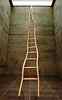 woodworker
to Minimalism's precise forms has been one of [Puryear's] most pointed contributions
to sculpture. . . . Puryear's work has a way of sneaking up on us perceptually,
and it is partially through his surfaces that we are drawn in, invited to
inspect his wooden objects more closely, as one would a more intimate construction,
through the subtlety of inflection that he at times imparts to the surface."
(right: Martin Puryear, Ladder for Booker T. Washington, 1996,
Ash and maple, 36' x 22 34" x 3" (10.97 m x 57.8 cm x 7.6 cm);
width narrows to 1 14" (3.2 cm) at the top. Modern Art Museum of Fort
Worth. Gift of Ruth Carter Stevenson, by exchange © 2007 Martin Puryear.
Photo by David Wharton)
woodworker
to Minimalism's precise forms has been one of [Puryear's] most pointed contributions
to sculpture. . . . Puryear's work has a way of sneaking up on us perceptually,
and it is partially through his surfaces that we are drawn in, invited to
inspect his wooden objects more closely, as one would a more intimate construction,
through the subtlety of inflection that he at times imparts to the surface."
(right: Martin Puryear, Ladder for Booker T. Washington, 1996,
Ash and maple, 36' x 22 34" x 3" (10.97 m x 57.8 cm x 7.6 cm);
width narrows to 1 14" (3.2 cm) at the top. Modern Art Museum of Fort
Worth. Gift of Ruth Carter Stevenson, by exchange © 2007 Martin Puryear.
Photo by David Wharton)
Puryear's Ladder for Booker T. Washington, 1996,
part of the Modern Art Museum of Fort Worth's permanent collection, is included
in the exhibition.This work was inspired by homemade ladders that the artist
saw in the French countryside while he was working at Alexander Calder's
studio on an invitational grant. Speaking to Michael Auping about this work
in 2003, Puryear commented, "It just occurred to me that this would
be an interesting project to try to do, to make a very tall or long ladder.
For a long time I had been interested in working with a kind of artificial
perspective through sculpture, which if you think about it is not so easy
to do. With a ladder, a very long ladder, I could make a form that would
appear to recede into space faster visually than it in fact does physically,
by manipulating the perspective and exaggerating it by narrowing the parallel
side pieces toward the top of the form." Like the ladders that inspired
it, Ladder for Booker T. Washington is made from a single sapling
that the artist split down the middle. He added rungs to form a 36-foot-high
ladder that narrows to just over one inch wide at the top.This sculpture,
which will be reinstalled in the double-height concrete 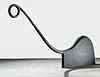 gallery for the exhibition, has been one of the Museum's
most popular works since it was installed for the grand opening in 2002.(left:
Martin Puryear, Lever #3, 1989, Carved and painted ponderosa pine,
7' 12" x 13' 6" x 13" (214.6 x 411.5 x 33 cm). National Gallery
of Art, Washington, D.C. Gift of the Collectors Committee © 2007 Martin
Puryear. Image courtesy Margo Leavin Gallery, Los Angeles)
gallery for the exhibition, has been one of the Museum's
most popular works since it was installed for the grand opening in 2002.(left:
Martin Puryear, Lever #3, 1989, Carved and painted ponderosa pine,
7' 12" x 13' 6" x 13" (214.6 x 411.5 x 33 cm). National Gallery
of Art, Washington, D.C. Gift of the Collectors Committee © 2007 Martin
Puryear. Image courtesy Margo Leavin Gallery, Los Angeles)
Other sculptures installed for the exhibition include Greed's
Trophy, 1984, a 12-foot-high net form made of wire mesh; Desire,
1981, a wooden wheel measuring 16 by 32 feet attached to an eight-foot-high
basket; and Some Tales, 1975-78, six wooden segments of varying lengths,
some of which resemble saws, spanning thirty horizontal feet of wall space.
The sculptures examine the chronological evolution of Puryear's
work and show how the artist refers to earlier ideas, reinterpreting familiar
themes in his works. Among these works are Puryear's Ring series
of the late 1970s, his Stereotypes and Decoys sculptures of
the 1980s, the vessel-like forms of the 1990s, and the more allegorical
work of recent years.
About the artist
As a child and adolescent, Martin Puryear constructed and
crafted objects such as bows and arrows, furniture, and guitars. After graduating
from Catholic University of America in Washington, he served in the Peace
Corps in Sierra Leone, where he was a teacher.There he observed and learned
the craft of local carpenters. Puryear spent two years at the Swedish Royal
Academy of Art in Stockholm, where he began working on independent sculpture
projects investigating popular craft traditions and modern Scandinavian
design. Returning to the United States, Puryear received an MFA in 1971
from Yale University. After leaving Yale, the artist joined the faculty
of Fisk University in Nashville. He taught at the University of Maryland
in College Park from 1974 to 1978 and later in Chicago at the University
of Illinois. In 1982, with the aid of a John Simon Guggenheim Memorial Foundation
fellowship, he traveled to Japan to study architecture and garden design.
Puryear stopped teaching in the late 1980s to devote his time to his art.
In 1990, he moved permanently to upstate New York.
Puryear is represented by his public art projects in River
Road Station of the Chicago Transit Authority; Chevy Chase Garden Plaza
in Maryland; Belvedere Park in Battery Park City, New York; and the National
Oceanic and Atmospheric Administration in Seattle. His major solo exhibitions
include a show in 1977 at the Corcoran Gallery of Art as well as traveling
exhibitions organized by the University Gallery, University of Massachusetts
in Amherst; the Art Institute of Chicago; and the Virginia Museum of Fine
Arts. His work was included in the Whitney Biennial in 1979, 1981, and 1989;
the Bienal de São Paulo in 1989, where he was the grand-prize recipient;
and Documenta in 1992, and in numerous group exhibitions devoted
to African American art, public art, and contemporary sculpture. Puryear
has received numerous awards, including fellowships from the National Endowment
for the Arts, the John D. and Catherine T. MacArthur Foundation, a Louis
Comfort Tiffany Grant, and the Skowhegan Medal for Sculpture. In 1992, he
was named to the American Academy and Institute of Arts and Letters, and
he received an honorary doctorate from Yale University in 1994.
Catalogue
The exhibition will be accompanied by a publication featuring
essays by the Modern Art Museum's chief curator, Michael Auping; exhibition
curator John Elderfield; and Elizabeth Reede.The catalogue also includes
an interview with the artist by Richard Powell, a chronology by Jennifer
Field, and illustrations of all works in the exhibition.
Editor's note: RL readers may also enjoy:
and from the Web:
 PBS's two-season television series Art-21, Art in the Twenty-First
Century welcome page explains that the series is "the only
series on television to focus exclusively on contemporary visual art and
artists in the United States, and it uses the medium of television to provide
an experience of the visual arts that goes far beyond a gallery visit. Fascinating
and intimate footage allows the viewer to observe the artists at work, watch
their process as they transform inspiration into art, and hear their thoughts
as they grapple with
PBS's two-season television series Art-21, Art in the Twenty-First
Century welcome page explains that the series is "the only
series on television to focus exclusively on contemporary visual art and
artists in the United States, and it uses the medium of television to provide
an experience of the visual arts that goes far beyond a gallery visit. Fascinating
and intimate footage allows the viewer to observe the artists at work, watch
their process as they transform inspiration into art, and hear their thoughts
as they grapple with  the physical
and visual challenges of achieving their artistic visions." The Art-21
web site contains video excerpts from the documentary relating to each
of the many featured artists including Laurie
Anderson, Margaret
Kilgallen, Sally
Mann, Bruce Nauman,
Raymond Pettibon,
Martin Puryear,
Collier Schorr,
Kiki Smith,
William Wegman
and Fred Wilson.
the physical
and visual challenges of achieving their artistic visions." The Art-21
web site contains video excerpts from the documentary relating to each
of the many featured artists including Laurie
Anderson, Margaret
Kilgallen, Sally
Mann, Bruce Nauman,
Raymond Pettibon,
Martin Puryear,
Collier Schorr,
Kiki Smith,
William Wegman
and Fred Wilson.
For the Martin
Puryear video excerpts and biography page, PBS introduces Puryear saying:
"Martin Puryear (born May 23, 1941) is an African American sculptor.
He was born in Washington, D.C., and he spent his youth studying practical
crafts, learning how to build guitars and furniture. He was a Peace Corps
volunteer in Sierra Leone from 1964 to 1966. His work is often described
as a union of minimalism and these traditional crafts. Puryear works in
media such as wood, stone, tar, and wire." Videos include a 1 minute
23 second clip on Ladder for Booker T. Washington.
The Art:21 series and its companion materials answer the
following questions: who are today's artists?; what are they thinking about?;
how do they describe their work? and why do they do what they do? The Season
One and Two home videos are two sets with four hours each. Viewers meet
"a diverse group of contemporary artists through revealing profiles
that take viewers behind the scenes-into artists' studios, homes, and communities
-- to provide an intimate view of their lives, work, sources of inspiration,
and creative processes." Representational as well as abstract artists
are featured in the videos. The Emmy nominated Season One video set features
21 artists and is divided into four general themes spanning four hours on
two separate tapes. Season Two of the series features 16 engaging artists
and is divided into four general themes spanning four hours on two tapes.
Read more articles and essays concerning this institutional
source by visiting the sub-index page for the Modern
Art Museum of Fort Worth in Resource
Library.
Links to sources of information outside of our web site
are provided only as referrals for your further consideration. Please use
due diligence in judging the quality of information contained in these and
all other Web sites. Information from linked sources may be inaccurate or
out of date. Resource Library neither recommends or endorses these
referenced organizations. Although Resource Library includes links
to other web sites, it takes no responsibility for the content or information
contained on those other sites, nor exerts any editorial or other control
over those other sites. For more information on evaluating web pages see
Traditional Fine Art Organization, Inc.'s General
Resources section in Online Resources for Collectors and Students
of Art History.
Visit the Table
of Contents for Resource Library for thousands
of articles and essays on American art.
© Copyright 2007 Traditional Fine Arts Organization, Inc., an Arizona nonprofit corporation. All rights
reserved.