Editor's note: The Cedar Rapids Art Museum provided
source material to Resource Library for the following article or
essay. If you have questions or comments regarding the source material,
please contact the Cedar Rapids Art Museum directly through either this
phone number or web address:
Laurie Hogin: The Forest
of the Future
September 22, 2007 - January 13,
2008
The Cedar Rapids Museum
of Art (CRMA) opened a new exhibition entitled Laurie Hogin: The Forest
of the Future on Saturday, September 22, 2007.
Best known for her paintings of plants and animals in overgrown
landscape settings, Chicago-based artist Laurie Hogin's work tackles issues
of consumer culture, brand loyalty, and the world's fragile ecosystem. More
than a social or political statement, Hogin addresses how single images
conjure up entire narratives and how these images imply stories and myths
that speak to individual and shared desires.
In her works, allegorical animal and plant specimens sport
the colors of branded commodities and nationalist identity. Angry little
songbirds, fashion-model monkeys, and reptiles patterned with the colors
of industrial entities, cosmetics, and modern media sit on rocky outcroppings
as though arranged for retail display. While thoroughly modern, her work
conjures up their 17th century Dutch and Flemish antecedents.
Her most recent work includes paintings, sculpture and
costumes that create narratives to form a wry commentary on various contemporary
cultural and political currents in the U.S. In other recent work, Hogin
refers to an environment where the products of industry have infiltrated
every last corner, where the global system of production has maneuvered
its way into the natural world, and the landscape itself has taken on industrial
hues. This is a world where the very DNA of all organic life has been altered
and manipulated by the culture of commerce, where identity is replaced with
product.
This exhibition will serve as an "early career retrospective,"
including a variety of different works of her art that will afford the visitor
the opportunity to see Laurie Hogin's work created over the past 15 years.
Drawn from private collections, the artist's galleries -- in Chicago, New
York, Culver City, California and Newcastle, England -- and the artist herself,
this exhibition is the largest solo exhibition of Hogin's work to date.
Accompanying many of the works are artist's statements about the ideas and
concepts that motivated the creation of the work. These texts ask the viewer
to think more critically about the world in which he or she lives and the
daily factors that influence the decisions we all make.
"It is both an honor and privilege to present this
15-year retrospective of the work of Laurie Hogin," says CRMA Curator
of Collections and Exhibitions Sean Ulmer, who organized the exhibition.
"In addition to being an extraordinary painter technically, Laurie's
work causes me to see the world around me differently. Her paintings and
installation pieces asks all of us to think more carefully and critically
about the various factors at play in popular culture that affect our daily
lives."
Laurie Hogin: The Forest of the Future will run through January 13, 2008. This exhibition is made possible
by The Momentum Fund and the Altorfer, Inc. Fund, both of the Greater Cedar
Rapids Community Foundation, and by the Annual Fund and Members of the Cedar
Rapids Museum of Art.
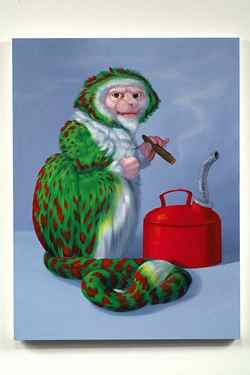
(above: Laurie Hogin, American Domestic Species--U.S.
Energy Policy (Satire Monkeys), 2006, oil on panel, 24 x 18 inches.
courtesy of the artist and Koplin Del Rio Gallery, Culver City, California)
Wall text for the exhibition
Best known for her paintings of strangely-colored animals
in fantastic landscape settings, Chicago-based artist Laurie Hogin's work
tackles issues of consumer culture, brand loyalty, and the world's fragile
ecosystem. Allegorical animal and plant specimens sport the colors of branded
commodities and nationalist identity. Angry little songbirds, fashion-model
monkeys, and reptiles patterned with the colors of industrial entities,
cosmetics, and modern media sit on rocky outcroppings as though arranged
for retail display. While thoroughly modern, her work conjures up their
17th century Dutch and Flemish antecedants, produced during the time of
the birth of the middle class and a new consumer culture.
Her most recent work includes paintings, sculpture, and
costumes that create narratives to form a wry commentary on various contemporary
cultural and political currents in the United States and the world. In other
recent work, Hogin refers to an environment where the products of industry
have infiltrated every last corner, where the global system of production
has maneuvered its way into the natural world, and the landscape itself
has taken on industrial hues. This is a world where the very DNA of all
organic life has been altered and manipulated by the culture of commerce,
where identity is replaced with product.
Born in Chicago in 1963, Laurie Hogin moved with her family
to the New York City suburb of Cos Cob, Connecticut, while still an infant.
Only 28 miles from midtown Manhattan, Hogin frequently went into the city
for museums, shopping, and a variety of cultural activities. She received
her Bachelor's degree in fine art in 1985 from Cornell University in Ithaca,
New York, and her Master's degree in 1989 from the School of the Art Institute
in Chicago. Since the early 1990s, Hogin has taught at several institutions:
the School of the Art Institute, the University of Chicago, Northwestern
University, Valparaiso University, and the University of Illinois at Urbana-Champaign,
where she is currently Associate Professor and Chair of the Painting and
Sculpture Program.
This exhibition is made possible by The Momentum Fund and
the Altorfer, Inc. Fund of the Greater Cedar Rapids Community Foundation,
and by the Annual Fund and Members of the Cedar Rapids Museum of Art.
Object labels for the exhibition
- PATRIOT Fungus, 2006
- Cast resin, paint, glitter
- Courtesy of the artist and Koplin Del Rio Gallery, Culver
City, California
- L2007.043
-
- "These fungus specimens are cast from a collection
of hundreds of fruiting bodies of the 'Artist's Fungus,' as the species
is called, collected from the woods around my parents' house in the New
York suburbs and from my own home in rural Illinois. Fungi, including rusts,
smuts, puffballs, shelf fungi and mushrooms, have long provided a semi-comic,
poetic metaphor for me. This metaphor has two simultaneous, yet somewhat
contradictory, references in my work. The plants themselves function in
an ecosystem to break down dead organic matter, destroying old structures,
recycling nutrients and making them available for new plant growth. The
fruiting bodies of the shelf fungus are evidence of rot within whatever
structure they appear on. In American and English cultural traditions,
fungi are disdained; they are associated with death, madness, and witchcraft
-- the process of decay is to be feared. Here, they provide a metaphor
for revolutionary change, even as they declare evidence of rot within."
-
- - Laurie Hogin
-
-
- American Domestic Species: Defense of Marriage
- (Satire Monkeys), 2006
- Oil on panel
- Courtesy of the artist and Koplin Del Rio Gallery, Culver
City, California
- L2007.044
-
- In this satirical work, Hogin portrays a heterosexual
pair of monkeys, clutching to each other, defending the traditional definition
of marriage. What they don't realize, however, is that the blue of the
boy and the pink of the girl -- traditional gender-related colors-are hardly
uniform. There is pink in the blue and blue in the pink, and even shades
of chartreuse and violet. This underscores that we all have "parts
of many genders in varying degrees," something the artist calls "multiformity."
She says: "I think people are far more complex, of course, and thought
the Defense of Marriage act was a reprehensible and silly assertion of
homophobia -- which...is about repression of latent feelings or [the] inappropriate
imposition of religion on public life.... It's about the culture and society
trying, inappropriately and wrongly, to define marriage as a single kind
of thing."
-
- According to the artist, the chocolates reference "romantic
love as articulated and exploited by consumerism-always selling us red
roses and candy as emblems."
-
-
- American Domestic Species: U.S. Energy Policy
- (Satire Monkeys), 2006
- Oil on panel
- Courtesy of the artist and Koplin Del Rio Gallery, Culver
City, California
- L2007.045
-
- In this work, the monkey stands in for politicians who
cater to the oil industry and the potential volatility of the situation
is clearly evident with the lit cigar in such close proximity to the gasoline
can. The cigar celebrates the profitability to politicians of this relationship
but the monkey, who pretends to be "green" or environmental,
is seen revealing his true colors, with the red of the gas can showing
through his fur. "The narrative suggests that this greedy, ignorant
course of action -- dependence on petroleum and investment in petroleum
alone -- will result in disaster," says the artist.
-
-
- Diorama: Land of Desire (Prozac Planet), 2007
- Oil on canvas
- Courtesy of the artist and Littlejohn Contemporary, New
York
- L2007.058
-
- "The painting...is one out of a body of work that
combines compositional and other formal elements and conventions from the
ideologically related practices of store window display, natural history
museum dioramas, product photography, and 17th century European paintings
with their 'embarrassment of riches' and their display of the spoils of
colonial empire. Each animal symbolizes a moment in which nature embodies
the substances of industrial society as each sports, as though by genetic
modification, the chemical colors of consumerism, advertising billboards,
food and pharmaceutical dyes, and product packaging."
-
- - Laurie Hogin
-
-
-
- Women's Work, 2004
- Oil on panel
- Courtesy of the artist and Peter Miller Gallery, Chicago
- L2007.062-073
-
- "Women's Work is an homage....I was thinking
of the saying, 'A man can work from sun to sun, but a woman's work is never
done' and the gender divisions of labor and privilege that persist all
over the globe; the fact being that greater professional and intellectual
opportunities for educated, demographically lucky women like me has not
translated into a more equitable division of labor. 'Women's work' is still
the responsibility of women; the major development is now they are also
required by economic necessity to work outside the home, and in many places,
it is in the repetitive production of small consumer items -- so the paintings
were to honor that kind of activity.
-
- There is still such a thing as 'women's work,' and most
women in the world are seriously burdened with it. My impulse in making
this intensely repetitive, labor-intensive little piece was to honor that
labor. Of course, the bunny has always been a feminine and feminist icon
to me -- a symbol of objectification, fertility and reproduction...and
a creature with the ability to claim agency by looking back at the viewer,
and growing fangs and claws, and blushing a violent pink as the fact of
its assigned identity gathers strength."
-
- - Laurie Hogin
-
-
- Subdivisions, 2006
- Oil on panel
- Courtesy of the artist and Peter Miller Gallery, Chicago
- L2007.074-085
-
- "Ecosystems of industry, commerce, desire and identity
shape the lay of the land.
-
- Landscapes have always provided us with a moment, a scene,
a visual representation of the ecosystems and economies that produce them.
They represent 'nature' as it is defined by the culture as well as depicting
a landscape altered by history and shaped by cities, highways, parks and
other manifestations of human activity.
-
- Landscapes also provide us with the settings for our
fantasies and desires, be they imperialist, heroic, erotic, apocalyptic
or pastoral. Among these fields, exurban subdivision construction sites,
where farmland topsoil is scraped off and transported for use on golf courses
and urban parks, are the backdrops for the appearance of imaginary, metaphorical
monsters in the garden whose skins sport the colors of construction and
hazmat signage.... These are from a series of 36...landscapes done on location
at six different new subdivisions in East Central Illinois, where prime
agricultural land is being turned into either big-box retail sprawl or
residential subdivisions. These scenes are painted quickly, from life,
in sizes and numbers that refer to snapshots, mimicking a tradition that
celebrated a long-lost belief in a pure Nature and suggesting both the
economic and political forces underlying the landscape, but also the narratives
we write over them, the stories we want to believe about the Nature of
our desires."
-
- - Laurie Hogin
-
-
- Natural History Diorama-Reedy Creek Estates, 2007
- Oil on canvas
- Private collection
- L2007.101
-
- "Woodlands, preserved as forest parks within urbanized
industrialized Illinois, are the habitats of hybrid, reptilian creatures,
magenta bunnies, blaze orange deer, and turkey-like birds whose marking
mimic those of brightly colored litter that blows along the roadsides."
- - Laurie Hogin
-
-
- NBC News (And thus Good Things are Brought to Life), 1997
- Oil on canvas
- Private collection
- L2007.088
-
- In a work such as this, Laurie Hogin uses the symbol
of the National Broadcasting Company (NBC) -- a peacock with a rainbow
tail -- to illuminate the power of the media in today's society. In this
case, the mascot has been made to look haggard and sickly, the result of
a corrupted system: "My NBC peacock is a disturbed, ravenous creature,
presented in a still-life format, like a Dutch hunt trophy still life (an
emblem of material excess)."
-
- The phrase "And thus good things are brought to
life" is a specific reference to General Electric, the corporate parent
of NBC, whose slogan was "We bring good things to life." At the
time of the creation of this work, NBC was reporting on the performance
of weaponry made by GE for the Gulf War. This potential conflict of interest
struck the artist as "a kind of sickness in a democracy when the interests
that have the most to gain in a situation are the same interests reporting
on events." By extension, the work also addresses the consolidation
of media in today's society and the ways in which information is controlled
and released: "Major news media are far more interested in our eyeballs
as consumers than our informed participation as citizens."
-
-
- His Master's Champion, "American Pride," 1995
- Oil on canvas
- Private collection
- L2007.089
-
- In American Pride, Laurie Hogin takes up the issue
of labor relations in the United States. One of a pair of paintings, the
bull in this painting is marked for slaughter; each section branded with
text. Labor acts such as the Davis Bacon Act, which provided for paying
laborers prevailing wages, and the Scaffold or Structural Work Act, which
allowed workers injured in accidents the right to sue their employers for
damages, were on the artist's mind during the creation of this work. These
acts, protecting workers' rights, were being challenged, suspended, and
repealed at the time this piece was being painted. It is an indictment
of corporate America's thirst for profits at the expense of workers' rights:
"basically worker health, safety, and fair labor and wage practices...[are]
about to be slaughtered for filet mignon."
-
-
- Kitchen Still Life Series: "Rhine - Style Meat
with (polychlorinated) Biphenyls (PCB's)," 1992
- Oil on panel
- Private collection
- L2007.090
-
- Emerging out of the Dutch still life painting tradition
of the 17th century, dead game paintings or "hunting trophies"
created an aristocratic image of country life. Artists such as Frans Snyders,
Jan Fyt, and Jan Weenix specialized in paintings of dead game, where assemblages
of dead fowl, hares, deer, and other animals were transformed into studies
of color and texture, and a testament of abundance in the lives of the
affluent. The slabs of meat also make reference to large "market"
and "kitchen" still lifes that had become popular in the mid-16th
century. In Laurie Hogin's hands, however, the original purposes of such
paintings have been transformed. Here an angry, semi-rabid animal pulls
strenuously at the meat. As in much of Hogin's work, the animal is a stand-in
for the human, who in this case is consumed with consuming the uncooked
meat, filled, as the title indicates, with biphenyls, a toxic byproduct
of several industrial processes including high octane motor and aviation
fuels. In a work such as this, Hogin questions not only our consumer culture
but also how our demand for products affects the environment around us.
-
-
- Sideboard Painting #6, 1994
- Oil on canvas
- Private collection
- L2007.091
-
- In this work, Laurie Hogin evokes the 17th century Netherlandish
still life tradition in painting. While still life painting as a genre
can be traced all the way back to Roman frescoes, this subject matter came
into its own particularly in 17th century Holland and Flanders. This was
due, in part, to limited opportunity to produce religious images as they
were strongly discouraged by the Dutch Reformed Protestant Church. The
Netherlandish tradition of detailed realism, coupled with this neutral
subject matter appealed to the emerging middle class, who were becoming
important patrons of the arts. Sumptuous banquet tables, filled with fine
china and crystal, beautiful flowers, exotic fruits, and dead game, became
the subject of these paintings. In their way, they referred to the success
and accomplishments of the owner of the painting. In fact, the ownership
of the painting itself was a status symbol. The possession of a status
symbol, such as a painting, was however somewhat at odds with a society
that eschewed opulent accumulation of wealth, and it is this dichotomy
that fascinates Hogin. In her hands, the brilliantly-colored plumage of
the birds is a metaphor for the merchant class art patron wrapping himself
up in all his finery -- an occurrence that still happens today.
-
-
- Looking Back to the Forest of the Future: Crick-Watson
Crane: Male, 2003
- Oil on canvas
- Courtesy of George and Giulia Papailias and Littlejohn
Contemporary, New York
- L2007.096
-
- Looking Back to the Forest of the Future: Crick-Watson
Crane: Female, 2003
- Oil on canvas
- Courtesy of George and Giulia Papailias and Littlejohn
Contemporary, New York
- L2007.097
-
- "This pair of paintings is a diptych representing
a pair of strange crane or egret type birds, painted in a style that mimics
and combines traditions in Dutch 17th century aviary paintings as well
as Audubon and other American and English naturalist illustrations. The
Dutch aviary paintings usually portrayed exotic or spectacular species,
and were emblematic of the Dutch Golden Age interest in exotic flora and
fauna. Audubon and other naturalist painters reflected an intense interest
in and love for nature and natural history, and dovetailed with transcendentalist
and romanticized views of nature."
-
- - Laurie Hogin
-
-
- Field Guide III-Guide to North American Sugar Based
Cereals, 2006
- Oil on panel
- Courtesy the artist and Koplin Del Rio Gallery, Culver
City, California
- L2007.112-117
-
- These paintings come from a series of sets of bird paintings
by Hogin all reflecting the "taxonomic impulse" -- the desire
to organize the overwhelming variety of nature by means of classification
systems. These allegorical migratory songbirds sport the colors of a global
economy, from the day-glow hues of package design to the pixilated palettes
of television and the Internet. This is an imagined nature's literal embodiment
of contemporary conditions.
-
- In all of Laurie Hogin's works, the frame is an integral
part of the work, a reminder of how much of the world is framed and "packaged."
They mimic the rectangles through which the world is viewed: paintings,
photographs, television screens, computer monitors, store display windows,
car windows. The frames surround a dazzling array of "specimens"
from around the world, brought together for a new narrative of a "natural"
world.
-
-
- The Thrift Project, 2007
- From left to right:
- Songbird
- The People Had Done It To Themselves
- Reciprocal Love
- The Fascist Leader
- Arcadia
- Found t-shirts from various thrift stores, silk screen
ink
- Courtesy of the artist
- L2007.120-124
-
- "This project is intended to collect psychodemogrqphic
information related to consumers' responses to seven different iconic or
mascot-like animals printed on recycled t-shirts along with text that suggests
possible satirical meanings for the images. The shirts were gathered from
thrift shops, printed with leftover inks by Weiskamp Screen Printing of
Champaign [Illinois], and distributed to thrift stores and 'vintage' clothing
stores all over the United States. A label inside the shirts asks purchasers
to visit a website and provide demographic information about themselves
as well as to describe the reasons they responded to the designs."
-
- - Laurie Hogin
-
-
- Film Costume #1" Professor Alba Simeon from "Monkey
See and the Ivory Tower," 2006
- Academic regalia denoting degree in Education altered
with faux fur, satin, silk thread on mannequin
- Courtesy of the artist and Koplin Del Rio Gallery, Culver
City, California
- L2007.040
-
- Film Costume #2: Iris Hatchett's Hockey Uniform from
"In a Man's World," 2006
- Bridal satin, embroidery, hockey equipment, mannequin
- Courtesy of the artist and Koplin Del Rio Gallery, Culver
City, California
- L2007.041
-
- Film Costume #3: Ceremonial Uniform for Emperor Little
from "The Great Little Man," 2006
- British and American military surplus, chicken bones,
gold leaf,
- Ivy League t-shirt, mannequin
- Courtesy of the artist and Koplin Del Rio Gallery, Culver
City, California
- L2007.042
-
- In sculptural work such as these three costumed mannequins,
Hogin continues her investigation into consumer culture, stereotypes, and
identity. The mere use of clothing on mannequins evokes retail display,
and immediately situates the works in a consumer culture milieu. Issues
of branding and brand loyalty are brought out in a vivid way in works such
as these. The costumes allude to iconic identities from fictitious films
and present odd juxtapositions of materials and meanings. Like her paintings,
these sculptures surprise and engage with their clever manipulations.
-
- Professor Alba Simeon's traditional academic robes have
been altered with faux fur, satin, and silk thread, becoming more of a
negligee than an academic robe. Her fictitious name, Simeon, is a play
on the word "simian," which means an ape or monkey. The work's
materials have usurped the normal gravity and seriousness of academia and
one isn't quite certain exactly what she is teaching.
-
- In Iris Hatchett -- itself an interesting combination
of the name of a flower and of a cutting tool -- Hogin utilizes the image
of one of her mad bunnies, an empowered feminine image, as the mascot for
a women's hockey team. Hockey, a sometimes violent and brutal sport for
its own sake, is traditionally seen as a male sport, although women's teams
have been around for some time now. Hogin here created the hockey jersey
with bridal satin, further underscoring the tension between traditional
and untraditional roles for women.
-
- Emperor Little, clad in army uniform encrusted with gilded
chicken bones, conjures up Chicken Little, who ran around claiming that
the sky was falling because a drop of rain hit his head. The work illuminates
the "overstating" frequently found in contemporary society, from
the wonders that a particular product might do to weapons of mass destruction
supposedly housed in Iraq. The military uniform underscores this latter
connection to the so-called "War on Terror," as it was dubbed
by the White House and reinforced by the media. According to the artist,
the chicken bones also reference "being chicken," avoiding the
fight yourself and having others do it for you.
-
-
- Twelve Moments of Saturday Morning TV- -T he Colonization
of My Child's Mind, 2006
- Oil on panel
- Courtesy of the artist and Koplin Del Rio Gallery, Culver
City, California; and Collection of Meg Linton and Marc Meredith
- L2007.102-105
-
- "These are from a series titled The Colonization
of My Child's Mind: Advertising from 12 hours of Saturday Morning TV.
The colors of the monkeys are taken from [the products featured on] ads
viewed during children's programming on network TV over 12 hours of viewing."
-
- - Laurie Hogin
-
-
- Allegory of Politics: Politics Defeats History on
a Battlefield of Chickens, 1996
- Oil on canvas
- Courtesy of the artist and Peter Miller Gallery, Chicago
- L2007.061
-
- "This painting was made as I listened to the 1996
Presidential and Vice Presidential debates on public radio, and all I could
think was that these people were a bunch of chickens and turkeys whose
politics were limited to sentiment, jingoism, and fear, or some delicate
combination of all three.
-
- This work is meant to recall the plethora of 19th century
French imperialist war paintings that depicted French victories over Middle
Eastern forces, including Algerians, Arabs, Turks and Egyptians.... My
chickens and turkeys are not engaged in the kind of extreme physical activity
of most battle scenes since the violence they are committing is less spectacular,
less obvious: they are consuming the butterflies that float in the air
around them. Butterflies, in the history of painting, represented the loss
of corporeal presence and transformation into pure spirit and memory. Though
the content of those metaphors was specifically the transformation of the
Christian Resurrection, I am using a secularized version of the metaphor
to suggest that the insects represent memory as it becomes history, which
we must remember for its lessons.
-
- The birds are all red, white and blue, displaying in
their plumage the ideals of liberty, equality and brotherhood (I use that
gendered term with reluctance and in the absence of an alternative that
wouldn't sound forced).... But these bird feathers are for show: they have
'wrapped themselves in the flag' even as they destroy the lessons of history.
While the eggs are decorated in the birds' own image, they suffer breakage
and destruction as the big birds feed. These were added as I listened to
political rhetoric about the lives of children even as I saw no evidence
of real concern among politicians.
-
- The frame is gold and royal blue with an American eagle
in each corner. The eagles resemble a large carved eagle my parents gave
me and which hung over their front door as long as I can remember. It now
hangs in my studio. It is gold-leafed, and it clutches an American flag
in its talon, and in its beak it holds a banner, which reads, 'LIVE AND
LET LIVE.' This object has great meaning to me; as it evokes personal history,
it invokes an obvious but rather painful irony."
-
- - Laurie Hogin
-
-
- Big Empire Bedroom, 1992
- Bed frame
- Mad Bunny Sheets, 1992
- Hazmat Sign Quilt, 1999
- Needlepoint Footstool, 1999 (one of 4 in series)
- Courtesy of the artist
- L2007.060.a-d
-
- left:
- Ophelia, 1994
- Oil on canvas
- Denise and Eric Macey, Winnetka, Illinois
- L2007.118
-
- right:
- Daphne, 1994
- Oil on canvas
- Private collection
- L2007.119
-
- "This installation, originally conceived for a private
bedroom, includes paintings, a quilt made for an earlier work, and a full-size
replica of a Shaker-style cherry canopy bed that has been altered with
carved text and taxidermy eyes.
-
- The quilt and the Mad Bunny sheets transform a bed, a
place of safety, intimacy and privacy, into a platform for a sleep disturbed
by semi-comic but insistent little monstrosities that even home fashions
and cushy materials can't keep entirely at bay. The sleeper rests amid
repeated images of nature, in the form of the bunny, gone a little monstrous,
as he is literally blanketed with industrial signage used to indicate hazards
such as radiation, explosivity, flammability, and biohazard. The quilt
is based on a common Victorian design called 'Around the World.' Patterned
after the excessive decorating practices seen in high-end shelter magazines
and home design stores, these parodies of home fashions suggest that our
domestic arrangements cannot exclude what is outside the door."
-
- - Laurie Hogin
-
-
- The Body You've Always Wanted #1 (Imagine Yourself), 1997
- Oil on panel
- Courtesy of the artist
- L2007.046
-
- The Body You've Always Wanted #2 (Authentic-Invent
Yourself), 1997
- Oil on panel
- Courtesy of the artist
- L2007.047
-
- Monkey Portraits
- Allegories of Brand Loyalty
-
- "Since 1995, images of monkeys have figured prominently
in my work. These paintings comment on the phenomenon of social identities
as constructed by consumerism in the 21st century economy, with it's proliferation
of products and services that seek the loyalty if not the very sense of
identity of their consumers through various 'branding' strategies: logo,
color, slogan, sound, naming, and association with 'lifestyle.'
-
- The imagesare meant to simultaneously evoke visual strategies
from the history of European portraiture, Dutch still life, and contemporary
advertising. They are all sets; variations on a theme that vary in color,
pattern, accessories, emotional states, or the orientation of the monkey.
This is a reiteration of the current marketing trend to present the consumer
with an [array] of products, suited to the specific moods or minutely differing
preferences of the brand-loyal consumer. For example, Dawn dishwashing
liquid comes in five colors, each with a different title, fragrance, and
attendant mythology, such as 'Fresh Rain' or 'Spring Blossoms.' Other brands
that engage this same strategy are too numerous to name, including Lysol,
Dial soap, Bounce fabric softener, and my own 'branded' products.
-
- Monkeys in the history of European paintings were always
parodies of or stand-ins for human beings, as they are in my works. My
reference to portrait-painting is meant to evoke [some of] the social conventions
that result in portrait-painting: social status, narcissism, and commodity
fetishism."
-
- - Laurie Hogin
-
-