Editor's note: The Asheville Art Museum provided
source material to Resource Library for the following article or
essay. If you have questions or comments regarding the source material,
please contact the Asheville Art Museum directly through either this phone
number or web address:
-
-
Lines of Discovery: American
Drawings
November 9, 2007 - February 10,
2008
Lines of Discovery:
American Drawings at the Asheville Art Museum celebrates
the rich history of American drawing and explores how artists have used
the medium to define the nation's evolving character. The featured works
were selected by the Asheville Art Museum from the holdings of The Columbus
Museum in Columbus, Georgia.; one of the most important collections of American
drawings in the Southeast.
The exhibition represents various styles and techniques
through works by major artists from the late 19th century to the present.
While showcasing an overview of American art, Lines of Discovery
attests to the unique properties of drawing and its status as the most intimate,
immediate and versatile art medium.
Lines of Discovery ncludes
works by 19th century American artists William Merritt Chase, Thomas Cole
and Winslow Homer. Also included are a range of works by diverse 20th century
artists such as Charles Burchfield, Isamu Noguchi and Andrew Wyeth. In addition,
there are drawings by contemporary artists like Thornton Dial, Leslie Dill
and Jerome Witkin.
The selected works demonstrate the essential role drawing
has played in the formation and development of American art. While representing
an overview of American art, Lines of Discoveryattests to the unique
properties of drawing and its status as the most intimate, immediate and
versatile art medium.
Traditionally, drawing is the first step in planning any
design or image. It can reflect the artist's most creative moments, a direct
record of his or her immediate gestures and thought processes. While some
drawings are preliminary sketches for a painting or sculpture, others are
complete and finished works of art in and of themselves. The simplicity
of the materials and immediacy of drawing allow the artist expressive freedom,
thus making the process the most direct manifestation of an artist's ideas
and talents.
Some drawings are preliminary sketches for a painting or
sculpture. Others are complete and fully finished works of art in and of
themselves. The works in the exhibition demonstrate how drawings serve various
purposes.
Beginning in the early 20th century, drawings came to be
appreciated for their immediacy and spontaneity. Charles T. Butler,
director of The Columbus Museum, said "This 'bigger is better' approach
is easily challenged if one considers that a drawing is an artist's immediate
response to an idea, a scene before one's eyes or a reflection of a memory
long past."
Lines of Discovery underscores
the importance of drawing as a medium and its historical role as the fundamental
skill required of virtually all artists, architects and designers.
The exhibition is grouped according to several major themes.
- Works featured in A New and United Country define
the nation's identity through its unique landscape and people.
- American Renaissance and Cosmopolitan Outlook consists of drawings that reflect American artists' involvement
in international art movements such as Impressionism.
- Progressive and Avant-Garde Artists focuses on works by Ashcan School artists and others who broke
away from academic tradition and paved the way for modern movements of
the 20th century. Regionalism,
- Socialism and American Visions
includes images by Depression-era artists who portrayed American life in
the city and on the farm during a time of great uncertainty and economic
hardship.
- Post-War Modernism features
ground-breaking images by artists seeking to free art from the shackles
of visible reality in order to explore the expressive possibilities of
abstraction.
- A Resurgence of Realism includes
recent drawings by artists who turned away from abstraction and discovered
realism to be a more effective style for expressing their artistic vision.
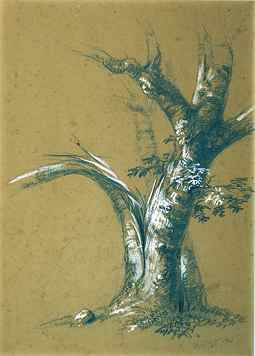
(above: Thomas Cole, Study of a Blasted Tree, 1841,
Pencil and gouache on brown-colored wove paper, 22 x 18 inches. Courtesy
of The Columbus Museum.)
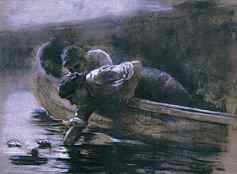
(above: Winslow Homer, Pond Lilies, 1884, Charcoal,
chalk and gouache on laid paper, 25 x 31 inches. Courtesy of The Columbus
Museum.)
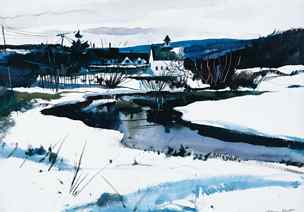
(above: Andrea Newell Wyeth, North Sutton, 1940,
Watercolor on wove paper, 29 x 38 inches. Courtesy of The Columbus Museum.)
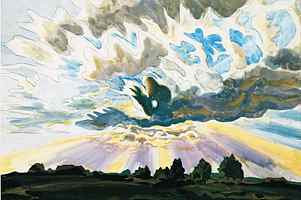
(above: Charles Burchfield, Daybreak, 1920, Gouache,
watercolor and pencil on wove paper, 26 x 35 inches. Courtesy of The Columbus
Museum.)
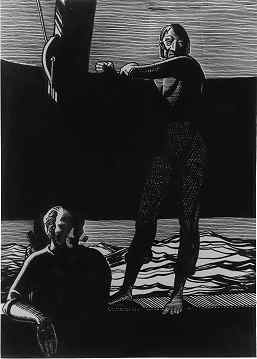
(above: Rockwell Kent, Stubb and Tashtego, 1930,
Pin and ink on wove paper, 20 x 16 inches. Courtesy of The Columbus Museum.)
Wall text from the exhibition
Lines of Discovery celebrates
the rich history of American drawing and the many ways in which artists
have used the medium to define the nation's evolving character. The 78 featured
works are selected from the extensive holdings of The Columbus Museum, which
owns one of the most important collections of American drawings in the Southeast.
Assembled over 25 years and greatly enhanced with the recent and significant
acquisition of the Dr. and Mrs. Philip L. Brewer Collection, it represents
various styles and techniques by major artists from the 19 th century to
the present. The Columbus Museum defines drawing as any unique work on paper,
and its collection represents a variety of media, including pencil, charcoal,
watercolor, gouache, pastel, tempera, ink and monoprint.
The exhibition is grouped according to several major themes.
Works featured in Towards A New and United Country define the nation's
identity through its unique landscape and people. American Renaissance
and Cosmopolitan Outlook consists of drawings that reflect American
artists' involvement in international art movements such as Impressionism.
Progressive and Avant-Garde Artists focuses on works by Ashcan School
artists and others who broke away from academic tradition and paved the
way for modern movements of the 20th century. Regionalism, Socialism
and American Visions includes images by Depression-era artists who portrayed
American life in the city and on the farm during a time of great uncertainty
and economic hardship. Post-War Modernism features ground-breaking
images by artists seeking to free art from the shackles of visible reality
in order to explore the expressive possibilities of abstraction. A Resurgence
of Realism includes recent drawings by artists who turned away from
abstraction and discovered realism to be a more effective style for expressing
their artistic vision.
Lines of Discovery demonstrates
the essential role drawing has played in the formation and development of
American art. While representing an overview of American art, this selection
of works attests to the unique properties of drawing and its status as the
most intimate, immediate and versatile art medium.
Object labels from the exhibition
- AMERICAN RENAISSANCE
-
-
- ABBOTT HANDERSON THAYER
- b. Boston 1849 - d. Dublin, New Hampshire 1921
- Horse Team ca. 1870-85
- Pencil and wash on wove paper
- Promised Gift, Dr. and Mrs. Philip L. Brewer Collection
-
- Although Abbott Thayer would later become famous for his figure painting,
portraiture and landscapes, his earliest paintings focused on animal subjects.
From childhood, he was a passionate naturalist who could identify bird
species by a single feather. As a young artist, his first professional
commissions were for a series of dog portraits. By 1870, he was also painting
rural cattle and the lions and tigers at the Central Park Zoo. Horse
Team depicts a team of five energetic white horses pulling a street
trolley. Thayer's use of washes suggests an early morning fog, and the
barking dog shows his love of detail and animals.
-
-
- JOHN HENRY TWACHTMAN
- b. Cincinnati 1853 - d. Gloucester, Maine 1902
- Bridge across the Ohio River at Cincinnati ca. 1878-1880
- Pencil on wove paper
- Promised Gift, Dr. and Mrs. Philip L. Brewer Collection
-
- After studying in Europe, John Henry Twachtman returned to his native
Cincinnati in the fall of 1879. There, he created a group of fascinating
images depicting the city's hills, which were being quickly turned into
suburbs after rail lines made them reachable. Despite this interest in
the growth of his home city, this rare pencil sketch is the only drawing
he did during that visit. It depicts a view looking east across the river
toward the suspension bridge connecting Cincinnati and Covington, Kentucky.
-
- With minimal outlines, Twachtman recorded curves of the shore, angles
of barges on the water, tiny forms of figures walking on the riverbank,
industrial warehouses in the distance, and bridge pilings, tower and cable.
-
-
- WILLIAM MERRITT CHASE
- b. Franklin, Indiana 1849 - d. New York City 1916
- Portrait of Alice Gerson, Mrs. Chase ca. 1880s
- Monotype on wove paper
- Gift of Dr. and Mrs. Philip L. Brewer in honor of Dr. and Mrs. Sidney
H. Yarbrough III for their generosity and long years of service to the
Columbus Museum 2004.17.2
-
- William Merritt Chase's wife, Alice Gerson Chase, was one of his favorite
models from the time he married her in 1886. This small, intimate monotype
shows her face emerging from the shadows. The image has the feeling of
a sketch because it uses only lights and darks.
-
- To make a monotype image, Chase brushed ink onto the smooth surface
of the plate, as if he was painting it. He then used either a cloth or
his fingertips to take ink away from the surface, which created highlights
on the face and head. The horizontal line to the right of the sitter's
head hints that the glass plate had a crack in it. The artist may have
made this monotype so he would have an image of his beloved wife when they
were apart.
-
-
- JOSEPH PENNELL
- b. Philadelphia 1860 - d. Brooklyn 1926
- Norman Stairway in the Close 1885
- Pen and ink on wove paper
- Dr. and Mrs. Philip L. Brewer Collection, Museum purchase made possible
by the Ella E. Kirven Charitable Lead Trust for Acquisitions 2003.1.3
-
-
- JOHN SINGER SARGENT
- b. Florence, Italy, 1856 - d. London, England 1925
- Spanish Window ca. 1905
- Watercolor on laid paper
- Gift of Dr. and Mrs. Louis Hazouri 80.50
-
- Despite the fact that he was at the height of his popularity, by 1900
Sargent was becoming disenchanted with his usual subject matter of formal
portraiture. He began to use the more spontaneous medium of watercolor.
Over the next 25 years, he produced 1,500 acclaimed watercolors, which
he exhibited to critical praise and commercial success.
-
- Throughout his life, Sargent was an avid traveler, and during the early
20th century, he chose places that he had visited as a child -- the Alps,
Venice and Spain. Spanish Window was probably made during a 1903
trip to Spain and has a kind of "snapshot" quality.
-
-
- CATHERINE ALICE TREANOR ROUNDEY
- b. 1857 - d. 1923, San Francisco, California
- Still Life ca. 1900
- Pastel on gold-colored wove paper
- Gift of Paul G. Stein 2004.18
-
-
- PHILIP LESLIE HALE
- b. 1865 - d. 1931 Boston, Massachusetts
- Lady with a Fan ca. 1910-1914
- Pastel on brown wove paper
- Museum purchase made possible by the Art Acquisition and Restoration
Fund and the Endowment Fund in honor of D.A. Turner 2004.15
-
-
- CHILDE HASSAM
- b. Dorchester, Massachusetts 1859 - d. East Hampton, New York 1935
- Bab's Cove 1912
- Watercolor on paper
- Gift of Hirschl and Adler Galleries, Inc., New York 74.32
-
- In 1886, Childe Hassam made his first of many trips to Appledore Island
off the coast of Portsmouth, New Hampshire. During his visit in 1912, he
worked almost entirely in watercolor to capture the island's ledges and
coves as well as the grand flower gardens of his friend and poet Cecilia
Thaxter. These watercolors show daring brushwork and color.
-
- Babb's Cove is an inlet of Appledore Island that was often used as
a swimming hole. In this drawing, the cove is at low tide, with the curved
rock in the background. Working quickly in choppy strokes, Hassam drew
the seaweed on the shore, the line of plants on top of the rocks and the
clouds in the sky.
-
-
- WILLARD METCALF
- b. Lowell, Massachusetts 1858 - d. New York City 1925
- Sketch for Benediction 1920
- Pencil and chalk on dark gray-colored wove paper
- Promised Gift, Dr. and Mrs. Philip L. Brewer Collection
-
- Willard Metcalf and his family spent the summer of 1920 in Kennebunkport,
Maine, a lively seaside resort. The town's many fine examples of Colonial
architecture became one of the artist's favorite themes in the 1910s. Sketch
for Benediction features Kennebunkport's First Congregational Church.
In the finished painting of the same name, the church is seen close up,
standing tall under a full moon, and surrounded by a white rail fence and
elm trees. Metcalf's wife, Henriette, gave the painting and its study the
title. Benediction reflects the artist's own deep feelings about
the Colonial Revival, which celebrated the American traditions of democracy
and optimism.
-
-
-
- PROGRESSIVE AND AVANTE GARDE
-
-
- JOHN SLOAN
- b. Lock Haven, Pennsylvania 1871 - d. Hanover, New Hampshire 1951
- Cheering ca.1903
- Crayon on buff-colored wove paper
- Dr. and Mrs. Philip L. Brewer Collection, Museum purchase made possible
by the Ella E. Kirven Charitable Lead Trust for Acquisitions 2003.1.46
-
- John Sloan's detailed scenes of everyday urban life made him one of
the most original artists of early 20th century America. Sloan, like so
many other important artists of his day, began as a newspaper illustrator
before becoming a painter. Cheering is based on John Kendrick Bangs'
"The Genial Idiot," a series of humorous stories about manners
published in the Philadelphia Press in the fall of 1903. In Sloan's
drawing, the hero of Bangs' tale annoys the other spectators, while his
girlfriend adoringly looks on. Soon after Sloan finished his illustrations
for "The Genial Idiot," he left Philadelphia for New York. There,
he joined friends and fellow artists William Glackens, George Luks and
Robert Henri, and became one of the founders of the "Ashcan School"
of urban realism.
-
-
- WILLIAM GLACKENS
- b. Philadelphia 1870 - d. Westport, Connecticut 1938
- Mulberry Street ca. 1905
- Pencil and charcoal on paper
- Gift of Dr. and Mrs. Philip L. Brewer 2002.47.4
-
- Although William Glackens wanted to succeed as a painter, he was also
one of the best illustrators of his generation. As an artist for Philadelphia
and New York newspapers and many illustrated magazines, Glackens trained
himself not only to make rapid on-the-spot sketches, but also to memorize
whole scenes. He would then return to his studio and reproduce them in
vivid detail. Here, he depicts Mulberry Street, which in 1900 was a main
street in New York's Little Italy and Chinatown districts and was filled
with immigrants. Glackens' street is crowded with vehicles, people of different
ethnic backgrounds, and shops of all kinds. Working quickly in short, rapid
strokes of charcoal and pencil, he captures the passing image of a mother
and child in front of a storefront where a satisfied salesman looks admiringly
at the bridal mannequin he displays.
-
-
- GEORGE LUKS
- b. Williamsport, Pennsylvania 1867 - d. New York City 1933
- Celebrating the Completion of the Third Avenue El ca. 1905
- Watercolor and ink on buff-colored wove paper
- Gift of Herbert Waide Hemphill, Jr., in memory of his grandparents
Mr. and Mrs. Dan Bradley 68.250
-
-
- JOHN MARIN
- b. Cape Split, Maine 1870 - d. Rutherford, New Jersey 1953
- Untitled (View of Bay) 1914
- Watercolor on wove paper
- Museum purchase made possible by the Art Acquisition and Restoration
Fund and the Endowment Fund in honor of D. A. Turner 82.1
-
- This double-sided watercolor was created by John Marin during his first
visit to Maine's Casco Bay region in the summer of 1914. It became a site
for many of his best-known images, and he visited the area each year for
the rest of his life. In a letter from 1914, Marin described the area as
"fierce, relentless, cruel, beautiful, fascinating....At high tide...our
little shack is 15 feet from the water on a ledge of rock running down
into the water. In fact, all ledges run down into the water here, and it
is all ledges." In this watercolor, the artist depicts hidden coves,
open seas, distant hills, small rocky islands, high cliffs and banks of
trees in his angular, simplified style. More than likely, Marin painted
Untitled at the end of the season's trip on the back of an earlier
watercolor after he ran out of paper.
-
-
- GEORGE WESLEY BELLOWS
- b. Columbus, Ohio 1882 - d. New York City 1925
- Study of Leon Kroll, 1915-16
- Crayon on wove paper
- Gift of Dr. and Mrs. Philip L. Brewer 2002.47.1
-
-
- ROBERT HENRI
- b. 1865 - d. 1929 Cincinnati, Ohio
- A Place in the Woods 1918
- Pastel on tan wove paper
- Museum purchase made possible by an anonymous donor 83.7
-
- As the leader of The Eight, Robert Henri was an important writer, teacher
and painter. His interest in depicting various types of ordinary people
led him to varied locales such as Monhegan Island, Maine, Santa Fe, New
Mexico, Spain and Ireland. Henri first visited Monhegan Island in 1903,
and he was immediately enthralled with the wild and picturesque landscape.
He returned to Monhegan Island repeatedly and encouraged other artists
of his circle to visit, as well. This pastel was one of a group of over
100 sketches that Henri made on the island during the summer of 1918.
-
-
- ERNEST LAWSON
- b. Halifax, Nova Scotia, Canada 1873 - d. Miami Beach, Florida 1939
- Landscape ca. 1919
- Monotype in oil on wove paper
- Promised Gift, Dr. and Mrs. Philip L. Brewer Collection
-
-
- CHARLES BURCHFIELD
- b. Ashtabula, Ohio 1893 - d. Buffalo, New York 1967
- Daybreak ca. 1920
- Gouache, watercolor and pencil on wove paper
- Gift of the Royal Crown Cola Company on the occasion of the Museum's
Silver Anniversary 77.37
-
-
- WILLIAM ZORACH
- b. Eurburick-Kovno, Lithuania 1887 - d. Bath, Maine 1966
- Lightning Storm, Provincetown 1922
- Watercolor on wove paper
- Dr. and Mrs. Philip L. Brewer Collection, Museum purchase made possible
by the Ella E. Kirven Charitable Lead Trust for Acquisitions 2003.1.52
-
-
- OSCAR F. BLUEMNER
- b. Prenzlau, Germany 1867 - d. South Braintree, Massachusetts 1938
- Red House by a Stream 1927
- Watercolor and gouache on wove paper
- Dr. and Mrs. Philip L. Brewer Collection, Museum purchase made possible
by the Ella E. Kirven Charitable Lead Trust for Acquisitions 2003.1.42
-
-
- ISAMU NOGUCHI
- b. Los Angeles 1904 - d. New York City 1988
- Female Nude 1928-29
- Charcoal on buff-colored wove paper
- Dr. and Mrs. Philip L. Brewer Collection, Museum purchase made possible
by the Ella E. Kirven Charitable Lead Trust for Acquisitions 2003.1.43
-
-
- JAN MATULKA
- b. Prague, Czechoslovakia, 1890 - d. Queens, New York 1972
- Interior ca. 1930
- Watercolor on wove paper
- Gift of Dr. and Mrs. Philip L. Brewer in honor of the Museum's 50th
Anniversary 2003.38.4
-
- Jan Matulka was a talented artist and teacher who was familiar with
the latest European art trends of the first part of the 20th century. His
style combined traditional drawing and composition with a strong interest
in abstraction. In many of his landscapes, seaport scenes, cityscapes and
still lifes, Matulka turns objects into flattened and basic shapes, inspired
by the Cubism style made popular by Picasso and George Braque. In Interior,
Matulka depicts an ordinary room with commonplace objects on a table. The
banjo and a wind-up record player reflect his love of progressive jazz
music and modern technology, which were a part of his daily life in New
York City.
-
-
- ARSHILE GORKY
- b. Dzov, Turkish Armenia 1904 - d. Sherman, Connecticut 1948
- Abstract Figure 1931
- Pen and ink on wove paper
- Promised Gift, Dr. and Mrs. Philip L. Brewer Collection
-
- During the early 1930s, drawing was the central focus of Arshile Gorky's
art, including small line studies such as Abstract Figure. "Drawing
is the basis of art," Gorky wrote in 1942. "A bad painter cannot
draw. But a good drawer can always paint. Drawing gives the artist the
ability to control his line....This is the path toward masterwork."
This important ink drawing is one of his first works to combine Surrealist
ideas with the abstract geometry of Cubism.
-
-
- BLANCHE LAZZELL
- b. Maidsville, West Virginia 1878 - d. Morgantown, West Virginia 1956
- Calendula 1932
- Monotype in oil on wove paper
- Promised Gift, Dr. and Mrs. Philip L. Brewer Collection
-
-
- MARSDEN HARTLEY
- b. Lewiston, Maine 1877 - d. Ellsworth, Maine 1943
- Granite Rocks, Dogtown 1934
- Crayon on wove paper
- Promised Gift, Dr. and Mrs. Philip L. Brewer Collection
-
- Marsden Hartley was one of America's most adventurous modernists of
the early 20th century. Believing in a mystical earth spirit, Hartley followed
modern art trends that led to simplified landscapes as a way to express
nature's spirituality. The ancient-looking landscape of Granite Rocks,
Dogtown reflects this philosophy; the boulders and rough hills influenced
the artist on a strong emotional level. This drawing is one of several
that Hartley produced during the 1930s that depict the landscape formed
by glaciers near Gloucester, Massachusetts.
-
-
- HANS HOFMANN
- b. Weissenburg, Bavaria, Germany 1880 - d. New York City 1966
- Untitled 1935
- India ink on wove paper
- Museum purchase made possible by the Edward Swift Shorter Bequest Fund
2002.53
-
- In 1930, Hans Hofmann was asked to teach at the University of California,
Berkeley, and he enjoyed the United States so much that he moved here permanently,
becoming a citizen in 1941. After moving to New York, Hofmann spent his
summers in Provincetown, Massachusetts, where he operated a school for
artists. He taught important artists such as Helen Frankenthaler, Larry
Rivers, Mary Frank and Richard Stankiewicz.
-
- In Untitled, Hofmann uses flat forms and shapes to describe
the monumental female figure. A leg or arm is no longer a volume; it is
a two-dimensional element that occupies space. White and dark areas appear
to move forward and then recede, using what he calls his "pushes and
pulls." This last aspect of using bold color, line, gesture and adding
emotional energy is essential in Abstract Expressionism.
-
-
- FEDERICO CASTELLON
- b. Altamira, Spain 1914 - d. Brooklyn Heights, New York 1971
- The Bride ca. 1938
- Pencil on wove paper
- Dr. and Mrs. Philip L. Brewer Collection, Museum purchase made possible
by the Ella E. Kirven Charitable Lead Trust for Acquisitions 2003.1.36
-
- Like fellow Surrealist Salvator Dali, Federico Castellon followed his
own artistic visions. His mysterious images float between dreams and nightmares.
His drawing of The Bride is filled with strange figures and fragments
of buildings. The bride could symbolize the beginning of a new life, but
the darkened doorway hints at danger. Castellon's undefined landscape adds
to the feeling of uncertainty.
-
-
- MILTON AVERY
- b. Altmar, New York 1893 - d. New York City 1965
- Nude on Chair ca. 1943-1953
- Brown and black marker on wove paper
- Dr. and Mrs. Philip L. Brewer Collection, Museum purchase made possible
by the Ella E. Kirven Charitable Lead Trust for Acquisitions 2003.1.10
-
-
- POST-WAR MODERNISM
-
-
- HANANIAH HARARI
- b. Rochester, New York 1912 - d. New York City 2000
- 218 E.12th Street 1945
- Ink, gouache and crayon on wove paper
- Promised Gift, Dr. and Mrs. Philip L. Brewer Collection
-
-
- BURGOYNE DILLER
- b. 1906 - d. New York City 1965
- Study for Wall Construction 1950
- Graphite and crayon on tissue paper
- Gift of halley k harrisburg and Michael Rosenfeld 98.8
-