Editor's note: The Morris Museum of Art provided
source material to Resource Library for the following article or
essay. If you have questions or comments regarding the source material,
please contact the Morris Museum of Art directly through either this phone
number or web address:
Pleasant Journeys and Good
Eats along the Way: A Retrospective Exhibition of Paintings by John Baeder
December 8, 2007 - March 9, 2008
Pleasant Journeys
and Good Eats along the Way: A Retrospective Exhibition of Paintings by
John Baeder, the first major traveling exhibition
solely devoted to the work of this important contemporary realist, opens
to the public on Saturday, December 8, 2007, and remains on view through
March 9, 2008 at the Morris Museum of Art in Augusta, Georgia.
"This exhibition enables us to bring to our
community and region the work of an artist who is justly renowned as one
of America's preeminent realist painters, "said Kevin Grogan, director
of the Morris Museum of Art.
Organized by Morris Museum of Art curator Jay Williams,
the exhibition includes forty of Baeder's painstakingly rendered oils and
watercolors, spanning the period 1974-2004, Baeder's work documents the
roadside eateries he reveres -- diners, taco trucks, and barbecue dives.
His depiction of them captures the pulse of America in a bygone era.
As American art critic, poet, and professor Dr. Donald
Kuspit states in his catalogue essay, "Unspoiled America: John Baeder's
Diners," There is a lyric ease to Baeder's handling, a delicacy of
touch especially evident in his watercolors, giving them a poetic cast,
in contrast to the hard-edged intensity of his oil paintings, where the
diners are presented with abrupt clarity, giving them the 'sensation of
the new' . . . The paintings especially make it clear that Baeder is a master
of geometrical abstraction as well as nuanced representation . . . "
After its premier at the Morris Museum, the exhibition
travels to the Gibbes Museum of Art in Charleston, South Carolina, where
it will be on view in March and April, 2008, the Asheville Art Museum in
Asheville, North Carolina, July - October, 2008, and the Tennessee State
Museum in Nashville, Tennessee, December 2008 - January 2009. (The
Nashville showing will coincide with the artist's seventieth birthday.)
This exhibition is accompanied by a fully color-illustrated
book, Pleasant Journeys and Good Eats along the Way: The Paintings of
John Baeder. Co-published by the Morris Museum of Art and the University
Press of Mississippi, it includes essays by Dr. Donald Kuspit, one of the
leading critical voices in contemporary American art, and Morris Museum
curator Jay Williams, a preface by Morris Museum director Kevin Grogan,
and a statement by the artist. The book is available through the Morris
Museum of Art store.
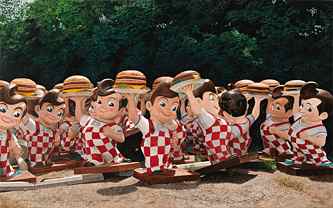
(above: John Baeder, Big Boy Bop, 1985. Collection
of Mr. and Mrs. Mitchell Boyd)
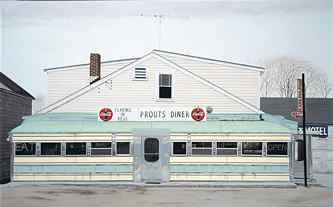
(above: John Baeder, Prout's Diner, 1974. Morris
Museum of Art, Augusta, Georgia)
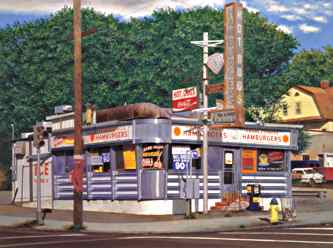
(above: John Baeder, Orange Circle Diner, 1996. Collection
of Fred Kanter)
The artist
One of America's most-admired realist painters, John Baeder
was born in South Bend, Indiana, in 1938 and shortly afterward, moved with
his family to Atlanta where he was raised. He attended Auburn University
before embarking on a career in advertising in 1960. He pursued a very successful
career asan art director for ad agencies, in Atlanta and New York City until
the early nineteen-seventies.
During his years in New York, Baeder kept his technique
sharp by drawing, painting, and taking photographs, while his day job as
an art director kept him focused on American material culture. He also began
to collect old postcards of roadside America whose images were grounded
in early modern realist photography and early color lithography. They helped
to inspire him to make the transition from the world of advertising to the
world of art.
In 1974, Ivan Karp began exhibiting Baeder's paintings
at his well-known SoHo gallery OK Harris Works of Art in New York. Since
then Baeder's work has been the subject of more than thirty solo exhibitions,
and it has been included in more than 150 group shows. Baeder's paintings
can be found in the permanent collections of many noteworthy American museums,
including those of the Whitney Museum of American Art, the Cooper-Hewitt
Museum, the Norton Museum, the Denver Art Museum, the Milwaukee Art Museum,
the Newark Museum, the High Museum of Art, the Virginia Museum of Fine Arts,
the Detroit Institute of Arts, the Yale University Art Gallery, and the
Morris Museum of Art, to cite just a few, as well as corporate and private
collections in Europe and the United States too numerous to mention.
The author of three popular books -- Diners (New
York: Harry N. Abrams, 1978 and 1995), Gas, Food, and Lodging (New
York: Abbeville Press, 1986), and Sign Language: Street Signs as Folk
Art (New York: Harry N. Abrams, 1996) -- John Baeder continues to live
and work in Nashville, Tennessee, his home since 1981.
Related Event
Tuesday, January 29, 6:00-8:00 p.m.
Lecture: Making Baeder. Morris Museum director Kevin
Grogan and curator Jay Williams discuss how the John Baeder exhibition developed
from an idea into a comprehensive retrospective. Members, free; nonmembers,
regular museum admission.
Wall labels and text panels from the exhibition
Quotations about specific diners:
-
- Maple Diner
-
- "Fall is my favorite time of year. The symphony
of color, light, and mood provides a different kind of energy for my travels
and searching. . . . I have yet to capture this extraordinary light. Ironically,
the "Maple" is a fall image, with a fall look, and fall colors.
It was not intended to look like a department store window; it just happened."
-
-
-
- Al Mac's
-
- "We were out dinering, drinking coffee, and scarfing
down rice pudding at Al Mac's, watching the sun sitting down in haste and
the looming low dark clouds moving with the speed of a drag racer. . .
. 'Tell me who Al and Mac were. The original owners, eh?' Not so, More
rice pudding, and then we learned that the original owner was Al McDermott.
A little cinnamon on the pudding. 'Al started with his first diner back
in 1910.'
-
-
-
- Harris Diner
-
- "I heard about the Harris Diner at an antique show
inNew Yorkin January 1991. On later trips north that year I would take
sojourns to the Harris to find the right light. It took several trips before
I was satisfied. The last one was made in the O.K. Harris jeep. . . . I
added the vehicle to the painting to provide color, to pay homage to the
gallery, and to offer another variant of its distinguished namesake."
-
-
-
- Whitey's Diner
-
- "Whitey called himself a sandwichman, or a counterman,
or a short-order man, and was at his craft for fifty-three years. . . .
When I met him, Whitey had been at his present location since 1954. He's
mighty proud of his double griddle of the same vintage."
-
-
-
- Blue Sky Diner
-
- "I went out on Sunday to meet the 'Blue Sky.' It
was a rare day inNew York City, a clear blue sky that stayed such until
sunset. Did the sky know how I felt about a diner's essence? . . . Walking
around the diner, I was wondering about the notion of Father Sky and Mother
Earth. I find sacredness in diners. . . . The diner is the Mother symbol-the
great provider."
-
-
-
- Empire Diner
-
- "I always passed the Empire during the day and knew
it was out of place. . . . At night, the Empire becomes stately, changes
garb, and turns into a nocturnal melody forGotham's chic, pseudo-chic,
kinky, and pseudo-kinky crowd. . . . I have deep and everlasting respect
for the Empire gang that had the brilliant idea to take and early 1940s
Fodero diner that catered to theLower West Sidetruckies and turn it around
into an upscale restaurant."
-
-
-
- Street Scene, Klamath,California
-
- "This was a pivotal painting for me because it was
the first painting where I started getting into detail. I was beginning
to paint representationally (re-presenting the image), and I enjoyed the
monochromatic paint: modeling and shaping."
-
-
-
- Highway Diner
-
- "When Dick Gutman and I first met in 1973, we exchanged
much diner talk-and also pictures and other paraphernalia related to diners
and the great American roadside. He had a photo of this diner. I couldn't
bear seeing it so small and knew it had to be painted. It was a way of
preserving the picture rather than the diner. It was at that point that
I began to pursue the diner as subject matter."
-
-
-
- Shorty's Shortstop
-
- "When I decided to paint the bus and let my fantasies
mesh into the reality of the painting, I made the aging, rusty white become
rusty landlord green, a favored color of the day. It was also a favored
color of Bud Holcombe, who owned the bus-turned-diner for a few years,
and for unknown reasons sold it to "Shorty" McGuire, who was
a chef (euphemism for short-order cook) aboard an aircraft carrier during
World War II."
-
-
-
- Airline Diner
-
- "If you are a visitor to New York City, more than
likely you arrive at La Guardia airport and cab it into the city. Before
the traffic gets too congested and tempers roar, the easy-to-miss Airline
Diner sails by you on the right."
-
-
-
- Roarin' Rohrer
-
- I look at these early "linen" postcard paintings,
and they still hold up. Some are stronger than others. They were a phase,
a beginning moment, a boost for the burner. I moved off the color linen
image and on to the black and white photo image, using postcards as a base
of visual operation. These images were mostly of small towns and corner
drugstores and gas stations and other auto-related images. At this time,
the postcard pushed me into painting more realistically. I was soon labeled
a "photorealist." . . . . I was disturbed a bit by the label.
I just wanted to be a painter. I didn't use all the mechanical tools, fuzzy
backgrounds and extra-sharp foregrounds, slick paint, and I didn't want
to have the self-consciousness that gets in the way of many "photorealist"
painters. I just went ahead and painted what I believed in."
-
-
-
- Schanaker's Diners
-
- "This was my sixth painting and second diner postcard
image, but I was still very green when it came to painting and exposure
to diners. However, the thrust of my newfound career was upon me. I had
to keep cleansing my confidence. The contrast of the diners was exciting."
-
-
-
- King's Chef
-
- "This Valentine diner was an extremely fine example
of an owner's imagination and fantasy. . . . Why does he think of himself
as chef to the king? If he had more personal pride, he would be the king.
And then he could have named the diner 'King Chef.' A man's diner is his
castle."
-
-
-
- Prout's Diner
-
- Prout's is the kind of diner you'd not expect to be around
for another five years. I returned to it five years later: still there,
same color, same everything-like it was sealed in a vault. It had a few
more gray hairs and needed some cosmetic work; that's all."
-
-
-
- Majestic
-
- "After fifteen years, I returned to the Majestic
inAtlanta. It was the same; as with all diners, it says what it is and
nothing more. . . As we walked out, another early visual experience confronted
me: a bright yellow Colonial Bread truck. . . The sight of the truck and
the reacquaintance with the 'May-Jay' made me very happy."
-
-
-
- Super Diner
-
- "I find more diners while getting lost (but usually
not inBrooklyn). Well, I was doing one of those psychic trips on myself,
thinking about my need for a diner. . . I passed a couple of heavy-duty
wrecker trucks, and I was thinking to my self (no kidding now): 'I need
a super diner just to get me out of this mess and make it through the day.
. . Eh, I might as well forget it.' . . . The light turned green; me feeling
lost; two blocks up to the left there was a glowing light, and it was reflecting
metal. I got closer and hee-hawed to myself as I answered my own question
as to what that glimmer could be."
-
Quotations about more general topics:
- Diners
-
- "I am concerned with process: the revelation of
a particular and
- poignant part of the urban landscape, and thus the preservation
- of a unique and rapidly disappearing icon of American
roadside
- culture. (Take from culture in one dimension and contribute
- back in another dimension.) A significant aspect of the
process
- is the quest, which basically is the transformation of
- documented archaeological findings-travel, investigation,
- gathering of material. Painting is the mere act of transcendence;
- an end product that enters space and time; the final
leg of the quest."
-
- "I was taking photos of diners while still in the
ad business for the 'fun of it,' not knowing I'd paint full time nor paint
diners as subject matter. After that beginning, I started doing road trips,
going on what I called 'archeological digs' for more research."
-
- Diners are "very nurturing kinds of places, horizontal,
earth-hugging in form, and the grill is the hearth. You know when you enter
that you're going to be treated like family and served family food."
-
-
- "I am moved by diners; it cannot be explained. It
is absurd to ask an artist what he means by his product. . . . There is
a certain spiritual lift to be gained by having been touched by deeper
material things."
-
- "The journey took me. I didn't take it. The diners
found me. I didn't find them."
-
-
- "The diner is a great leveler, indeed, a people's
place, a place in which everyone is equal, where class distinctions are
blurred and irrelevant, for everyone can afford to eat there, and one can
find the everyday kind of food that everyone eats. I am suggesting, strange
as it may seem to say so, that Baeder is a folk artist, for the diner is
a place where everyone is "just folks"-a feeling that Baeder
seems to yearn for, as his travels through the back roads of America suggest."
-
- Donald Kuspit, art historian
-
-
-
- John Baeder on Signs:
-
- "I love the way all alphabets look: letterforms,
signs, anything involving type and typography."
-
-
On John and his work, in general:
-
- "John Baeder is the Galahad of barbecue, a man on
a quest, a man in search of the ideal: a perfect meal in the perfect setting.
His metaphorical journey has set him on blue highways, clocking more miles
than it is possible to imagine on more cars -- usually, shall we say,
"vintage" and massive on roads that are typically
identified by three and four digits."
-
- Kevin Grogan, Director, Morris Museum of Art
-
-
-
- "For Baeder, making a painting is like creating
a short story or a poem, not like writing a newspaper article. As Eudora
Welty observed, "It is by the nature of itself that fiction is all
bound up in the local. The internal reason for that is surely that feelings
are bound up in place. The human mind is a mass of associations-associations
more poetic even than actual." Baeder balances actuality with sufficient
ambiguity, enough edited detail, to encourage larger associations and hint
at universality. Welty understood that "from the dawn of man's imagination,
place has enshrined the spirit; as soon as man stopped wandering and stood
still and looked about him, he found a god in that place." John Baeder
has said that he was first attracted to diners because they reminded him
of temples, places to celebrate the values of the "sacred small town."
He understood intuitively that diners acrossAmericashould be interpreted
more as expressions of spirit than of matter."
-
- Jay Williams, Curator, Morris Museum of Art
Selected gallery guide text:
-
- Pleasant Journeys and Good Eats along the Way:
- A Retrospective Exhibition of Paintings by John Baeder
-
-
- Pleasant Journeys and Good Eats along the Way celebrates the
life and work of one of the South's most important painters, John Baeder.
Born in Indiana, Baeder spent his childhood in Atlanta before attending
Auburn University in Alabama. Drawn back to the region, he moved to Nashville
in 1980, where he still resides.
-
- Baeder is known for his unusual subject matter, sometimes categorized
as roadside architecture but more often narrowed down, simply, to diners.
This is the focus of the Morris's retrospective exhibition.
-
- Initially derived from postcard images, Baeder's diner paintings depict
unpretentious restaurants from the mid-twentieth century that catered to
residents and travelers looking for "meals like Mother makes,"
a descriptive phrase found above the image in Dutch Diner, his very
first diner painting. Home cooking was especially appealing to weary tourists,
who hit the American highway in increasing numbers between the 1920s and
the 1960s. To meet their needs, diners spread along the system of national
roadways. "I remember noticing diners and small family businesses
along U.S. 29 when I was driving to Auburn in 1956, before the interstate
highway era," Baeder reflects. "These images stayed in my mind.
I didn't think of them then as paintings." When Congress passed the
National Interstate and Defense Highways Act in 1956, it doomed the diner,
along with other mom-and-pop businesses-although few understood the impact
of limited access superhighways before 1970.
-
- By this time John Baeder had begun to collect old postcards picturing
life in America's small cities and towns, gradually becoming obsessed with
these timeless, almost surreal, views. "Postcards and their images
played a pivotal part in my life," he wrote, reflecting on his decision
to give up a career in advertising for life as a painter. "They were
a catalyst in setting thoughts and feelings in motion. Postcards were responsible
for a career change and a new beginning." Identifying with the viewpoint
of "the anonymous photographer," Baeder began to document downtown
storefronts and diners with his camera long before he decided to commit
himself to painting. Once he began painting full time, he soon concentrated
on diners as his main subject matter.
-
- For Baeder, making a painting is like creating a short story or a poem,
not like writing a newspaper article. As Eudora Welty observed, "It
is by the nature of itself that fiction is all bound up in the local. The
internal reason for that is surely that feelings are bound up in
place. The human mind is a mass of associations-associations more poetic
even than actual." Baeder balances actuality with sufficient ambiguity,
enough edited detail, to encourage larger associations and hint at universality.
Welty understood that "from the dawn of man's imagination, place has
enshrined the spirit; as soon as man stopped wandering and stood still
and looked about him, he found a god in that place." John Baeder has
said that he was first attracted to diners because they reminded him of
temples, places to celebrate the values of the "sacred small town."
He understood intuitively that diners across America should be interpreted
more as expressions of spirit than of matter.
-
- In Baeder's paintings the image of the diner becomes a symbol for accommodating
the enduring values of hearth and home, a connection threatened by postwar
mobility and affluence. Each of his classic diner paintings invites viewers
to embrace America's values before the era of corporate consumerism.
-
- -- Jay Williams, Curator
-
- Notes
- 1. John Baeder, Diners, rev. ed. (New York: Harry N. Abrams,
1995), 96.
- 2. John Baeder, Interview with Jay Williams, October 25, 2006, Nashville,
Tennessee.
- 3. John Baeder, Gas, Food, and Lodging (New York: Abbeville
Press, 1982), 9.
- 4. Eudora Welty, "Place in Fiction," in The Eye of the
Story: Selected Essays and Reviews (New York: Random House, 1978),
118.
- 5. Welty, 123.
- 6. Baeder, Interview.
- 7. Baeder, Gas, Food, and Lodging, 117.
-
- [Illustrations]
-
- Al Mac's, 1991, Oil on canvas, 30 x 48 inches
- Collection of the Philbrook Art Museum, Tulsa, Oklahoma, museum purchase,
1998.9
-
- Street Scene, Klamath, California, 1972, Acrylic on canvas, 42 x 66
inches
- Collection of Diane and Judd Maze, New York City
-
- Maple Diner, 1973, Oil on canvas, 42 x 66 inches
- Collection of the John and Maxine Belger Family Foundation
-
- Darling's, 2000, Watercolor, 23 x 30 inches
- Private Collection
-
Please click
here to view the checklist
for the exhibition
Editor's note: RL readers may also enjoy:
Links to sources of information outside of our web site
are provided only as referrals for your further consideration. Please use
due diligence in judging the quality of information contained in these and
all other web sites. Information from linked sources may be inaccurate or
out of date. Traditional Fine Arts Organization,
Inc. (TFAO)
neither recommends or endorses these referenced organizations. Although
TFAO includes links to other web sites, it takes no responsibility for the
content or information contained on those other sites, nor exerts any editorial
or other control over them. For more information on evaluating web pages
see TFAO's General Resources section in
Online Resources for Collectors and Students of Art History.
Read more articles and essays concerning this institutional
source by visiting the sub-index page for the Morris
Museum of Art in Resource Library.
Visit the Table
of Contents for Resource Library Magazine for
thousands of articles and essays on American art.
Copyright 2007 Traditional Fine Arts Organization, Inc., an Arizona nonprofit corporation. All rights
reserved.