Venetian Scenes by Walter Launt Palmer
December 15, 2007 - June 1, 2008
On December 15, 2007 the Albany Institute of History & Art opened the exhibition Venetian Scenes by Walter Launt Palmer. Venetian Scenes will be on view through June 1, 2008, and will include 10 paintings, several borrowed from private collections and which have not been on public view for many years, along with sketches, diaries, photographs and account books related to Palmer's Venetian work.
Palmer first visited Venice during a European tour in 1874, and returned in 1881, spending two months, painting, sketching and photographing views of the city and its environs. Palmer focused on the landmarks around and near the Piazza San Marco, the Grand Canal, and San Giorgio, capturing the serenity of Venice in an evolving Impressionist style that appealed to his American customers.
A gifted colorist, Palmer was a master of mediums and worked well in oil, watercolor, pastel and mixed media. In addition to his popular Venetian scenes, Palmer painted landscapes of all seasons, including his color-filled impressionistic snow scenes and detailed interior views of Victorian homes during his prolific sixty-year career. Palmer attributes his success to John Ruskin and the Pre-Raphaelites for influencing his early work, especially the discovery that the shadows on snow are blue, an important original element found in all of his snow scenes.
Son of neoclassical American sculptor Erastus Dow Palmer, Walter Launt Palmer grew up in Albany, in an artistic atmosphere, around Hudson River School artists such as Frederic E. Church, James and William Hart, George Boughton, Homer Dodge Martin and Edward Gay. Walter Launt Palmer went on to briefly study portrait paintings with Charles Loring Elliot, followed by landscape painting with Church at his Olana home, near Hudson, New York, between 1870 and 1872. In 1873, Palmer first traveled abroad, visiting Scotland, France, Germany and Italy. Palmer made his home in Albany from 1882 until his death in 1932.
Selected wall text for the exhibition
In the late nineteenth century American artists were drawn to Venice and the Albany-born Walter Launt Palmer (1854-1932), was no exception. Palmer first visited Venice in 1874 during a European tour. He returned to Venice in 1881 and spent a fruitful two months painting, sketching and photographing views of the city and its environs. Concentrating on the landmarks around and near the Piazza San Marco, the Grand Canal, and San Giorgio, Palmer captured the serene quality of Venice in an evolving Impressionist style that appealed to his American customers. He painted more than one hundred Venetian subjects that were especially in demand from the late 1880s to the early 1900s.
Palmer was a prolific and successful artist with over 1,200 documented works. He was a master of mediums and worked well in oil, watercolor, pastel, and mixed media. Above all, he was a gifted colorist. During his prolific and successful career Palmer painted landscapes of all seasons including his color-filled impressionistic snow scenes, detailed interior views of Victorian homes, and his ever-popular luminous Venetian scenes, the focus of this exhibition.
Son of the well-known neoclassical American sculptor Erastus Dow Palmer (1817-1904), Palmer grew up in Albany, New York in an artistic atmosphere. E. D. Palmer's studio was a gathering place for second-generation Hudson River School artists such as Frederic E. Church, James and William Hart, George Boughton, Homer Dodge Martin and Edward Gay. Palmer studied portrait paintings briefly with Charles Loring Elliot, and then landscape painting with Church at his home called Olana, near Hudson, New York between 1870 and 1872.
In 1873 he made his first trip to abroad and traveled to Scotland, France, Germany, and Italy and while he was in Paris he studied with Charles Carolus-Duran. Palmer shared a studio with Frederic Church at the Tenth Street Studio Building in New York City from 1877 to 1881. Though Palmer visited Europe and the Middle East several more times during his lifetime, he made his home in Albany from 1882 until his death in 1932.
To complement the museum's collection of Venetian scenes, the museum borrowed eight paintings from private collections, several of which have not on public view for many years. In addition, two of the museum's Venetian paintings, Interior, San Marco and A Venetian Twilight, were recently conserved especially for this exhibition. The Albany Institute would like to thank Hawthorne Fine Art, LLC, New York City for funding the conservation of Interior, San Marco.
Major support for this exhibition has been provided by James and Barbara Hoehn
Selected images of paintings from the exhibition followed by their label text
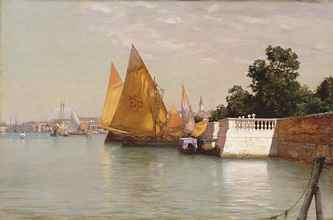
(above: The Garden Steps; Walter Launt Palmer (1854-1932) 1886; oil on canvas, ht.18_in., w.27_in; signed lower left "W.L. Palmer 1886." Albany Institute of History & Art Purchase; 1985.13)
The Garden Steps
oil on canvas, 1886
signed lower left: W.L. PALMER 1886
original gilt frame
Collection of the Albany Institute of History & Art, 1985.63
As one of Palmer's earliest Venetian scenes in the exhibition, this picture is painted in the academic tradition with rich colors and realistic, sharply delineated shapes. The bright Baroque balustrade and deeply saturated amber-orange sails of the fishing boats provide a striking contrast with the aquamarine blue sky and water. Purchased by George A. Cheney of Essex Connecticut, Palmer recorded many details of this commission in his diary and noted on February 27, 1886 that he "Drew in Cheney's picture carefully in brown & tints" and completed the painting on March 17.
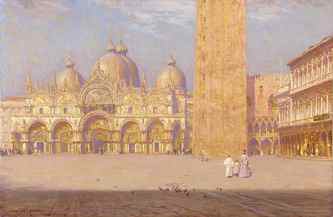
(above: San Marco; Walter Launt Palmer (1854-1932) ca.1895, oil on canvas, ht.19_in., w. 29_in.; signed lower left "Walter L. Palmer." Albany Institute of History & Art, gift of Beatrice Palmer, daughter of the artist, 1942.34.33)
San Marco
Oil on composition board, 1895
Signed lower left: - WALTER L. PALMER -
Original gilt frame
Collection of the Albany Institute of History & Art
Gift of Beatrice Palmer, 1942.34.33
Impressionism pervaded Palmer's painting style in the 1890s, when his
Venetian scenes were in demand. In this light-filled picture Palmer
truncated the vertical shaft of the Campanile of San Marco and used its
smooth surface as a foil to the rounded domes of the Basilica of San Marco
and the decorative columns of the Doges Palace. The broad expanse of the
Piazza San Marco and figures approaching the viewer are also bathed in luminous
sunlight while flocks of pigeons feeding in the foreground are painted in
deep shadow. Palmer won honorable mention for a similar version of
San Marco at the 1900 Paris Universal Exposition.
Editor's note: Resource Library readers may also enjoy:
Selected biographical information from Oxford Gallery on Walter Launt Palmer:
Book:
Walter Launt Palmer: Poetic Reality, by Maybelle Mann, Schiffer Publishing, 1989 (right: thumbnail
image of from cover of Walter Launt Palmer: Poetic Reality,
Excerpt of Amazon.com editorial review of the book:
In October, 2007 Barbara Hazeltine photographed the following scenes in Venice which may be of interest to readers: All photos © Barbara Hazeltine 2007
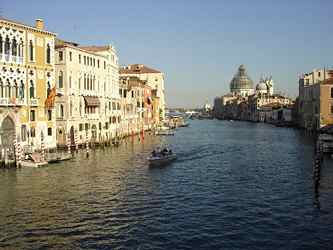
(above: Grand Canal in Venice, October, 2007 © Barbara Hazeltine 2007)
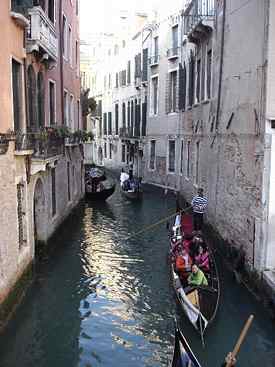
(above: Gondoliers in Venice, October, 2007 © Barbara Hazeltine 2007)
Volunteer photographs can be sent by email to TFAO for adding to the editor's notes of previously published Resource Library articles and essays. Click here for details.
Read more articles and essays concerning this institutional source by visiting the sub-index page for the Albany Institute of History and Art in Resource Library.
Visit the Table of Contents for Resource Library for thousands of articles and essays on American art.
© Copyright 2008 Traditional Fine Arts Organization, Inc., an Arizona nonprofit corporation. All rights reserved.