Editor's note: The Noyes Museum of Art provided
source material to Resource Library for the following article or
essay. If you have questions or comments regarding the source material,
please contact the Noyes Museum of Art directly through either this phone
number or web address:
Herbert Pullinger: A Cape
May Historical Journey
January 18 - March 9, 2008
Philadelphia artist
Herbert Pullinger (1878-1961) will be featured in a new exhibit opening
on January 18, 2008 at the Noyes Museum of Art. The exhibit, 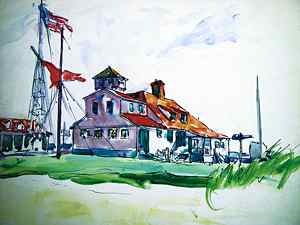 titled Herbert Pullinger: A Cape May Historical Journey,
offers a pictorial account of Cape May's natural and man-made environment
during the mid-20th century. The exhibition, which continues to March 9,
2008, includes 42 drawings and paintings of Cape May's fishing and lodging
industries, churches, neighborhoods and landscapes. The collection represents
a 2006 gift to the Museum by the Cape May County Art League of Cape May,
N.J. (right: Herbert Pullinger, Cape May Point Naval / Lifesaving
Station, c. 1944)
titled Herbert Pullinger: A Cape May Historical Journey,
offers a pictorial account of Cape May's natural and man-made environment
during the mid-20th century. The exhibition, which continues to March 9,
2008, includes 42 drawings and paintings of Cape May's fishing and lodging
industries, churches, neighborhoods and landscapes. The collection represents
a 2006 gift to the Museum by the Cape May County Art League of Cape May,
N.J. (right: Herbert Pullinger, Cape May Point Naval / Lifesaving
Station, c. 1944)
Pullinger spent much of his time during the 1940's and
1950's painting the sites and landscapes in Cape May, N.J. Many of the artists
images have not changed since he set up his easel over 50 years ago. Familiar
scenes such as Congress Hall, the Chalfonte Hotel and the Franklin Street
Methodist Church are included in the exhibit. The exhibition also includes
images that have vanished from the Cape May landscape giving the viewer
an historical overview of this famous seaside town. Lost for over 40 years,
these watercolors and drawing were found by Cape May County Art League President
Stan Sperlak during a recent move of the Leagues' archives. This is the
first showing of these paintings at the Noyes Museum and only the second
time that they have ever been shown publicly.
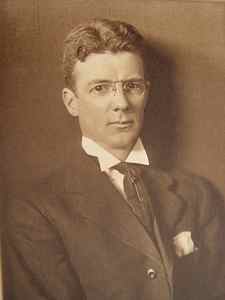 Described as an "urban romantic,"
Pullinger's first exhibited works were etchings and paintings of urban environments.
He captured scenes of weapon and ammunition production at the Bethlehem
and Midvale Steel Companies, U.S. war ships, the Pennsylvania coal industry
and city buildings. Though most of these settings were of his hometown Philadelphia,
he also included New York, Camden, Quebec, Boston, and Baltimore in his
artwork. He once described Philadelphia as, "one of the most picturesque
places in America, where nowhere could there be found such a blending of
the old and new, the natural and the artificial." (left: Herbert
Pullinger portrait , courtesy of Philadelphia Sketch Club.)
Described as an "urban romantic,"
Pullinger's first exhibited works were etchings and paintings of urban environments.
He captured scenes of weapon and ammunition production at the Bethlehem
and Midvale Steel Companies, U.S. war ships, the Pennsylvania coal industry
and city buildings. Though most of these settings were of his hometown Philadelphia,
he also included New York, Camden, Quebec, Boston, and Baltimore in his
artwork. He once described Philadelphia as, "one of the most picturesque
places in America, where nowhere could there be found such a blending of
the old and new, the natural and the artificial." (left: Herbert
Pullinger portrait , courtesy of Philadelphia Sketch Club.)
Pullinger was born in West Philadelphia in 1878. He studied
at the Philadelphia Museum School of the Industrial Arts and Drexel University.
He completed his education at the Pennsylvania Academy of the Fine Arts
under the instruction of realist painter, Thomas Anshutz. After becoming
an illustrator for the Philadelphia Record in 1923, Pullinger taught perspective,
etching, watercolor, and printmaking for 40 years at the Philadelphia Museum
School (now known as the Philadelphia College of Art.)
Pullinger's long and accomplished career has been acknowledged
with many awards and exhibitions. In 1926, Pullinger won the Eyre gold medal
from the Pennsylvania Academy of Fine Arts and a silver medal for wood engraving
at the Sesquicentennial Exhibition. His works have been on exhibit in the
Luxembourg Museum; the New York Public Library; the Library of Congress
in Washington, D.C.; the Springfield, Mass. Public Library; the Pennsylvania
Academy of the Fine Arts; and the Philadelphia Museum of Art. His works
also appeared in the Saturday Evening Post and the Philadelphia
Bulletin. He was a member of the Fellowship of the Pennsylvania Academy
of the Fine Arts; the Art Alliance; the Philadelphia Sketch Club; the Philadelphia
Art Club; and the Woodmere Art Gallery where he designed the official seal.
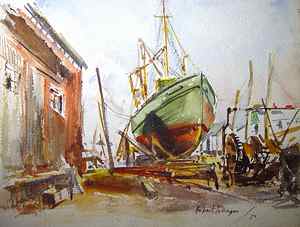
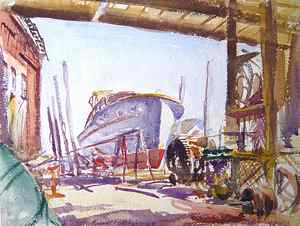
(above: Herbert Pullinger, Drydock at Schellenger's,
Watercolor, 27 _ x 24 inches)
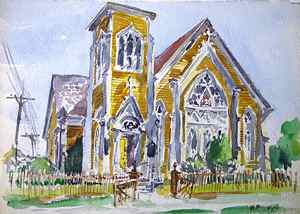
(above: Herbert Pullinger, Franklin Street Methodist
Church, Watercolor, 20 x 24 inches)
(above: Herbert Pullinger, Sport Fisher at Pharoah's,
Watercolor, 26 x 23 inches)
Gallery guide text for the exhibition
- The unique beauty of Cape May's beaches, culture and historic buildings
draw visitors from New York, Philadelphia and other surrounding areas.
This same beauty attracted Herbert Pullinger to record the life and work
of Cape May, New Jersey during the 1930s, 40s and 50s. The exhibition Herbert
Pullinger: A Cape May Historical Journey is a collection of paintings
that form a record of Cape May as it was over half a century ago.
-
- An accomplished American etcher, wood engraver, lithographer, painter
and illustrator, Herbert Pullinger studied at the Pennsylvania Academy
of Fine Arts with Thomas Eakins and other prominent Philadelphia artists
of the late 19th and early 20th centuries. His first exhibited works of
art were mainly etchings and paintings portraying urban settings. During
the 1920s Pullinger was a superb technician of wood engraving. As a specialist
of the graphic arts, his etchings, lithographs and wood engravings captured
architectural landmarks of historic interest. Wood engraving was used for
illustration in newspapers before photography become the common practice.
An artist would create an on-site drawing of the event, and take it back
to the office where he would engrave it into a boxwood block. Entered into
the press, the image would appear in the paper the following day. With
these engravings, Pullinger emerged as one of America's foremost wood engravers
and examples of his art were included in major exhibitions in Britain,
France, Germany and elsewhere. Pullinger became known for his depictions
of urban environs, not only of hometown Philadelphia, but other North American
cities including New York, Camden, Quebec, Boston, Baltimore and Washington.
-
- It is Pullinger's love of place that gives viewers the sensation of
recognizing familiar and unfamiliar scenes. In 42 drawings and paintings,
Pullinger offers a pseudo walking tour of Cape May's natural and made-made
environment during the mid-20th century, including the fishing and lodging
industries, churches, neighborhoods and landscapes. The significance of
Pullinger's work lies in his decision to compose pictures of Cape May's
dry docks, fishing boats and back alleys, instead of the more proper Victorian
parasols and costumes. You'll see no carriages or women strolling with
parasols, Pullinger preferred the more common or ram shackled, capturing
the grit and clamor of busy street life.
-
- During this time, he painted some scenes that have not changed since
the artist set up his easel over 50 years ago. Familiar images such as
Congress Hall, the Chalfonte Hotel and Colonial Inn can be seen in his
artwork. The Franklin Street Methodist Church has remained almost unchanged
from the time Pullinger painted it at Lafayette and Franklin. Though many
of these locations have changed very little, others have been forgotten
and have disappeared. One of Pullinger's watercolors titled Drydock
at Schellenger's was identified as modern-day's Tony's Marine Railway.
Another titled Day Dragger is thought to be a part of the harbor
now known as Devil's Reach. On the Promenade, captures Weightman
Cottage and the Morning Star Hotel at their original locations; the Colonial
Hotel, at right remains the sole architectural survivor.
-
-
- Detailed Studies of Place
-
- In order to historically archive his scenes, Pullinger created graphite
studies on location to document the very details of time and place. Within
several of the graphite drawings are insets, concentrated studies, indicating
that this work was intended to be used in a finished piece. Numerous notes
accompany Pullinger's graphite drawings to guide the artist in a more finished
work to be produced at a later date. Outside the margins of the main drawing,
he refined the details before committing his hand directly to the primary
drawing. This practice allowed Pullinger to keep the drawing clean and
free from the smudges of an erasure. Detailed graphic notes identify weather
conditions, time of day and location. To historically document the day
in Coast Guard Station, Pullinger includes the pennant under the
American flag which is a small craft warning for treacherous conditions.
-
- Lost for over 40 years, Pullinger's nostalgic paintings and drawings
of Cape May were discovered recently by Cape May County Art League President
Stan Sperlak during a move of the Leagues' archives. At first, he passed
over the paintings, until noting the initials H.P. on a similar valuable
collection of watercolors. Sperlak researched the mystery painter and embarked
on a two year conservation effort and spearheaded a campaign to raise funds
to preserve the collection. The paintings represent a 2007 gift to the
Museum's permanent collection by the Cape May County (N.J.)
- Art League.
- Pullinger studied at the Philadelphia Museum School of the Industrial
Arts, Drexel University and the Pennsylvania Academy of Fine Arts under
the instruction of realist painter, Thomas Anshutz. After becoming an illustrator
for the Philadelphia Record in 1923, Pullinger taught perspective, etching,
watercolor and printmaking for 40 years at the Philadelphia Museum School
(now known as the Philadelphia College of Art). In 1925, Pullinger won
the Eyre Gold Medal from the Pennsylvania Academy of Fine Arts and a silver
medal for wood engraving at the Sesquicentennial Exhibition in 1926. His
works have been on exhibit at the Luxembourg Museum; the New York Public
Library; the Library of Congress in Washington, D.C.; the Springfield,
Mass. Public Library; the Pennsylvania Academy of the Fine Arts; and the
Philadelphia Museum of Art. His works also appeared in the Saturday
Evening Post and the Philadelphia Bulletin. He was a member
of the Fellowship of the Pennsylvania Academy of Fine Arts; the Art Alliance;
the Philadelphia Sketch Club; the Philadelphia Art Club; and the Woodmere
Art Gallery, where he designed the official seal.
-
-
Wall labels for the exhibition
- Herbert Pullinger
- Menhaden Boat at Schellenger's
- Graphite on paper
- 19 _ x 28 in.
-
- Herbert Pullinger
- Eastern Rigged Fishing Boat
- Graphite on paper
- 19 _ x 28 in.
-
- Herbert Pullinger
- Backyard Apartment, 1945
- Graphite on paper
- 19 _ x 28 in.
-
- Herbert Pullinger
- Behind Petroff's
- Graphite on paper
- 19 _ x 28 in.
-
- Herbert Pullinger
- Last Chance
- Graphite on paper
- 19 _ x 28 in.
-
- Herbert Pullinger
- Railway, Pullcars and Shadows
- Graphite on paper
- 19 _ x 28 in.
-
- Herbert Pullinger
- Henry L. Hunt House
- Graphite on paper
- 19 _ x 28 in.
-
- Herbert Pullinger
- Eldridge Johnson House
- Graphite on paper
- 19 _ x 28 in.
-
- Herbert Pullinger
- Fisherman Homes and Boat Houses
- Graphite on paper
- 19 _ x 28 in.
-
- Herbert Pullinger
- Dock at Cold Spring Harbor
- Graphite on paper
- 19 _ x 28 in.
-
- Herbert Pullinger
- House with Trees
- Graphite on paper
- 19 _ x 28 in.
-
- Herbert Pullinger
- House on the Corner
- Graphite on paper
- 19 _ x 28 in.
-
- Herbert Pullinger
- On the Promenade
- Graphite on paper
- 19 _ x 28 in.
-
- Herbert Pullinger
- Weightman Cottage and Morning Star
- Graphite on paper
- 19 _ x 28 in.
- Herbert Pullinger
- Approaching Gale, 1944
- Ink on paper
- 20 _ x 17 in.
-
- Herbert Pullinger
- The Mainstay
- Graphite on paper
- 18 _ x 15 _ in.
-
- Herbert Pullinger
- House with Sign
- Graphite on paper
- 19 _ x 14 in.
- Herbert Pullinger
- Drying the Nets
- Graphite on paper
- 19 _ x 17 _ in.
-
- Herbert Pullinger
- Congress Hall
- Ink on paper
- 21 x 18 _ in.
- Herbert Pullinger
- Porches at the Chalfonte, 1948
- Graphite on paper
- 15 x 18 in.
-
- Herbert Pullinger
- Beach, 1945
- Graphite on paper
- 18 _ x 15 _ in.
-
- Herbert Pullinger
- Beach Avenue Stores
- Graphite on paper
- 15 _ x 18 _ in.
-
- Herbert Pullinger
- Jackson's Clubhouse, 1945
- Graphite on paper
- 8 _ x 15 _ in.
-
- Herbert Pullinger
- Fishing Boat Studies
- Graphite on paper
- 19 _ x 16 _ in.
-
- Herbert Pullinger
- Harbor with Bridge
- Graphite on paper
- 19 _ x 15 _ in.
-
- Herbert Pullinger
- Lone Wolf, 1952
- Graphite on paper
- 21 _ x 16 _ in.
-
- Herbert Pullinger
- Franklin Street Methodist Church
- Watercolor
- 24 x 20 in.
-
- Herbert Pullinger
- Washlines
- Watercolor
- 24 x 21 in.
-
- Herbert Pullinger
- Coast Guard Station, Cape May Point
- Watercolor
- 24 x 21 in.
-
- Herbert Pullinger
- Small Craft Advisory
- Watercolor
- 27 x 23 in.
-
- Herbert Pullinger
- Schooner at Dock
- Watercolor
- 28 x 24 in.
-
- Herbert Pullinger
- Doorway
- Watercolor
- 22 x 27 in.
-
- Herbert Pullinger
- Jackson's Clubhouse
- Watercolor
- 23 _ x 20 in.
-
- Herbert Pullinger
- Overcast and Schooner
- Watercolor
- 26 x 22 in.
-
- Herbert Pullinger
- Day Dragger
- Watercolor
- 25 _ x 23 in.
-
- Herbert Pullinger
- General Store, 1945
- Watercolor
- 23 _ x 20 in.
-
- Herbert Pullinger
- Under Repair
- Watercolor
- 26 x 22 in.
-
- Herbert Pullinger
- Dayboat at Drydock
- Watercolor
- 26 x 22 _ in.
-
- Herbert Pullinger
- A Schooner at Cape Island Creek
- Watercolor
- 26 x 23 in.
-
- Herbert Pullinger
- Sport Fisher at Pharoah's
- Watercolor
- 26 x 23 in.
-
- Herbert Pullinger
- Cape May Boatworks
- Watercolor
- 25 _ x 23 _ in.
-
- Herbert Pullinger
- Drydock at Schellenger's
- Watercolor
- 27 _ x 24 in.
Read more articles and essays concerning this institutional
source by visiting the sub-index page for the Noyes
Museum of Art in Resource Library.
Visit the Table
of Contents for Resource Library for thousands
of articles and essays on American art.
© Copyright 2008 Traditional Fine Arts Organization, Inc., an Arizona nonprofit corporation. All rights
reserved.