Editor's note: The Museum of Fine Arts, Boston
provided source material to Resource Library for the following article
or essay. If you have questions or comments regarding the source material,
please contact the Museum of Fine Arts, Boston directly through either this
phone number or web address:
Winslow Homer: American
Scenes
June 20 - December 7, 2008
Winslow Homer:
American Scenes, an installation that spans the
breadth of Winslow Homer's career -- from an early drawing he made at age
13, to his 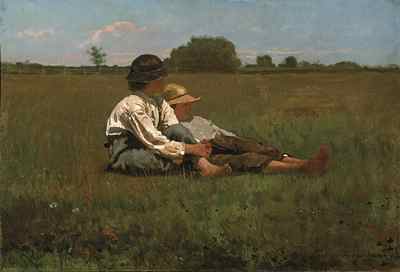 last seascape at age
73 -- opened June 20, 2008 at the Museum of Fine Arts, Boston (MFA), in
conjunction with the opening of the Museum's new State Street Corporation
Fenway Entrance. Winslow Homer: American Scenes celebrates the artistry
of the great American master, Winslow Homer (1836-1910), in an installation
that highlights approximately 70 of his iconic images, including 11 paintings,
five watercolors, and more than 40 prints and drawings selected from the
Museum's extensive collection. Included are familiar masterpieces, such
as Boys in a Pasture (1874), Long Branch, New Jersey (1869),
and The Fog Warning, Halibut Fishing (1885), as well as the first
showing at the MFA of his watercolor Woman Standing by a Gate, Bahamas
(1885), acquired by the Museum in 2003. The installation in the Lee
Gallery, on view through December 7, is the MFA's largest since it mounted
the exhibition Winslow Homer in 1996. (right: Winslow Homer,
American, 1836-1910, Boys in a Pasture, 1874, Oil on canvas. The
Hayden Collection-Charles Henry Hayden Fund, 1953. Museum of Fine Arts,
Boston)
last seascape at age
73 -- opened June 20, 2008 at the Museum of Fine Arts, Boston (MFA), in
conjunction with the opening of the Museum's new State Street Corporation
Fenway Entrance. Winslow Homer: American Scenes celebrates the artistry
of the great American master, Winslow Homer (1836-1910), in an installation
that highlights approximately 70 of his iconic images, including 11 paintings,
five watercolors, and more than 40 prints and drawings selected from the
Museum's extensive collection. Included are familiar masterpieces, such
as Boys in a Pasture (1874), Long Branch, New Jersey (1869),
and The Fog Warning, Halibut Fishing (1885), as well as the first
showing at the MFA of his watercolor Woman Standing by a Gate, Bahamas
(1885), acquired by the Museum in 2003. The installation in the Lee
Gallery, on view through December 7, is the MFA's largest since it mounted
the exhibition Winslow Homer in 1996. (right: Winslow Homer,
American, 1836-1910, Boys in a Pasture, 1874, Oil on canvas. The
Hayden Collection-Charles Henry Hayden Fund, 1953. Museum of Fine Arts,
Boston)
The installation begins with the artist's early drawing,
Rocket Ship (1849-50), which Homer began in 1849 at the age of 13
when his father, Charles Savage Homer, left his Massachusetts home to prospect
for gold out west. Rocket Ship is Homer's interpretation of a Currier
& Ives lithograph that features a miner riding a rocket toward California's
gold fields. The MFA installation continues with a survey of Homer's Civil
War illustrations; his Parisian-influenced works; depictions of rural life;
seascapes in Gloucester, Massachusetts, and Prout's Neck, Maine; and images
of England, Florida, and the Caribbean. It ends with Driftwood (1909),
Homer's last seascape and his final completed work, a majestic homage to
the stormy coast of Prout's Neck, where he spent the last 27 years of his
life.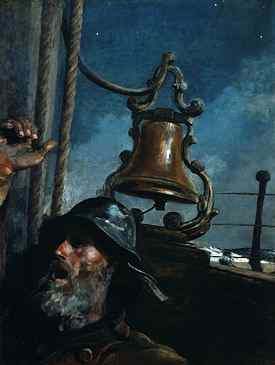
A native of Boston, Homer was born in 1836 and moved with
his family as a young boy to Cambridge, then later to Belmont, Massachusetts.
When it became apparent that his talents were more artistic than academic,
Homer apprenticed with a commercial lithographer, John H. Bufford, in Boston.
While there, he designed sheet music covers for popular songs of the day,
creating lithographs for Katy Darling (1855) and The Wreath (1856),
which showed his burgeoning artistic potential. Two years later, Homer struck
out on his own as a freelance illustrator, working for Ballou's Pictorial
and Harper's Weekly, among other publications. The artist's association
with Harper's continued when he moved to New York City in 1859 as
a freelancer, covering Abraham Lincoln's inauguration for the illustrated
journal in 1861. Later that year, Homer was assigned by Harper's
to chronicle Union troops in Virginia as a "special artist" at
the front during the Civil War. (left: Winslow Homer, American, 1836-1910,
The Lookout -"All's Well", 1896, Oil on canvas. Museum
of Fine Arts, Boston. Warren Collection-William Wilkins Warren Fund. Photograph
© Museum of Fine Arts, Boston)
From this unique vantage point, Homer created popular color
lithographs of army camp life for the magazine, and began to paint in oils.
The two months he spent in 1862 during the Siege of Yorktown marked the
beginning of a prolific period of artistry based upon his wartime experiences,
such as the lithograph Campaign Sketches: The Letter for Home (1863)
and the painting Playing Old Soldier (1863). Homer also created color
illustrations for Louis Prang Company which were used to produce a series
of Civil War collectors' cards, Life in Camp, First Series (1864)
and Life in Camp, Second Series (1864), in which he included his
self-portrait. Also of note is that Homer was one of the first American
artists to give serious attention to African-Americans during the war, as
can be seen in his wood engraving, A Bivouac Fire on the Potomac (1861),
and the chromolithograph, The Bright Side, drawn by Homer in 1889,
which is included in the installation. It is based on his acclaimed Civil
War-era painting of the same name that appeared at the 1867 Paris Exposition
Universelle, attended by Homer.
During his 10-month sojourn in Paris, Homer became familiar
with avant-garde works, especially the French landscape paintings of the
Barbizon school, and the early Impressionists. Their treatment of light
and the artist's interest in scenes of popular leisure and urban entertainment
can be seen in a variety of his images, including Long Branch, New Jersey
(1869), a sun-filled vision of a popular seaside resort in New Jersey, and
the wood engraving A Parisian Ball-Dancing at the Mabille, Paris (1867).
Another view of the seashore, albeit a more naturalistic one, is the painting
Rocky Coast and Gulls (1869), a depiction of a Manchester, Massachusetts,
beach populated only by sea gulls and horseshoe crabs.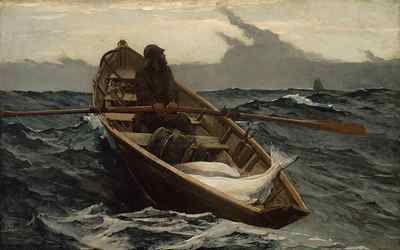
In the 1870s, the artist created drawings, wood engravings,
watercolors, and paintings that celebrated rural life in works such as Twilight
at Leeds, New York (1876), and a variety of scenes based on travels
throughout the Adirondacks, Gloucester, and Prout's Neck. After the devastation
of war, Homer focused for a time on optimistic pictures of young people
enjoying themselves outdoors, which harkened back to simpler, more innocent
days. These include the wood engraving Snap the Whip! (1873), the
paintings The Dinner Horn (about 1870) and Enchanted (1874,
Private Collection), and the perennial favorite, Boys in a Pasture (1874).
(right: Winslow Homer, American, 1836-1910, The Fog Warning,
1885, Conservation status: After treatment, Oil on canvas. Museum of Fine
Arts, Boston. Otis Norcross Fund. Photograph © Museum of Fine Arts,
Boston)
From rural life to seascapes, Winslow Homer: American
Scenes also highlights the period Homer spent in Gloucester. There he
lived in solitude on Ten Pound Island in the summer of 1880, producing more
than 100 watercolors and drawings including Girl Seated (1880), and
he continued to find inspiration in Gloucester during the ensuing years,
as seen in Gloucester, Mackerel Fleet at Sunset (1884), part of a
group of paintings he did for the interior of his brother's boat, and The
Fog Warning, Halibut Fishing (1885). (right: Winslow Homer, American,
1836-1910,
For the last 27 years of his life, Homer was based at his
family's compound on Prout's Neck, where he continued to produce numerous
seascapes, including the painting The Lookout-"All's Well"
(1896), and etchings of The Life Line (1884) and Eight Bells
(1887), based on his oil paintings of the same name. Homer also took a trip
to Cullercoats, a fishing village in England, as reflected in the etching,
Mending the Nets (1888), and tempered the harsh New England winters
with visits to Cuba, the Bahamas, and Florida. The watercolors Street
Corner, Santiago de Cuba (1885), Woman Standing by a Gate, Bahamas
(1885), and Palm Trees, Florida (1904) depict his visits to sunnier
climes.
Winslow Homer: American Scenes concludes
with his dramatic masterpiece, Driftwood (1909), the artist's last
work, a seascape completed the year before he died. The installation also
features Homer's illustrations for the anthology, Winter Poems (1871)
and his silhouettes for James Russell Lowell's 1874 book, The Courtin'.
[The latter are evocative of another MFA work, Kara Walker's The Rich
Soil Down There (2002), exhibited on the second floor of the West Wing,
a tableau that uses silhouetted figures to provide a visual commentary on
unsettling relationships caused by racial and gender stereotypes.]
"Winslow Homer: American Scenes offers visitors
a rare and intimate glimpse of the artist's working method in all media
throughout his career and draws upon the rich collections of his work held
at the Museum of Fine Arts, Boston," said Elliot Bostwick Davis, John
Moors Cabot Chair of the Art of the Americas department at the MFA, who
curated the installation with the assistance of Elizabeth Mitchell, assistant
curator in the Prints and Drawings department.
Joining Winslow Homer: American Scenes are two additional
installations that also are on display in celebration of the State Street
Corporation Fenway Entrance: Preserving History, Making History: The
Museum of Fine Arts, Boston, an exploration of the MFA's history from
its founding in 1870 to the present, with a look toward the future (on view
through September 22); and Great Company: Portraits by European Masters,
a selection of renowned portraiture from the Museum's collection (on view
through January 5, 2009).
Editor's note: RL readers may also enjoy
these earlier articles and essays:
- Winslow Homer In America (10/25/07)
- Winslow Homer-American Illustrator (8/29/06)
- Winslow Homer in the National Gallery of
Art (7/14/05)
- Winslow Homer: Survival and the Sea (6/21/05)
- Winslow Homer: Making Art, Making History
(6/2/05)
- Winslow Homer the Illustrator: His Wood
Engravings, 1857-1888 (1/22/05)
- Winslow Homer and the Great Forest; essay
by David Tatham (7/20/04)
- Winslow Homer: Masterworks from the Adirondacks
(7/9/04)
- Winslow Homer - The Illustrator: His Wood
Engravings 1857-1888 (11/18/03, rev. 12/19/03)
- "The American Spirit: Frederic Church,
Winslow Homer, Thomas Moran" and "Leelanau: Michigan's Eden"
(8/26/03)
- Winslow Homer The Illustrator: His Wood
Engravings, 1857-1888 from the Cornell Fine Arts Museum, Winter Park, Florida
(8/11/03)
- Winslow Homer the Illustrator: His Wood
Engravings, 1857-1888 (12/9/02)
- Americans Outdoors: Seasonal Prints by
Winslow Homer (with selected wall text) (7/5/01)
- Rab and the Girls: A Riddle in Paint, by
Sarah Burns (5/31/01)
- Winslow Homer: The Civil War Years and
Winslow Homer: The Gloucester Years (12/4/00)
- Winslow Homer: An American Genius at the
Parthenon (7/25/00) including an image of Rab and the Girls
- Winslow Homer Watercolors at Canajoharie
Library and Art Gallery (2/24/01)
- Winslow Homer: The Civil War Years and
Winslow Homer: The Gloucester Years (12/4/00)
- Winslow Homer and the Critics: Forging
a National Art in the I870s (8/30/00)
- A Fair Wind" - Maritime Paintings
by Winslow Homer (4/15/00)
- Winslow Homer Facing Nature (2/20/00)
- The Art of American Life: Winslow
Homer's Graphics (1857-1877) (10/18/99)
- Winslow Homer: Early Prints and Paintings
(9/11/99)
- Winslow Homer (1836-1910) (10/7/99)
- Winslow Homer: Works on Paper (8/11/99)
- Winslow Homer: Illustrating America
(5/15/99)
- Winslow Homer and the Elusive African-American
Boy (1/16/99)
- Winslow Homer (1999)
- Winslow Homer: Facing Nature (4/7/98)
From TFAO's Topics in American Representational Art:
Also enjoy online multimedia:
a streaming slide show titled Winslow Homer's Right
and Left from the National Gallery of Art, which is a narrated show
interpreting one painting. Narration is by Nicolai Cikovsky Jr., senior
curator of American and British paintings. A transcript is included in the
presentation.
 from the Virginia Museum of Fine Arts the online
audio segment Art on the Air, which features two-minute radio
artist and curator interviews narrated by Daphne Maxwell Reid
from the Virginia Museum of Fine Arts the online
audio segment Art on the Air, which features two-minute radio
artist and curator interviews narrated by Daphne Maxwell Reid  produced by the Virginia Museum of Fine Arts and New Millennium Studios,
and directed by Ruth Twiggs and Anne Barriault, Virginia Museum of Fine
Arts. The broadcasts focus on works of art and artists, materials, and techniques.
Sample selections
from 2004 include Winslow Homer. (right: Art on the Air graphic courtesy
of Virginia Museum of Fine Arts)
produced by the Virginia Museum of Fine Arts and New Millennium Studios,
and directed by Ruth Twiggs and Anne Barriault, Virginia Museum of Fine
Arts. The broadcasts focus on works of art and artists, materials, and techniques.
Sample selections
from 2004 include Winslow Homer. (right: Art on the Air graphic courtesy
of Virginia Museum of Fine Arts)
 from High Museum of
Art partnering with the Forum Network for Winslow
Homer's Watercolors: Markers in a Life Journey, (52 minutes) a lecture
by Elizabeth Johns, professor emerita, art history, UPenn. in which Dr.
Johns discusses the relationship of Homer's watercolors and some of his
oils to his life's journey. (Lecture contributed by WABE/AFN) [May 11, 2006]
from High Museum of
Art partnering with the Forum Network for Winslow
Homer's Watercolors: Markers in a Life Journey, (52 minutes) a lecture
by Elizabeth Johns, professor emerita, art history, UPenn. in which Dr.
Johns discusses the relationship of Homer's watercolors and some of his
oils to his life's journey. (Lecture contributed by WABE/AFN) [May 11, 2006]
from an online course by Dr. Liana Cheney of the Graduate
School of Education at the University of Massachusetts at Lowell titled
"Art History and Film,"
the video Winslow Homer: An American Original, a 49 minute 1999 HBO
Artists' Specials series program directed by Graeme Lynch and produced by
Devine Entertainment.
from WTTW11, which
is producing a series of original "Artbeat"
segments, a regular feature on its nightly newsmagazine Chicago Tonight,
to help audiences learn about and connect to the variety of activities that
are part of American Art American City, the clip "Winslow
Homer 06:34 2/14/08." For more than 50 years, WTTW11 has served
the Chicago community and beyond as the nation's most watched public television
station, earning a reputation for providing outstanding programming in many
areas, including the arts. (text courtesy Terra
Foundation for American Art). Recent programs include:
- Vandepoel Art Collection 05:43 4/7/08
- Edward Hopper 12:13 2/21/08
- Winslow Homer 06:34 2/14/08
- Henry Darger 07:16 1/22/08
- Roger Brown 06:31 12/12/07
- jasper Johns 03:58 11/7/07
- Alfred Jurgens 07:42 10/18/07
and other online resources:
- Tour:
Winslow Homer Watercolors -- A Survey of Themes and Styles from
the National Gallery of Art
- Winslow
Homer (1836-1910) by H. Barbara Weinberg, Department of American Paintings
and Sculpture, The Metropolitan Museum of Art
- Artcyclopedia.com for links to images of Winslow
Homer paintings.
- Winslow Homer an encyclopedic
online resource by Tony Harrison
- Winslow Homer: The Obtuse
Bard, by Peter Bueschen
- From The Art Bulletin Antipastoralism
in early Winslow Homer,(essay) March, 1998 by Kenneth Haltman
- From Magazine Antiques The
Courtship of Winslow Homer - letters reveal relationship with Helena de
Kay, Feb, 2002 by Sarah Burns; Winslow
Homer and the critics in the 1870s - painter, August, 2001 by Margaret
C. Conrads; The
language of flowers and other floral symbolism used by Winslow Homer, Nov,
1999 by Judith Walsh; Robert
Sterling as a collector of Homer - painter Winslow Homer - Sterling and
Francine Clark Art Institute, Oct, 1997 by Franklin Kelly; 'Driftwood',
Winslow Homer's final painting, July, 1996 by Theodore E. Stebbins, Jr.
- Winslow
Homer Collection Online
TFAO also suggests these DVD or VHS videos:
- Atlantic Coast of Winslow Homer, The Introduces painter
Winslow Homer (1836--1910) and shows his work featuring scenes along the
Atlantic Ocean. 35-minute video Description source: Amon
Carter Museum Teacher Resource Center. The Museum contains a comprehensive
lending library including many videos.
-
- Winslow Homer: An American Original is a 49 minute 1999
HBO Artists' Specials series program directed by Graeme Lynch and produced
by Devine Entertainment. The artist
 Winslow Homer
has become famous for his illustrations of battle scenes during the Civil
War, but he feels disenchanted with what he has experienced and withdraws
to a quiet farm. There he meets a pair of teenagers whose lives have been
shaken by the war. Together, Homer and the kids learn from each other and
move forward with life.
Winslow Homer
has become famous for his illustrations of battle scenes during the Civil
War, but he feels disenchanted with what he has experienced and withdraws
to a quiet farm. There he meets a pair of teenagers whose lives have been
shaken by the war. Together, Homer and the kids learn from each other and
move forward with life.
Winslow Homer: Society and Solitude is a 2007 full-length
documentary by filmmaker Steven John Ross, professor of communication, University
of Memphis. Excerpts from an April 6, 2007 press release from Colby-Sawyer
College follow:
- Ross, a professor at the University of Memphis, worked on the Homer
documentary for six years. He is best known for his award-winning PBS documentaries,
"Oh Freedom After While!" (2000),"Black Diamonds, Blues
City" (1996) and "At The River I Stand," (1993), and the
literary adaptations "A Game of Catch" (1990) and "The Old
Forest" (1984).
-
- Don Coonley, professor of humanities and communication studies at Colby-Sawyer
College, is one of the film's co-producers and sound recorders. Coonley
is also the on-screen and voice-over actor representing Homer in the re-creation
sequences filmed at the artist's studio on Prout's Neck, Maine. Coonley
and Ross have collaborated on each other's film projects over the last
28 years.
-
- "Winslow Homer: Society and Solitude" exists in two forms:
as a feature length documentary (one hour and 49 minutes long); and as
two separate, 55-minute films, the first depicting Homer's life and work
up to 1880, and the second dealing with the last three decades of his life
and work.
-
- The new film depicts more than 180 Homer paintings, watercolors, etchings
and illustrations, which were filmed in the Homer family archives and museums
such as The Boston Museum of Fine Arts, The National Gallery of Art, The
Portland Museum of Art and The Fogg Museum at Harvard University. Re-creations
of Homer in Maine were shot with the cooperation of his descendants at
his cliff-side studio in Prout's Neck. Other locations captured by 16mm
cameras for this project include Gloucester, Mass., and The North Woods
Club in The Adirondack Mountains.
-
- This documentary offers multiple perspectives on the artist through
interviews with artists and major Homer scholars. Noted scholars and artists
who appear in the film include Frank Kelly, Nicolai Cikovsky, Jr., Judith
Walsh, Sarah Burns, Linda Docherty, Elizabeth Johns, Gary Gallagher, Ted
Stebbins, Marc Simpson, David Tatham, Peter Wood, Tim Rollins, David Driskell,
Sue Welsh Reed, Carol Troyen, Roy Perkinson and Patricia Junker. Other
scholars who served as consultants include John Wilmerding, Bruce Robertson,
Katherine Woltz, Margi Conrads, Henry Adams, and Nancy Mowll Mathews.
-
- Winslow Homer: The Nature of the Artist is
a 29 minute 1986 video directed by Steve York from the National Gallery
of Art Series. The art of Winslow
 Homer is examined
in this profile of the American artist, from his early illustrations of
the Civil War and his picturesque scenes of the country and shore, to the
powerful images of nature that characterize his mature and late work. Commentary
by the American art historian John Wilmerding provides a guide to Homer's
artistic progress and to his achievements, particularly his transformation
of the watercolor medium from the purely descriptive into a highly expressive
vehicle.
Homer is examined
in this profile of the American artist, from his early illustrations of
the Civil War and his picturesque scenes of the country and shore, to the
powerful images of nature that characterize his mature and late work. Commentary
by the American art historian John Wilmerding provides a guide to Homer's
artistic progress and to his achievements, particularly his transformation
of the watercolor medium from the purely descriptive into a highly expressive
vehicle.
-
- TFAO does not maintain a lending library of videos or sell videos.
Click here
for information on how to borrow or purchase copies of VHS videos and DVDs
listed in TFAO's Videos -DVD/VHS, an authoritative guide to videos in VHS and DVD format
Links to sources of information outside of our web site
are provided only as referrals for your further consideration. Please use
due diligence in judging the quality of information contained in these and
all other web sites. Information from linked sources may be inaccurate or
out of date. Traditional Fine Arts Organization,
Inc. (TFAO)
neither recommends or endorses these referenced organizations. Although
TFAO includes links to other web sites, it takes no responsibility for the
content or information contained on those other sites, nor exerts any editorial
or other control over them. For more information on evaluating web pages
see TFAO's General Resources section in
Online Resources for Collectors and Students of Art History.
Read more articles and essays concerning this institutional
source by visiting the sub-index page for the Museum
of Fine Arts, Boston in Resource Library.
Search Resource
Library for thousands of articles and essays on American art.
Copyright 2008 Traditional Fine Arts Organization, Inc., an Arizona nonprofit corporation. All rights
reserved.