Editor's note: The Allen Memorial Art Museum at Oberlin College, Oberlin, OH provided source material to Resource Library for the following article. If you have questions or comments regarding the source material, please contact the Allen Memorial Art Museum directly through either this phone number or web address:
"The Painted Arrow People": Art of the Cheyenne
September 9 - December 23, 2008
"Art was completely integrated in the life of the Plains people and was an accepted part of daily existence. No differentiation was made between art and craft."
-- Dr. Joyce C. Szabo
The Allen Memorial Art Museum (AMAM) at Oberlin College is presenting "The Painted Arrow People": Art of the Cheyenne. The exhibit is on view in the museum's Ripin Gallery through December 23, 2008.
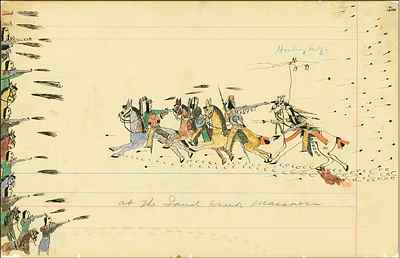
Works from the AMAM's collection of Native American art, particularly those of the Plains Indians, are highlighted in this exhibition. One artist in particular, Southern Cheyenne warrior Howling Wolf, documented battles, hunts, ceremonies, and everyday life for 19th-century Native Americans in his vivid and colorful "ledger drawings."
The drawings are displayed alongside exquisitely beaded artifacts created by Cheyenne women of the time. The respect for female Cheyenne artists' geometric quillwork and beadwork was akin to that of male warrior-artists for their trials in battle and subsequent representational accounts, such as those created by Howling Wolf. Invaluable documents of Plains history, the drawings and beadwork present an overview of artistic achievement among the Cheyenne of the late 19th century.
On October 16, noted Native American scholar Dr. Joyce Szabo (University of New Mexico) presented a lecture on the life of warrior-artist Howling Wolf and discuss his works on display in the exhibition.
This exhibition was organized by Jason Trimmer, AMAM Curator of Education, and Penelope Fisher (OC '08).
Introductory text panel
This exhibition of ledger drawings by the warrior-artist Howling Wolf and objects made by Cheyenne women provides a fascinating account of the Cheyenne people and explores the influence white settlers had on their life and art. The show's title refers to this Native American group by both its tribal name "Painted Arrow People" and the name given to them by white settlers, the Cheyenne -- itself a term adopted from the Sioux language.
Howling Wolf's drawings are remarkable for their color, composition and close attention to detail --traits that establish him as one of the most accomplished ledger artists of the late 19th century. The practice of ledger drawing arose from an earlier tradition of recording battle victories onto animal hides. As with many other Plains customs, this tradition changed dramatically through trade with white settlers. From this contact, accountants' ledger books became the preferred support medium on which the Cheyenne to recorded acts of warfare. The size of these books and their portability made them especially conducive to individual artistic expression. Indeed, Howling Wolf's drawings are vibrant illustrations of this, while still exemplifying the masculine tradition of Cheyenne representational art.
Howling Wolf's work is exhibited here with examples of feminine arts of the Cheyenne, specifically geometric beadwork. In addition to creating intricate designs to decorate apparel, personal accessories, and dwellings, women were also charged with the difficult task of preparing the animal hides. For women on the Plains, these artistic endeavors granted a respect akin to a man's for victory in battle. Female artistic guilds were similar to male warrior societies, as both heightened social status and recognized individual accomplishment.
Selected images and wall text from the exhibition
(above: Howling Wolf (Southern Cheyenne Indian, 1849 - 1927), At the Sand Creek Massacre, 1874-1875, Pen, ink, and watercolor on ledger paper, Oberlin Ledger - pg. 4. Gift of Mrs. Jacob D. Cox, 1904.1180.5)
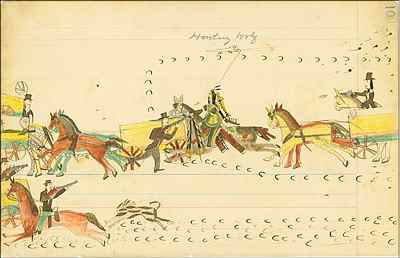
(above: Howling Wolf (Southern Cheyenne Indian, 1849 - 1927), Howling Wolf in battle against wagon train, 1874-1875, Pen, ink, and watercolor on ledger paper, Oberlin ledger - pg. 100, Gift of Mrs. Jacob D. Cox, 1904.1180.28)
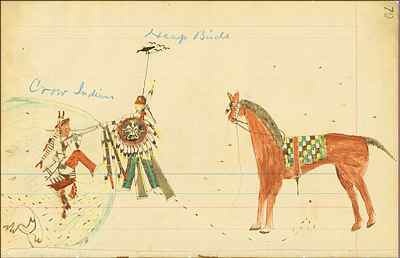
(above: Howling Wolf (Southern Cheyenne Indian, 1849 - 1927), Crow Indians, Heap of Birds, 1874-1875, Pen, ink, and watercolor on ledger paper, Oberlin Ledger - pg. 72. Gift of Mrs. Jacob D. Cox, 1904.1180.18)
A major characteristic of Howling Wolf's drawings is an attention to detail, especially in regards to dress. Both Cheyenne figures and their adversaries are rendered in such a way that they are easily identifiable. The Snake and Crow warriors seen in the two drawings displayed here exhibit garments distinctive of their people. For instance, the Crow man in battle against the Cheyenne warrior Heap of Birds wears the characteristic long-netted hair covering.
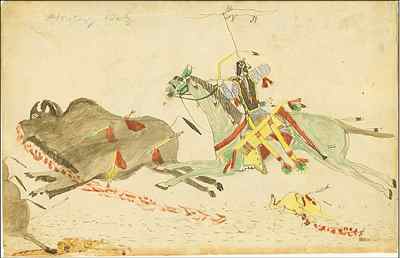
(above: Howling Wolf (Southern Cheyenne Indian, 1849 - 1927), Howling Wolf Hunting Buffalo, 1874-1875, Pen, ink, and watercolor on ledger paper, Oberlin Ledger - end piece. Gift of Mrs. Jacob D. Cox, 1904.1180.29)
Please click here to view more images and wall text from the exhibition
Resource Library editor's note:
readers may also enjoy:
Read more articles and essays concerning this institutional source by visiting the sub-index page for the Allen Memorial Art Museum in Resource Library.
Search Resource Library for thousands of articles and essays on American art.
Copyright 2008 Traditional Fine Arts Organization, Inc., an Arizona nonprofit corporation. All rights reserved.