Editor's note: The Art Institute of Chicago provided
source material to Resource Library for the following article or
essay. If you have questions or comments regarding the source material,
please contact the Art Institute of Chicago directly through either this
phone number or web address:
- 312-443-3600
- http://www.artic.edu/aic/index.html
Ed Ruscha and Photography
March 1 - June 1, 2008
Ed Ruscha is perhaps
best known as a seminal American pop and conceptual artist. His iconic paintings
of words, American landscapes, and vernacular 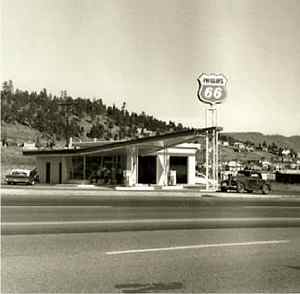 architecture
speak of his deep affinity for the commonplace. But the medium of photography
has always been a source of inspiration and discovery. The eye-opening exhibition,
Ed Ruscha and Photography, on view at the Art Institute of Chicago
from March 1 through June 1, 2008, features Ruscha's signature photographic
books and dozens of previously unseen original prints. It provides the most
comprehensive view of how photography functioned for this leading American
artist. Organized in conjunction with the exhibition, a free daylong symposium
on March 1 included a talk by the artist, a conversation with Ruscha and
cultural critic Dave Hickey and the exhibition's curator Sylvia Wolf, and
lectures by scholars Ken Allan and Thomas Crow. (right: Edward Ruscha
(American, born 1937). Phillips 66, Flagstaff, Arizona, 1962. From
the series Twentysix Gasoline Stations, 1963. Gelatin silver print;
4-3/4 x 4-11/16 inches. Whitney Museum of American Art, New York; purchase,
with funds from The Leonard and Evelyn Lauder Foundation, and Diane and
Thomas Tuft 2004.467. © Ed Ruscha.)
architecture
speak of his deep affinity for the commonplace. But the medium of photography
has always been a source of inspiration and discovery. The eye-opening exhibition,
Ed Ruscha and Photography, on view at the Art Institute of Chicago
from March 1 through June 1, 2008, features Ruscha's signature photographic
books and dozens of previously unseen original prints. It provides the most
comprehensive view of how photography functioned for this leading American
artist. Organized in conjunction with the exhibition, a free daylong symposium
on March 1 included a talk by the artist, a conversation with Ruscha and
cultural critic Dave Hickey and the exhibition's curator Sylvia Wolf, and
lectures by scholars Ken Allan and Thomas Crow. (right: Edward Ruscha
(American, born 1937). Phillips 66, Flagstaff, Arizona, 1962. From
the series Twentysix Gasoline Stations, 1963. Gelatin silver print;
4-3/4 x 4-11/16 inches. Whitney Museum of American Art, New York; purchase,
with funds from The Leonard and Evelyn Lauder Foundation, and Diane and
Thomas Tuft 2004.467. © Ed Ruscha.)
Organized by Wolf at the Whitney Museum of American Art
to celebrate its acquisition of a deep collection of Ruscha's photographs,
the exhibition features more than 100 original prints, many of which have
rarely been published or exhibited. Exclusive to the Chicago presentation
of Ed Ruscha and Photography are an additional 13 paintings, drawings,
and prints from the museum's own outstanding holdings as well as from local
private collections.
"I'm thrilled that we can introduce our visitors to
a range of Ed Ruscha's photographic works. More than that, viewers will
see in Ruscha's photographs his abiding interest in typography, language,
and the everyday. They'll also discover these motifs in his books, prints,
drawings, and paintings, which will also be on view," said Katherine
Bussard, assistant curator of photography at the Art Institute of Chicago.
Included in Ed Ruscha and Photography are original
prints made for his photographic books: Twentysix Gasoline Stations
(1963); Various Small Fires and 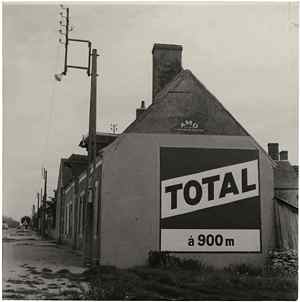 Milk (1964); Some Los Angeles Apartments (1965); and Thirtyfour
Parking Lots in Los Angeles (1967). In addition, the show features a
striking selection from the more than 300 original photographs made during
a seven-month tour that Ruscha took of Europe in 1961. In these images of
Austria, England, France, Greece, Italy, Spain, and Yugoslavia, visitors
will see the stylistic elements that have marked Ruscha's work-signage and
his strong graphic sensibility-in a context very different from the more
well known Ruscha landscapes of Southern California and the west. These
photographs are also compelling records of Ruscha's experimentation with
his camera. (left: Edward Ruscha (American, born 1937). France,
1961. Gelatin silver print; 3-1/2 x 3-1/2 inches. Whitney Museum of American
Art, New York; gift of the artist; courtesy Gagosian Gallery 2004.95. ©
Ed Ruscha.)
Milk (1964); Some Los Angeles Apartments (1965); and Thirtyfour
Parking Lots in Los Angeles (1967). In addition, the show features a
striking selection from the more than 300 original photographs made during
a seven-month tour that Ruscha took of Europe in 1961. In these images of
Austria, England, France, Greece, Italy, Spain, and Yugoslavia, visitors
will see the stylistic elements that have marked Ruscha's work-signage and
his strong graphic sensibility-in a context very different from the more
well known Ruscha landscapes of Southern California and the west. These
photographs are also compelling records of Ruscha's experimentation with
his camera. (left: Edward Ruscha (American, born 1937). France,
1961. Gelatin silver print; 3-1/2 x 3-1/2 inches. Whitney Museum of American
Art, New York; gift of the artist; courtesy Gagosian Gallery 2004.95. ©
Ed Ruscha.)
Another highlight of this exhibition is a selection of
Ruscha's photographic books of the 1960s and 1970s, which have come to embody
conceptual artists' embrace of serial imaging. These books have had a profound
impact on the art and careers of many American artists, and they speak to
the intermingling of Ruscha's conceptual approach to imagery and photography
as a medium. Lewis Baltz, Dan Graham, and Robert Venturi all cite Ruscha's
photographic books as highly influential, and the German photographers Bernd
and Hilla Becher presented Ruscha's work to their students, including the
contemporary artists Thomas Struth and Andreas Gursky.
Born in 1937 in Omaha, Nebraska, and raised in Oklahoma
City, Ruscha moved to Los Angeles when he was 18. He attended the Chouinard
Art Institute until 1960, before working briefly in commercial advertising.
In 1961, Ruscha embarked on a career as an artist and produced enigmatic
paintings, drawings, and photographic books of gasoline stations, apartment
buildings, palm trees, vacant lots, and Los Angeles's famous "Hollywood"
sign. The irony and objective stance of his works from this period placed
him in the context of Pop art and Conceptualism, but Ruscha consistently
defies categorization. Now 70, Ruscha is recognized as one of our most important
and influential contemporary American artists.
The role photography has played in Ruscha's career has
not been deeply explored until now. What we see in Ed Ruscha and Photography
is that the artist has consistently looked to photography, as a subject,
a medium, and a vehicle, to inform his artistic practice.
Related Programs
-
- Ed Ruscha and Photography: A Symposium
- Saturday, March 1, 10:30 a.m.-4:30 p.m.
- Rubloff Auditorium
-
- Artist Ed Ruscha was at the Art Institute for a free
daylong symposium, which began with a talk by the artist. Ruscha also participated
in a conversation featuring cultural critic Dave Hickey and exhibition
curator Sylvia Wolf. Lectures by art history professors Ken Allan and Thomas
Crow completed the day.
-
- Exhibition Overview
- Tuesday, March 11, 12:00 p.m.
- Katherine Bussard, Assistant Curator of Photography
- Gallery 100
-
- Lecture: Ed Ruscha and Photography
- Katherine Bussard, Assistant Curator of Photography
- Thursday, March 20, 6:00 p.m.
- Rubloff Auditorium, Fee.
-
- Lecture: American Perspectives: Ed Ruscha
- Monday, April 7, 1:00 p.m.
- Annie Morse, Museum Education
- Gallery 100
-
- Lecture: American Perspectives: Ed Ruscha
- Thursday, April 24, 1:00 p.m.
- Annie Morse, Museum Education
- Gallery 100
-
- After Dark
- Friday, April 25, 6:00-10:00 p.m.
- Fee.
-
- Exhibition Overview
- Friday, May 16, 12:00 p.m.
- Katherine Bussard, Assistant Curator of Photography
- Gallery 100
Editor's note: RL readers may also enjoy:
and from other websites:
 "Ed
Ruscha," 57 minutes, February 13, 2005, National Gallery of Art's
Conversations with Artists series
"Ed
Ruscha," 57 minutes, February 13, 2005, National Gallery of Art's
Conversations with Artists series
TFAO also suggests this video:
- Ed Ruscha is the taping of
a June 29, 2000 lecture by the artist at the Hirshhorn Museum. The Hirshhorn
Museum Library's web
page contains a video clip from the lecture.
TFAO does not maintain a lending library of videos or sell videos.
Click here
for information on how to borrow or purchase copies of VHS videos and DVDs
listed in TFAO's Videos -DVD/VHS, an authoritative guide to videos in VHS and DVD format
Read more articles and essays concerning this institutional
source by visiting the sub-index page for the Art
Institute of Chicago in Resource Library.
Search Resource
Library for thousands of articles and essays on American art.
Copyright 2008 Traditional Fine Arts Organization, Inc., an Arizona nonprofit corporation. All rights
reserved.