The Third Mind: American
Artists Contemplate Asia, 1860-1989
January 30 - April 19, 2009
Exhibition Sections
The exhibition is organized chronologically and thematically
into seven sections:
Aestheticism and Japan: The Cult of the Orient
American artists' fascination with the East began in the
late 1850s and developed from intellectual circles radiating from 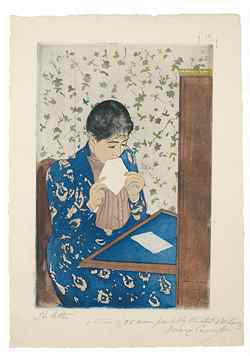 Boston, especially the interlocking communities of Harvard
University, the Unitarians, and the transcendentalists. This opening section
explores an interconnected group of artists who, in the wake of Commodore
Matthew Perry's opening of Japan in 1853-54, turned to the philosophies
and artistic practices of "the Orient" and especially Japan as
an alternative to European sources of cultural identity and creative inspiration.
Artists associated with the Aesthetic movement and Tonalism developed specific
techniques, compositional devices, and an appreciation of numinous form
derived from their studies of Asian art and texts. This section features
important paintings by John La Farge which he made in Japan, such as The
Great Statue of Amida Buddha at Kamakura (ca. 1997, Fine Arts Museum
of San Francisco) and by James McNeill Whistler, including Nocturne:
Blue and Gold-Old Battersea Bridge (ca. 1872-75, Tate,
London). Both artists deployed Asian techniques in their work and were key
in fostering interest in Asian art among their peers, as was Mary Cassatt,
whose 1890-91 suite of ten color drypoint etchings, manipulates conventions
and themes drawn from Japanese ukiyo-e woodblock prints. Thomas Wilmer Dewing
and Abbott Handerson Thayer, artists who were championed by the great Asian
art collector Charles Lang Freer, are also included. A key piece in this
section is a plaster cast of American Renaissance sculptor Augustus Saint-Gaudens's
famous memorial sculpture of Henry Adams's wife, "Clover" Marion
Hooper Adams. This work was conceived and styled as a nondenominational
evocation of the "White-Robed" Buddhist bodhisattva Avalokitesvara.
(left: Mary Cassatt, The Letter, 1890-91, Drypoint and aquatint
on cream laid paper, 34.4 x 21.1 cm. S.P. Avery Collection, Miriam and Ira
D. Wallach Division of Art, Prints and Photographs, The New York Public
Library, Astor, Lenox and Tilden Foundations )
Boston, especially the interlocking communities of Harvard
University, the Unitarians, and the transcendentalists. This opening section
explores an interconnected group of artists who, in the wake of Commodore
Matthew Perry's opening of Japan in 1853-54, turned to the philosophies
and artistic practices of "the Orient" and especially Japan as
an alternative to European sources of cultural identity and creative inspiration.
Artists associated with the Aesthetic movement and Tonalism developed specific
techniques, compositional devices, and an appreciation of numinous form
derived from their studies of Asian art and texts. This section features
important paintings by John La Farge which he made in Japan, such as The
Great Statue of Amida Buddha at Kamakura (ca. 1997, Fine Arts Museum
of San Francisco) and by James McNeill Whistler, including Nocturne:
Blue and Gold-Old Battersea Bridge (ca. 1872-75, Tate,
London). Both artists deployed Asian techniques in their work and were key
in fostering interest in Asian art among their peers, as was Mary Cassatt,
whose 1890-91 suite of ten color drypoint etchings, manipulates conventions
and themes drawn from Japanese ukiyo-e woodblock prints. Thomas Wilmer Dewing
and Abbott Handerson Thayer, artists who were championed by the great Asian
art collector Charles Lang Freer, are also included. A key piece in this
section is a plaster cast of American Renaissance sculptor Augustus Saint-Gaudens's
famous memorial sculpture of Henry Adams's wife, "Clover" Marion
Hooper Adams. This work was conceived and styled as a nondenominational
evocation of the "White-Robed" Buddhist bodhisattva Avalokitesvara.
(left: Mary Cassatt, The Letter, 1890-91, Drypoint and aquatint
on cream laid paper, 34.4 x 21.1 cm. S.P. Avery Collection, Miriam and Ira
D. Wallach Division of Art, Prints and Photographs, The New York Public
Library, Astor, Lenox and Tilden Foundations )
Landscapes of the Mind: New Conceptions of Nature
This section features leading artists of the early to mid-twentieth
century who championed modern and abstract art in America 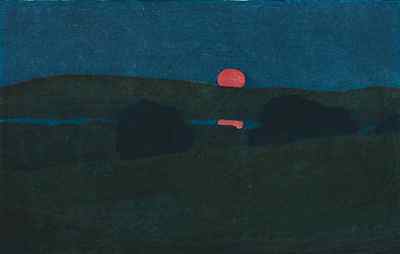 while invoking Asian aesthetics and philosophies that
conceived of nature as a unity of matter and spirit. Informed by syncretic
spiritualist discourses such as transcendentalism and Theosophy, they appropriated
from Asian art forms an aesthetic of transparency, weightlessness, dematerialization,
silence, and rhythmic form. Eschewing traditional Western schemes of landscape
as monumental and eternal, they took from the East the notion of landscape
as ephemeral form and dynamic process. They appropriated techniques like
ink brushwork and compositional devices like multiple viewpoints in Chinese
landscape painting to achieve a dynamism that suggested something numinous
and wondrous beyond external form. Opening with the influential teacher
and Japanese-art specialist Arthur Wesley Dow, this section features paintings,
woodblock prints, and photographs by Georgia O'Keeffe, Alvin Langdon Coburn,
and Arthur Dove; by the Photo-Secessionists Edward Steichen and Alfred Stieglitz;
and the Synaesthesia painters Marsden Hartley and Stanton Macdonald-Wright.
This development culminates with the Northwest school of painters that coalesced
in the 1930s around Mark Tobey and included Kenneth Callahan, Paul Horiuchi,
and Morris Graves. Increased Asian immigration inspired many artists to
study Buddhism and East Asian calligraphy. These influences can be seen
in Graves's masterwork, Time of Change (1943), which demonstrates
his desire "to move toward Eastern art's basis of metaphorical perceptions...as
an outflowing of religious experience." Highlights include Steichen's
The Pond-Moonrise (1904), O'Keeffe's Abstraction (1917), and
Dove's Fog Horns (1929). (right: Arthur Wesley Dow, August
Moon, ca. 1905, Woodcut print, 13.5 x 18.5 cm. Collection of Edgar Smith,
New York)
while invoking Asian aesthetics and philosophies that
conceived of nature as a unity of matter and spirit. Informed by syncretic
spiritualist discourses such as transcendentalism and Theosophy, they appropriated
from Asian art forms an aesthetic of transparency, weightlessness, dematerialization,
silence, and rhythmic form. Eschewing traditional Western schemes of landscape
as monumental and eternal, they took from the East the notion of landscape
as ephemeral form and dynamic process. They appropriated techniques like
ink brushwork and compositional devices like multiple viewpoints in Chinese
landscape painting to achieve a dynamism that suggested something numinous
and wondrous beyond external form. Opening with the influential teacher
and Japanese-art specialist Arthur Wesley Dow, this section features paintings,
woodblock prints, and photographs by Georgia O'Keeffe, Alvin Langdon Coburn,
and Arthur Dove; by the Photo-Secessionists Edward Steichen and Alfred Stieglitz;
and the Synaesthesia painters Marsden Hartley and Stanton Macdonald-Wright.
This development culminates with the Northwest school of painters that coalesced
in the 1930s around Mark Tobey and included Kenneth Callahan, Paul Horiuchi,
and Morris Graves. Increased Asian immigration inspired many artists to
study Buddhism and East Asian calligraphy. These influences can be seen
in Graves's masterwork, Time of Change (1943), which demonstrates
his desire "to move toward Eastern art's basis of metaphorical perceptions...as
an outflowing of religious experience." Highlights include Steichen's
The Pond-Moonrise (1904), O'Keeffe's Abstraction (1917), and
Dove's Fog Horns (1929). (right: Arthur Wesley Dow, August
Moon, ca. 1905, Woodcut print, 13.5 x 18.5 cm. Collection of Edgar Smith,
New York)
Ezra Pound, Modern Poetry, and Dance Theater
This section explores American translations of classical
Asian literature and dance-theater spanning World War I and the interwar
period. Both art forms were well known among visual artists and inspired
experimentation with Asian thought-forms. Featured are rare first-edition
books by such influential writers as Ezra Pound and Lafcadio Hearn, as well
as manuscript pages from T. S. Eliot's masterwork, The Waste Land
(1922). Pound's seminal translations of classical Chinese poetry (Cathay,
1915) revolutionized modern Anglo-American literature with their terse,
powerful, and imagist language and free-form verse. Pound also introduced
classical Japanese No dance-theater to American modernists, and this section
features documentary photographs of the charismatic Japanese dancer Ito
Michio performing William Butler Yeats's No-inspired play, At The Hawks
Well (ca. 1916). These metaphoric literary and dance-theater aesthetics
influenced Martha Graham and Isamu Noguchi, represented by a video documentary
of their seminal collaboration in the dance performance Frontier
(1935).
Abstract Art, Calligraphy, and Metaphysics
This section explores the calligraphic brushstroke, which
was an approach to abstract painting that focused on the spontaneous gesture
of the artist's hand and was informed by the East Asian art of calligraphy
as well as popular writings on Zen and its ethics of direct action. Paintings,
ink paintings, and sculpture by such towering artists as Franz Kline, Sam
Francis, Philip Guston, Isamu Noguchi, Robert Motherwell, Jackson Pollock,
David Smith, and Mark Tobey reveal how this cross-cultural discourse inspired
the creative culture of postwar America. The traditions of metaphysical
speculation in Hinduism, Taoism, and Zen Buddhism provided artists with
a conceptual basis for the understanding and representation of the visionary,
spiritual, and universal potential of abstract art. Rare and important paintings
by Natvar Bhavsar, Georgia O'Keeffe, Okada Kenzo, Gordon Onslow-Ford, and
Lee Mullican reinterpreted Asian cultural theory and artistic practices
to enhance the meaning and value of abstraction during a period when it
was considered the most significant and progressive form of modern art.
A centerpiece of this section is Brice Marden's breakthrough series of calligraphic
ink-on-paper works based on Chinese calligraphy, Cold Mountain Studies
1-35 (1988-90). Other works on view include Pollock's Untitled [Red
Painting 1-7] (ca. 1950) and Kline's Mahoning (1956).
Buddhism and the Neo-Avant-Garde
This section follows three interconnected collectives of
artists and writers whose sustained if eclectic connections to Zen and 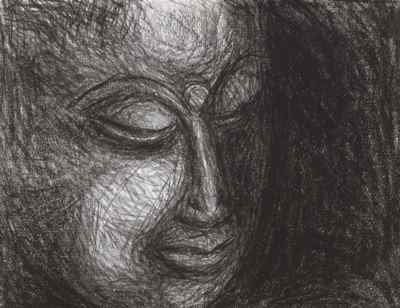 other forms of Mahayana Buddhism emerge as critical methodological
and philosophical influences in the American postwar neo-avant-garde. These
collectives are "Cage Zen," linking the activities of neo-Dada,
Fluxus, and Happenings through the mediation of John Cage; "Beat Zen,"
revealing how the spontaneous writings and modes of subjectivity forged
by Jack Kerouac, Allen Ginsberg, and others in the Beat movement appropriated
Buddhism; and Bay Area conceptualism, which stemmed from both Cagean and
post-Beat approaches to Zen as method. Zen rhetoric gave these artists and
writers the conceptual framework to abandon artistic intention and compositional
structure. It corresponded with the manifestos of Cage's silent music, Kerouac's
spontaneous prose, George Maciunas's anti-art, and Tom Marioni's situation
art-all of which disposed of orthodox modernism in favor of the sheer immediacy
and authenticity of everyday life. This section features sixteen scores,
prints, drawings, and watercolors by Cage dating from 1952 to 1992, which
will be installed using Cage's chance operation method. Other key works
are a live projection of Nam June Paik's Zen for Film (1964); Yoko
Ono's twenty-two Instructions for Paintings (1961-62); Robert Rauschenberg's
Gold Standard (1964), which he made in Tokyo using a Japanese folding-screen;
and Jasper Johns's Dancers on a Plane (1980-81), which is inspired
by a Tantric Buddhist painting. An original manuscript of Kerouac's Dharma
Bums (1957), his best-selling novel that recounts his experiences as
a mountaineering Zen Buddhist, is featured together with important publications,
photographs, and paintings by the Beat writers Ginsberg, Lawrence Ferlinghetti,
and Michael McClure, and an abstract film by Harry Smith (Abstract Film
No. 11: Mirror Animations, ca. 1957). Four panels from Arakawa and Madeline
Gins's seminal Conceptual artwork, The Mechanism of Meaning (1963-71)
will be on view, while William Anastasi and Marioni will each reenact historic
works for the exhibition. In addition, Paul Kos's Sound of Ice Melting
(1970) will be installed in the rotunda. (right: Jack Kerouac, Face
of the Buddha, 1958?, Pencil on paper, 16.5 x 20.9 cm. Henry W. and
Albert A. Berg Collection of English and American Literature, The New York
Public Library, Astor, Lenox and Tilden Foundations. © John Sampas,
Legal Rep., Estate of Stella Kerouac 2009)
other forms of Mahayana Buddhism emerge as critical methodological
and philosophical influences in the American postwar neo-avant-garde. These
collectives are "Cage Zen," linking the activities of neo-Dada,
Fluxus, and Happenings through the mediation of John Cage; "Beat Zen,"
revealing how the spontaneous writings and modes of subjectivity forged
by Jack Kerouac, Allen Ginsberg, and others in the Beat movement appropriated
Buddhism; and Bay Area conceptualism, which stemmed from both Cagean and
post-Beat approaches to Zen as method. Zen rhetoric gave these artists and
writers the conceptual framework to abandon artistic intention and compositional
structure. It corresponded with the manifestos of Cage's silent music, Kerouac's
spontaneous prose, George Maciunas's anti-art, and Tom Marioni's situation
art-all of which disposed of orthodox modernism in favor of the sheer immediacy
and authenticity of everyday life. This section features sixteen scores,
prints, drawings, and watercolors by Cage dating from 1952 to 1992, which
will be installed using Cage's chance operation method. Other key works
are a live projection of Nam June Paik's Zen for Film (1964); Yoko
Ono's twenty-two Instructions for Paintings (1961-62); Robert Rauschenberg's
Gold Standard (1964), which he made in Tokyo using a Japanese folding-screen;
and Jasper Johns's Dancers on a Plane (1980-81), which is inspired
by a Tantric Buddhist painting. An original manuscript of Kerouac's Dharma
Bums (1957), his best-selling novel that recounts his experiences as
a mountaineering Zen Buddhist, is featured together with important publications,
photographs, and paintings by the Beat writers Ginsberg, Lawrence Ferlinghetti,
and Michael McClure, and an abstract film by Harry Smith (Abstract Film
No. 11: Mirror Animations, ca. 1957). Four panels from Arakawa and Madeline
Gins's seminal Conceptual artwork, The Mechanism of Meaning (1963-71)
will be on view, while William Anastasi and Marioni will each reenact historic
works for the exhibition. In addition, Paul Kos's Sound of Ice Melting
(1970) will be installed in the rotunda. (right: Jack Kerouac, Face
of the Buddha, 1958?, Pencil on paper, 16.5 x 20.9 cm. Henry W. and
Albert A. Berg Collection of English and American Literature, The New York
Public Library, Astor, Lenox and Tilden Foundations. © John Sampas,
Legal Rep., Estate of Stella Kerouac 2009)
Art of Perceptual Experience: Pure Abstraction and Ecstatic
Minimalism
This section traces the development of a new iteration
of Asian rhetoric in American art of the 1960s that recasts the art object
as a specific focus of contemplation and perceptual experience aimed at
the transformation of consciousness. Ad Reinhardt's radical conclusion that
art is a perceptual experience with the specific power to purify consciousness
through concentrated contemplation was constructed from his close readings
of Asian art and religious thought. The "pure abstraction" and
reductive forms of Reinhardt, Agnes Martin, Anne Truitt, Dan Flavin, and
Robert Irwin shifted the conception of seeing from an optical event to a
phenomenological process, and made durational time (spent looking at the
object) a medium of ontological awareness. In addition to sculpture associated
with Minimalism, such as Flavin's icon IV (the pure land) (to David John
Flavin 1933-1962) (1962/1969), and Irwin's Untitled (1969), this
section features the experimental cinema of Jordan Belson, and the site-specific
sound and light environment, Dream House ([1962-present]), by La
Monte Young and Marian Zazeela. During the course of the exhibition live
performances of Young's innovations in North Indian classical raga will
be presented by Young and Zazeela with The Just Alap Raga Ensemble.
Experiential Performance Art: The Aesthetics of Time
The final exhibition section presents video, installation,
and live performance art of the 1970s through 1989. This period reflects
the growing popularity of Asian wisdom traditions in American culture, and
the gradual breakdown of the long-entrenched "East-West" constructs
and worldviews in a postmodern, global era. Several of the artists in this
section, such as James Lee Byars, Linda Montano, Adrian Piper, Bill Viola,
and Kim Jones are advanced practitioners of an Asian contemplative discipline
and meditation technique, have spent an extended period of time in Asian
countries, or served in the Vietnam War. As part of their practice, they
explore endurance and extreme duration to achieve self-awareness. Highlights
include Viola's Room for St. John of the Cross (1983), Adrian Piper's
Hypothesis Situation #4 (1968), and Hsieh's Punching the Time
Clock on the Hour, One Year Performance, 11 April 1980-11 April 1981.
Performances by Laurie Anderson, Meredith Monk, and Robert Wilson will be
presented in the rotunda and the Peter B. Lewis Theater as an integral part
of this section.
In addition to the two site-specific installations by James
Lee Byars and Young and Zazeela included in the exhibition, Ann Hamilton
responds to the exhibition thesis with human carriage (2009), a new
work created especially for the Guggenheim's rotunda. Focusing on themes
of transmission and transformation-specifically on the artist's act and
use of reading Asian source texts and how that process can change an artist's
conceptual approach to art-making-Hamilton devises a mechanism that traverses
the entire Guggenheim balustrade, taking the form of a white silk "bell
carriage" with Tibetan bells attached inside. As the cage spirals down
along the balustrade, the purifying bells ring, awakening viewers. The mechanism
is hoisted back up to a post at the uppermost Rotunda Level 6, where an
attendant exchanges weights composed of thousands of cut-up books that counter
the pulley system that propels the mechanism itself. According to Hamilton,
the elements of human carriage compose a visual metaphor for the processes
of "reading which leaves no material trace but which might forever
change you."
 Return to The Third Mind: American
Artists Contemplate Asia, 1860-1989
Return to The Third Mind: American
Artists Contemplate Asia, 1860-1989
Search Resource
Library for thousands of articles and essays on American art.
Copyright 2008 Traditional Fine Arts Organization, Inc., an Arizona nonprofit corporation. All rights
reserved.