
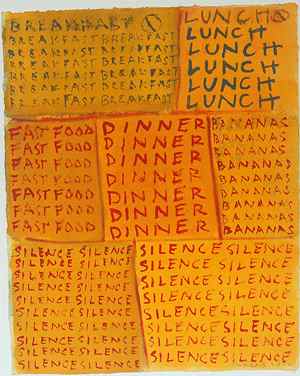
 Enders, Fast
Food/Bananas, 2002, Watercolor on paper, 11 1/2 x 9 1/4 inches)
Enders, Fast
Food/Bananas, 2002, Watercolor on paper, 11 1/2 x 9 1/4 inches) Editor's note: The Lyman Allyn Art Museum provided source material to Resource Library for the following article or essay. If you have questions or comments regarding the source material, please contact Lyman Allyn Art Museum directly through either this phone number or web address:
Elizabeth Enders: Landscape/Language/Line
March 7 - August 23, 2009.
Lyman Allyn Art Museum
is presenting Elizabeth Enders: Landscape/Language/Line, on view
through August 23, 2009. (right: Elizabeth Enders, Fast
Food/Bananas, 2002, Watercolor on paper, 11 1/2 x 9 1/4 inches)
Elizabeth Enders was born and raised in New London, Connecticut so it is a special honor for the Museum to mount the first retrospective of this important contemporary American artist. Five decades of Enders' work will be on view ranging from marine landscapes to large language-based paintings to small, intimate watercolor botanicals.
Elizabeth Enders: Landscape/Language/Line is curated by Charlotta Kotik, Curator Emerita of Contemporary Art at the Brooklyn Museum. Kotik has been praised by the New York Times as "the unofficial but undisputed top talent scout" for artists in New York City. Kotik will present a lecture Elizabeth Enders: The Line Revisited on Thursday, April 2.
Curator Kotik comments on Enders' work: "Lyrical and meditative, Elizabeth Enders heightens our curiosity to learn more about the world around us, to penetrate deeper into the often-concealed magic of simple everyday experiences. The power of Enders' artistic persuasion energizes our perception to see the beauty in the simple willow twig as much as in the magnificence of the ocean."
The exhibition is accompanied by an 80-page exhibition catalogue Elizabeth Enders: Landscape/ Language/Line that features an essay written by Guest Curator Charlotta Kotik, an interview with Elia by Irving Sandler, pre-eminent American Art Historian, and a foreward by Nancy Stula, Director of the Museum.
Lecture
Elizabeth Enders: The Line Revisited
Thursday, April 2, 2009 6:00 pm.
Charlotta Kotik, Guest Curator of the exhibition and Curator Emerita of Contemporary Art at the Brooklyn Museum. Kotik has known the artist for some time, making her insights particularly enlightening when visitors view the exhibition and then come to the lecture. Wine and cheese reception at 5:00 pm. Reservations suggested. 860.443.2545 x 112. Fee.
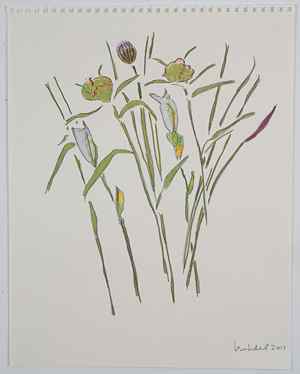
(above: Elizabeth Enders, Iris/Peony/Chive II, Day I, 2007, Colored pencil, pencil on paper, 14 x 11 inches)
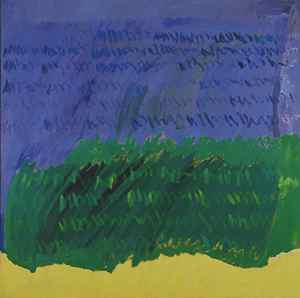
(above: Elizabeth Enders, Atlantic, 1992, Oil on linen, 60 x 60 inches)
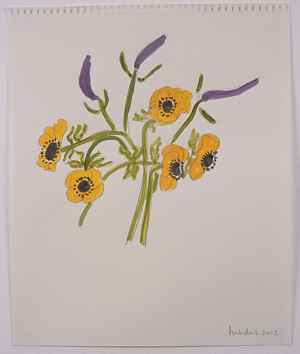
(above: Elizabeth Enders, Yellow Anemone/Purple Veronica II, Series I, 2003, Watercolor, pencil on paper)
Wall panel texts from the exhibition
Introductory panel
Elizabeth Enders' early interests were literary. After attending Barnard College in New York, she enrolled at Connecticut College to study creative writing, languages, and playwriting. During this time she began to draw extensively, illustrating her notebooks with whimsical drawings. Much of the page space was accorded to these quick sketches and soon the words themselves started to metamorphose into calligraphic marks of Enders' mysterious alphabet. These were to remain the essential components of the majority of her subsequent works. The artist's early literary interests inform a large portion of her work. Enders sees her paintings as a sort of communication: in order to establish a potential discourse with others, Enders often marks sheets of paper or canvas with mysterious marks of a fictional alphabet. We perceive these as images, but also have tendency to "read" them, acknowledging the presence of a visual poetry which remains an important undercurrent in this artist's oeuvre.
Enders' interest in the principles of abstraction led to the reduction of descriptive details in her work. The 1970's ushered in an unending fascination with the ocean, an element Enders was familiar with since her childhood, spent in coastal New London and in Newburyport, Massachusetts. In these seascapes, the essential parts of a particular site, such as horizon line or a color hue, are acknowledged. It is the elimination of the nonessential detail that transforms Enders' paintings into universal statements about the elusive beauty of the coastal areas.
Enders' most recent work includes small marine paintings and watercolors, numerous botanical drawings, as well as ambitious large oil paintings. Conjuring the subjects that have always interested her -- the abstracted nature imagery, the cryptic messages hidden in the complex arrangement of short energetic marks of various colors, the soft gradation of background hues -- all account for the well-balanced composition Enders aims for. In the diverse artistic universe of today, Enders creates microcosms of her own design. Fusing descriptive tendencies with those of lyrical abstraction, the artist unites opposites in purposeful harmony. Working in a number of genres, she offers us a kaleidoscope of impressions. Lyrical and meditative, the work of Elizabeth Enders energizes our perception to see beauty in the simple blossom as much as in the magnificence of the ocean.
Charlotta Kotik,
Guest Curator
Ocean Series
Enders began her exploration of coastal imagery in the l970s. According to the artist, the Atlantic Ocean was a factor in her family's life "from the time we were born." She recalls: "It was so intense and large when we were quite small. It was a huge force [but]. . . there is something comforting about it as well." In Enders' seascapes, the essential parts of a particular site, such as horizon line or a color hue, are acknowledged. However, it is the elimination of the nonessential details that transforms Enders' paintings into universal statements about the elusive beauty of the coastal areas.
In l986 and 1987 Enders painted on the coast of Maine. This experience brought new visual stimuli to her work: the color blue became predominant, corresponding to the richness of variegated blues of the ocean and the seaside atmosphere. In l990 she began to spend part of her summers in Chester, Nova Scotia. Many of the works executed there are her observations from a sailboat when the twists and turns of the craft change the perspective, ushering in unexpected angles and pints of view. In the Nova Scotia series we encounter a number of abstracted landscape motifs based on the keen observation of the coastline. While in the earlier Maine Series the artist almost completely dissociated herself from the visual references to the existing environment, in the works from the Nova Scotia Series one can detect the artist's resolve to capture the local topography, albeit in a flattened, simplified and chromatically altered form. The countless number of oil paintings, watercolors, and gouaches based on Enders' keen, steadfast, and loving observation of the ocean comprises the largest portion of her work. Presently Elizabeth Enders is among the most dedicated and accomplished of the contemporary marine painters.
Botanicals
Some of Enders' earliest works were renderings of various plants. Her mother, who liked to spend time arranging flowers, instilled in the young artist a love of this subject. Enders feels that her portrayals of plants and blossoms fall short of their real beauty. "I do not have training to really do a botanical, a proper one, but it really is using the basic look of the flowers and then launching off with some kind of inspiration. . . I find flowers that are interesting. I look at them closely, and make a pencil sketch. I then complete the drawing with colored pencil and watercolor, often adding text or calligraphic marks."
Her botanicals have a literary quality as well. Described in various stages of maturing, in full splendor turning to slight decline, we read the story of the flower sketched in a delicate but affirmative manner. This progression and effect of time, first suggested in 1958 in Black Eyed Susan, is evidenced in the many depictions of flowers in Enders' oeuvre. Elizabeth Enders has distinguished predecessors in Ellsworth Kelly, Nancy Graves, Jim Dine, and Pat Steir, all of whom have expressed their enchantment with the beauty of flowers at some point during their career.
New York, September 11, 2001
Enders executed numerous works after the fateful morning of September 11, 2001. In these images, the "writing" is both subject and object, or form and content. For Enders, whose studio was in lower Manhattan, not far from the World Trade Center, the obsessive repeated writing of very common words became a kind of personal art therapy. Enders remembers: "I wrote all the time, performing a ritual, as if obsessive mark making could change the outcome. 'Breakfast.' 'Lunch.' 'Dinner.' 'Silence.' 'Look at Art.' Days of writing, repetition of words about rock bottom needs. It could not change the situation, it could only transform it."
The extensive series began with the poignant words, Look at Art, a phrase that is repeated in tightly organized rows over the width of the paper. The eerie silence that enveloped downtown Manhattan after the tragedy was commemorated in several pieces. In Silence/Saffron from 2002, the word "silence" is written in script ranging from clearly legible to barely decipherable. Silence has always impressed Enders with its mysterious power. She notes: "Silence. . . has volume. It is loud and quiet at the same time and it is full and empty." Although the origin of the series was the unfathomable tragedy of 9/11, there is an almost sensual beauty in these simple renderings of ordinary words. When we first encounter them, we read them for their literal meaning. The new situation de-contextualizes the words, partially obliterating their accustomed significance. Words and/or short phrases take on a new metaphoric meaning, as they become components of the paintings. The inclusion of words in a work of art greatly extends their capacity of meaning.
London
From l973 until l977, the Enders family lived in London. Elizabeth rented a studio in Islington and there, she began to work larger than before, purchasing the largest canvases that would fit in a taxi -- 40 x 60 inches. The artist remembers: "First of all it began with the streets, the grey streets making patterns through the place to the park and the studio -- taking a bus from Hyde Park Corner across London to Islington. . . The canvas was soft and grey like the sky. . . The first lines were like the streets. Finding one's way across town, in a strange place, or across the canvas, is knowing that one is alive."
London offered opportunities to see and study the work of contemporary artists. She frequently went to galleries and museums. She was particularly inspired by Nigel Greenwood's gallery at Sloane Square and the New Art Center, which showed the work of Prunella Clough. She saw Manzoni at the Tate; and she met Michael Craig-Martin and Josef Beuys at the ICA in London. During these four years abroad, Enders greatly expanded the scale and repertory of her work.
At her Islington studio, Enders arrived at some of the essential principles of her subsequent work, such as the repetition of similar elements and horizontal orientation of her compositions. She also ventured into large formats, using oil paint, which she prefers to acrylic, while still creating countless watercolors and drawings.
Biography
Elizabeth Enders was born Elizabeth McGuire in New London, Connecticut to the late Francis F. McGuire and Helen McGuire. She attended elementary school in New London at the Harbor School and Bulkeley Junior High School. She attended the Williams Memorial Institute for two years, as it became the Williams School and moved to its current location on the Connecticut College campus. Enders completed high school at Abbot Academy (now Phillips Academy) in Andover, Massachusetts. She began her college career at Barnard College in New York City and spent the semester following her sophomore year abroad, traveling to Greece, Rome, and Florence. She returned to New London in January of 1960, enrolled in Connecticut College.
Elizabeth met Anthony Enders in 1961 at a Labor Day party given by Anthony's aunt, Elvia Enders Richards, in nearby Waterford, Connecticut. They were married in June of the following year on the day of their graduations; Anthony's from Harvard Business School and Elizabeth's from Connecticut College. For more than a decade they lived in Boston and Cambridge where Anthony worked as a banker at Brown Brothers Harriman & Co., a company for whom he has worked ever since. During the 1960s, the Enders had four children: Charles, Alexandra, Camilla, and Ostrom (Jack), the youngest, born in 1969. In the summer of 1965, Elizabeth began to exhibit her work: her first was an exhibition at the Stonington Art Gallery in Stonington, Connecticut, followed by a solo show at the Paul Schuster Gallery in Cambridge, Massachusetts in June, 1966. In 1971, Enders, along with several other artists, opened the Inman Square Artists Co-op at Inman Square in Cambridge.
In 1973, Anthony's position at Brown Brothers, Harriman took the family to London for four years. In addition to her role as mother of four school-aged children, Enders found the time to paint. During these four years abroad, she greatly expanded the scale and repertory of her work.
The Enders family returned to the U.S. in 1977 and settled in New York on the Upper East Side of Manhattan. Elizabeth soon enrolled in several evening courses at the School of Visual Arts and in 1987 she received her M.A. from New York University. That year she joined the Board of Artists Space in New York, along with Irving Sandler, Richard Armstrong, Elizabeth Murray, Cindy Sherman, and Carolyn Alexander.
Soon after receiving her masters' degree, Enders began to find recognition as an artist with one-person exhibitions. Among her most important solo exhibitions were shows at the Ulysses gallery in New York (1992 and 1994), the Lyman Allyn Art Museum (1994), and the Charles Cowles Gallery in New York (1995). Exhibitions at Artists Space, New York (2001); the Charles E. Shain Library at Connecticut College (2004 and 2006); Real Art Ways in Hartford, Connecticut (2004), and the Chester Art Association, Chester, Nova Scotia followed.
Today, Elizabeth Enders lives and works in New York City and in Waterford, Connecticut. Her work can be found in public and private collections across the country, including the Addison Gallery of American Art, the Brooklyn Museum, Connecticut College, the Wadsworth Atheneum Museum of Art, the Lyman Allyn Art Museum, the Art Gallery of Nova Scotia, the Florence Griswold Museum, the Dow Jones Art Collection, and the art collection at Pfizer, Inc.
Label text from the exhibition