Editor's note: The Whitney Museum of American Art
provided source material to Resource Library for the following article
or essay. If you have questions or comments regarding the source material,
please contact the Whitney Museum of American Art directly through either
this phone number or web address:
Chimneys and Towers: Charles
Demuth's Late Paintings of Lancaster
February 23, 2008 - April 27, 2008
Between 1927 and his
death in 1935, Charles Demuth produced his last major series of paintings
based on the architecture of Lancaster, Pennsylvania, the 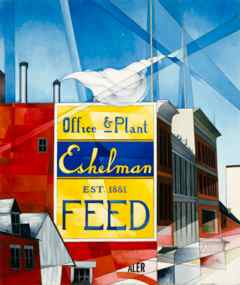 town in which he was raised and lived intermittently throughout
his life. This exhibition carefully examines, for the first time, this key
group of paintings, beginning with My Egypt, the precisionist depiction
of a Lancaster grain elevator that is perhaps Demuth's best known and most
powerful late work. Through analyzing the specifics of place, subject, and
style, the exhibition and accompanying catalogue explore the complex dynamics
of Demuth's world at the end of his career. In addition to six major paintings,
the exhibition includes preparatory drawings, watercolors, photographs of
Lancaster industrial sites, and conservation photographs. (right:
Charles Demuth, Buildings, Lancaster, 1930, Oil and graphite on composition
board , 24 x 20 inches (60.96 x 50.8 cm). Whitney Museum of American Art,
New York; Gift of an anonymous donor 58.63. Photograph by Sheldan C. Collins)
town in which he was raised and lived intermittently throughout
his life. This exhibition carefully examines, for the first time, this key
group of paintings, beginning with My Egypt, the precisionist depiction
of a Lancaster grain elevator that is perhaps Demuth's best known and most
powerful late work. Through analyzing the specifics of place, subject, and
style, the exhibition and accompanying catalogue explore the complex dynamics
of Demuth's world at the end of his career. In addition to six major paintings,
the exhibition includes preparatory drawings, watercolors, photographs of
Lancaster industrial sites, and conservation photographs. (right:
Charles Demuth, Buildings, Lancaster, 1930, Oil and graphite on composition
board , 24 x 20 inches (60.96 x 50.8 cm). Whitney Museum of American Art,
New York; Gift of an anonymous donor 58.63. Photograph by Sheldan C. Collins)
Chimneys and Towers: Charles Demuth's Late Paintings
of Lancaster is organized by the Amon Carter Museum.
Whitney curators-incharge are Barbara Haskell and Sasha Nicholas.
Wall panel texts and object labels
-
- Introductory section text
-
- Chimneys and Towers: Charles Demuth's Late Paintings
of Lancaster
-
- In 1927, Charles Demuth (1883-1935) began working on
a small group of ambitious paintings depicting industrial sites in his
native Lancaster, Pennsylvania. This exhibition is the first in-depth examination
of this series, one of the most notable achievements by an early-twentieth-century
American artist. Created during an intense six-year period, the paintings
ushered in a new era of American modernism. These oils, the last in Demuth's
career, represent the final creative surge of an artist who was progressively
ill with diabetes.
-
- A central figure in the American avant-garde, Demuth
was nurtured by the intellectual and artistic circles he encountered on
frequent visits to New York City and in Paris, where he traveled on three
occasions. Despite these journeys, Demuth's home was always the eighteenth-century
house he shared with his mother in Lancaster. Unlike most of his modernist
colleagues, he never relocated to a cosmopolitan urban center. Demuth's
illness, diagnosed in 1921, became a central element of his life, governing
his ability to work and travel.
-
- For Demuth, Lancaster was a source of both strength and
frustration. He found sanctuary there and an imagery that suited his creative
inclinations, and yet, it was remote from the cultural milieu in which
he thrived. Demuth's affectionate and ironic nickname for Lancaster --
"the province" -- conveys his experience of his hometown as simultaneously
nurturing and provincial.
-
- The works in this exhibition reflect Lancaster's primary
commercial enterprises -- linoleum and tobacco production. They are examples
of Precisionism, a movement whose artists, including Demuth, depicted architectural
subjects using crisp geometric lines and flat, austere planes of color.
Precisionist paintings highlight the rise of American industry after World
War I and the country's fascination with technological progress; they also
manifest the artists' desire to create a distinctly American aesthetic
rooted in shared national experience. In his final paintings, Demuth fuses
these concerns with a lifetime's experience of a specific place, transforming
local industrial structures into icons of American identity.
-
- Chimneys and Towers: Charles Demuth's Late Paintings
of Lancaster is organized by the Amon Carter Museum, Fort Worth, Texas.
The Texas presentation of the exhibition and the accompanying publication
have been made possible in part by a generous grant from The Henry Luce
Foundation.
-
- Major support for this exhibition is provided by the
American Fellows of the Whitney Museum of American Art.
-
-
-
- My Egypt, 1927
- Oil and graphite on fiberboard
- Whitney Museum of American Art, New York; purchase with
funds from Gertrude Vanderbilt Whitney 31.172
-
- My Egypt portrays the concrete grain elevator of the
John W. Eshelman Feed Company, constructed in 1919. The majestic structure
rises up as the pinnacle of American achievement -- a modern-day equivalent
to the monuments of ancient Egypt. A series of intersecting diagonal planes
add geometric dynamism and an almost heavenly radiance to the composition,
invoking the correlations between industry and religion that were widespread
in the 1920s.
-
- The painting's title suggests an ironic, yet poignant,
commentary on living in a provincial backwater. The artist likely knew
of the biblical significance of Egypt as both the site of the Israelites'
bondage and a point of reference for their emergence as a distinct nation.
In designating the image his Egypt, Demuth hints at a parallel in his own
relationship with Lancaster, the place to which he was bound involuntarily
through illness but which also became a source of artistic inspiration.
-
-
- Buildings, Lancaster, 1930
- Oil and graphite on fiberboard
- Whitney Museum of American Art, New York; gift of an
anonymous donor 58.63
-
- The structures portrayed in this painting stood adjacent
to the grain elevator of My Egypt. Both were parts of the Eshelman Feed
Company, whose vibrant two-story painted sign appears in this image. Following
World War I, the expansion of the American economy led to a dramatic growth
in advertising, which harnessed the bold, streamlined forms of the machine
age to captivate consumers at home and abroad. Demuth's prominent placement
of the Eshelman sign accords with the desire among many avant-garde artists
during this period to extol the new language of advertisements, which they
perceived as quintessentially American.
-
-
- And the Home of the Brave,
1931
- Oil and graphite on fiberboard
- The Art Institute of Chicago, Alfred Stieglitz Collection;
gift of Georgia O'Keeffe
-
- In 1931, the year this work was painted, Congress officially
selected "The Star Spangled Banner" as the national anthem. In
using its final line as his painting's title, Demuth draws a parallel between
the song and local industry as new symbols of American identity.
-
- The structures shown in this work are the offices and
warehouses of the Bayuk Brother's Cigar Company. Tobacco was a leading
crop in Lancaster County during Demuth's lifetime. It was also the livelihood
of the artist's family, who owned what was then the oldest tobacco shop
in America.
-
-
- After All, 1933
- Oil and graphite on fiberboard
- Norton Museum of Art, West Palm Beach, Florida; bequest
of R.H. Norton
-
- After All is Demuth's last major work. The title may
come from Walt Whitman's "Song of the Exposition," a poem written
for the opening of the National Industrial Exposition in 1871. Whitman's
poetry exerted a pronounced intellectual influence on Demuth's circle,
serving as a touchstone for cultural nationalism. In the poem, Whitman
wrote:
-
- After all not to create only, or found only,
- But to bring perhaps from afar what is already founded,
- To give it our own identity, average, limitless, free,
- To fill the gross the torpid bulk with vital religious
fire,
- Not to repel or destroy so much as accept, fuse, rehabilitate,
- To obey as well as command, to follow more than to lead,
- These also are the lessons of our New World;
- While how little the New after all, how much the Old,
Old World!
-
-
- Buildings, c. 1930-31
- Oil and graphite on fiberboard
- Dallas Museum of Art; Dallas Art Association Purchase
Fund, Deaccession Funds/City of Dallas (by exchange) in honor of Dr. Steven
A. Nash
-
- Demuth executed all of the paintings in this series on
fiberboard, a sturdy modern material that was similar in composition to
the linoleum flooring manufactured at the industrial plant depicted in
this work. Each side of the fiberboard had a different texture; Demuth
most often painted on the rough side of the board, whose subtle surface
grain is visible upon careful inspection.
-
-
- Sketchbook, c. 1921-35
- Graphite and watercolor on paper
- Yale University Art Gallery, New Haven, Connecticut;
gift of Dr. and Mrs. William R. Hill in memory of Richard Weyand
-
- Demuth generally did not make sketches before beginning
to paint. But the large scale and complex compositions of his late architectural
paintings led him to make a series of rapid graphite notations, on site,
of the factory buildings in Lancaster.
-
- In translating his sketches into paintings, Demuth used
carefully ruled graphite lines, which played an important compositional
role. The artist applied enough pressure so that the lines were recessed
into the fiberboard support. They then served as a "working drawing,"
providing Demuth with a framework to follow with his brushes.
-
-
- Alfred Stieglitz (1864-1946)
- Charles Demuth, 1923
- Gelatin silver print
- Amon Carter Museum, Fort Worth, Texas; gift of Doris
Bry
-
- If Lancaster was the lifelong anchor of Demuth's activity,
connections to the avant-garde moored his intellectual growth and development.
His core group of friends were the American artists in the circle of photographer
and art dealer Alfred Stieglitz. Of these, Demuth was particularly close
to Marsden Hartley and Georgia O'Keeffe, to whom he bequeathed all of his
oil paintings.
-
- In this 1923 portrait, Stieglitz reveals the shocking
physical deterioration that Demuth experienced as a result of his diabetes,
while still capturing his friend's essential poise and elegance. Demuth
wrote to Stieglitz regarding the image: "I think the head is one of
the most beautiful things that I have ever known in the world of art. A
strange way to write of one's own portrait but, -- well, I'm a perhaps
frank person."
-
-
- Section text for back gallery containing nine watercolors
from the Whitney and Amon Carter collections
-
- Despite Demuth's success with working in oil, watercolor
was his favored medium throughout his career. As with his late paintings
of industrial architecture, most of the watercolors on view in this gallery
were executed in the second-floor studio in the back of Demuth's family
home in Lancaster. They illuminate the artist's technical evolution toward
an increasingly crisp and controlled handling of the medium.
-
- Demuth began working in watercolor after receiving his
formal training at the Pennsylvania Academy of the Fine Arts from 1905
to 1910. Among his frequent early subjects were the vaudeville entertainers
and artistic circles he encountered on visits to New York; these subjects
were followed by still lifes of flowers and fruit from his mother's garden
and markets in Lancaster.
-
- Demuth's late industrial oil paintings evolved from his
treatment in the late 1910s and early 1920s of architectural subjects in
watercolor and tempera. Works from this period, such as In the Province
#7, which depicts the church behind Demuth's house in Lancaster, represent
the artist's first efforts to define the Precisionist style that reached
its apex in his later oils.
Checklist for the exhibition (all works by Charles Demuth unless otherwise
noted)
- My Egypt, 1927
- Oil and graphite on fiberboard
- 34 3/4 x 30 in. [framed: 39 3/4 x 33 3/4 x 1 1/4 in.]
- Whitney Museum of American Art, New York;
- Purchase with funds from Gertrude Vanderbilt Whitney
- 31.172
-
- Buildings, Lancaster, 1930
- Oil and graphite on fiberboard
- 24 x 20 in. [framed: 26 7/8 x 23 x 1 3/4 in.]
- Whitney Museum of American Art, New York;
- Gift of an anonymous donor
- 58.63
-
- Buildings, c. 1930-31
- Oil and graphite on fiberboard
- 30 x 24 in. [framed: 33 9/32 x 29 1/32 x 1 in.]
- Dallas Museum of Art; Dallas Art Association Purchase
Fund, Deaccession
- Funds/City of Dallas (by exchange) in honor of Dr. Steven
A. Nash
- 1988.21
-
- Chimney and Water Tower,
1931
- Oil and graphite on fiberboard
- 29 1/4 x 23 1/4 in. [framed: 34 3/16 x 28 3/16 in.]
- Amon Carter Museum, Fort Worth, Texas
- 1995.9
-
- And The Home of the Brave,
1931
- Oil and graphite on fiberboard
- 30 x 24 in. [framed: 34 1/2 x 28 5/8 in.]
- The Art Institute of Chicago; Alfred Stieglitz Collection,
gift of Georgia O'Keeffe
- 1948.650
-
- After All, 1933
- Oil and graphite on fiberboard
- 36 x 30 in. [framed: 38 x 32 1/8 x 2 1/2 in.]
- Norton Museum of Art, West Palm Beach, Florida;
- Bequest of R. H. Norton
- 53.43
-
- Sketchbook, ca. 1921-35
- 28 sketches in graphite and watercolor
- 10 5/8 x 8 1/4 in.
- Yale University Art Gallery
- Gift of Dr. and Mrs. William R. Hill in memory of Richard
Weyand
- 1995.51.3a-bb
- [selected sketch presented at each venue from bound volume]
-
- Study for Buildings, Lancaster, c. 1930-31
- (two-sided drawing; verso: Study for And The Home
of the Brave)
- Graphite on paper
- 8 1/4 x 6 1/2 in. [framed 17 x 14 in]
- Judith and Arthur Marks
-
- Study for My Egypt, c.1927
- Graphite on paper
- 8 1/2 x 6 1/2 in. [framed 17 x 14 in]
- Tacoma Art Museum, Tacoma, Washington
-
- Study for Chimney and Water Tower, c. 1931
- Graphite on paper
- 8 1/4 x 6 7/16 in. [framed 17 x 14 in]
- Amon Carter Museum, Fort Worth, Texas
- 1995.18
-
- Study for Chimney and Water Tower, c. 1931
- Graphite on paper
- 8 1/4 x 6 7/16 in. [framed 17 x 14 in]
- Amon Carter Museum, Fort Worth, Texas
- 1995.19
-
- Study for And The Home of the Brave, c. 1931
- Graphite on paper
- 8 1/4 x 6 7/16 in. . [framed 17 x 14 in]
- Professor Joseph Masheck
-
- Study for And The Home of the Brave, c. 1931
- Graphite on paper
- 10 15/16 x 8 9/16 in. [framed 20 x 16 in]
- Jay E. Cantor
-
- Three Acrobats, 1916
- Watercolor and graphite on paper
- 12 15/16 x 7 7/8 in. [framed 20 x 16 in]
- Amon Carter Museum, Fort Worth, Texas
- 1983.127
-
- Eight O'Clock, 1917
- Watercolor and graphite on paper
- 8 x 10 in. [framed 14 x 17 in]
- Whitney Museum of American Art, New York; Gift of Carl
D. Lobell
- 93.108
-
- Daisies, 1918
- Watercolor on paper
- Sight: 17 1/4 x 11 3/8 in. [framed 20 x 16 in.]
- Whitney Museum of American Art, New York; Gift of Gertrude
Vanderbilt Whitney
- 31.423
-
- In the Province #7, 1920
- Tempera, watercolor, and graphite on composition board
- 19 7/8 x 15 7/8 in. [framed 30 x 24 in.]
- Amon Carter Museum, Fort Worth, Texas
- 1982.55
-
- August Lilies, 1921
- Watercolor on paper
- 12 1/16 x 19 1/8 in. [framed 19 x 24 in.]
- Whitney Museum of American Art, New York; Purchase
- 31.422
-
- Cineraria, 1923
- Watercolor and graphite on paper
- 9 15/16 x 13 15/16 in. [framed 18 x 22 in]
- Amon Carter Museum, Fort Worth, Texas;
- Purchase with funds provided by Nenetta Burton Carter
- 1981.2
-
- Study of Bee Balm, ca. 1923
- Watercolor and graphite on paper
- Sight: 16 1/2 x 11 1/8 in. [framed 20 x 16 in.]
- (41.91 x 28.26 cm)
- Whitney Museum of American Art, New York; Lawrence H.
Bloedel Bequest
- 77.1.16
-
- Red Gladioli, 1928
- Watercolor on Paper
- 20 x 14in. (50.8 x 35.6cm) [framed 29 x 23 in.]
- Whitney Museum of American Art, New York; Bequest of
Mr. and Mrs. Laurance S. Rockefeller in honor of Tom Armstrong
- 2004.459
-
- Distinguished Air, 1930
- Watercolor on paper
- Irregular 16 3/16 x 12 1/8 in. [framed 24 x 19 in.]
- Whitney Museum of American Art, New York; Purchase, with
funds from the Friends of the Whitney Museum of American Art and Charles
Simon
- 68.16
-
- Alfred Stieglitz (1864-1946)
- Charles Demuth, 1923
- Gelatin silver print
- 9 1/2 x 7 5/8 in. [framed 22 x 18 in]
- Amon Carter Museum, Fort Worth, Texas; Gift of Doris
Bry
- Copyright Courtesy of the Georgia O'Keeffe Foundation
- P1998.75.
Editor's note: RL readers may
also enjoy:
rev. 7/1/11
Read more articles and essays concerning this institutional
source by visiting the sub-index page for the Whitney
Museum of American Art in Resource Library.
Visit the Table
of Contents for Resource Library for thousands
of articles and essays on American art.
Copyright 2008 Traditional Fine Arts Organization, Inc., an Arizona nonprofit corporation. All rights
reserved.