Editor's note: The Gibbes Museum of Art provided
source material to Resource Library for the following article or
essay. If you have questions or comments regarding the source material,
please contact the Gibbes Museum of Art directly through either this phone
number or web address:
Landscape of Slavery: The
Plantation in American Art
May 9 - August 3, 2008
The Gibbes Museum
of Art has organized a groundbreaking exhibition entitled Landscape of
Slavery: The Plantation in American Art to offer a 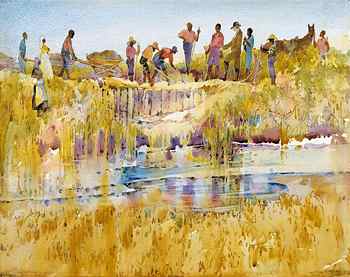 comprehensive, interdisciplinary examination of plantation
images in the American South from the eighteenth century to the present.
comprehensive, interdisciplinary examination of plantation
images in the American South from the eighteenth century to the present.
Curated by Angela D. Mack, the museum's Executive Director,
the exhibition features over 100 paintings, works on paper, photographs,
mixed media and installation works. Through the eyes of a range of
artists such as Eastman Johnson, Winslow Homer, William Aiken Walker, Alice
Ravenel Huger Smith, John Biggers, Edwin Harleston, Carrie Mae Weems and
Kara Walker, Landscape of Slavery examines depictions of plantations,
plantation views and related slave imagery in the context of the history
of landscape painting in America. "More than a history of the visual
imagery related to the plantation, the show invites one to consider the
impact that this imagery has had on race relations for three centuries,"
says Mack. (right: Alice Ravenel Huger Smith (1876 -1958), Mending
A Break in a Rice Field, from the series, A Carolina Rice Plantation
of the Fifties, ca. 1935, Watercolor on paper, 17.40 x 21.93 inches.
Gibbes Museum of Art)
A genre predominantly tied to the Southern region of the
United States, the plantation view has traditionally received marginal attention
in the study of American landscape art. Previous work on the plantation
subject has emphasized the debt the genre owes to 18th century British aesthetic
theories and styles. In recent years, however, art historians have
worked to identify general shifts in plantation iconography that reflect
specific historical events. Meanwhile, plantation views have attracted the
attention of social historians who have identified the genre as a rich source
for exploring issues of wealth, power, race, memory and nostalgia.
Landscape of Slavery seeks to bring these current discussions on
the topic together for the public's consideration.
Landscape of Slavery: The Plantation in American Art is supported in part by an award from the National Endowment for
the Arts. Sponsors of the Gibbes exhibition include Gibbes, etc.,
Charleston Renaissance Gallery, The Henry and Sylvia Yaschik Foundation,
The Humanities Council SC, Dr. and Mrs. George W. Williams, Geiss &
Sons Jewelers, Amelia T. Handegan Interior Design, Hulsey Law Group,
Piggly Wiggly and media sponsor Charleston Magazine.
Itinerary
- University of Virginia Art Museum in Charlottesville,
VA January 25 - April 20, 2008
- Gibbes Museum of Art in Charleston, SC May 9 - August
3, 2008
- Morris Museum of Art in Augusta, GA August 23 - October
19, 2008
Wall texts from the exhibition
-
- INTRODUCTION
-
- The plantation is a by-product of European colonization
and a distinctive New World institution. Initially used to refer to the
act of planting the usage of the word plantation quickly evolved to identify
a large land holding in tropical or semitropical regions. The link
to enslaved Africans and African Americans and to specific labor-intensive
crops such as rice, indigo, tobacco, cotton, sugar and coffee occurred
swiftly and remained unshakeable even after emancipation efforts took hold
across the Americas.
-
- Art has played a significant role in picturing the plantation
and in defining the inextricable bonds between slave, landowner and landscape.
Nowhere is this more evident than in the art of the American South. The
works in this exhibition, while demonstrating astonishing stylistic variety,
are unified thematically. What emerges is a pictorial legacy that has tackled
the intertwining of the land and the people that comprised the plantation
south. These images provide a rich source for exploring themes of wealth,
power, race, resistance, nostalgia and conflict. Landscape of Slavery
examines southern plantation and related slave imagery in an effort to
understand more fully its role in the history of American art from the
eighteenth century to the present and to understand the historical legacy
of plantation slavery.
-
-
-
- POLITICS
-
- The depiction of the plantation and slavery has often
been tightly bound up with contemporary politics. Both artists and audiences
have used these images of the American South to further political agendas.
The objects in this section demonstrate ways that images helped shape contemporary
political debate. For example, in the antebellum period, views of famous
plantations such as Mount Vernon were sometimes used to bolster proslavery
arguments by picturing a pastoral ideal and representing slavery as a benevolent
system. Conversely, other artists chose to represent the institution's
physical residue.
-
- Since the Civil War, artists have often used plantation
imagery to show the unbroken chain that links slavery and sharecropping
to segregation, the Ku Klux Klan and lynching. Ultimately the politics
of plantation imagery rest with what is made visible and what is made invisible,
what is accentuated and what is obscured.
-
-
-
- IDENTITY
-
- Plantation imagery of the eighteenth and nineteenth centuries
most often testified to the wealth and power of the slaveowners. While
this European derived pastoral ideal is the image most often associated
with the plantation period, an African aesthetic was a vital contributor
to the visual culture of the plantation. Enslaved Africans and African
Americans learned through ancestral memory and artistic innovation to identify
their own spaces, away from the oversight of their masters. Some were in
objects often considered utilitarian such as baskets, pottery, and quilts.
Others were in their environments such as their homes, gardens, and gravesites.
-
- Contemporary African American artists confront their
culture and history, informed through the legacies of ancestral memory.
As part of their work many contemporary African American artists incorporate
the past through utilizing craft traditions commonly associated with enslaved
artisans -- such as pottery, quilts, and baskets -- or vernacular places
-- such as slave cabins or grave sites -- into their own work. Together
these artists -- African and African American, enslaved and free, from
the eighteenth to the twenty-first centuries -- present powerful images
of a plantation experience different from painted landscapes produced for
plantation owners.
-
-
-
- NOSTALGIA
-
- Even before the economic and physical ruin brought on
by the Civil War, southern plantations were viewed through a veil of nostalgia
-- a loss and longing for an imagined past. Images of Mount Vernon
for example, particularly after Washington's death in 1799, often focused
on the mansion house as the physical embodiment of the new republic and
its heroic leader.
-
- After Reconstruction, images of the plantation transformed
rapidly to match the romantic vision that southerners proclaimed to a national
audience. Mostly for northern consumption, these views bore little
resemblance to the harsh racial realities of life across the region during
the tumultuous decades of the early twentieth century. Two types
of images dominated the post-war nostalgic views. The first depicted the
pre-war plantation as a site of physical grandeur and racial harmony, such
as in the representations of Tara and Twelve Oaks in Gone with the Wind.
The second portrayed the ruins of a once great plantation house as a way
of commenting on the physical and economic toll of the Civil War and serving
as a reminder of its lingering scars.
-
-
-
- PROTEST
-
- Through the centuries plantation-related images have
encompassed contradictory visions and competing views. For instance,
most antebellum plantation paintings exclude the enslaved workers whose
labor created the wealth and shaped the land. In the tradition of
the British estate view, these images omitted the brutal labor necessary
for carving out a successful agricultural enterprise. Instead it
is the planter's house often shown in its park-like setting viewed from
a great distance that serves as a symbol of the planter's wealth and social
standing.
-
- After the Civil War the emancipated slave is celebrated
for the first time in art; first by white artists and later by African
American artists who begin to reinscribe what was previously omitted.
Through their eyes the house portrait gives way to an image that emphasizes
the physical burden of agricultural labor. In the twentieth century, many
African American artists continued to draw upon plantation imagery in order
to depict black resistance to slavery and to make a statement about the
continuing impact of the historical legacy of slavery.
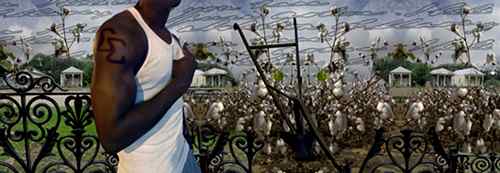
(above: Stephen Marc (American, b. 1954), Untitled from
the Passage on the Underground Railroad Series, 2002, Archival pigment
inkjet print, 18 x 52 inches. Courtesy of the artist)
Resource Library readers may
also enjoy:
Read more articles and essays concerning this institutional
source by visiting the sub-index page for the Gibbes Museum
of Art in Resource Library
Search Resource
Library for thousands of articles and essays on American art.
Copyright 2008 Traditional Fine Arts Organization, Inc., an Arizona nonprofit corporation. All rights
reserved.