Editor's note: The Neuberger Museum of Art provided
source material to Resource Library for the following article. If
you have questions or comments regarding the source material, please contact
The Neuberger Museum of Art directly through either this phone number or
web address:
Future Tense: Reshaping
the Landscape
May 11 - July 20, 2008
They experience the
post 9-11 world and it makes them tense -- tense about the forecast for
the future of our environment. Their work considers the 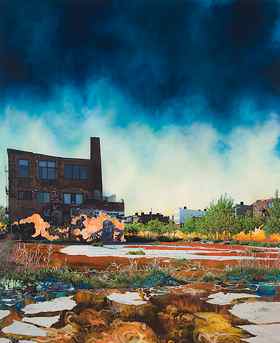 landscapes of today and the future, as those of globalization,
isolation, and at times, hope. "They" are the sixty or more artists,
featured in Future Tense: Reshaping the Landscape, on view at the
Neuberger Museum of Art / Purchase College from May 11 through July 20,
2008, who are taking a critical look at issues raised by the state of the
environment. The future they see is rife with pollution, poor air quality,
the deleterious effects of climate change, and man-made disasters. The tension
they feel is reflected in their paintings, photography and sculpture --
much of which was recently created and will be on view for the first time. (right:
Bradley Castellanos, American, b. 1974, East into Brooklyn, 2006,
74 x 61 inches. Lent by Caren Golden, New York )
landscapes of today and the future, as those of globalization,
isolation, and at times, hope. "They" are the sixty or more artists,
featured in Future Tense: Reshaping the Landscape, on view at the
Neuberger Museum of Art / Purchase College from May 11 through July 20,
2008, who are taking a critical look at issues raised by the state of the
environment. The future they see is rife with pollution, poor air quality,
the deleterious effects of climate change, and man-made disasters. The tension
they feel is reflected in their paintings, photography and sculpture --
much of which was recently created and will be on view for the first time. (right:
Bradley Castellanos, American, b. 1974, East into Brooklyn, 2006,
74 x 61 inches. Lent by Caren Golden, New York )
"Current global realities and environmental changes,
caused by a constellation of factors concern these artists, are conveyed
in images that range from depictions of true-life events to fictional narrative
and biting satire," notes Dede Young, Curator of Modern and Contemporary
Art at the Neuberger Museum of Art, who curated the show. "While some
artists question the past, some forecast the future, indicating solutions
for alternative, potentially sustainable conditions for human life."
She notes that many of the younger, emerging artists in
the show take positions ranging from cautious hope to utter disenchantment.
"Their imagery presents sobering information from current events and
expresses complex political and social dimensions of landscape, architecture,
science and technologies. There is an undertone indicating a moral
imperative," she says.
For example, Sarah Trigg's paintings are directly inspired
by news stories and headlines she reads online from sites around the world.
Her Lake Vostok with Two Olympias (2007), refers to a report on drilling
into a sub-glacial lake in Antarctica that had been sealed off from the
world for close to a million years, which she conflates with imagery
from headlines in other time zones. Trigg comments, "Today, mostly
what we see of the Earth's surface on a daily basis, and what we process
subconsciously, is in the form of digitized imagery, not what we see in
its true physical form. By pulling this disparate imagery of the Earth into
one view, the paintings project the spiritual and physical tensions between
technologized culture and the natural landscape."
 Bradley Castellanosis gripped by the mounds
of trash, polluted lots, and deserted docks of New York City and Brooklyn. His
post-apocalyptic landscapes are created through a process of mounting large-scale,
computer-manipulated images on board, which are then covered in resin as
shiny as an oil slick. "In a language colored with cynicism and sarcasm,
I create a dialogue about the contemporary world, where human desires are
obtained through force and man-made objects disturb the natural order of
life," he says. "These elements come together to address the driving
forces behind our culture war, and sex, greed and lust." His urban
landscapes may reek of contamination and decay, yet glimmers of beauty do
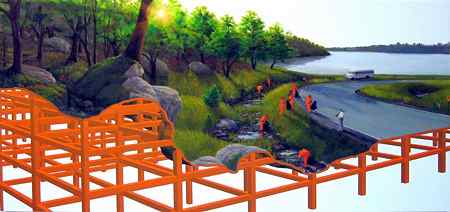
peak through the wreckage. (left: Michael Hayden, American, born
1981, Clean Up, 2007, Oil and acrylic on panel, 35 x 80 inches. Courtesy
The Progressive Corporation, Cleveland, Ohio)
Bradley Castellanosis gripped by the mounds
of trash, polluted lots, and deserted docks of New York City and Brooklyn. His
post-apocalyptic landscapes are created through a process of mounting large-scale,
computer-manipulated images on board, which are then covered in resin as
shiny as an oil slick. "In a language colored with cynicism and sarcasm,
I create a dialogue about the contemporary world, where human desires are
obtained through force and man-made objects disturb the natural order of
life," he says. "These elements come together to address the driving
forces behind our culture war, and sex, greed and lust." His urban
landscapes may reek of contamination and decay, yet glimmers of beauty do
peak through the wreckage. (left: Michael Hayden, American, born
1981, Clean Up, 2007, Oil and acrylic on panel, 35 x 80 inches. Courtesy
The Progressive Corporation, Cleveland, Ohio)
Dana Melamed has always been fascinated with the development
of the city from an architectural, historical, social and political point
of view. "Indeed, some pieces are built out of numerous cells that
grow into an organic form, which symbolize an ever-developing metropolis,"
she explains. The urban experience serves as a trigger and a framework for
the emotional turmoil that she sets forth with her fierce and impulsive
practice. Melamed uses a blowtorch to scar and shred the surface of her
dense drawings. A post-human world in which fires, earthquakes, floods,
hurricanes or acts of human aggression are evident create a tension between
calamitous episodes and the need to rewrite our structural pattern.
Swiss artist Markus Wetzel positions himself at the intersection
of art and technology, using digital imaging to create multi-layered synthetic
topographies. His recurring theme is a remote location ideally suited
for one -- a place of pure escapism where the larger world cannot affect
the individual. Here, Wetzel's image of an island paradise, constructed
entirely by computer, utilizing a 3-D modeling program, recalls the romantic
notion of the sublime: a world in which the sky is majestic, the horizon
goes on forever, nature is awesome and beautiful. The irony in this
custom-constructed, allegedly controllable environment is the existential
threat embodied in the form of an iceberg, equivalent in mass to the island,
floating just offshore. Is there any question that the melting iceberg
of today is anything but an icon of global warming?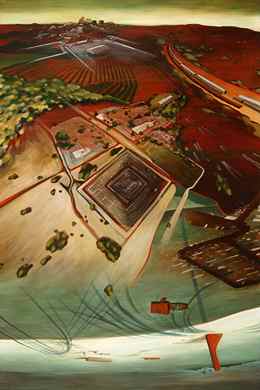
Yoon Lee's paintings are "the outcome and by product
of my pursuits -- finding a balance in contradiction, finding harmony in
chaos, finding where the con-temporary and history co-exist." She
starts with a jumble of scanned images of engineering structures and the
like, then adds colorful lines, fluid whorls, and abstract shapes that appear
to be both organic and computer generated, hinting at a tangle of intriguing
ideas -- the commotion at an airport, the speed of travel, the electrical
blueprints of a power plant, the path of unknown orbits, the sudden unraveling
of the world's biggest ball of string. Her powerful mix of chaos and order,
along with her bold use of color, adds to the expression of a world in motion,
with force lines pushing in every direction at once, stressed to the point
of implosion.
Dean Byington's works on canvas that incorporate drawing,
painting and silkscreen transfer imagery that cover the large, white field
with a detailed matrix of flora and fauna in which surreal worlds within
worlds co-exist. Microscopic, fairy-tale like colonies in the grass
underfoot create a peculiar geography in which quasi-rational systems of
productivity abound. The inference of human-free, self-sufficient environment
is inferred, and the moral of the story is that nature may exist with or
without us. (right: Sarah Trigg, American, Lake Vostok with Two
Olympias, 2007, Acrylic on panel, 60 x 40 inches. Sara Nightingale
Gallery, Bridgehampton)
Selected wall text from the exhibition
- Future Tense: Reshaping the Landscape was conceived as an exhibition to demonstrate that the medium
of painting -- historically the format of the landscape genre in art --
is adaptive enough to deal with timely issues conceptually and symbolically,
and to characterize vividly ways in which we are all connected.
-
- The Landscape tradition, which flourished in the Nineteenth
Century in Europe and in the United States, maintained a dynamic connection
with contemporary philosophies and religious beliefs, and was a powerful
form of communication. The narrative and allegorical power of painted
imagery served the public as a vehicle for comprehension of the wider world.
-
- Building on that tradition, the sixty artists in Future
Tense: Reshaping the Landscape employ painting, drawing, photography,
and sculpture to grapple with sweeping changes in politics, society, and
culture since 2001, a pivotal and historic year.
-
- They describe the present, a time when anxiety about
the high threat level is color-coded and the catch phrases global
warming, going green, and eco-friendliness are often repeated in news headlines
and advertising tags. But they are concerned as well with the future,
and their work reflects the vulnerability of our existence.
-
- Drawing upon sources as varied as Dr. Seuss, Tim Burton,
and Japanese computer games, the artists in this exhibition amplify the
historical tradition of the Sublime and the Romantic to deal with a broad
range of complex political and social themes, including architecture and
technology, community and isolation, utopia and dystopia.
-
- Quotes from artists who answered ten questions we posed
about the connection between their work and politics, the environment,
the landscape tradition in art, and activism appear on object labels throughout
the galleries. A DVD of artists responding on camera to these questions
is on view in the museum's Murray Benjamin Library, near the front entrance.
-
- Dede Young, Curator of Modern and Contemporary Art and
Avis Larson, Curatorial Assistant, developed Future Tense: Reshaping
the Landscape as part of the Neuberger Museum of Art's balanced program
and the 2008 campus theme of Purchase College -- 'environment is everything.'
Related events
- The following programs are offered in conjunction with
the exhibition:
-
- FAMILY FIRST SATURDAY
- From Trash to Treasure
- Saturday, June 7, 1-4 pm
- Make art with recycled and repurposed materials. Art
workshops (1-4 pm), themed gallery Talks (1-3 pm), and live music provided
by Purchase College Conservatory of Music students (3 pm) round out the
afternoon. Workshops are for children 5-10. Free admission
-
- ART SANDWICHED-IN
- Wednesday, July 9, noon
- Artist Danielle Tedeger discusses her work on view in
Future Tense. Free with museum admission; free to Purchase College
faculty, staff and students.
RL readers may also enjoy:
Read more articles and essays concerning this institutional
source by visiting the sub-index page for the Neuberger
Museum of Art in Resource Library.
Search Resource
Library for thousands of articles and essays on American art.
Copyright 2008 Traditional Fine Arts Organization, Inc., an Arizona nonprofit corporation. All rights
reserved.