Editor's note: The Buffalo Bill Historical Center
provided source material to Resource Library for the following article
or essay. If you have questions or comments regarding the source material,
please contact the Buffalo Bill Historical Center directly through either
this phone number or web address:
An Artist with the Corps
of Discovery: One Hundred Paintings Illustrating the Journals of Lewis and
Clark
June 6 - August 30, 2009
Charles Fritz has
always loved history. One look at this summer's exhibition of his Lewis
and Clark paintings at the Buffalo Bill Historical Center and viewers will
say, "We can tell."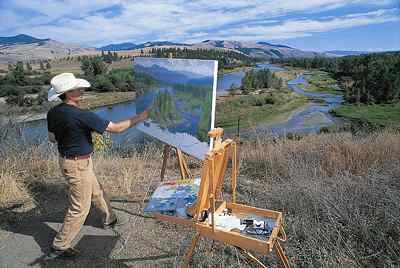
This popular western artist brings his exhibition An
Artist with the Corps of Discovery: One Hundred Paintings Illustrating the
Journals of Lewis and Clark to the historical center for a three-month
stay. It opens to the public on June 6, 2009, and will remain on view through
August 30, 2009. (right: Charles Fritz painting at Traveler's Rest
just west of Lolo, Montana, one of the camping sites of Lewis and Clark
and the Corps of Discovery. Photo courtesy Charles Fritz.)
Ten years ago, Fritz received a commission to paint a scene
from the Journals of Lewis and Clark. In the process, he discovered
the Corps of Discovery had no artist traveling with them who could document
the sites and experiences of the journey. An idea began to gel that would
find Fritz traveling the entire route of the expedition twice, his palette
in one hand, the Lewis and Clark journal entries in the other.
In the end, he created scores of paintings, sketches, and
studies depicting the Lewis and Clark adventure, a hundred of which will
be included in the One Hundred Paintings exhibition.
Born in 1955, Fritz grew up in Mason City, Iowa, and studied
history and education at Iowa State University in Ames. Soon his interest
in art became his focus, and he decided to forego a teaching career. He
moved to Montana in 1980 and became enamored of the history of the Great
Plains and the West. Today, he lives in Billings, Montana, with his wife
and two sons and paints historical subjects in "vast, luminous landscapes."
Fritz's work is familiar to western art aficionados as
it's included in numerous museum exhibitions and collections across the
country, including the Buffalo Bill Art Show & Sale each fall in Cody.
He's listed in Who's Who in the American West and Who's Who in
America, and his work has been featured in many magazines and journals.
During the Lewis and Clark Bicentennial celebration 2003
- 2006, the collection, which then numbered 70 paintings, traveled to seven
museums across the country. The Buffalo Bill Historical Center is pleased
to be the first venue to exhibit the finished collection.
Also see:
"Charles Fritz: a present-day
artist on the trail of Lewis and Clark," by Christine C. Brindza
"On the heels of Lewis and Clark:
Charles Fritz follows the inspiring visions of western artist-explorers,"
by Christine C. Brindza
"Collection connections with
the Corps of Discovery," by Christine C. Brindza
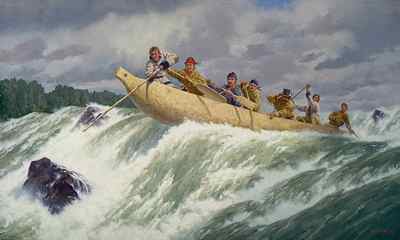
(above: Charles Fritz (b. 1955). The Corps of Discovery
in the Great Shute of the Columbia, 2006. Oil on canvas, 36 x 60 inches.
Collection of Timothy Peterson.)
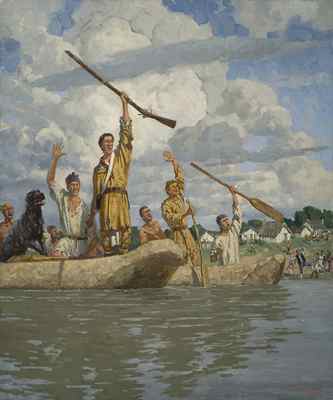
(above: Charles Fritz (b. 1955). Home from the Pacific-Triumphant
Return to St. Louis, 2008. Oil on canvas, 30 x 25 inches. Collection
of Timothy Peterson.)
Wall panels for the exhibition
- The Journey Begins
-
- The journey of the Corps of Discovery began in spring 1804 when the
Expedition ascended the Missouri River from St. Louis. The men, in clean
regulation uniforms, stocked their boats full of supplies. They eagerly
anticipated the new sights and experiences of the uncharted West.
-
- Artist Charles Fritz began to illustrate the journals of the Corps
of Discovery in 1998. He visited the same places as Lewis and Clark and
conducted extensive research to paint them as historically accurate as
possible.
-
-
- We Proceeded On
-
- The Corps of Discovery grew weary as the Expedition continued. They
traveled hundreds of miles with hundreds more to go. Their uniforms were
dirty and torn and were often replaced with animal hides. They traded goods
and services with the local Indians when their supplies ran low. The men
realized the trip was taking much longer than originally thought. Determined,
they proceeded on.
- For ten years, Charles Fritz immersed himself in the Expedition through
his paintings. He, too, faced challenges along the way, such as dealing
with harsh temperatures in winter and summer, but he persevered through
it all.
-
-
- The Return
-
- The Lewis and Clark Expedition arrived back in St. Louis in September
1806. They did not find a trade route through the North American continent
as they had hoped, but they did reach the Pacific Ocean. Many at home feared
the men were lost forever and gladly celebrated the Corps of Discovery's
triumphant return.
-
- In 2008, Fritz added the final touches to his Lewis and Clark series.
After much hard work and dedication, he successfully completed his own
journey with the Corps of Discovery.
Family guide for the exhibition
- Charles Fritz: An Artist's Vision
-
- Charles Fritz was born in 1955 and grew up in Mason City, Iowa. He
studied both history and education in college. He left teaching to pursue
his art, a passion of his for thirty years. In 1980, he moved to Montana
where he developed an interest in the history of the Great Plains and the
Rocky Mountain West.
-
- The writings of Lewis and Clark and their famous journey to the Pacific
Ocean in search of the Northwest Passage inspired Fritz. They saw wondrous
things, but no artist accompanied the Expedition. With this exhibit, Charles
Fritz seeks to give the journey an artist's vision.
-
- "In order to ensure accuracy in the paintings, I traveled the
entire route of the Expedition twice, locating and visiting the sites of
noteworthy events in the Journals and painting field studies there."
-
- - Charles Fritz
-
-
- The Lewis and Clark Expedition: Quest for the Northwest Passage
-
- President Thomas Jefferson appointed Meriwether Lewis and his friend
William Clark to lead a small group, the Corps of Discovery, to explore
and document the uncharted West.
-
- On May 14, 1804, three boats and forty men started their journey on
the Missouri River. The Corps of Discovery traveled thousands of miles
and discovered lands, rivers, and peoples that few had ever seen before.
The challenging trip took much longer than expected, and many thought the
group was lost forever. After more than two years, the Corps of Discovery
returned to St. Louis on September 23, 1806.
-
- Activity: The Corps of Discovery traveled numerous waterways on various
types of boats. How many different kinds of boats can you find? Can you
find a pirogue? A keelboat? A canoe? Hint: Look at the titles of the paintings
for help.
-
-
- Experience the Expedition
-
- The Corps of Discovery traded with the Mandan people for corn and vegetables.
In this scene, the Mandans are trading for blacksmith services to repair
guns and sharpen knives. What do you think the people are saying in this
painting?
-
- Activity: The Corps of Discovery's journey took more than two years
to complete. Lewis and Clark traveled in all seasons. Find a painting of
a winter scene. What do you see that helps you know it is winter? Is there
snow? Now, find a painting of a summer scene. What helps you know it is
summer? Did the artist use different colors?
-
-
- On Your Own
-
- Lewis and Clark kept detailed journals of the Expedition. Write your
own journal entry of your trip this summer and then draw an illustration
to go with it.
-
-
- The Buffalo Bill Historical Center gratefully acknowledges Timothy
Peterson for his support of the exhibition, and for sharing his collection
of artwork by Charles Fritz and Michael Haynes.
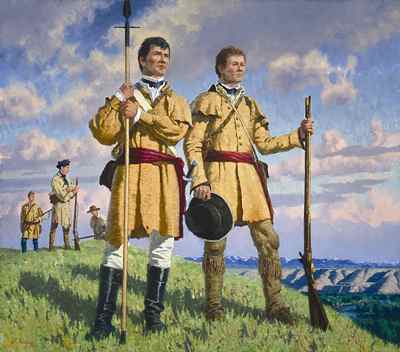
(above: Charles Fritz (b. 1955). The Captains Lewis and
Clark-Trusted Leaders, Loyal Friends, 2007. Oil on canvas, 44 x 50 inches.
Collection of Timothy Peterson.)
To view additional images please click
here.
RL readers may also enjoy:
Read more articles and essays concerning this institutional
source by visiting the sub-index page for the Buffalo
Bill Historical Center in Resource Library.
Search Resource
Library for thousands of articles and essays on American art.
Copyright 2009 Traditional Fine Arts Organization, Inc., an Arizona nonprofit corporation. All rights
reserved.