The Spectacle of Life: The Art of William Glackens
Images, page 2
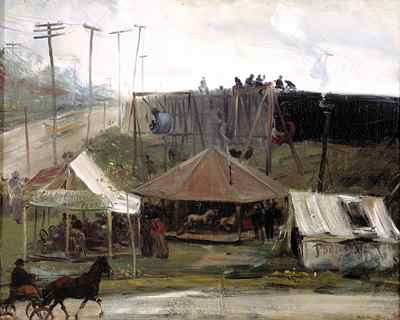
(above: William Glackens, Outside the Guttenberg Race Track (New Jersey), 1897, Oil on canvas)
Pictures like this one earned Glackens, as well as Robert
Henri, John Sloan, George Luks, and Everett Shinn, such nicknames as the
Black Gang and Devotees of the Ugly. The main theme here is motion -- seen
in the speeding trolley and echoed in the merry-go-round, the high-flying
swing set, the willowy plumes of smoke, the horse-drawn buggy. This is among
Glackens's first known paintings specifically related to the greater New
York area, where the artist had moved in 1896, although it was not exhibited
until 1901, at the Pennsylvania Academy of Fine Arts.
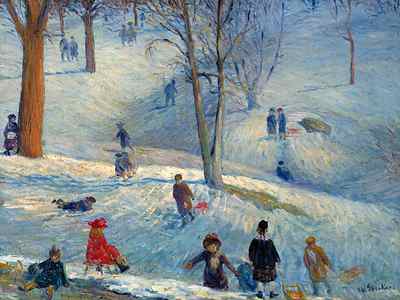
(above: William Glackens, Sledding, Central Park, 1912, Oil on canvas)
In his monograph William Glackens, William Gerdts wrote: "This is a truly Impressionist scene, with the bright colors of the children's winter clothing played off against the white snow filled with blue and violet shadows. Painted from on high, the view follows the course of the sleds and suggests a limitless play field for the young folk; right of center, and about to join the fun, is five-year-old Ira Glackens, dressed in a distinctive Scottish costume."
Glackens took great pleasure in following the activities
of his children. But even in this disarming depiction of children at play,
the artist remains keenly aware of differences in social status -- on the
far left of the painting, a nanny leans against a large tree, watching over
the children in her care.
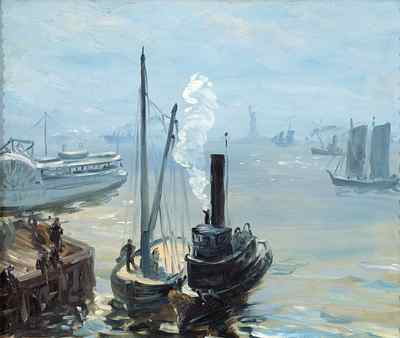
(above: William Glackens, Tugboat and Lighter, 1904-05, Oil on canvas)
The Statue of Liberty, symbol of the highest aspirations of American values, appears on the horizon, a pale, ghostly presence that reigns over the daily toil in the harbor. The focus of the painting, however, is the unassuming encounter between a tugboat and a lighter, two workhorses of the urban waterways. It was for eschewing the grandiosity of New York and concentrating instead on the beauty of its backbone and underside that Glackens and "the Eight" became known.
Glackens biographer William Gerdts wrote about this painting:
"The urban realists, Glackens among them, were drawn especially to
the tugboats on the rivers and harbors, the workhorses of the seaways, rather
than elegant steamships. He made one the center of focus in Tugboat and
Lighter... The dark, dramatic tug is contrasted...with the white paddle
steamer at the left, more graceful and elegant. This vessel bears the name
Sloan, but whether this was the boat's actual name or a witty tribute
to Glackens's colleague is not known. If the painting does date to 1904,
this might have been in recognition of Sloan's recent move to New York."
 Please click here
to return to The Spectacle of Life: The Art of William Glackens.
Please click here
to return to The Spectacle of Life: The Art of William Glackens.
Search Resource Library for thousands of articles and essays on American art.
Copyright 2009 Traditional Fine Arts Organization, Inc., an Arizona nonprofit corporation. All rights reserved.