Editor's note: The Nelson-Atkins Museum of Art
provided source material to Resource Library for the following article
or essay. If you have questions or comments regarding the source material,
please contact the Nelson-Atkins Museum of Art directly through either this
phone number or web address:
Hide & Seek: Picturing
Childhood
September 26, 2009 - February 21,
2010
Exploring our fascination
with childhood as captured throughout photography's history, Hide &
Seek: Picture Childhood will feature 45 works by 42 photographers from
The Nelson-Atkins Museum of Art collection. Among the works are a stunning
mid-19th-century portrait by Lewis Carroll, and contemporary color photographs
by Jocelyn Lee, Sage Sohier and Julie Blackmon. They will be on view at
the Museum for the first time. The exhibition runs September 26, 2009 through
February 21, 2010 Admission is free.
"Childhood, as a phase of life distinct from adulthood,
is a modern, Western construct," said Associate Curator of Photography
April M. Watson, who co-curated the exhibition with Jane L. Aspinwall, Assistant
Curator of Photography. "In many ways, it eludes easy definition. As
society changes, the parameters defining childhood have become increasingly
mutable. Our aim in selecting these works from the rich holdings in our
collection is to explore the inherent complexity of the subject, which falls
somewhere between innocence and knowing, nature and nurture, metaphor and
fact."
Watson and Aspinwall have assembled a variety of works
by some of the most recognized figures in the history of the medium, including
Lewis Carroll, Gertrude Käsebier, Lewis Hine, Helen Levitt, Ralph Eugene
Meatyard, Emmet Gowin and Sally Mann. "We wanted to explore a variety
of concepts and themes, from romantic notions of innocence as seen in the
Pictorialist work of Gertrude Käsebier, to documents of childhood's
harsher, social realities, as seen in the photographs of Lewis Hine and
Dorothea Lange," Aspinwall said. "In selecting contemporary works,
we included photographers such as a Sage Sohier and Julie Blackmon, who
touch on more current trends, like over-involved parenting and over-scheduled
families."
The significance of education, play and imagination, the
relationship between adults and children, and the place of children in the
adult world also are considered.
The Photography Collection at the Nelson-Atkins grew from
its initial holding of 1,015 prints to a collection of more than 7,000 works
with the acquisition in late 2005 of the famed Hallmark Photographic Collection,
one of the finest holdings of its kind in the world. The Museum's photography
holdings span the entire range of photography's history, from 1839 to the
present, with a particular strength in American work.
In Kansas City, this exhibition is supported by the Hall
Family Foundation. Midwest Airlines is the official airline sponsor.
Images
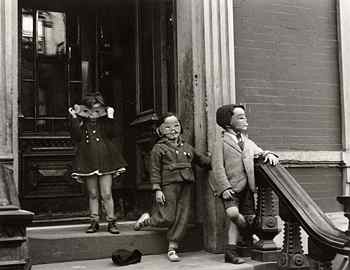
(above: Helen Levitt, American (1913-2009). New York,
ca. 1939. Gelatin silver print, image: 5 7/8 x 8 5/8 inches. Gift of Hallmark
Cards, Inc., 2005.27.4240. © Courtesy Estate of Helen Levitt/Laurence
Miller Gallery, N.Y.)
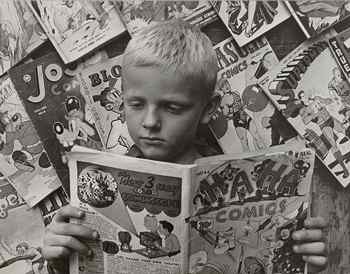
(above: Morris Engel, American (1918-2005). Comic Book
Stand, New York, ca. 1945. Gelatin silver print, image: 10 1/2 x 13
3/8 inches. Gift of Hallmark Cards, Inc., 2005.27.3953. © Morris Engel.)
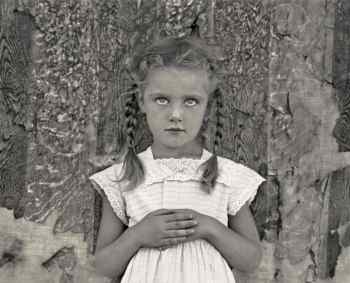
(above: Frederick Sommer, American (b. Italy, 1905-1999).
Livia, 1948. Gelatin silver print, image: 7 _ x 9 5/16 inches. Gift
of the Hall Family Foundation, 2005.37.395. © Frederick & Frances
Sommer Foundation.)
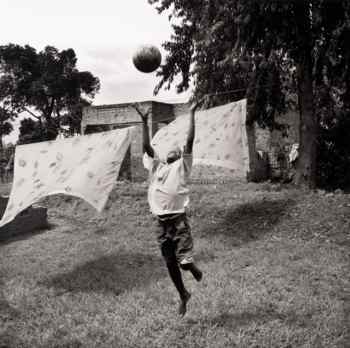
(above: Gloria Baker Feinstein, American (b. 1954). Boy
with Ball, Kajjansi, Uganda, 2007. Inkjet print, image: 16 x 16 inches.
Gift of the Hall Family Foundation, 2008.41.13. © Gloria Baker-Feinstein.)
Wall text from the exhibition
- Hide & Seek:
- Picturing Childhood
-
- I'd give all wealth that years have piled,
- The slow result of Life's decay,
- To be once more a little child
- For one bright summer day.
-
- -- Lewis Carroll, from the poem "Solitude"
(1853)
-
- Since photography's inception in 1839, children have
been popular subjects for the camera. For personal posterity, families
record individual moments in a child's life. More broadly, we look to pictures
of children as collective memories of childhood itself -- a phase of life
to which we can never return. This exhibition explores our fascination
with childhood as pictured throughout photography's history. In a variety
of ways, these photographers explore the inherent complexity of the subject
itself, which falls somewhere between innocence and knowing, nature and
nurture, metaphor and fact. Conceptions and themes include romantic childhood
and childhood's harsher realities; the significance of education, play
and imagination; the relationship between adults and children; and the
place of children in the adult world.
-
- The modern, Western concept of childhood as distinct
from adulthood dates to around the 17th century, when it was first thought
that children were born innocent: blank slates upon which society writes
its moral and ethical prescriptions. Today, in an age of helicopter parenting
and media-saturation, innocence means something quite different. Cultural,
economic and family structures have shifted in an increasingly globalized,
televisual society, such that the social and biological parameters defining
childhood have become more difficult to secure.
-
- Various tensions inform these images, including the desire
to protect and shelter a child, while acknowledging life's darker corners;
and the push towards material and social success, while wanting a place
for imagination and play. Collectively, these photographers evoke the complexities
and contradictions of childhood, acknowledging its importance as a subject
worthy of serious contemplation.
-
-
Object labels from the exhibition
-
- Lewis Carroll (Charles Lutwidge Dodgson)
- English, 1832-1898
- Alexandra Kitchin, ca. 1868
- Albumen print
-
- Lewis Carroll, an Oxford deacon best known today as the
author of Alice's Adventures in Wonderland, was a prolific amateur
photographer who, between 1856 and 1880, produced some of the most arresting
portraits of children ever made.
-
- Carroll was uncomfortable with adults, preferring instead
the company of young children-girls in particular. With a genuine understanding
of a child's imagination, Carroll immediately put his subjects at ease.
The resulting photographs suggest-in sometimes unsettling ways for modern
viewers-the intense seriousness of a child's inner life without sentimental
overlay.
-
- Alexandra Kitchin, the daughter of Carroll's old friend
and Oxford colleague, was one of Carroll's favorite models throughout the
1870s. She is shown here, at age four, in a stunning early portrait.
-
- Gift of the Hall Family Foundation, 2008.41.8
-
-
- Frances Benjamin Johnston
- American, 1864-1952
- Washington, D.C., Classroom,
1899
- Cyanotype
-
- In 1899, Frances Benjamin Johnston spent six weeks photographing
the schools of Washington, D.C., producing a total of 700 views. A social
issue of vital importance at the turn of the 20th century, education was
widely regarded as the key to establishing moral and civic virtue. A well
behaved and educated child was expected to become a productive future member
of society. With this in mind, Johnson's carefully composed views portray
classrooms as models of order and civility.
-
- Gift of Hallmark Cards, Inc., 2005.27.2720
-
-
- Frank Lloyd Wright
- American, 1867-1959
- Girls Gym Class, 1900
- Collotype
-
- The education of children at the turn of the 20th century
took many forms. The Hillside Home School, in Spring Green, Wisconsin,
was a progressive school run by Ellen and Jane Lloyd-Jones, the aunts of
architect Frank Lloyd Wright. It opened in 1886 on property owned by Wright's
grandfather, and Wright's nieces, nephews and younger sisters were all
students there. In addition to academic achievement, Hillside emphasized
personal growth, physical activity, artistic self expression and love of
nature. In this view of a girls' gym class exercise, Wright's eye for structural
relationships is evident: the verticality of the girls and the trees is
juxtaposed with the long horizontal shadows on the ground.
-
- Gift of Hallmark Cards, Inc., 2005.27.4534
-
-
- Clifton Johnson
- American, 1865-1940
- Blackboard Problems, Montana,
ca. 1910
- Gelatin silver print
-
- Gift of Hallmark Cards, Inc., 2005.27.4040
-
-
-
- William Larue
- American, b. 1928
- Understanding Numbers, 1963
- Gelatin silver print
-
- Gift of Hallmark Cards, Inc., 2005.27.2753
-
-
- Wendy Ewald (with Angelica Molina)
- American, b. 1951
- Hello, Hello, Hello, Benson, North Carolina, 1990
- Gelatin silver print
-
- As an educator in Durham, North Carolina, Wendy Ewald
taught photography to elementary school children as a means of self-expression.
This experience led to the development of her innovative Literacy Through
Photography program in which Ewald used the medium to inspire children
to explore their own lives and dreams. In this series, Ewald photographed
each student and then encouraged them to inscribe their image in some meaningful
way. The result is a poignant collaborative portrait-a creative interaction
between photographer and subject.
-
- Gift of Hallmark Cards, Inc., 2005.27.4548
-
-
- Judith Joy Ross
- American, b. 1946
- Michael Bodner, A.D. Thomas Elementary School (first
grade), Hazleton, PA, 1993
- Gelatin silver print
-
- Gift of Hallmark Cards, Inc., 2005.27.215
-
-
- F. Milton Armbrust
- American, 1896-1964
- Untitled (Two Children Reading Comics), ca. 192025
- Carbon print
-
- Gift of Hallmark Cards, Inc., 2005.27.2527
-
-
- Morris Engel
- American, 1918-2005
- Comic Book Stand, New York,
ca. 1945
- Gelatin silver print
-
- The first American comic books were produced in the 1930s;
by the 1940s they had become a big business. Morris Engel's tightly composed
image of a young boy engrossed in, and surrounded by, comic books at a
newsstand emphasizes both the popularity of the genre and its ability to
fully absorb the attention of its young reader.
-
- After World War II, television came to dominate domestic
leisure and entertainment. The commensurate downturn in comic book sales
incited more lurid and violent content, which in turn raised anxieties
about the genre's potential for corrupting young minds. In his shrill book
Seduction of the Innocent (1954), Dr. Frederic Wertham wrote: "Badly
drawn, badly written, and badly printedthe effects of these pulp-paper
nightmares is that of a violent stimulant."
-
- Gift of Hallmark Cards, Inc., 2005.27.3953
-
-
- Gertrude Käsebier
- American, 1852-1934
- Happy Days, 1903
- Photogravure
-
- The turn of the 19th century gave rise to the Pictorialists-photographers
who made highly poetic and subjective images, often muted in focus, centering
on themes of nature, family and home. The Pictorialists' emphasis on photography
as a fine art dovetailed perfectly with the romantic belief in the "priceless
child," uncorrupted by-and existing outside-a world of commerce, schedules
and labor. Gertrude Käsebier's pastoral scene of children playing
outdoors exemplifies these romantic values. The image is dramatically cropped
to focus attention on the youngest child in the middle of the picture.
This bold framing creates a sense of childhood as a world unto itself,
timeless and untouched by the materiality of the everyday world.
-
- Gift of Hallmark Cards, Inc., 2005.27.3227
-
-
- Harry C. Rubincam
- American, 1871-1940
- Untitled (Boy with Toy Soldiers),
ca. 1905
- Platinum print
-
- Gift of Hallmark Cards, Inc., 2005.27.2897
-
-
- Julie Blackmon
- American, b. 1966
- Birds at Home, 2007
- Inkjet print
-
- In the 21st century, middle-class childhood often involves
a litany of activities and obligations, an over-extension of the entire
family to prioritize sports practices, music and dance lessons, academic
tutoring, play dates and work. Much of the time in a child's day is scheduled
and structured by organized activities or social engagements. Inspired
by the 17th-century Dutch paintings of Jan Steen (see Gallery P17), Julie
Blackmon evokes a rare moment of equilibrium amidst the day's haste and
confusion. Here, children are depicted in a myriad of different activities-one
child plays with toys, one reads, one plays with a cat, one stands holding
her dress and one leans contemplatively on a chair, as if considering what
to do next.
-
- Gift of the Hall Family Foundation, 2008.13.2
-
-
- Sid Grossman
- American, 1913-1955
- New York, 1947
- Gelatin silver print
-
- Children use play as a means of decoding and mimicking
the world around them. Play can be an experiential way of learning, teaching
lessons about cooperation and problem solving, as well as an outlet for
competitive instincts, role-playing and fantasy. Here, Sid Grossman captures
two children aiming toy guns at each other in a blur of action; the differing
wall surfaces in the background further enforce the two opposing figures.
The use of guns in play-of understandable concern to some-evokes powerful
cultural stereotypes of Western gunslingers and World War II soldiers.
In today's increasingly violent society, the fear that make-believe will
translate into reality continues to incite anxieties about the effects
of popular culture on children.
-
- Gift of Hallmark Cards, Inc., 2005.27.4012
-
-
- Helen Levitt
- American, 1913-2009
- New York, ca. 1939
- Gelatin silver print
-
- Gift of Hallmark Cards, Inc., 2005.27.4240
-
-
- Helen Levitt
- American, 1913-2009
- New York, ca. 1938
- Gelatin silver print
-
- One of the most important photographers of children,
Helen Levitt's entire life's work was devoted to evoking the vitality of
New York street life. Her resulting images, imbued with grace, drama and
humor, influenced generations of future photographers. Intrigued by the
chalk drawings she saw on the sidewalks of New York, Levitt photographed
the spontaneous and imaginative play of children in working class neighborhoods.
Increasingly, in mid-20th-century America, these children were left to
their own devices, often without sustained adult supervision, to create
games on their streets and sidewalks.
-
- Gift of Hallmark Cards, Inc., 2005.27.1787
-
-
- Walter Rosenblum
- American, 1919-2000
- Three Children on Swings, "Pitt Street"
Series, New York, 1938
- Gelatin silver print
-
- Gift of Hallmark Cards, Inc., 2005.27.4333
-
-
- William Klein
- American, b. 1928
- Swing & Boy & Girl, New York, 1955
- Gelatin silver print
-
- Gift of Hallmark Cards, Inc., 2005.27.4177
-
-
- Gloria Baker Feinstein
- American, b. 1954
- Boy with Ball, Kajjansi, Uganda,
2007
- Inkjet print
-
- Shortly after her return from a 2006 trip to East Africa,
Gloria Baker Feinstein established the non-profit organization Change the
Truth to assist Ugandan children orphaned as a result of AIDS or war. While
fully aware of the harsh facts of their situation, Feinstein strives to
suggest a larger sense of affirmation and transcendence. The dire circumstances
of many of these children would seem to point to a sorrowful existence,
but the joy one child exudes in the simple act of throwing a ball is impossible
to suppress. The repeated acts of floating-the boy, the ball, the billowing
sheets on the laundry line-suggest at least a temporary freedom from the
weight of this reality.
-
- Gift of the Hall Family Foundation, 2008.41.13
-
-
- Francis Miller
- American, 1905-1973
- Ten grade school kids sitting around TV set in living
room, Minneapolis, Minnesota, 1951
- Gelatin silver print
-
- Television remains the most ubiquitous-and controversial-technology
to impact childrearing in the 20th century. Since the early 1950s, when
TV became a common presence in American households, cultural critics and
educators have debated the relative merits and hazards of "the boob
tube" with respect to the emotional, educational and psychological
development of children. This image first appeared in a Life magazine
article titled "School by TV." It depicts children in Minneapolis
gathered in front of a television set to watch a hygiene program broadcast
from their school during a teacher's strike, while the mother of four of
them looks on from the kitchen.
-
- Gift of the Hall Family Foundation, 2009.37.8
-
-
- Yasuhiro Ishimoto
- Japanese, b. 1921
- Girl with Balloon, Chicago,
ca. 1950s
- Gelatin silver print
-
- Gift of Hallmark Cards, Inc., 2005.27.2716
-
-
- Edward Sturr
- American, b. 1937
- Chicago (girl against column),
1966
- Gelatin silver print
-
- Gift of Hallmark Cards, Inc., 2005.27.2963
-
-
- Andrea Modica
- American, b. 1960
- Treadwell, New York, 1987
- Platinum print
-
- Writer E. Annie Proulx, who wrote the introductory essay
for Andrea Modica's Treadwell book, wrote of this image: "is
the clasp tender, is the bathrobed child prevented from hearing something
dreadful, is the other seeing something that cannot be forgotten?"
-
- Gift of Hallmark Cards, Inc., 2005.27.2781
-
-
- Nicholas Nixon
- American, b. 1947
- Joel Geiger, Perkins School for the Blind, 1992
- Gelatin silver print
-
- Gift of Hallmark Cards, Inc., 2005.27.4275
-
-
- Robert Lyons
- American, b. 1954
- Young Girl Outside Manhiya Palace, Kumasi, Ghana, 1997
- Chromogenic print
-
- In the photographic depiction of childhood, a central
theme is the intricate relationship between adults and the young. Some
adults are seen on the periphery, not completely engaged with the child,
but standing at arm's length in a supervisory role. Other adults, through
gesture or embrace, convey their desire to nurture, guide, support, and
protect. In this photograph, from Robert Lyons' series Another Africa,
the focus is squarely on the young girl. Although the adult holding her
hand is clearly in a supportive role, only a portion of his body is included
in the frame; the man is headless, cropped across one shoulder and above
the knee.
-
- Gift of Hallmark Cards, 2005.27.4056
-
-
-
- Sally Mann
- American, b. 1951
- Gorjus, 1989
- Gelatin silver print
-
- Sally Mann's sensual and sometimes controversial portraits
of her children received great attention in the early 1990s. Mann's Immediate
Family series, which includes this photograph of her two daughters
playing dress-up, marked a pivotal moment in the visual history of childhood.
By crafting lush, black-and-white photographs of her beautiful, often naked
or semi-clothed children, engaged in various forms of play, Mann deliberately
blurred the line between private and public realms. In so doing, Mann challenged
conventional notions of motherhood, childhood innocence and artistic propriety.
Mann's children are not the blank slates of Jean-Jacques Rousseau's Enlightenment
ideal. Rather, they are knowing beings, endowed with a physical and psychological
self-identity, who nonetheless remain vulnerable to the realities of the
adult world.
-
- Gift of Hallmark Cards, Inc., 2005.27.4058
-
-
- Walter Rosenblum
- American, 1919-2000
- Boy on Roof, New York,"Pitt Street" Series, 1950
- Gelatin silver print
-
- Gift of Hallmark Cards, Inc., 2005.27.4332
-
-
- Henri Leighton
- American, b. 1917
- Untitled (boy on street),
ca. 195053
- Gelatin silver print
-
- Gift of Hallmark Cards, Inc., 2005.27.1777