Heartland Art: Selections
from Your Indiana Collection
May 1, 2010 - February 13, 2011
Wall panels for the exhibition
-
-
- INTRODUCTORY PANEL
-
- The creative expressions of Hoosiers are varied. Some
seem familiar while some challenge or even shock. This exhibit traces 175
years of Indiana art making and includes works created here and elsewhere
by Indiana natives. From early portraits of our Statesmen to abstract impressions
of the 21st century, Indiana's history and culture are discovered through
the eyes of our own artists.
-
- Indiana art is a mirror of American art. Hoosier artists
have explored Realist and conceptual styles including Post-impressionism,
Abstract Expressionism and Pop Art.
-
- As you explore this exhibit, take a moment to study works
that you might normally dismiss. Art is communication. The messages these
artists have worked to convey may surprise, delight, or provoke, but all
try to connect you to the artist's message.
-
-
-
-
- THE HOOSIER GROUP
-
- John Ottis Adams William Forsyth
- Richard Buckner Gruelle Otto Stark
- Theodore Clement Steele
-
- In the early-1880s, several Indiana artists sought training
abroad. Though art schools were available in Indiana and many artists had
left for study in New York, but true success required European training.
While Paris was the center of the art world in the 19th century, it was
very expensive. Munich, on the other hand, offered a less expensive education.
That and the Indiana's Germanic roots led most of the state's young painters
there.
-
- Surprisingly, these painters chose to come back to Indiana
after their studies instead of migrating to cities in the eastern United
States, where the art market was more profitable. Upon their return, they
transformed Indiana art.
-
- T.C. Steele, J. Ottis Adams, William Forsyth, and Otto
Stark were accomplished artists, skilled in modern techniques and, most
significantly, the idea of painting en plein air, or out in the
open. These painters, joined by Richard Gruelle, became the loudest proponents
of this new style of painting in the Midwest and were widely considered
the most significant regional school in the country.
-
-
-
-
- THE BROWN COUNTY ART COLONY
-
- Beginning in the early 1900s, Chicago artist Adolph Shulz
and fellow artists made exploratory trips to the county seat of Nashville.
When the Illinois Central railroad added tracks through the rugged terrain
in 1905, Shulz spread the word to his Chicago compatriots that "ideal
painting grounds" were less than a day's travel from the windy city.
-
- Noted Hoosier Group impressionist T.C. Steele
constructed his Brown County home in 1907. He named it "The House
of the Singing Winds." Explaining their move to this remote area,
his wife Selma declared, "We felt and believed that here in this
hill country were evidences of a character in the outdoors that would command
of us our best and finest spirit."
-
- Attracted by the scenic hills and rural subjects, and
delighted with the low cost of living, more than 25 artists arrived in
Nashville in 1908. The hospitable Pittman Inn provided room and board,
eliminating domestic chores for summer outdoor painting enthusiasts. When
his inn was full, Bill Pittman found nearby rooms and cabins for the artists
to rent. By 1935, 18 artists were calling Brown County their permanent
home.
-
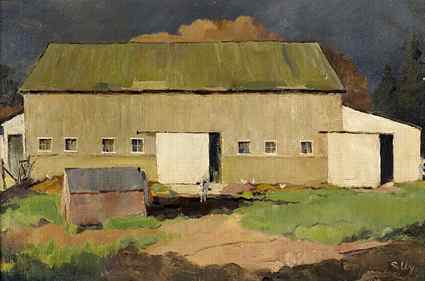
(above: Robert Selby (1909-1997), Dairy Barn, Oil
on board, 1958. Donated by Susan Forsyth Selby Sklar)
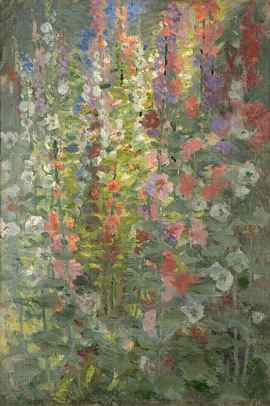
(above: Otto Stark (1859-1926), Hollyhocks, Oil on
canvas, c. 1900. Indiana State Museum Collection)
 Return to Heartland Art:
Selections from Your Indiana Collection
Return to Heartland Art:
Selections from Your Indiana Collection
For biographical information on artists referenced above
please see America's Distinguished
Artists, a national registry of historic artists
Search Resource
Library for thousands of articles and essays on American art.
Copyright 2010 Traditional Fine Arts Organization, Inc., an Arizona nonprofit corporation. All rights
reserved.