Editor's note: The American
Folk Art Museum provided source material to
Resource Library for the following article or essay. If you have
questions or comments regarding the source material, please contact the
American Folk Art Museum
directly through either this phone number or web address:
Women Only: Folk Art by
Female Hands
April 6 - September 12, 2010
The exhibition Women
Only: Folk Art by Female Hands, on view from April 6 through September
12, 2010, highlights the wealth of female artistic 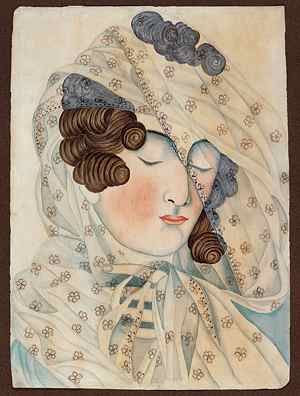 expression
from the eighteenth and nineteenth centuries. These graceful works were
largely made during years spent in the cultivation of skills that prepared
a young woman to shoulder the many roles required of her in adulthood as
a wife and a mother. Others demonstrate that women continued to nourish
their creative selves by plying those skills throughout their lives. Most
of the artworks were created within the prescribed conventions of female
life. Yet these paintings, drawings, samplers, quilts, rugs, and other works
were artful from conception to execution, were displayed in parlors and
best rooms, and conferred status and taste upon both heads of household:
male and female. Selected by senior curator Stacy C. Hollander, Women
Only: Folk Art by Female Hands includes approximately 60 objects drawn
from the museum's collection, rich in this area. (right: Attributed
to Emily Eastman (1804-c. 1841), Loudon, New Hampshire, Woman in Veil,
c. 1825, Watercolor and ink on paper, 14 9/16 x 10 5/8 inches. Collection
American Folk Art Museum, New York. Promised gift of Ralph Esmerian. P1.2001.7.
Photo © 2000 John Bigelow Taylor, New York)
expression
from the eighteenth and nineteenth centuries. These graceful works were
largely made during years spent in the cultivation of skills that prepared
a young woman to shoulder the many roles required of her in adulthood as
a wife and a mother. Others demonstrate that women continued to nourish
their creative selves by plying those skills throughout their lives. Most
of the artworks were created within the prescribed conventions of female
life. Yet these paintings, drawings, samplers, quilts, rugs, and other works
were artful from conception to execution, were displayed in parlors and
best rooms, and conferred status and taste upon both heads of household:
male and female. Selected by senior curator Stacy C. Hollander, Women
Only: Folk Art by Female Hands includes approximately 60 objects drawn
from the museum's collection, rich in this area. (right: Attributed
to Emily Eastman (1804-c. 1841), Loudon, New Hampshire, Woman in Veil,
c. 1825, Watercolor and ink on paper, 14 9/16 x 10 5/8 inches. Collection
American Folk Art Museum, New York. Promised gift of Ralph Esmerian. P1.2001.7.
Photo © 2000 John Bigelow Taylor, New York)
Ironically, the exhibition is introduced with the work
of a male sculptor, as female sculptors were rare. Samuel A. Robb's imposing
Sultana of c. 1880 embodies the ideal of female authority and self-possession.
By the twentieth century, the discovery of Anna Mary Robertson "Grandma"
Moses stimulated an interest in folk art by female hands. Grandma Moses
set the tone for a nostalgic association of women's art in the public imagination.
Her paintings of rural life evoked an earlier time, and her grandmotherly
presence had a calming effect during the turbulent early decades of the
twentieth century. The emergence of Grandma Moses as a popular figure, a
folk artist, and also as a woman artist played into the tenets of the Colonial
Revival movement and the renewed interest in America's colonial past. Women's
work, especially pieced cotton quilts, seemed to capture the romance of
an American heritage and led to the notion of folk art as the home where
female creativity dwelled. As the field of folk art began to develop, the
female contribution to American folk art became increasingly apparent.
Throughout the seventeenth and eighteenth centuries, artmaking
activities were primarily the province of male artists, and women's work
operated almost entirely within a separate circle that was admired and judged
by female peers and important figures such as teachers and parents. Needle
and thread were the traditional tools used to fulfill women's roles in society:
clothing the family, warming and covering the beds, and ornamenting the
home. The elegant Hannah Carter Canvaswork Picture, one of the earliest
works in the exhibition, is part of a 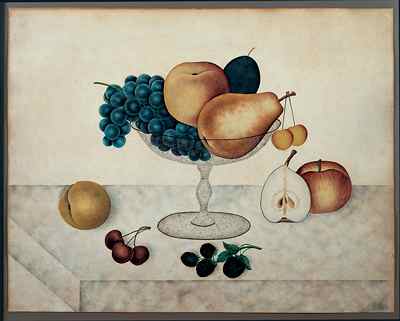 group
of related pastoral embroideries worked by young girls from some of the
wealthiest colonial families while attending Boston boarding schools. The
same set of skills could be parlayed into major artistic expressions, such
as the stunning Crewel Bedcover that relates in material and technique
to the schoolgirl needlework. Quilts showcased individual creativity and
awareness of current aesthetic trends, and, in some cases, a woman's independent
thoughts. The unidentified maker of the Cleveland-Hendricks Crazy
Quilt used the fashionable format of the Crazy quilt to make her
political sentiments known. Incorporating political ribbons and other ephemera,
the strutting rooster (an emblem used by the Democratic Party during the
1880s and 1890s) and portraits of Grover Cleveland and his running mate,
Thomas A. Hendricks, the graphic, colorful quilt presents a strong statement
of Democratic sympathies in a socially sanctioned format. (left:
Emma Jane Cady (1854-1933), East Chatham, New York, Fruit in Glass Compote,
c. 1895, Watercolor, gouache, pencil, and mica flakes on paper, 14 3/4 x
18 3/4 inches. Collection American Folk Art Museum, New York. Promised gift
of Ralph Esmerian. P1.2001.260)
group
of related pastoral embroideries worked by young girls from some of the
wealthiest colonial families while attending Boston boarding schools. The
same set of skills could be parlayed into major artistic expressions, such
as the stunning Crewel Bedcover that relates in material and technique
to the schoolgirl needlework. Quilts showcased individual creativity and
awareness of current aesthetic trends, and, in some cases, a woman's independent
thoughts. The unidentified maker of the Cleveland-Hendricks Crazy
Quilt used the fashionable format of the Crazy quilt to make her
political sentiments known. Incorporating political ribbons and other ephemera,
the strutting rooster (an emblem used by the Democratic Party during the
1880s and 1890s) and portraits of Grover Cleveland and his running mate,
Thomas A. Hendricks, the graphic, colorful quilt presents a strong statement
of Democratic sympathies in a socially sanctioned format. (left:
Emma Jane Cady (1854-1933), East Chatham, New York, Fruit in Glass Compote,
c. 1895, Watercolor, gouache, pencil, and mica flakes on paper, 14 3/4 x
18 3/4 inches. Collection American Folk Art Museum, New York. Promised gift
of Ralph Esmerian. P1.2001.260)
By the end of the eighteenth/ turn of the nineteenth century,
a woman's intellectual attainments were directly tied to her ability to
raise educated and moral sons, and female literacy reached a new high. Historians
now refer to this enlarged role of women as Republican Motherhood. According
to Ms. Hollander the decades that followed in the early nineteenth century
"have been among the least examined in women's studies, with few female
public figures or events of notable historical significance. Interestingly,
they were years of unprecedented female artistic activity, much of it under
the auspices of a talented schoolmistress."
During this period, serious schools, such as the Litchfield
Academy in Connecticut, offered ornamental arts including watercolor painting
and pictorial needlework, but combined them with rigorous academic studies
that "ornamented the mind" as well, such as Greek, Latin, botany,
history, geography, 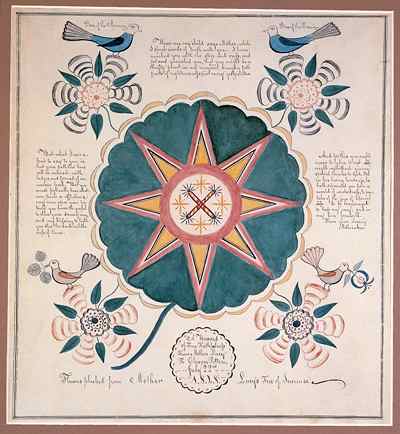 philosophy,
and religion. Mourning pieces that combined Christian values and neo-classical
motifs were a uniquely female expression for this post-Revolutionary era.
Ellen Ogden's poignantly rendered Ogden Family Mourning Piece,
a watercolor and ink on silk, is dated 1813 on the reverse-painted eglomise
mat of its original frame. She pictured only herself and her parents, as
it commemorates the deaths of her six siblings, one older sister and five
younger brothers. An unusual Map of the Animal Kingdom, 1835, illustrates
the introduction of geography into the curriculum. Probably based on a print
source, the map with its charming depictions of animals native to each locale,
is framed with delicate theorem painting of roses with thorny stems. (right:
Polly Ann (Jane) Reed (1818-1881), New Lebanon, New York, Gift Drawing:
A Reward of True Faithfulness From Mother Lucy To Eleanor Potter, 1848,
Watercolor and ink on paper, 11 3/8 x 10 1/2 inches (sight). Collection
American Folk Art Museum, New York. Promised gift of Ralph Esmerian. P1.2001.302.
Photo by Gavin Ashworth, New York)
philosophy,
and religion. Mourning pieces that combined Christian values and neo-classical
motifs were a uniquely female expression for this post-Revolutionary era.
Ellen Ogden's poignantly rendered Ogden Family Mourning Piece,
a watercolor and ink on silk, is dated 1813 on the reverse-painted eglomise
mat of its original frame. She pictured only herself and her parents, as
it commemorates the deaths of her six siblings, one older sister and five
younger brothers. An unusual Map of the Animal Kingdom, 1835, illustrates
the introduction of geography into the curriculum. Probably based on a print
source, the map with its charming depictions of animals native to each locale,
is framed with delicate theorem painting of roses with thorny stems. (right:
Polly Ann (Jane) Reed (1818-1881), New Lebanon, New York, Gift Drawing:
A Reward of True Faithfulness From Mother Lucy To Eleanor Potter, 1848,
Watercolor and ink on paper, 11 3/8 x 10 1/2 inches (sight). Collection
American Folk Art Museum, New York. Promised gift of Ralph Esmerian. P1.2001.302.
Photo by Gavin Ashworth, New York)
Portrait painting throughout the nineteenth century was
largely produced by male artists. Not only was there a long history of men
as portrait painters, it was also not deemed appropriate for a woman to
participate in an itinerant lifestyle. One rare exception, represented by
a small watercolor of a family group, Mr. and Mrs. Lyman Day and
Daughter Cornelia, was Deborah Goldsmith, who painted to support herself
and her "aged parents." When she traveled in western New York
State she was usually accompanied by a family member or trusted religious
leader. Female artists through the mid-nineteenth century, however, created
pastels, miniatures, or watercolors that were meant as tokens of friendship
or as gifts for family and friends. Emily Eastman's delicate Woman in
Veil, a watercolor c. 1825, was probably inspired by a print source,
possibly a fashion plate of the neo-classical period.
Home and church represented the two poles of a woman's
life. From samplers to sermons, a woman's world provided many of the metaphors
through which she visually conveyed her spirituality. The concept of "Virtue"
expressed the values a girl should aspire to and that was inculcated into
every aspect of female life. The Lucy Low Sampler, stitched
in 1776 when she was 12 years old, is composed of alphabets and a religious
sentiment at the top, over a pastoral scene with figures and a rose tree
flanked by stubby trees at the bottom. As a 79-year-old woman, Maria Cadman
Hubbard proudly signed her name and the date of 1848 on the front of her
unique Pieties quilt. She combined the pieced-letter device of seven
small, stacked blocks, with religious texts, highlighting her role as her
family's moral and religious center. In Shaker communities, founded by Mother
Ann Lee, several Shaker sisters received messages from deceased Shaker elders
during the period known as "woman's work." These visions were
transcribed in intricate works that were gifted to specific Shakers. Six
of these rare "gift drawings" are on view.
"Women worked with mediums that were culturally acceptable
or innovated with unusual materials, such as tinsel and marbledust, that
were outside the high-art canon of easel painting and sculpture. Within
these parameters, as in life, lay the freedom for innumerable iterations
and personal artistic satisfaction," notes Ms. Hollander.
What did women look like in the eighteenth and nineteenth
centuries? Visitors leaving the exhibition will pass a wall of faces of
women, painted, of course, by men.
To view wall texts from the exhibition please click here.
To view the checklist from the exhibition please click here.
To view additional images from the exhibition please click here.
Editor's note: Resource Library readers may also
enjoy:
For further biographical information on selected artists
cited in this article please see America's
Distinguished Artists, a national registry of historic artists.
Read more articles and essays concerning this institutional
source by visiting the sub-index page for the American
Folk Art Museum in Resource Library.
Visit the Table
of Contents for Resource Library for thousands
of articles and essays on American art.
© Copyright 2010 Traditional Fine Arts Organization, Inc., an Arizona nonprofit corporation. All rights
reserved.