Editor's note: The Amon Carter Museum provided
source material to Resource Library for the following article. If
you have questions or comments regarding the source material, please contact
the Amon Carter Museum directly through either this phone number or web
address:
American Modern: Abbott,
Evans, Bourke-White
October 2, 2010 - January 2, 2011
The Amon Carter Museum
of American Art is presenting American Modern: Abbott, Evans, Bourke-White,
a special exhibition exploring the work of 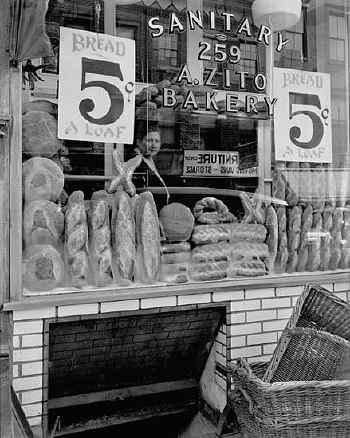 three
of the foremost photographers of the twentieth-century and the golden age
of documentary photography in America. American Modern will be on
view through January 2, 2011. (right: Berenice Abbott (1898-1991),
Bread Store, 259 Bleecker Street, 1937, Gelatin silver print. Museum
of the City of New York, 49.282.57.)
three
of the foremost photographers of the twentieth-century and the golden age
of documentary photography in America. American Modern will be on
view through January 2, 2011. (right: Berenice Abbott (1898-1991),
Bread Store, 259 Bleecker Street, 1937, Gelatin silver print. Museum
of the City of New York, 49.282.57.)
Featuring more than 140 photographs by Berenice Abbott
(1898-1991), Margaret Bourke-White (1906-1971) and Walker Evans (1903-1975),
American Modern was co-organized by the Amon Carter Museum of American
Art and the Colby College Museum of Art in Waterville, Maine. The exhibition
is the result of a unique partnership between three curators: Jessica May
and Sharon Corwin of the Carter and Colby, respectively, and Terri Weissman,
assistant professor of art history at the University of Illinois, Urbana-Champaign.
Together, the three curators present the works of these three artists as
case studies of documentary photography during the Great Depression and
demonstrate how three factors supported the development of documentary photography
during this important period in American history: first, the expansion of
mass media; second, a new attitude toward and acceptance of modern art in
America; and third, government support for photography during the 1930s.
"This exhibition considers the work of three of the
best-loved American photographers in a new light, which is very exciting,"
says curator Jessica May. "Abbott, Evans, and Bourke-White are undisputed
masters of the medium of photography, but they have never been shown in
relation to one another. This exhibition offers viewers an opportunity to
see works together that have not been shown as such since the 1930s."
In addition to vintage photographs from over 20 public
and private collections, the exhibition also features rare first-edition
copies of select books and periodicals from the 1930s. American Modern,
May says, "reminds us that documentary photography was very much a
public genre-this was the first generation of photographers that truly anticipated
that their work would be seen by a vast audience through magazines and books."
A scholarly catalogue, published by the University of California
Press, accompanies the exhibition. The museum has also prepared a mobile
tour of the exhibition, which will be available on the museum's website
or on preloaded iTouch devices available for free loan from the Carter's
Information Desk.
Wall panel texts from the exhibition
- Introductory Text
-
- As the United States and much of the modern world struggled
with an economic depression that was inaugurated (symbolically at least)
by massive drops in the U.S. stock market on October 24 and 29, 1929, and
deepened through the following years, photographic activity flourished
in America, and the genre of documentary emerged as a mode of understanding
contemporary culture. While the nation's and the world's economies were
severely tested, political systems were in flux, and Europe prepared again
for war, Americans recognized in their own country a viable cultural heritage
and sought to stabilize and document that heritage -- even to build upon
it. Thus, the country's literary, artistic, and architectural traditions
were subject not only to examination and revision, but also to expansion
in the form of an explosion of popular literature, the founding of new
art museums, and the establishment of New Deal government-funded arts programs.
Moreover, advances in technology, production, and distribution transformed
mass media in this country: Americans enjoyed popular movies, weekly picture
magazines, and radio broadcasts in unprecedented numbers. Photography had
an important new public role in American life -- during this decade millions
more people than ever before saw photographs in books and magazines, at
art museums and galleries, and in the context of official documentary records
of the Great Depression. Photographs crossed the boundaries between public
and private use, impersonal documentation and expressive creation, and
popular visual culture and fine art.
-
- American Modern examines
the practice of documentary photography through the work of three of the
most important photographers of the decade -- Berenice Abbott, Walker Evans,
and Margaret Bourke-White. Although they were not the decade's only documentary
photographers, each contributed a fundamental, independent, and novel idea
about documentary to the common pool of artistic practice: for Abbott,
it was the notion that photography was a means of critical dialogue and
communication; Evans thoroughly investigated the idea that photography
has a unique and essential relationship to time; and Bourke-White developed
a repertoire wherein documentary could fuse the logic and pageantry of
modern industry with drama and the individual narratives of its subjects.
-
- American Modern: Abbott, Evans, Bourke-White has been co-organized by the Amon Carter Museum of American Art,
Fort Worth, Texas, and the Colby College Museum of Art in Waterville, Maine.
The exhibition and accompanying publication have been made possible in
part by the National Endowment for the Arts, the Mr. and Mrs. Raymond J.
Horowitz Foundation for the Arts, and the Robert Mapplethorpe Foundation.
- The Fort Worth presentation is supported in part by RBC
Wealth Management. Promotional support is provided by the Star-Telegram,
WFAA, and American Airlines.
-
-
-
- Text Panels
-
- Margaret Bourke-White and the Image of Industry
-
- By the late 1920s, Margaret Bourke-White had secured
a position as one of America's preeminent photographers of industry. Working
sometimes on assignment and sometimes speculatively, Bourke-White actively
sought to convey the scale of modern industrial production. She quickly
settled on several important strategies, including borrowing lighting methods
from the burgeoning Hollywood film industry; repeating images of consumer
goods and the machines that produced them to suggest endless chains of
production and abundance; and adopting the graphic dynamism and sharp angles
associated with modern art to express energy and excitement. Her efforts
were not unnoticed. Despite the onset of the Great Depression, Bourke-White
was hired by advertisers, corporate executives, and magazine publishers
to photograph at many of America's largest factories, including those of
major auto manufacturers such as Chrysler and Ford.
-
- Bourke-White's interest in the machines, products, and
places of production brought her attention as a photographer, as did her
glamorous self-fashioning. She was regularly photographed with her camera,
and her own self-image tended to reinforce the sense of exuberance that
characterized many of her early photographs of industry. She was so well-known
that Henry R. Luce, the publisher of Fortune magazine, hired her
in 1930 as a staff photographer for the debut issue of his prestigious
business periodical. Bourke-White's was a somewhat unusual situation --
her professional success came at a moment when many American workers were
feeling the economic sting of the Depression. After 1930, Bourke-White's
photographs increasingly included working people, though they were often
diminutive within the larger composition. The tiny workers in Bourke-White's
industrial photographs may reflect her perception that workers ought to
be represented within the context of industrial photography as well as
her uncertainty about how to represent them appropriately. As the decade
progressed, Bourke-White became more sure-footed and committed in her approach
to working people as the subjects of her photographs.
-
-
- Seeing the World, Telling Stories
-
- In addition to photographing close to home, which for
Abbott, Evans, and Bourke-White during the 1930s meant New York City, these
photographers (and many of their peers) traveled far afield to document
stories. Making important trips within the United States as well as abroad
prompted Abbott, Evans, and Bourke-White to develop more sophisticated
approaches of linking sequences of photographs together to create an overarching
narrative -- one of the defining characteristics of documentary photography
in the 1930s.
-
- Abbott's major work of the decade, Changing New York,
was a city project, but she spent the summer of 1935 traveling by car through
much of the United States in preparation for a proposed (and unrealized)
photo-book that addressed American life and culture. Bourke-White traveled
to the Soviet Union in 1930, 1931, and 1932 in order to make photographs
for American audiences. Although she was already a Fortune staff
photographer, her editors feared she would not be able to get a visa and
refused to pay for her trip. Ironically, the inconvenience of undertaking
expensive travel without support gave Bourke-White freedom of ownership
over the work and allowed her to distribute it as she liked. She eventually
published two books and a short documentary film on the Soviet Union. Evans
took several early assignments abroad, including a 1932 trip to Tahiti
on a private yacht and a 1933 trip to Cuba for the Philadelphia publisher
J. P. Lippincott to make photographs for the journalist Carelton Beals'
book The Crime of Cuba (1933). Later in the decade, both Bourke-White
and Evans traveled-like Abbott, mostly by car -- within the United States
to work on extensive documentary projects.
-
-
- Documentary Photography and the South: Projects and
Assignments
-
- Although the 1930s saw a profusion of documentary photography
throughout the country, images of the American South are particularly resonant
in public memory of the Depression. One of the most important and prolific
public art projects of President Franklin Delano Roosevelt's New Deal government
was the Historical Division of the federal agency called the Resettlement
Administration (RA), later named the Farm Security Administration. Its
director, Roy Stryker, renamed Evans in 1935 to document the agency's work
of building planned communities and relocating poor, rural farmers, as
well as to make photographic records of the devastating effects of the
Depression on sharecroppers in the South and migrant workers in the West
and Midwest. Stryker tirelessly promoted the RA, and as a result of his
efforts many Americans became familiar with RA photographs in magazines
and newspapers, as well as via exhibitions.
-
- Evans worked for the RA until late winter 1937. In the
summer of 1936, however, he was furloughed from the agency to work on a
project with the writer James Agee for Fortune. They traveled together
to Hale County, Alabama, to make photographs of three sharecropper families.
Fortune eventually dropped the project, but Agee and Evans published
it as the book Let Us Now Praise Famous Men in 1941.
-
- Bourke-White's work for Fortune and Life
took her to the Midwest and the South in 1934 (with Agee) and in 1937 to
document environmental disasters. In 1936, she embarked on a project with
the writer Erskine Caldwell that would be published as the book You
Have Seen Their Faces (1937). Like Evans, Bourke-White was keenly attuned
to the dramatic conditions that poor, rural farmers experienced during
the Depression. Her approach to her subjects built on her previous experience
with industrial subjects and dramatic compositions, but the photographs
from her time in the South suggest that her focus by the mid-1930s had
turned decidedly toward human subjects.
-
-
- The Legacy of American Documentary
-
- Signs and portraiture became increasingly crucial subject
matter for documentary photography as the 1930s progressed and the Depression
wore on. Both portraiture and public signs allowed photographers to make
images that seemed simple and direct. Similarly, in Let Us Now Praise
Famous Men (1941), the writer James Agee expressed the desire for his
writing to transcend the act of representation and convey material facts.
He wrote, "If I could, I'd do no writing here at all. It would be
photographs; the rest would be fragments of cloth, bits of cotton, lumps
of earth."
-
- By the end of the decade, the values of authenticity,
accuracy, and evenhandedness that Abbott, Bourke-White, and Evans sought
-- despite their radically different approaches -- had become values that
were commonly associated with photography itself. Despite this remarkable
achievement, the means for producing major documentary projects diminished
toward the end of the Great Depression. By the end of the decade documentary
had saturated public culture as the primary vehicle of description for
a social transformation-the Depression-that was itself passing into history.
-
- Abbott, Bourke-White, and Evans each saw their careers
take a different path shortly thereafter. Abbott published Changing
New York in 1939 and began making complicated and technically sophisticated
photographs of scientific phenomena. In the 1940s, Bourke-White became
one of the premier photojournalists of her generation, but she did not
take on another explicitly documentary project in the same model as You
Have Seen Their Faces. Finally, Evans had a major solo exhibition at
the Museum of Modern Art, American Photographs, in 1938 and then
published, with Agee, Let Us Now Praise Famous Men. The photographs
were already five years old by the time the book came out, and Evans was
deeply engaged with a project of making surreptitious photographs of subway
riders in New York.
-
-
- Walker Evans
- The South as Subject
-
- Just as Margaret Bourke-White made her mark as a photographer
in northeastern factories and Berenice Abbott established herself professionally
by photographing the transformation of New York City into a modern metropolis,
Walker Evans forged his artistic legacy on location. From 1935 through
1937, he traveled through the American South photographing sharecroppers;
antebellum architecture; and the streets, railroads, and shop fronts of
small towns. These subjects were not obvious choices for the young photographer,
who learned to photograph on the streets of New York and whose friends
and supporters included many of that city's artistic and literary elite.
Yet Evans was also interested in photographing the everyday aspects of
American culture, and he was friendly with a number of writers and intellectuals
from the South, including the critic James Agee. Although they were raised
in the South, many of his friends relocated to New York City to be part
of the publishing and modern art scene, and their perspectives on southern
culture made a deep impact on Evans.
-
- Evans traveled throughout the South on assignment for
both public and private organizations. He primarily used an 8-by-10-inch
view camera and worked very slowly. The resulting photographs crystallized
the formal lessons he learned earlier in the decade: he strove for a direct
and balanced composition, eschewed dramatic camera angles, and made sure
that the ground glass of the camera was directly parallel to the subject.
Perhaps Evans' most significant contribution to the history of documentary
photography was to fuse the formal quality of straightforwardness as a
means of organizing a photograph with the moral idea of straightforwardness
as a form of truth.
Additional images
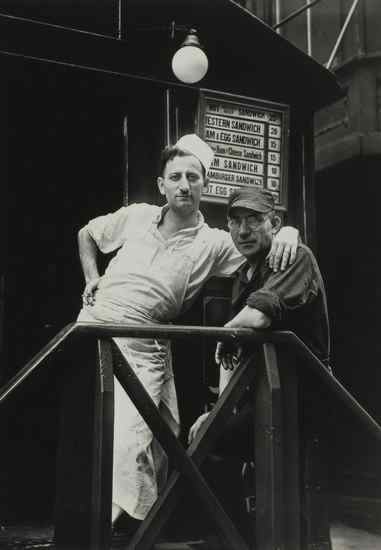
(above: Walker Evans (1903-1975), Posed Portraits, New
York, 1932, Gelatin silver print. © Walker Evans Archive, The Metropolitan
Museum of Art. The Art Institute of Chicago, Gift of Mrs. James Ward Thorne,
1962.169)
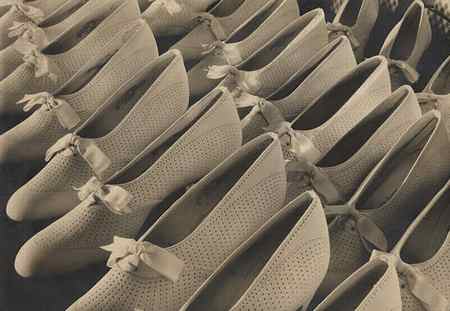
(above: Margaret Bourke-White (1906-1971), Delman Shoes,
1933, Gelatin silver print. © Estate of Margaret Bourke-White/ Licensed
by VAGA, New York, NY Margaret Bourke-White Collection, Special Collections
Research Center, Syracuse University Library)
Editor's note: readers may also enjoy
and biographical information on artists cited in this article
in America's Distinguished Artists,
a national registry of historic artists.
Read more articles and essays concerning this institutional
source by visiting the sub-index page for the Amon
Carter Museum in Resource Library.
Search Resource
Library for thousands of articles and essays on American art.
Copyright 2010 Traditional Fine Arts Organization, Inc., an Arizona nonprofit corporation. All rights
reserved.