Editor's note: The Huntington Museum of Art provided
source material to Resource Library for the following article or
essay. If you have questions or comments regarding the source material,
please contact the The Huntington Museum of Art directly through either
this phone number or web address:
American Spirit: The A.G.
Edwards/Wachovia Securities Collection
April 12 - July 13, 2008
More than 50 works
of art make up American Spirit: The A.G. Edwards/Wachovia Securities
Collection, an exhibit that runs from April 12 through July 13,
2008, at the Huntington Museum of Art.
This exhibition captures the "American Spirit"
with prints, posters, and photographs from the mid-19th century to the end
of the 20th century. Each artwork addresses what it is that makes us uniquely
American. Themes of the exhibit include issues of western expansion in the
19th century, small town life, urban life, recreational pastimes, industry,
the immigrant experience, our national icons, women's rights, and wartime
propaganda.
Artists featured in the exhibit include Andy Warhol, Roy
Lichtenstein, Robert Rauschenberg, George Catlin, Howard Chandler Christy,
and Edward Penfield.
A special opening reception for the exhibit was held Sunday,
April 13, 2008, featuring music by The 1937 Flood and refreshments. That
afternoon, the Musical Arts Guild presented "We the People," a
concert of patriotic music and song in HMA's Grace Rardin Doherty Auditorium.
This exhibition is sponsored by the Huntington Office of
A.G. Edwards. A.G. Edwards is a division of Wachovia Securities, LLC. Additional
support for this exhibition comes from the West Virginia Commission on the
Arts, St. Mary's Medical Center, Champion Publishing, Inc./The Herald-Dispatch,
the West Virginia Chamber of Commerce, and The Earl and Nancy Heiner Donor
Advised Fund of the Foundation for the Tri-State Community, Inc.
Wall text from the exhibition
In 1991, A.G. Edwards created a traveling exhibition program,
encouraging branch offices to partner with local art institutions, bringing
a selection of the corporate collection based in St. Louis, Missouri to
their communities. The Huntington Museum of Art is excited to host a branch
sponsored exhibition, presenting fifty selected works from a large collection
of more than 4,000 by noted American and European artists.
This exhibition addresses our "American Spirit"
with an array of prints, posters, and photographs from the mid-nineteenth
century to the end of the twentieth century. Each work speaks to what it
is that makes us uniquely American. The over riding themes of the exhibition
deal with artistic renditions of the following issues: western expansion
in the nineteenth century, everyday work and life in small towns and urban
areas, celebration days, recreational pastimes, industry (steel, oil, rail,
steamboats), the immigrant experience, our national icons, women's rights,
and war time propaganda.
Artists who are completely disparate, in terms of style
and sensibilities, for example George Catlin and Andy Warhol, fit together
perfectly in this exhibition. They range from painters depicting the early
west; illustrators producing war propaganda posters; photo-journalists;
Pop and contemporary artists. Many of these images have become icons of
American art, such as Alfred Stieglitz's photograph entitled The Steerage,
and James Montgomery Flagg's Uncle Sam posters.
The artists included in this exhibition capture our collective
memories, and address the major concerns of Americans both today and throughout
our country's history -- the same values as denoted in the Declaration of
Independence -- life, liberty, and the pursuit of happiness.
Object labels from the exhibition
- Vito Acconci (American; b.1940)
- Wav(er)ing Flag
- 1990
- Lithograph
- 6 individually-framed sheets
- 26 _ x 20 _ inches each [framed]
- Condition: Excellent.
-
- Vito Acconci began his career as a writer and poet. In the late 1960s
and early '70s, he created his first visual artwork by using his own body
as a subject for photography, film, video, performance- and conceptual-art.
This provocative group of work proved very influential, earning Acconci
an international reputation. By the 1980s Acconci became interested in
sculpture, multimedia installation, and architecture and landscape design.
-
- Wav(er)ing Flag is an unusual print of six individually framed
sheets intended to be viewed as one work of art. Acconci's American flag,
emblazoned with the pledge of allegiance, waves in the wind. It is important
to Acconci that individuals interact in some way with his artwork by touching
it or, in this case, reading the words on it. Acconci professes that he
does not create a "kind of self-enclosed art, but . . . art as an
instrument in the world."
-
- In 1892 Francis Bellamy, a Baptist minister, served as the chairman
of a National Education Association's committee of state superintendents.
As chairman, he prepared the program for the public schools' quadricentennial
celebration for Columbus Day. Bellamy structured this public school program
around a flag raising ceremony and a flag salute he composed in August
-- his "Pledge of Allegiance."
- Anonymous
- Remember Your First Thrill of American Liberty
- 1917
- Color lithograph
- 21 x 30 _ inches [framed]
- Condition: Good.
-
- Sources estimate that World War I cost the United States more than
$30 billion. About two-thirds of this amount was raised through the four
Liberty Loans and the final Victory Loan government bond campaigns. Part
of the success of these campaigns is due to the aggressive publicity techniques
employed to sell the American public on the plans.
-
- In a time before television, posters provided a critical level of publicity.
Remember Your First Thrill of American Liberty was created to promote
the Second Liberty Loan of 1917. The scene (rendered in soft reds, blues
and grays) shows an immigrant ship passing the Statue of Liberty en route
to Ellis Island. The poster was designed to appeal to recent immigrants,
for it would remind them of their arrival in America while stressing their
duty to support their newly-adopted homeland.
- Anonymous
- Remember! The Flag of Liberty - Support It!
- 1918
- Color lithograph
- 28 5/8 x 38 7/8 inches [framed]
- Condition: Very good.
-
- Sources estimate that World War I cost the United States more than
$30 billion. About two-thirds of this amount was raised through the four
Liberty Loans and the final Victory Loan government bond campaigns. Part
of the success of these campaigns is due to the aggressive publicity techniques
employed to sell the American public on the plans.
-
- The Third Liberty Loan was launched on April 6, 1918, the first anniversary
of America's entrance into World War I. President Woodrow Wilson endorsed
the campaign and announced that, although he had already overextended his
personal budget by purchasing numerous liberty bonds, he would still buy
another $50 bond -- this time on an installment plan. Wilson immediately
called on all Americans to match his effort.
-
- In this poster a newly immigrated family honors the flag and stands
before the ship that carried them to America. The poster's message, though,
appeals to immigrants and citizens alike.
-
- Anonymous
- Official United States War Films Now Being Shown
- 1918-19
- Color lithograph
- 26 x 39 inches [image]
- Condition: Good.
-
- A week after the United States entered WWI in April 1917, President
Woodrow Wilson created the Committee on Public Information (CPI) to publicize
American war efforts abroad and promote support domestically. One of many
divisions within the CPI, the Division of Films focused upon promoting
the war through the cinema. In addition to producing one-reel films, the
Division of Films also produced three major feature films, Pershing's
Crusaders, America's Answer and Under Four Flags.
-
- Thomas Frederick Arndt (American; b.1944)
- Two American Flags, Freed Iranian Hostage Tickertape Parade, New
York City, Jan. 20, 1981
- 1981
- Gelatin silver print
- 31 _ x 25 inches [framed]
- Condition: Very good.
-
- In November 1979, students seized the American embassy in Tehran during
Iran's Islamic revolution. In the United States, failure to resolve the
crisis contributed to Ronald Reagan's defeat of Jimmy Carter in the 1980
presidential election. After the election, with the assistance of Algerian
intermediaries, successful negotiations began. On January 20, 1981, the
day of President Reagan's inauguration, the United States released almost
$8 billion in Iranian assets, and the hostages were freed after 444 days
in Iranian detention. Thomas Arndt's photograph of the tickertape parade
in New York City captures the joy of this Liberation.
-
- George Caleb Bingham (American; 1811-79)
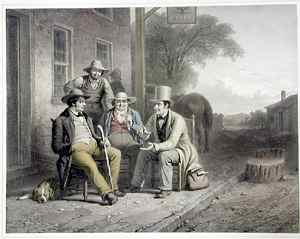
- Canvassing for a Vote
- 1853
- Lithograph with hand-coloring
- 30 _ x 27 inches [framed]
- Condition: Very good.
-
- As one of the first major American painters to work west of the Mississippi,
George Caleb Bingham may be one of the most well known American genre artists
of the pre-Civil War era. In 1849 Bingham was elected to the Missouri State
Legislature; in 1868 he lost his bid for Congress. Canvassing for a
Vote captures the personalized nature and accessibility of mid-nineteenth-century
American politics.
-
- George Caleb Bingham (American; 1811-79)
- The County Election
- 1854
- Engraving with hand-coloring
- 29 _ x 22 inches [image]
- Condition: Good.
-
- As one of the first major American painters to work west of the Mississippi,
George Caleb Bingham may be one of the most well known American genre artists
of the pre-Civil War era. In 1849 Bingham was elected to the Missouri State
Legislature; in 1868 he lost his bid for Congress. The County Election,
along with Bingham's Stump Speaking, captures the communal and
participatory nature of mid-nineteenth-century American politics.
-
-
- Karl Bodmer (Swiss; 1809-93)
- View Of the Stone Walls on the Upper Missouri
- Tableau 41 from Travels in the Interior of North America, 1832-34
- 1839-43
- Engraving, etching and aquatint with hand-coloring
- 26 _ x 22 _ inches [framed]
- Condition: Excellent.
- Prince Maximilian of Wied-Nuwied, along with Swiss artist Karl Bodmer,
undertook one of the most important explorations of the Louisiana Purchase
territory. Between 1832 and 1834 their expedition, which traveled further
up the Missouri River than had artist George Catlin, made a thorough record
of flora, fauna and local people. Maximilian's treatise, Travels in
the Interior of North America in the Years 1832-34, was later published
with Bodmer's prints bound into separate volumes. Each of the 81 plates
created for the publication (33 as small-format vignettes and 48
as large-format tableaux) were engraved by hand and underwent five
to six different process to achieve the final print.
-
- In early August 1833, Maximilian and Bodmer passed through the Stone
Walls region of the Missouri River on their way to Fort McKenzie (modern-day
Great Falls, Montana). Maximilian recorded, "We came to a most remarkable
place. The strata of sandstone . . . run along both banks of the river,
which is rather narrow. . . . At some distance before us, the eye fell
on an apparently narrow gate, the white walls of the two banks approaching
so near to each other, that the river seemed to be very contracted between
them. This illusion was heightened by the turn which the Missouri makes
in this place to the southwest."
-
- Peter Brown (American; b.1948)
- Rialto Theater, Brownfield, Texas, 1994
- 1994/99
- Chromogenic print
- 29 _ x 24 _ inches [framed]
- Condition: Very good.
-
- Peter Brown first became interested in the Great Plains while on cross-country
car trips with his parents. They would travel by state highways, rather
than by interstates, and drive through one small town after another. After
settling in Houston, Texas, Brown began photographing the Texas Coastal
Prairie and eventually places further north. "After a few years,"
says Brown, "it became clear to me. I was trying to photograph the
Great Plains." He has since made hundreds of trips, photographing
small-town life -- deserted Main Streets -- and the environs beyond.
-
- Rialto Theater, Brownfield, Texas, 1994 features a once-popular,
now abandoned, movie theater on Main Street. As in many small American
towns, the movie theater was once a major cultural attraction for the community.
The mural above the marquee depicts cowboys around a campfire.
-
- Esther Bubley (American; 1921-98)
- Memorial Day Services, Arlington, Virginia, 1942
- 1942
- Vintage gelatin silver print
- 23 x 21 inches [framed]
- Condition: Very good.
-
- In 1940 Esther Bubley arrived in Washington D.C. after studying photography
at the Minneapolis School of Design. After briefly working at the National
Archives, she was hired as a darkroom technician by Roy Stryker, head of
the documentary photography project for the Farm Security Administration
(FSA). On her days off she wandered the city with her camera documenting
people and further developing her photography skills. When World War II
began, Stryker hired Bubley to work as a staff photographer for the Office
of War Information (OWI). It is possible that this photograph of Memorial
Day services in Arlington, Virginia was one of Bubley's early assignments
for the OWI.
-
- Esther Bubley (American; 1921-98)
- Main Street, Tomball, Texas, May 1945
- 1945
- Vintage gelatin silver print
- 21 x 23 inches [framed]
- Condition: Very good.
-
- In 1940 Esther Bubley arrived in Washington D.C. after studying photography
at the Minneapolis School of Design. After briefly working at the National
Archives, she was hired as a darkroom technician by Roy Stryker, head of
the documentary photography project for the Farm Security Administration
(FSA). On her days off she wandered the city with her camera documenting
people and further developing her photography skills. When World War II
began, Stryker hired Bubley to work as a staff photographer for the Office
of War Information (OWI).
-
- From 1944 until 1950, Stryker hired Bubley for freelance projects for
Standard Oil of New Jersey (SONJ). For one of these projects Bubley traveled
to Texas and documented oil boom towns. Tomball, Texas, a small town near
Houston, was occupied mostly by the employees of Humble Oil and Refining
Company, an affiliate of Standard Oil. In Tomball Bubley captured images
of everyday life as well as the odd juxtapositions attributed to the sudden
industrial growth.
-
- A horse is tethered near a "No Parking" curb while the buildings
of Main Street (lined with cars) fill the background.
-
- Evelyn Rumsey Cary (American; 1855-1924)
- Woman Suffrage -- Give Her the Fruit of Her Hands and Let Her Own
Works Praise Her in the Gates
- 1903-07
- Color lithograph
- 31 x 49 inches [framed]
- Condition: Very good.
-
- Evelyn Rumsey Cary was born into a prominent Buffalo, New York family.
Her father was a founding member of the Buffalo Fine Arts Academy, where
Cary trained and exhibited her paintings at the end of the nineteenth century.
This poster was Cary's contribution to the women's suffrage movement in
the early 1900s. Cary's allegorical figure of 'woman' is literally one
with the earth: Her body is depicted in the organic form of a tree that
grows upwards to mingle with the leaves, branches and fruit.
-
- George Catlin (American; 1796-1872)
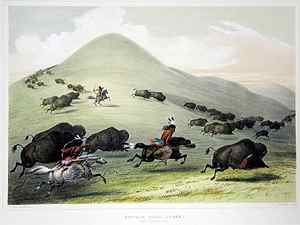
- Buffalo Hunt, Chase
- Plate 6 from North American Indian Portfolio
- 1844
- Hand-colored lithograph
- 17 _ x 12 _ inches [image]
- Condition: Excellent.
- In 1832, painter George Catlin left St. Louis for a 2,500-mile trip
up the Missouri River to Fort Union near the junction of the Yellowstone
and Missouri rivers. He created a remarkable series of images depicting
native individuals and their villages, games and ceremonies. He also recorded
how the Plains tribes hunted buffalo, antelope and bear as well as the
ritual dances associated with these hunts.
-
- The works and artifacts he collected formed a large exhibition that
opened in New York City in 1837. When the exhibition traveled to Washington,
D.C., Catlin tried to persuade Congress to buy his collection. When Congress
declined his offer, Catlin sailed with the exhibition to England. In Europe
Catlin conceived the idea for the North American Indian Portfolio, a
series of prints based on his paintings and sketches. Catlin also wrote
Letters and Notes on the Manners, Customs and Condition of the North
American Indians, a copiously illustrated two-volume book recalling
his experiences among the Native Americans.
-
- Catlin enjoyed portraying hunting scenes, particularly of buffalo.
Artists who later painted the West depicted at least one "buffalo
chase" in Catlin's style.
-
- Howard Chandler Christy (American; 1873-1952)
- Americans All!
- 1919
- Color halftone
- 26 7/8 x 40 inches [sheet]
- Condition: Very good.
-
- Howard Chandler Christy is probably best known for his 'Christy Girl,'
a female character-type that appeared in his early prints for Century
Magazine and then again in his WWI posters for the Red Cross and Navy.
Americans All! was created to advertise the Victory Liberty Loan.
Here Lady Liberty raises a laurel wreath to honor a small sampling of Americans
who have fallen in battle. The listed surnames speak of a variety of ethnicities
that immigrated to America, making it their chosen home for which they
gave their lives.
-
- Gordon Coster (American; 1906-88)
- War Ends, Chicago
- 1945
- Vintage gelatin silver print
- 22 x 19 inches [framed]
- Condition: Very good.
-
- Gordon Coster's photographs regularly appeared on the pages of Life
magazine. His scenes of the World War II victory celebration in Chicago
on August 14, 1945, are among the most recognizable images associated with
the end of the war.
-
- Walker Evans (American; 1903-75)
- Illustrating Bridgeport's War Factories, Fortune, September
1941
- 1941
- Vintage gelatin silver print
- 17 x 21 1/8 inches [framed]
- Condition: Excellent.
-
- Best known for the documentary-style photographs of southern farming
communities he took for the Farm Security Administration in the 1930s,
Walker Evans also had several bodies of work published in Fortune
magazine. When America began gearing up its war effort in 1941, Evans was
asked by Fortune to photograph the many factories making arms and
munitions in Bridgeport, Connecticut. Although the Bridgeport series was
stylistically reminiscent of the early street photographs he made in New
York, as with his deeply moving work done for the FSA, Evans managed to
capture the complex human face of the wartime American worker: women with
children.
-
- Nat Fein (American; 1914-2000)
- Babe Ruth Bows Out, June 13, 1948
- 1948/57
- Gelatin silver print
- 17 x 21 inches [framed]
- Condition: Very good.
- Nat Fein began working as a copyboy for the New York Herald Tribune
in 1932. Three years later he bought a Speed Graphic camera and became
a press photographer. He quickly established himself as a risk-taker
with a keen ability to both shoot straight and stage shots. During the
thirty-three years he photographed for the Tribune he won numerous
awards for his large body of work, which has been described as a photo-documentary
of bygone New York City.
-
- Fein was assigned to cover Babe Ruth's farewell at Yankee Stadium in
1948. The day was overcast, and Fein chose to use natural light to create
a clear, yet soft, image of Ruth standing at the plate saying goodbye to
his fans. Even though Fein did not capture Ruth's face, the identity of
the stolid figure is unmistakable. Dozens of photographers shot hundreds
of photos of Ruth bowing out, yet Fein's image was awarded the 1949 Pulitzer
Prize for the best journalistic photograph.
-
- Harrison Fisher (American; 1875-1934)
- Have You Answered the Red Cross Christmas Roll Call?
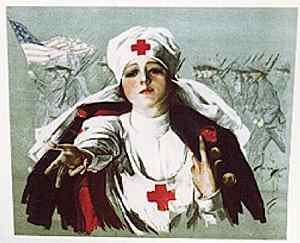
- 1918
- Color lithograph
- 31 _ x 28 3/8 inches [framed]
- Condition: Good.
-
- In the first quarter of the twentieth century Harrison Fisher's work
was widely recognized in the United States. An illustrator for numerous
Hearst publications, Fisher's work appeared in magazines and newspapers
coast-to-coast. During World War I, Fisher worked for the Division of Pictorial
Publicity created by President Woodrow Wilson. The committee's mission
was to create posters that would generate a widespread appeal for individuals
to enlist, invest in war bonds and conserve food and fuel. The Committee
selected four of Fisher's designs, including this image of an American
Red Cross nurse reaching out her hands. Have You Answered the Red Cross
Christmas Roll Call? became a symbol of the Red Cross and played a
major role in its war campaigns.
-
- James Montgomery Flagg (American; 1877-1960)
- Tell that to the Marines!
- 1917
- Color halftone offset
- 38 x 47 _ inches [framed]
- Condition: Very good.
-
- As a member of President Woodrow Wilson's Division of Pictorial Publicity
during World War I, James Montgomery Flagg designed numerous posters for
the government. One of the more famous images he produced was the I
Want You For the U.S. Army poster with Uncle Sam. Tell That to the
Marines was inspired by an August 1914 newspaper headline reporting
the German troops' swift march through Belgium. Here a white-collar worker
is so enraged by the atrocities committed against women and children that
he is determined to enlist in the Marines.
-
- James Montgomery Flagg (American; 1877-1960)
- Boys and Girls! You Can Help Your Uncle Sam Win the War
- 1918
- Color lithograph
- 20 x 30 inches [sheet]
- Condition: Good.
-
- James Montgomery Flagg was an early master of pen and ink, selling
his first illustration to the St. Nicholas Magazine at age twelve.
By the age of fifteen he was on staff at Life and Judge Magazines.
His rendering of Uncle Sam in this and other posters has been championed
as an icon of Liberty and Duty.
-
- William Gottlieb (American; b.1917)
- Duke Ellington
- 1946/printed later
- Gelatin silver print
- 23 x 27 inches [framed]
- Condition: Very good.
-
- William Gottlieb's photographs of jazz musicians are among his most
notable. In addition to Duke Ellington, his subjects have included Billie
Holiday, Ella Fitzgerald and Charlie Parker. While Gottlieb's photographs
have been featured in numerous museum exhibitions, they have also graced
the covers of record albums and have even served as the basis of a series
of United States postal stamps depicting famous jazz artists. In 1997,
Gottlieb was awarded Downbeat magazine's "Lifetime Achievement
Award for Contributions to Jazz."
-
- Rene Gregg (American; b.1953)
- Liberty
- 1993
- Ilfochrome
- 46 _ x 31 _ inches [framed]
- Condition: Very good.
-
- Rene Greg studied finance in college and began her career as the comptroller
for a small film company. She soon became interested in filmmaking and
abandoned her calculator for a camera. Today, she works in New York City
as a commercial and fine art photographer.
-
- Harold Leroy Harvey (American; 1899-1971)
- Untitled (NewYork, Flags Blowing)
- 1931-36
- Vintage gelatin silver print
- 15 x 23 _ inches [framed]
- Condition: Very good.
-
- During the 1920s, Harold Leroy Harvey worked as an assistant to renowned
American photographer and painter Man Ray. During this period Man Ray began
exploring different photographic methods, including the photogram -- an
image created directly on photographic paper without using a camera. During
the 1930s Harvey began to make his own photographs.
-
- Untitled shows the recently completed Empire State Building
from Fifth Avenue with blowing flags in the foreground. Harvey successfully
captured the majestic American architectural feat that reigned as the world's
tallest building for nearly fifty years.
-
- Lewis Hine (American; 1874-1940)
- Untitled Industry Series, Woman at Machine
- 1920-29
- Vintage gelatin silver print
- 19 x 22 inches [framed]
- Condition: Very good.
-
- Lewis Hine's early work was primarily concerned with social reform.
After World War I, however, Hine returned from Europe, where he had been
working with the Red Cross and documenting war refugees, and began his
self-described 'work portraits' series. With this series, upon which Hine
worked until his death in 1940, Hine sought to portray workers as individuals
who controlled the machinery of industrialization rather than as victims
of mechanization. His images are well-lit and aesthetically-structured
to emphasize the subject's dominance over the machine. He called his approach
'interpretive photography' and published his photographs in the form of
picture essays in two publications edited by social reformist Paul Kellogg,
The Survey and The Survey Graphic.
-
- Peter B. Kaplan (American; b.1939)
- 1st Sunset
- 1983/90
- Dye-transfer print
- 50 x 37 _ inches [framed]
- Condition: Very good.
-
- Known for his specialty of 'height photography,' Peter B. Kaplan climbs
tall buildings, monuments and bridges, and then places his camera -- on
the end of a 20-foot pole -- over the edge to capture a unique vantage
point. He has photographed the Empire State Building, Chrysler Building,
St. Louis Arch, World Trade Center and numerous other tall landmarks using
this unique method. Kaplan was honored when the United States and French
governments selected this image for the Statue of Liberty's 100th anniversary
commemorative stamp issued on July 4, 1986. His images of the Statue of
Liberty were also selected to appear on 170 different commemorative stamps
in thirteen other nations. This 'height photograph' was taken while Kaplan
stood on the torch observatory of the Statue.