Shaping an Art Collection: Strategies for Acquiring Works of Art
with an emphasis on American Representational Art
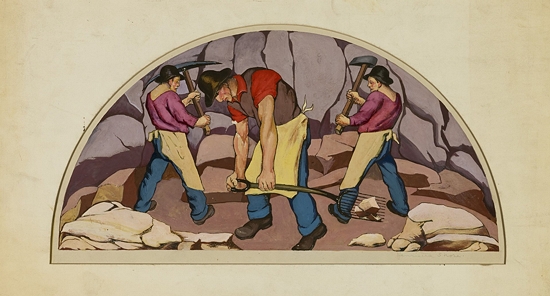
(above: Henrietta Shore, Study for Mural of Rock Breakers, Smithsonian American Art Museum. Public domain, via Wikimedia Commons*)
If you are a casual collector, your acquisition strategy may consist of visiting galleries in your community. If you wish to become a more serious collector, a more complex strategy may be in order. Following are several building blocks for strategies that will help you towards successful acquisitions.
TFAO strongly recommends self-education in your field of interest before acquiring expensive works of art. You may seek out lectures by curators and other experts offered by museums. Joining museum councils, described in Councils for museum members, is always useful. Essays and articles in books and magazines provide vital information. A TFAO keyword search will access thousands of articles and essays published online in TFAO's Resource Library, plus much more. You are able to find further texts not published in Resource Library by visiting TFAO's list of authors, A wealth of knowledge is available through TFAO's catalogues, directing viewers to museum exhibit information, artist biographies, online audio and video, DVD and VHS videos, paper-printed books and other materials.
Resource Library has published a series of essays titled Fine Art Valuation by Roger Dunbier, including the essay What Makes an Art Collection? A Collector? TFAO suggests reading this essay and Dr. Dunbier's other essays - often humorous - in the series. Also see Plein Talk by Connie Kirk, in which an artist offers her perspective on collecting.
If you are building a collection, fundamental decisions are needed on an approach. Instead of a helter-skelter approach, consider questions such as:
While educating yourself in your field of interest, you will see names of experts who have written texts regarding your favorite topics or artists. Write down authors' names along with notes on how to reach them. such as information on their employers or publishers. Many times the authors will be professors in universities or curators in museums. If they are retired, the institutions where they worked may graciously contact the author on your behalf or share contact information with you. Many savvy collectors contact relevant experts before contacting dealers, galleries or auction houses.
Sometimes retired or part-time art museum curators (see Definitions in Museums Explained) also act as private advisors or curators for individuals building collections. An advisor or private curator, working on a fee basis, can be of enormous benefit as you form a collection. They know reputable dealers and perhaps other sources of works difficult to access. They can acquire works discretely on your behalf, help you use your dollars wisely, and guide you to experts in conservation and other fields. If you wish to acquire outstanding examples of an important artist's work, you may be faced with an extraordinary challenge: most of the best works of the artist may have been already acquired by public and private museums. The most informed consultants and dealers will be needed to meet this challenge. Some advisors are affiliated with the Association of Professional Art Advisors, which makes available names of its members on its website. An article in the February 2, 2015 Wall Street Journal describes the services of APAA.
If you are not using the services of a fee advisor/curator, when seeking an outstanding work to fit into your collection, your strategy may entail further steps. You may wish to prepare contact lists. Separate lists may be compiled with names of authors, presently employed museum curators, dealers, gallery owners and auction houses. Authors and museum curators might be contacted first to gain their general advice. Also, they may lead you to other collectors (including collectors who prefer to have their artworks in exhibits be identified only by the tag "Private collection") who may share information or even sell or trade with you directly without a transaction fee. Names of collectors sharing your topic of interest may also be gathered from checklists accompanying Resource Library articles and essays, at the back of exhibit brochures and catalogs, or directly from labels for artworks in museum exhibits.
After allowing sufficient time for the authors and museum curators to respond and further time to exhaust their leads, you may then decide to contact dealers, gallery owners and auction houses. When writing to multiple sources for an acquisition with specific criteria, it may be advisable that you make clear to each party that you seeking the acquisition from multiple sources and that there is no exclusive arrangement intended.
Once satisfactory self-education in a field of interest is accomplished and the focus of a collection has been settled in your mind, you may elect to enlist the services of a primary dealer, or a small group of dealers, instead of contracting with a private curator or conducting extensive networking. Several dealer associations with a code of ethics for members exist to help collectors choose trustworthy dealers. The use of dealers as main sources of building a collection has satisfied many individuals over the years.
Other online resources:
Many online pages offer advice on collecting. Although some tips are repetitious, the following pages contain worthwhile perspectives.
 On April 7, 2009 the Indianapolis Museum
of Art announced the launch of ArtBabble.org,
an online community created to showcase art-based video content. The site
allows visitors to explore works of art online through a collection of
interviews with artists and curators, original documentaries and art installation
videos. Incorporating cutting-edge technology, ArtBabble features high-definition
video, full text transcription of all the videos on site and interactive
features including viewer feedback and video sharing. One of the topics
covered by ArtBabble is "Collecting
Art."
The Kimbell
Art Museum was featured in a KERA video featuring Lee
Callum speaking with Kimbell Art Museum Director Eric Lee In the 27-minute
2014 video Lee "...discusses the sleuthing behind acquiring notable
works of art." Accessed June, 2015.
Mark Sublette has created a channel of YouTube
videos on topics relating to paintings and Native American carvings, weavings,
pottery and carvings. Titles regarding "How
To Buy, Sell, and Research Artwork" include:"What
art collectors should look for in paintings, the subtle details that make
a great painting" and "Red
Flags For Buying Art In A Gallery."
On April 7, 2009 the Indianapolis Museum
of Art announced the launch of ArtBabble.org,
an online community created to showcase art-based video content. The site
allows visitors to explore works of art online through a collection of
interviews with artists and curators, original documentaries and art installation
videos. Incorporating cutting-edge technology, ArtBabble features high-definition
video, full text transcription of all the videos on site and interactive
features including viewer feedback and video sharing. One of the topics
covered by ArtBabble is "Collecting
Art."
The Kimbell
Art Museum was featured in a KERA video featuring Lee
Callum speaking with Kimbell Art Museum Director Eric Lee In the 27-minute
2014 video Lee "...discusses the sleuthing behind acquiring notable
works of art." Accessed June, 2015.
Mark Sublette has created a channel of YouTube
videos on topics relating to paintings and Native American carvings, weavings,
pottery and carvings. Titles regarding "How
To Buy, Sell, and Research Artwork" include:"What
art collectors should look for in paintings, the subtle details that make
a great painting" and "Red
Flags For Buying Art In A Gallery."
 Return to Shaping an Art Collection
Return to Resources for Collectors, Life Long Learners,
Students and Teachers of Art History
Links to sources of information outside of our web site are provided only as referrals for your further consideration. Please use due diligence in judging the quality of information contained in these and all other web sites. Information from linked sources may be inaccurate or out of date. TFAO neither recommends or endorses these referenced organizations. Although TFAO includes links to other web sites, it takes no responsibility for the content or information contained on those other sites, nor exerts any editorial or other control over them. For more information on evaluating web pages see TFAO's General Resources section in Online Resources for Collectors and Students of Art History.
*Tag for expired US copyright of object image:

 Search Resource Library
Copyright 2022 Traditional Fine Arts Organization, Inc., an Arizona nonprofit corporation. All rights reserved.