Editor's note: The El Paso Museum of Art provided
source material to Resource Library for the following article or
essay. If you have questions or comments regarding the source material,
please contact the El Paso Museum of Art directly through either this phone
number or web address:
From Paris to North America:
American Impressionism Masterworks
March 6 - May 22, 2011
The El Paso Museum
of Art is celebrating its outstanding American Impressionist paintings with
the exhibition From Paris to North America: American 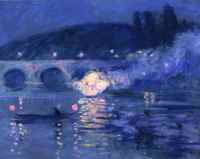 Impressionism Masterworks.
On displayare over thirty paintings by artists such as Theodore Earl
Butler, William Merritt Chase, Frederick Childe-Hassam, Henry Ossawa-Tanner
and John Twachtman who were influenced by and adopted the style of French
Impressionism in the last quarter of the nineteenth century to the first
half of the twentieth century. Centered primarily on the East coast, the
American Impressionist movement grew as young American artists returned
from study in Europe where they learned to focus on the transitory effects
of light and contemporary subject matter. The demand in the United States
for Impressionist paintings also increased as more and more exhibitions
brought the French avant-garde to the American public. (right: Theodore
Earl Butler (1876-1937), Fireworks, Vernon Bridge/Fuegos artificiales,
Puente de Vernon, 1908, oil on canvas, 23 1/2 x 29 inches. Gift of EPAMA
Members' Guild. 1974.53.1)
Impressionism Masterworks.
On displayare over thirty paintings by artists such as Theodore Earl
Butler, William Merritt Chase, Frederick Childe-Hassam, Henry Ossawa-Tanner
and John Twachtman who were influenced by and adopted the style of French
Impressionism in the last quarter of the nineteenth century to the first
half of the twentieth century. Centered primarily on the East coast, the
American Impressionist movement grew as young American artists returned
from study in Europe where they learned to focus on the transitory effects
of light and contemporary subject matter. The demand in the United States
for Impressionist paintings also increased as more and more exhibitions
brought the French avant-garde to the American public. (right: Theodore
Earl Butler (1876-1937), Fireworks, Vernon Bridge/Fuegos artificiales,
Puente de Vernon, 1908, oil on canvas, 23 1/2 x 29 inches. Gift of EPAMA
Members' Guild. 1974.53.1)
The El Paso Museum of Art holds a collection of American
Impressionism that is among the most comprehensive in the Southwest. This
collection was assembled in the 1970s and 1980s through hundreds of donations
and careful purchases made under the guidance of museum director Leonard
Sipiora. A native of Massachusetts with a background in English and American
Literature, Sipiora made his selections as the American art market emerged
from the shadow of its European counterpart.
With the support of the Member's Guild and the Collector's
Council of the El Paso Art Museum Association the El Paso Museum of Art
collected the work of both American expatriates as well as the artists of
Boston and New England.
Including among other artists; Frank Boggs, Theodore Earl
Butler, John Costigan, Frederick Childe Hassam, Ernest Lawson, William Merritt
Chase, and John Henry Twachtman, the El Paso Museum of Art's American Impressionist
collection is an important component of its overall mission mandated commitment
to the acquisition, interpretation and exhibition of American art from the
Colonial period to the contemporary.
Paris to North America
In the middle of the 19th century, many Americans from
Walt Whitman to Mark Twain proudly extolled the greatness of their new nation
over what they considered an exhausted European culture. In visual art this
attitude was represented by the Romantic naturalism of the Hudson River
School of landscape painting. Paradoxically, after the Civil War more and
more Americans were venturing overseas to study and to collect art. Paris,
a city many considered the art capital of the world, soon became a magnet
to artists such as James Abbott McNeill Whistler, Mary Cassatt, John Singer
Sergeant and William Merritt Chase. These artists, as well as collectors
with new fortunes, learned of recent developments in art and brought them
back to the United States.
In the 1870s and 1880s a group of French artists, including
Edgar Degas, Claude Monet, Camille Pissarro and Pierre-August Renoir, whose
work emphasized light and color over form, contrary to the official Salon's
taste for academic realism, organized a series of eight exhibitions of their
own. At first these exhibitions were ridiculed, but eventually received
much acclaim. Meanwhile, critics labeled these artists as "Impressionists"
because of the spontaneous, unfinished character of their paintings of modern
life.
By 1883 the first major exhibitions of French Impressionist
art were held in Boston and New York. Many viewers, artists and collectors
included, were at first viewing repelled by Impressionism, but with information
and repeated viewings some acknowledged its worth and sought to adopt its
avant-garde style. Soon, American artists from John Twachtman to Edmund
Tarbell and Frederick Childe Hassam to John Enneking were exploring the
expressive potential of lighter colors and lose brushwork. Within a decade,
an American brand of Impressionism, while not consistently defined, was
celebrated at the World's Fair in Chicago, by the organization of the artist's
group The Ten in 1897.
The twenty-five paintings in this exhibition are by twenty-five
of the best known American Impressionists, most of who studied in Paris,
and reveal the American interpretation of Impressionism.
Americans and Impressionism
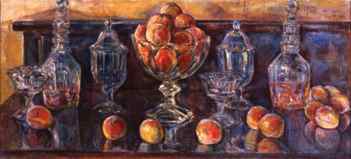 Every American artist who studied in Europe,
or Paris in particular, in the last quarter of the 19th century or the early
20th century had unique experiences that undoubtedly enhanced the artist's
reputation; they were exposed to a wide range of art, artists and cultural
richness centuries in depth. Each artist's work retained something uniquely
American, but integrated new, learned European aspects of technique, subject
matter and composition. Those artists who studied in Paris, including the
majority of the artists in this exhibition, encountered the French Impressionists'
loose brushwork, lightened palette and interest in the effects of light,
although no two Americans responded the same. (left: Frederick Childe
Hassam (American, 1859-1935), Still Life with Peaches and Old Glass,
1922, oil on canvas, 20 x 43 3/4 inches, F 29 x 52 inches. Gift of EPAMA.
1978.11.1)
Every American artist who studied in Europe,
or Paris in particular, in the last quarter of the 19th century or the early
20th century had unique experiences that undoubtedly enhanced the artist's
reputation; they were exposed to a wide range of art, artists and cultural
richness centuries in depth. Each artist's work retained something uniquely
American, but integrated new, learned European aspects of technique, subject
matter and composition. Those artists who studied in Paris, including the
majority of the artists in this exhibition, encountered the French Impressionists'
loose brushwork, lightened palette and interest in the effects of light,
although no two Americans responded the same. (left: Frederick Childe
Hassam (American, 1859-1935), Still Life with Peaches and Old Glass,
1922, oil on canvas, 20 x 43 3/4 inches, F 29 x 52 inches. Gift of EPAMA.
1978.11.1)
Most of the artists now known as American Impressionists
lived and worked in the Northeast upon their return, either in New York
or Boston. As the impressionistic style of painting found favor among American
critics and collectors, artists such as Chase, Tarbell and Twachtman found
positions where they could teach their individual versions of Impressionism.
At the same time, artists' colonies that espoused an Impressionist aesthetic
of painting en plein air developed throughout the country
in Connecticut, Indiana, New Hampshire, Pennsylvania, Missouri and, later
in California.
In many cases, the general public did not take the American
Impressionists seriously and considered them merely French imitators. The
reasons for this may be found in their early training and subject matter
which emphasized academic naturalism of American subjects painted using
a darker palette. Even so, the continued popularity of Impressionism in
the United States testifies to the artists' and the public's recognition
of the French avant-garde.
Artists in the exhibition
- Edward Mitchell Bannister
- Frank M. Boggs
- Theodore Earl Butler
- William Merritt Chase
- John Edward Costigan
- (Robert) Bruce Crane
- John Joseph Enneking
- William H. Glackens
- Arthur Clifton Goodwin
- John R. Grabach
- Frederick Childe Hassam
- Robert Henri
- Ernest Lawson
- Willard Leroy Metcalf
- Edward Henry Potthast
- Robert Louis Reid
- Julius Rolshoven
- Henry Ossawa Tanner
- Edmund C. Tarbell
- John H. Twachtman
- Robert William Vonnoh
- Guy Carleton Wiggins
- Irving Ramsey Wiles
- Charles Woodbury
- Mabel Woodward
Editor's note: RL readers may also enjoy:
Read more articles and essays concerning this source by visiting
the sub-index page for the El Paso Museum of
Art in Resource Library.
Search Resource
Library for thousands of articles and essays on American art.
Copyright 2011 Traditional Fine Arts Organization, Inc., an Arizona nonprofit corporation. All rights
reserved.