Editor's note: The Gibbes Museum of Art provided
source material to Resource Library for the following article. If
you have questions or comments regarding the source material, please contact
the Gibbes Museum of Art directly through either this phone number or web
address:
A Soldiers View of Civil
War Charleston
April 8 -July 10, 2011
The Gibbes Museum
of Art is presenting A Soldiers View of Civil War Charleston from
April 8 through July 10, 2011, to coincide with the 150th anniversary observance
of the start of the Civil War.
A Soldiers View features paintings
depicting the batteries and forts around Charleston Harbor as painted by
Conrad Wise Chapman (1842-1910) during the Civil War. The exhibition includes
multiple paintings of Fort Sumter and Fort Moultrie and a depiction of the
H.L. Hunley, the first submarine ever to sink an enemy ship. The Hunley
was painted just two weeks before its final voyage. Though Conrad Wise Chapman
spent many of his formative years in Rome, the American-born artist always
considered himself a Southerner. In 1861, Chapman left Rome to enlist in
the Confederate Army. As a soldier under the charge of General P. G. T.
Beauregard, Chapman created his remarkable paintings, displayed for the
first time in Charleston. The majority of these paintings are on loan to
the Gibbes from The Museum of the Confederacy, Richmond, Virginia.
"This is the first time our entire collection of Chapman
paintings have been exhibited outside of Richmond," stated Waite Rawls,
CEO and President of The Museum of the Confederacy, "and Charleston
is clearly the place for that to happen. We are especially indebted to the
Carolina Yacht Club for its assistance in conserving this important collection."
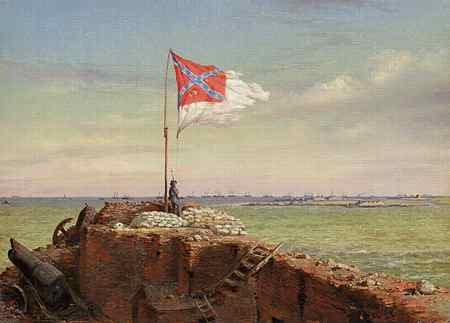
(above: Conrad Wise Chapman (American, 1842-1910), The
Flag of Sumter, 1864, Oil on board. Courtesy of The Museum of the Confederacy,
Richmond, Virginia)
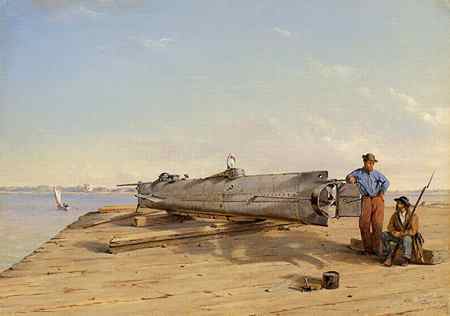
(above: Conrad Wise Chapman (American, 1842-1910), Submarine
Torpedo Boat H. L. Hunley, Dec. 6, 1863, 1864, Oil on board. Courtesy
of The Museum of the Confederacy, Richmond, Virginia)
Introductory wall panel for A Soldiers View of Civil
War Charleston and Stephen Marc: Passage on the Underground Railroad
- Perspectives on the Civil War
-
- By Pam Wall, Curator of Exhibitions, Gibbes Museum of
Art
-
- Balancing the past with the present is a goal for all
we do at the Gibbes Museum of Art. This April, the past is very much on
our minds as we observe the 150th anniversary of the start of the Civil
War, marked by the bombardment of Fort Sumter that began on April 12, 1861.
The Civil War is an incredibly significant part of our history, but also
a time period that elicits a great deal of emotion, both positive and negative.
The Gibbes is careful to approach the Civil War -- and all eras of history
-- with great cultural sensitivity. As an institution that interprets art
and history, we are charged with presenting a fair and balanced view while
introducing our audiences to new and interesting ways of thinking about
art and the world around us. This is a task we take very seriously, and
one that played a role in the selection of our April exhibitions: A
Soldier's View of Civil War Charleston and Stephen Marc: Passage
on the Underground Railroad.
-
- Some two years ago when the Gibbes staff began to plan
this exhibition season, we knew we wanted to offer two very different perspectives
on the Civil War. Pairing 19th century works with those of a contemporary
artist was a natural decision. For the 19th century perspective, the Gibbes
was fortunate to secure the loan of 31 paintings from The Museum of the
Confederacy in Richmond, Virginia. This series of paintings was created
in 1864 by the Confederate soldier and artist Conrad Wise Chapman. Chapman
was stationed in Charleston and assigned by General P. G. T. Beauregard
to create a pictorial record of the Confederate defenses surrounding Charleston
Harbor. He depicted the various forts and batteries throughout the area,
including multiple renderings of Fort Sumter and Fort Moultrie and a painting
of the H. L. Hunley, the first submarine to sink an enemy ship.
Frequently reproduced in Civil War publications, this significant series
of paintings will be showcased together for the first time in Charleston.
-
- As a counterpoint to Chapman's historical paintings,
the Gibbes selected the work of contemporary photographer Stephen Marc.
For the past decade, Marc has photographed and researched sites on the
Underground Railroad. Whereas Chapman's work focuses on the experiences
of soldiers on the front lines, Marc conveys the stories of slaves who
traveled the Underground Railroad in pursuit of freedom and those who helped
them along their journey. To accomplish this, Marc conducted primary research
in archives and historical societies throughout the United States. He gathered
documents, artifacts, and ephemera from his research and digitally combined
the material with contemporary photographs of the Underground Railroad
sites. The resulting montages elegantly weave together the past and present
and challenge viewers to contemplate the legacy of the Civil War today.
-
- It is our hope that these two exhibitions mark the 150th
anniversary of the start of the Civil War in a meaningful way. Careful
thought and consideration has gone into the organization of each exhibition,
and hopefully they generate interesting conversations among our museum
visitors.
-
- Pam Wall is Curator of Exhibitions at the Gibbes Museum
of Art.
Introductory wall panel for A Soldier's View of Civil
War Charleston
- Conrad Wise Chapman was born in Washington, DC in 1842.
As a young child, his family moved to Rome, Italy where he received training
from his artist father John Gadsby Chapman, a Virginia native. Despite
being raised in Italy, Conrad felt a deep connection to his family's southern
roots. At the outbreak of the Civil War, he enlisted in a Kentucky regiment
of the Confederate Army. Chapman served in the West and was wounded in
the Battle of Shiloh. After recovering, he was transferred to a Virginia
regiment under the command of General Henry A. Wise, a friend of Chapman's
father. In September 1863, Chapman's regiment was sent to Charleston, South
Carolina.
-
- In Charleston, General P. G. T. Beauregard assigned Chapman
to create a pictorial record of the Confederate defenses surrounding Charleston
Harbor. The resulting body of work is on view in this exhibition. The subject
matter for each painting was sketched in Charleston between September 1863
and March 1864. The finished paintings were created in Rome, where Chapman
was on furlough visiting family from April to December 1864. When completed,
the series of 31 small paintings remained in the Chapman family for over
thirty years. In 1898, the series was sold to Granville Valentine of Richmond,
Virginia for a total of $1,500. In the same year, Valentine sold the series
to the Confederate Memorial Literary Society in Richmond, known today as
The Museum of the Confederacy. Shown together for the first time in Charleston,
Chapman's paintings are a valuable record of the Civil War and illuminate
an incredibly significant part of Charleston's history.
Related Programming:
- Lecture by James McPherson
-
- Reflections on the 150th Anniversary of the American
Civil War
- Volunteers in Blue and Gray: Why They Fought
-
- Tuesday, April 12, at 7pm
- Free, reservations are not required but are suggested
by calling 843.722.2706, ext. 22.
-
- James M. McPherson is an American Civil War historian
and the George Henry Davis 1986 Professor Emeritus of United States History
at Princeton University. His lecture will focus on the soldiers who volunteered
to fight during this momentous event in American history. McPherson is
the author of numerous books on the Civil War including For Cause and
Comrades, winner of the Lincoln Prize; Drawn With the Sword: Reflections
on the American Civil War; and his Pulitzer Prize winner Battle
Cry of Freedom. This lecture is part of the Lowcountry Civil War Sesquicentennial
Commemoration, organized by the Fort Sumter-Fort Moultrie Historical Trust
(www.sccivilwar.org).
- Lecture by Tim Bolton
-
- Winslow Homer and the Civil War
-
- Thursday, April 14, 6pm
- Free for Members; fee for Non-Members. 843.722.2706,
ext. 22 www.gibbesmuseum.org/events
-
- Architect and art historian Kenyon (Tim) C. Bolton III
will provide insight into Winslow Homer's development at the beginning
of his career. Homer's painted subjects of the Civil War culminated in
the single most important image to symbolize that period. When the Civil
War began in 1861, Winslow Homer was a young man beginning his artistic
career. As a special correspondent for Harper's Weekly, Homer spent
extended periods of time on the front lines creating sketches of the soldiers
and events he witnessed. Many of his sketches were reproduced in Harper's
as wood engravings, while others were later developed into oil paintings.
Homer went on to achieve great success and is recognized as one of the
most significant American artists of the nineteenth century.
-
- Dr. Bolton holds a Ph.D. in art history from Harvard
University.
-
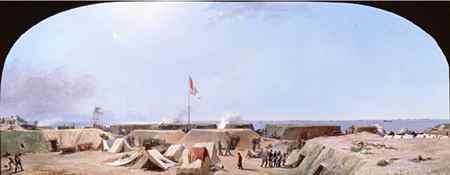
(above: Conrad Wise Chapman (American, 1842-1910), Bombardment
of Fort Moultrie, Charleston Harbor, South Carolina, 1864, Oil on canvas.
Museum purchase with funds provided by the Winnie Edwards Murray Fund)
Resource Library readers may
also enjoy:
Read more articles and essays concerning this institutional
source by visiting the sub-index page for the Gibbes Museum
of Art in Resource Library
Search Resource
Library for thousands of articles and essays on American art.
Copyright 2011 Traditional Fine Arts Organization, Inc., an Arizona nonprofit corporation. All rights
reserved.