Editor's note: The Wichita
Art Museum provided source material to Resource
Library for the following article or essay. If you have questions or
comments regarding the source material, please contact the Wichita Art Museum
directly through either this phone number or web address:
A Kansas Treasure in Context:
Mary Cassatt
April 24 - July 31, 2011
A Kansas Treasure
in Context: Mary Cassatt, on view April 24 through
July 31, 2011 at the Wichita Art Museum, invites visitors to experience
the beauty of one of the Wichita Art Museum's most treasured works of art,
"Mother and Child", in the context of Cassatt's other drawings
and paintings. The exhibition will feature numerous works by the artist
celebrated for her unique portrayal of the private lives of women and children.
"Our Cassatt is perhaps the most sought after work
of art from the Wichita Art Museum's collection," says Executive Director
Charles K. Steiner. "It is requested by other museums worldwide for
loan. Its importance is multiple, from its references from Japanese prints
to French Impressionism. It is also by a female artist in a time and place
when there were few. It is an extremely important and famous work of art."
Mother and Child will be the focal point alongside other paintings
and drawings created by Cassatt that illustrate the artist's central themes.
When viewed together, they reveal the range of Cassatt's creative process
and add to the viewer's understanding of this unique American master's approach
to creating art. Cassatt is recognized as a leading talent of the Impressionist
movement; included with the likes of Monet, Manet, Renoir and her close
friend and mentor Edgar Degas.
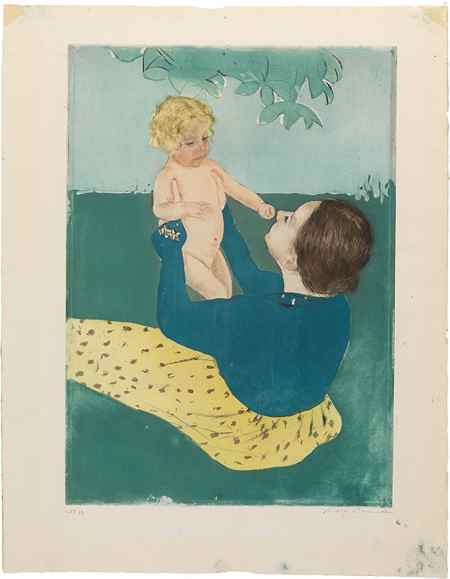
(above: Mary Cassatt (1844-1926), Under The Horse-Chestnut
Tree, 1896-97, Drypoint and aquatint on paper. Courtesy of Adelson Galleries,
New York, New York. This exhibition is made possible by the Marcellette
G. and Courtney Davis Trust along with the Friends of the Wichita Art Museum,
FWAM Endowment)
Wall panel text from the exhibition
- A Kansas Treasure in Context: Mary Cassatt
-
- Mary Cassatt (1844-1926) was one of only two women --
and the only American -- to have been included among the group of painters
known as the "Impressionists." Though she lived most of her life
in France, she is considered an American artist, in part because the major
collectors of her work were American; consequently, most of her work resides
in American collections. Among them is the Wichita Art Museum, which is
proud to be the custodian of one of her finest paintings: Mother and
Child of ca. 1889.
-
- One of the special exhibitions at the Art Museum celebrating
the 150th anniversary of Kansas' statehood features the Wichita painting
Mother and Child within two contexts: (1) a collection of her prints
and pastels on paper, and (2) prints by French artist-printmakers working
in the same time period as Ms. Cassatt. The Cassatt works on paper are
from the collection of the great French art dealer, Ambroise Vollard; they
have been lent to the Museum through the generosity of the Adelson Galleries,
New York. The contemporary French prints are from the Museum's permanent
collection.
-
-
- Mary Cassatt
-
- Mary Cassatt was the daughter of a Pittsburgh, PA banking
family. She was educated in both Pennsylvania and abroad. Extensive European
travel encouraged her love of the Old Master painters, especially Rubens
and Velázquez. Among the contemporary painters she admired most
were Thomas Couture, Edouard Manet, and Edgar Degas. She became an especially
close friend and artistic collaborator of Degas. She had already earned
a good reputation among French artists and critics when Degas invited her
to exhibit her work in the Fourth Impressionist Exhibition (1879). She
was subsequently featured in the Impressionist exhibitions of 1880, '81,
and '86.
-
- The characteristics of Cassatt's Impressionist style
include a high-key color palette; short, thick, distinct strokes of paint
that appear to have been applied quickly; and the optical mixing of colors
(the juxtaposition of colors rather than mixed color). While her subject
matter was not limited to the theme of the mother and child, it is certainly
the theme for which she is best known. The reason for her concentration
on mothers and children has been the subject of broad speculation, which
tends toward the absurd when it is attributed to her being an unmarried
woman with no children of her own. The mother and child subject was probably
attractive to her because it combined the Impressionists' collective interest
in subjects taken from contemporary everyday life with the dignity of the
subject's association with the great European tradition of the Madonna
and Child.
-
- In 1892 Cassatt was given the great honor of painting
a major mural, titled Modern Woman, for the Woman's Building of
the World's Columbian Exposition (Chicago, 1893). The central figures depicted
two contemporary women as allegories of "woman plucking the fruits
of knowledge or science." Cassatt's colleague Joseph De Camp paid
a tribute to Cassatt's allegory in a major painting The Pear Pickers,
now in the collection of the Wichita Art Museum (on display in the Rotunda
of this floor).
-
- Sales of Cassatt's work were strong enough that she was
able to acquire, in addition to her Paris apartment, a chateau north of
Paris. In 1910 her eyesight began to fail; by 1915 she was no longer painting.
During her lifetime her work entered French national collections, including
the Luxembourg (now the Musée D'Orsay).
-
-
-
- Mary Cassatt Works on Paper
-
- Mary Cassatt's beginnings as a printmaker were the result
of another invitation from Degas. In 1879 he conceived the idea of a very
deluxe journal that would include fine art prints by artists who were primarily
painters. A rare impression of her first print resulting from his invitation
is included in this exhibition: Two Ladies in a Loge, Facing Left.
Her earliest prints exhibit characteristics that run throughout all the
prints she created. They include rich tonality, exceptionally inventive
technical experiment, and exquisite draftsmanship manifest in the simplest
use of line. The latter is rather surprising given the bravura character
of her paintings. The Wichita Mother and Child, for example, is
so loosely painted that it is often thought to be unfinished (despite the
presence of her signature). In her prints and pastels Cassatt found a vehicle
for her exceptional talent for commanding linear design.
-
- In 1890 Cassatt's principal dealer asked her to do a
suite of prints as part of a major 1891 solo exhibition of her work. The
result was the group of ten prints, executed in drypoint and color aquatint,
that are among the most celebrated works on paper in the history of Western
art. Three are included in this exhibition: The Fitting, The Lamp, and
Afternoon Tea Party. The color and composition of the series derive
from the Japanese prints that she found so moving at an 1890 Paris exhibition.
It is a testament to her commitment to the highest level of art making
that she executed as many as 17 distinct stages (called "states")
along the path toward the final prints.
-
- Cassatt's last prints have a simplicity of design that
belies their exceptionally complicated technique. Peasant Mother and
Child, created for a special 1895 exhibition of her work at the Gallery
Durand-Ruel, New York, utilized two printing plates and monotype inking.
-
- The design for Peasant Mother and Child, which
is included in this exhibition, derives from a group of her pastel drawings
on paper. Cassatt took up pastels in earnest about the same time she began
printmaking. Her pastels emphasize the monumentality and dignity that can
be conveyed by the human body. The pastels included in this exhibition
are "counter proofs," meaning they were created by placing a
sheet of dampened print paper over a pastel drawing. Firm pressing transferred
an impression of the first pastel onto the second sheet of paper. The technique
appealed to Cassatt because it allowed her to keep a record of cherished
pastels that would be sold and, since the process reversed the design,
allowed her to experiment and play with composition.
-
-
-
- Ambroise Vollard
-
- A towering figure in the history of art dealers is Ambroise
Vollard (1866-1939), whose Montmartre (Paris) gallery featured many of
the most important Impressionist, Post Impressionist, and Modernist painters,
including Manet, Renoir, Cezanne, Picasso, and Matisse. Though Cassatt
had an exclusive sales agreement with the more established Durand-Ruel
Gallery, her frequent irritation with Durand-Ruel found release in her
pleasant and rewarding association with his major competitor, Vollard.
Friends since the 1890s, Cassatt admired Vollard's superior knowledge of
art, as well as his deference to artistic sensibility. By 1905 Cassatt
was selling directly to Vollard, and by 1906 she was opening her storage
cabinets to him. Feeling her mortality setting upon her, she sold bulk
lots of work to Vollard, who culled the very best of the lots -- especially
the prints -- for his own collection, which included 170 prints by Cassatt
at the time of his death in 1939. The best of Vollard's collection was
sold to a private collector and fell out of public scrutiny. Through the
efforts of the dealers Marc Rosen and Warren Adelson, the collection has
returned to the public realm. The Museum is grateful to the Adelson Galleries
for making part of Vollard's great collection of Mary Cassatt works on
paper available to the Wichita community.
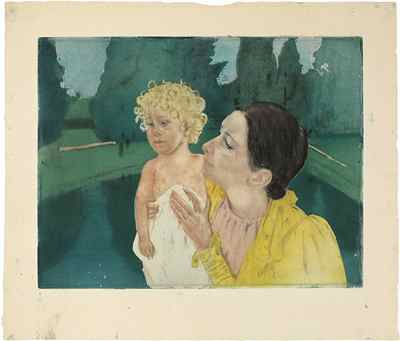
(above: Mary Cassatt (1844-1926), By the Pond, c.
1896, Drypoint and aquatint, printed in colors on paper. Courtesy of Adelson
Galleries, New York, New York. This exhibition is made possible by the Marcellette
G. and Courtney Davis Trust along with the Friends of the Wichita Art Museum,
FWAM Endowment.)
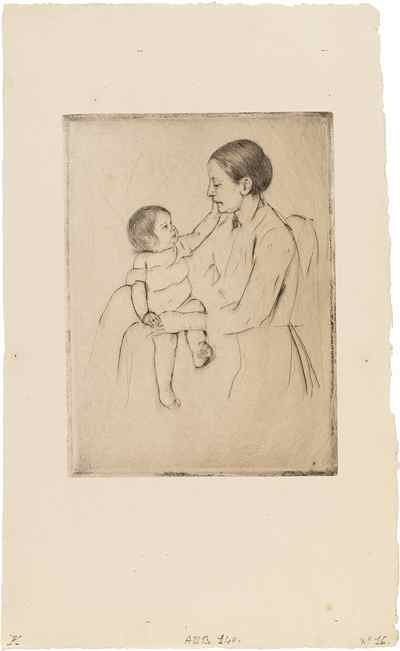
(above: Mary Cassatt (1844-1926), The Caress, c.
1891. Drypoint on paper. Courtesy of Adelson Galleries, New York, New York.
This exhibition is made possible by the Marcellette G. and Courtney Davis
Trust along with the Friends of the Wichita Art Museum, FWAM Endowment.)
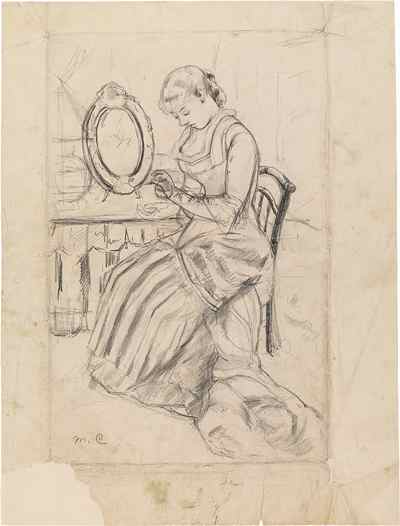
(above: Mary Cassatt (1844-1926), Drawing for "At
the Dressing Table", c. 1880, Pencil on paper with soft-ground
on the verso. Courtesy of Adelson Galleries, New York, New York. This exhibition
is made possible by the Marcellette G. and Courtney Davis Trust along with
the Friends of the Wichita Art Museum, FWAM Endowment.)
To view the checklist for the exhibition please click here.
Editor's note: RL readers
may also enjoy:
and biographical information on artists cited in this article
in America's Distinguished Artists,
a national registry of historic artists.
rev. 5/27/11
Read more articles and essays concerning this institutional
source by visiting the sub-index page for the Wichita
Art Museum in Resource Library.
Search Resource
Library for thousands of articles and essays on American art.
Copyright 2011 Traditional Fine Arts Organization, Inc., an Arizona nonprofit corporation. All rights
reserved.