Editor's note: The Morris Museum of Art provided
source material to Resource Library for the following article or
essay. If you have questions or comments regarding the source material,
please contact the Morris Museum of Art directly through either this phone
number or web address:
Philip Juras: The Southern
Frontier Landscapes Inspired by Bartram's Travels
May 28 - August 14, 2011
Philip Juras: The
Southern Frontier Landscapes Inspired by Bartram's Travels opens at the Morris Museum of Art Saturday, May 28 and remains
on 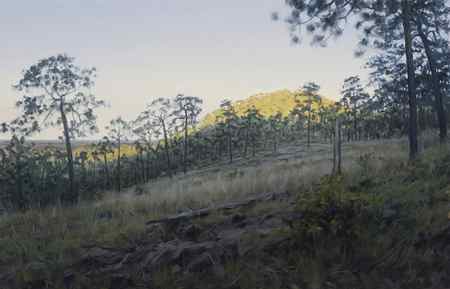 display through August 14, 2011.
The exhibition includes more than sixty works, nearly half of them studio
paintings; smaller plein-air pieces, produced on-site, round out the show.
(right: Philip Juras, Burks Mountain, Columbia County, Georgia.
October, 2010. Courtesy of the artist.)
display through August 14, 2011.
The exhibition includes more than sixty works, nearly half of them studio
paintings; smaller plein-air pieces, produced on-site, round out the show.
(right: Philip Juras, Burks Mountain, Columbia County, Georgia.
October, 2010. Courtesy of the artist.)
"Remarkably, Philip Juras, a wonderfully skilled painter
in the service of a higher ideal, has here made us aware of all that we've
lost -- the Edenic America that brave, curious, and somewhat foolhardy adventurers
like William Bartram explored in hopes of capturing their own first visions
of a continent they thought untouched by the hand of man. They were wrong,
of course; the landscape had in fact been managed from time immemorial,
but the simple awe felt by Bartram was both palpable and contagious,"
said Kevin Grogan, director of the Morris Museum of Art.
As Philip Juras has noted, "The paintings in this
exhibition allow a viewer to experience something that I would argue is
not easy to envision in the modern South: a glimpse of the presettlement
Southern frontier. While there are written descriptions of that landscape,
particularly by the eighteenth-century naturalist William Bartram, almost
no visual images exist that document the Southern wilderness before European
settlement." Juras himself -- a trained landscape architect, as well
as a highly proficient artist -- can and has provided those images through
his own paintings, bringing, perhaps for the very first time, the long lost
Southern frontier to twenty-first-century eyes. Juras has enabled contemporary
viewers to experience the South in much the same way that nineteenth-century
American landscape painters saw the Western frontier, which they introduced
to the residents of a 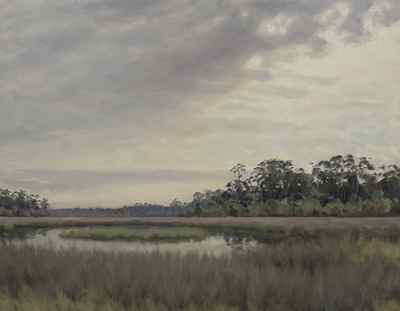 rapidly industrializing
nation.
rapidly industrializing
nation.
The majority of the images in the exhibition depict remnant
natural landscapes that are still to be seen across the Southeast. These
landscapes exhibit many of the qualities that Bartram encountered and documented
in his travels 230 years ago.
Juras came to know these places and their unique attributes
through the research he undertook for his master's degree thesis on the
pre-settlement South in 1997. His involvement with the Nature Conservancy
and his love of nature and travel have also supported this body of work
as it has evolved over the years. This background has allowed him to portray
environments described by Bartram that no longer exist, such as the prairies
of Alabama and the Keowee Valley of South Carolina. (left: Philip
Juras, Pellicer Creek, Faver-Dykes SP, FL. May 29, 2010. Courtesy
of the artist.)
The exhibition is accompanied by a fully-illustrated catalogue
that is published by the Telfair Museums and distributed by the University
of Georgia Press. It is available for purchase in the Morris Museum Store.
Philip Juras's commentary provides ecological and historical context for
the paintings in the catalogue, which also features a special contribution
from award-winning author Janisse Ray.
Juras, a resident of Athens, Georgia, earned an undergraduate
degree in drawing and painting from the University of Georgia, where he
also earned a master's degree in landscape architecture. His paintings have
been the subject of solo exhibitions at the North Carolina Botanical Garden,
Chapel Hill; the University of Georgia and the Aurum Studios, Athens; and
the Carolina Galleries, Charleston.
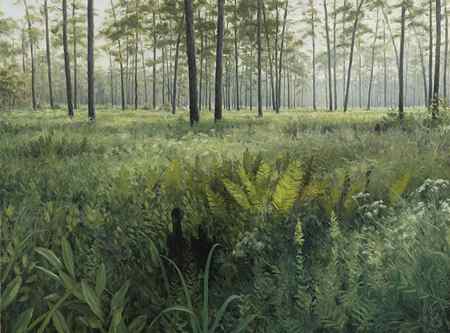
(above: Philip Juras, Longleaf, Greenwood Plantation
Thomasville, GA. December, 2005. Courtesy of the artist.)
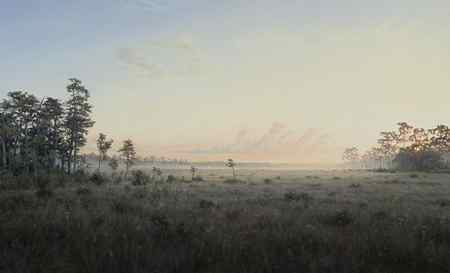
(above: Philip Juras, Dewy Witchgrass, Apalachicola
National Forest, Florida. July, 2010. Courtesy of the artist.)
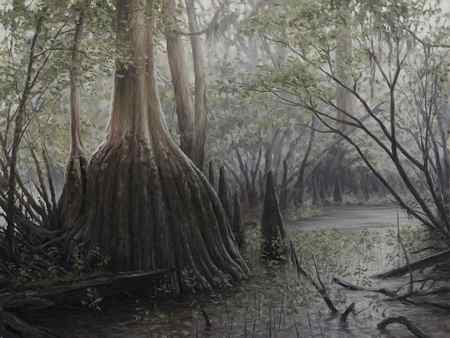
(above: Philip Juras, Old Growth Cypress in the Rain,
Altamaha River, Long County, Georgia. September, 2009. Courtesy of the artist.)
Wall text panels from the exhibition
-
- As Philip Juras has noted, "The paintings in this
exhibition allow a viewer to experience something that I would argue is
not easy to envision in the modern South: a glimpse of the pre-settlement
Southern frontier. While there are written descriptions of that landscape,
particularly by the eighteenth-century naturalist William Bartram, almost
no visual images exist that document the Southern wilderness before European
settlement." Juras himself -- a trained landscape architect, as well
as a highly proficient artist-can and has provided those images through
his own paintings, bringing, perhaps for the very first time, the long
lost Southern frontier to twenty-first-century eyes.
-
- The majority of the images in the exhibition depict remnant
natural landscapes that are still to be seen across the Southeast. These
landscapes exhibit many of the qualities that Bartram encountered and documented
in his travels nearly 230 years ago.
-
- Juras came to know these places and their unique attributes
through the research he conducted for his master's degree thesis on the
pre-settlement South in 1997. His involvement with the Nature Conservancy
and his love of nature and travel have also supported this body of work
as it has evolved over the years. This background has allowed him to portray
environments described by Bartram that no longer exist.
-
- A resident of Athens, Georgia, he earned an undergraduate
degree in drawing and painting from the University of Georgia, where he
also earned a master's degree in landscape architecture. His paintings
have been the subject of solo exhibitions at the North Carolina Botanical
Garden, Chapel Hill; the University of Georgia and the Aurum Studios, Athens;
and the Carolina Galleries, Charleston.
-
- In his Introduction to the catalogue that accompanies
the present exhibition, Juras mentions that he has chosen to organize this
collection of landscapes in a way that complements Bartram's melding of
the scientific and the romantic. The exhibition is divided into four sections
-- Uplands, A Grassy Coastal Plain, Wetlands and Waterways, and The Coasts
-- that reflect their physiographic location, ecological similarity, and
visual continuity.
-
-
- Uplands
-
- ...a pleasant territory, presenting varying scenes
of gentle swelling hills and levels, affording sublime forests, contrasted
by expansive illumined green fields, native meadows and Cane brakes...
-
- ...this space may with propriety be called the hilly
country, every where fertile and delightful, continually replenished by
innumerable rivulets, either coursing about the fragrant hills, or springing
from the rocky precipices, and forming many cascades; the coolness and
purity of which waters invigorate the air of this otherwise hot and sultry
climate.
-- William Bartram
- Travels through North and South Carolina, Georgia,
East and West Florida, the Cherokee Country, the Extensive Territories
of the Muscogulges or Creek Confederacy, and the Country of the Chactaws, published 1791
-
- In today's Piedmont region, and to some extent in the
mountains of Georgia and the Carolinas, it is difficult to find landscapes
reminiscent of the eighteenth century. After centuries of agriculture,
settlement, and waves of abandonment, the Piedmont in particular has become
a patchwork of pine plantations, sprawling development, agriculture, and
largely fire-intolerant, old-field successional forests. Long forgotten
is the "pleasant territory" of open, old-growth grassy woodlands
and vast canebrakes witnessed by Bartram in the lower Piedmont. Indeed,
many of the extraordinary upland landscapes he described are lost: clear
running rocky streams of the Piedmont are now filled with silt, balds of
the Nantahala Mountains are now forested, and even the beautiful Keowee
River which so charmed Bartram as it ran among the extensive old-fields
of the Cherokees is now submerged beneath a reservoir. But where other
Piedmont rivers still run free over rocky shoals, where mountain streams
spill down forested slopes, or where hazy ridges recede into the distance,
the upland wilderness of Bartram's Travels can still be glimpsed.
-
- Philip Juras, 2011
-
-
- A Grassy Coastal Plain
-
- This plain is mostly a forest of the great long-leaved
pine (P. palustris Linn.) the earth covered with grass, interspersed with
an infinite variety of herbacious plants, and embellished with extensive
savannas, always green, sparkling with ponds of water, and ornamented with
clumps of evergreen, and other trees and shrubs
. . .
-- William Bartram
- Travels through North and South Carolina, Georgia,
East and West Florida, the Cherokee Country, the Extensive Territories
of the Muscogulges or Creek Confederacy, and the Country of the Chactaws, published 1791
-
- When Europeans arrived on the continent, a vast fire-dependent
ecosystem of longleaf pine woods and grassy savannas covered ninety million
acres of the Coastal Plain from Virginia to Texas. In 1773, traveling between
Savannah and Augusta, Bartram succinctly described what was then a seemingly
endless landscape. By the late twentieth century, however, those grassy
pinelands had all but disappeared. Roads, railways, and farm fields had
become barriers to wide-ranging lightning fires, while timber barons cleared
the slow-to-reproduce longleaf pine from the region. With fire suppression,
cleared lands that were not turned to agriculture quickly grew into dense
forests, blocking the longleaf from regenerating and shading out the diverse
grassy ground layer. Now only a tiny fraction of these grassy coastal plain
environments remain. Conserving them, which is to say burning them, is
essential for the survival of this ecosystem.
-
- Philip Juras, 2011
-
-
-
- The Coasts
-
- ...I at length reached the strand, which was level,
firm, and paved with shells, and afforded me a grand view of the boundless
ocean.
- O thou Creator supreme, almighty! how infinite and
incomprehensible thy works! most perfect, and every way astonishing!
-- William Bartram
- Travels through North and South Carolina, Georgia,
East and West Florida, the Cherokee Country, the Extensive Territories
of the Muscogulges or Creek Confederacy, and the Country of the Chactaws, published 1791
-
- As recorded by Bartram at Saint Simons Island in 1774,
some of the most compelling scenes in nature are to be found in the dynamic
environment where the ocean transitions to dry land. Along the Atlantic
and Gulf Coasts today, where populations are low or where coastal lands
and estuaries have been protected, salt marshes, tidal creeks, and wide
sandy beaches still offer the traveler timeless and awe-inspiring settings.
Perhaps because they are more of ocean than of land, these places have
changed less in appearance than other southern environments Bartram described.
That is not to say they are not changing. Bartram himself noted evidence
that coastal marshes were migrating into what were "formerly high
swamps of firm land." As marshes and barrier islands continue their
shift landward in this century and as ever-spreading development brings
new houses, bridges, and concrete embankments to the coast, views of the
coastal environment as Bartram saw it may become increasingly elusive.
-
- Philip Juras, 2011
-
-
-
- Wetlands and Waterways
-
- I resigned my bark to the friendly current, reserving
to myself the controul of the helm. My progress was rendered delightful
by the sylvan elegance of the groves, chearful meadows, and high distant
forests, which in grand order presented themselves to view. The winding
banks of the river, and the high projecting promontories, unfolded fresh
scenes of grandeur and sublimity.
-- William Bartram
- Travels through North and South Carolina, Georgia,
East and West Florida, the Cherokee Country, the Extensive Territories
of the Muscogulges or Creek Confederacy, and the Country of the Chactaws, published 1791
-
- The interconnected wetlands and waterways of the Coastal
Plain were still very much an unaltered and primeval landscape in the late
1700s, but Bartram's "scenes of grandeur and sublimity" would
be seen in more commercial terms in the following centuries. Across the
region, wetlands would be drained for agriculture while the vast floodplain
forest would be cut for timber. Rivers would be channeled for shipping
and levees would be built for flood control. Even the mighty Mississippi
would be walled off from its bayous and swamps, no longer free to replenish
its vast floodplain with silt. But wild nature still abounds on southern
rivers and in its remaining wetlands. The undeveloped floodplain and ancient
trees of Georgia's Altamaha River and the wetland wilderness of Florida's
upper St. Johns River still present landscapes like those Bartram saw.
To visit these rivers, to see Florida's first-order springs and its wet
prairies, to see Bartram's Alachua Savanna being restored to its eighteenth-century
condition, is to begin to appreciate the intrinsic value of nature as Bartram
saw it.
-
- Philip Juras, 2011
Editor's note: RL readers may also enjoy:
Read more articles and essays concerning this institutional
source by visiting the sub-index page for the Morris
Museum of Art in Resource Library.
Search Resource
Library for thousands of articles and essays on American art.
Copyright 2011 Traditional Fine Arts Organization, Inc., an Arizona nonprofit corporation. All rights
reserved.