Editor's note: The Cummer Museum of Art & Gardens
provided source material to Resource Library for the following article.
If you have questions or comments regarding the source material, please
contact the Cummer Museum of Art & Gardens directly through either this
phone number or web address:
Eugene Savage: The Seminole
Paintings
October 7, 2011 - January 8, 2012
The Cummer Museum
of Art & Gardens is presenting Eugene Savage: The Seminole Paintings,
on view through January 8, 2012. The exhibition features 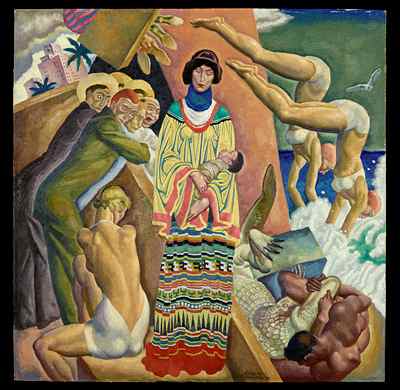 42 paintings and watercolors inspired by Savage's trips
to the Everglades. As part of the Museum's 50th Anniversary celebration,
the works are being displayed publicly for the first time since the 1960s.
The Cummer purchased the collection in 2007, after former trustee Samuel
Vickers introduced Savage's work to the Museum. Savage's series is the most
extensive painted record of the Florida Seminoles from the early twentieth
century.
42 paintings and watercolors inspired by Savage's trips
to the Everglades. As part of the Museum's 50th Anniversary celebration,
the works are being displayed publicly for the first time since the 1960s.
The Cummer purchased the collection in 2007, after former trustee Samuel
Vickers introduced Savage's work to the Museum. Savage's series is the most
extensive painted record of the Florida Seminoles from the early twentieth
century.
"The Cummer family had a long history of philanthropy
in northeast Florida," said Cummer Curator Holly Keris, "This
interest in Florida's art and natural environment continues to the present
day at The Cummer, where the history of our state is represented through
artwork in the permanent collection. The affection of Arthur and Ninah Cummer
for their adopted home state has come full circle with this important addition
to the Museum they lovingly created."
Eugene Savage (1883-1978) began his artistic journey as
a young boy. His mother encouraged him to draw, paint and take up music.
When he was 18 years old, he moved to Chicago, where he attended art classes
at The Chicago Art Institute and the Chicago Academy of Fine Arts. In 1912,
Savage won the competition for the Prix de Rome, a three-year fellowship
in painting at the American Academy in Rome.
"The Academy provided Savage with the occasion to
refine his skills and master new techniques [He] was particularly drawn
to the linear strength of the early Renaissance artists, who would have
a deep effect upon his early manner of painting," said guest curator
Dr. Elizabeth B. Heuer, Assistant Professor of Art History at the
University of North Florida. (left: Eugene Savage, Biscayne Holiday,
1935, oil on canvas adhered to aluminum and wood, 36 x 36 inches. Purchased
with funds provided by the Mae W. Schultz Lead Trust, AP.2007.2.2.
Photograph courtesy of Daniel Portnoy Photography.)
When Savage returned to the United States after his graduation
in 1915, he taught painting at Cooper Union in New York, and later on at
other collegiate level schools. In 1924, Savage was elected to the National
Academy of Design and also joined the faculty at Yale University, where
he was named Dean of Fine Arts in 1931. He was later appointed by President
Franklin D. Roosevelt to serve on the Commission of Fine Arts, a position
he held until 1941. Savage's work attracted national praise. He mainly created
murals for various public establishments and universities, such as the Butler
Library at Columbia University in New York.
In 1935, Savage and his wife, Mathilda, visited Florida
for a winter vacation. Around this time there was an ongoing debate raging
between 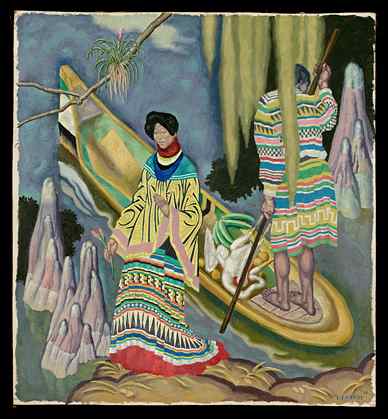 environmentalists, who wanted
total protection of the Everglades, and advocates who defended Seminole
culture. The Seminole Indians and their plight intrigued Savage. In his
work, he used bold colors with shifting perspectives and rhythmic lines
and patterns to create stylized scenes that conveyed the simplicity of the
Seminoles' lives. Savage continued to visit south Florida over the next
two decades of his life, surveying the Seminoles and their lives.
environmentalists, who wanted
total protection of the Everglades, and advocates who defended Seminole
culture. The Seminole Indians and their plight intrigued Savage. In his
work, he used bold colors with shifting perspectives and rhythmic lines
and patterns to create stylized scenes that conveyed the simplicity of the
Seminoles' lives. Savage continued to visit south Florida over the next
two decades of his life, surveying the Seminoles and their lives.
"The romanticized depictions of the Seminoles and
the Everglades that Savage created over the next 20 years hauntingly convey
the conflict between urban and native culture," said Keris.
While many of his works depict the Seminoles' struggles,
part of his series portrays them living in an Edenic paradise, free from
the contamination of modern society. South Moon Under (1935) depicts
a Seminole woman standing in a canoe on a peaceful lake that reflects the
full moon. According to folklore, the moon has the power to control nature.
This work conveys the idea that the Seminoles lived in balance and harmony
with the natural world. In Orchid Hunter (1935), a Seminole man and
woman are shown. The woman is collecting orchid buds, but leaves the plant
intact so that it may continue to bloom in the future. The man is poling
a canoe that is deliberately filled with only a small amount of game and
fruit. Savage is showing their respect for natural resources and stresses
their connection with the land.
In his work, Savage found a new way to express himself.
He found a way to depict native culture as well as critique modern urban
life. The natural rhythms of the Everglades are portrayed, which presents
a vision of Seminole life. "While certainly not documentary in nature,
Savage's abstracted compositions evoke mystery and imagination," said
Keris. "I hope visitors will be enthralled by the work of Eugene Savage,
and his magical recollections of the Seminoles and the Florida Everglades."
(right: Eugene Savage, Orchid Hunter, 1935, oil on canvas,
31 x 28 1/2 inches. Purchased with funds provided by the Mae W. Schultz
Lead Trust, AP.2007.2.7. Photograph courtesy of Daniel Portnoy Photography.)
Visitors can learn more about Savage and his work in the
book, Eugene Savage: The Seminole Paintings by Heuer, available at
The Cummer Store. The book is published by The Cummer in association with
D Giles Limited, London. In addition to the book, there will be a family
guide offered for the exhibition. A podcast will also be available to listen
to in the galleries, which features a Seminole Tribal member telling traditional
tales of animals of the Everglades.
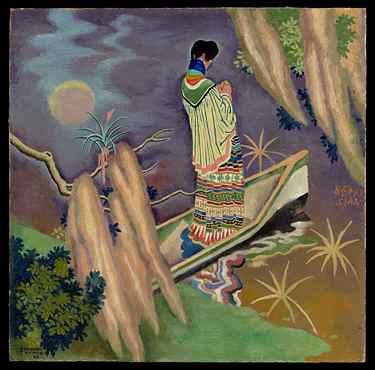
(above: Eugene Savage, South Moon Under, 1935, oil
on canvas adhered to aluminum and wood, 20 x 20 inches. Purchased with funds
provided by the Mae W. Schultz Lead Trust, AP.2007.2.1. Photograph
courtesy of Daniel Portnoy Photography.)
Special Programs and events for visitors throughout
the exhibition include:
-
- Lecture
- An Everglades Providence: Marjory Stoneman Douglas
and the American Environmental Century
- Tuesday, November 8, 2011, 7 p.m.
- University of Florida Professor of History Dr. Jack E.
Davis speaks on An Everglades Providence: Marjory Stoneman Douglas and
the American Environmental Century, winner of the gold medal in the
nonfiction category of the Florida Book Awards. Examining Douglas's eighty-year
relationship with the Everglades, the book explores nature as a historical
agent in south Florida life, the feminization of nature protection, and
the evolution of the science of ecology and its influence in environmental
awareness. Lecture will be followed by book signing. Free admission.
-
- Art for Two
- Saturday, November 12, 2011, 10:30 a.m. to Noon, Everglades
Seminole Patchwork
- Saturday, December 10, 2011, 10:30 a.m. to Noon, Animals
of the Swamp
- Children and their favorite adults will participate in
classes that infuse art, storytelling, movement and music that help channel
children's interests into the development of new skills. For ages 3 to
5. Fee.
-
- Art Adventures
- Saturday, November 19, 2011, 10:30 a.m. to 12:30 p.m.,
Everglades Foliage Still Life
- Saturday, December 17, 2011, 10:30 a.m. to 12:30 p.m.,
Animals of the Swamp
- Classes in painting, printmaking, collage and construction
with changing themes. For ages 6 to 12. Fee.
-
- Symposium Eugene Savage: Beyond Image
- Tuesday, November 15, 2011, 2 to 6 p.m.
- How does imagery tell a story, influencing thought and
behavior? How and why do we create visual representation to explain our
reality? These are questions to be explored in this one-day symposium which
includes presentations by University of North Florida Assistant Professor
of Art History Dr. Elizabeth B. Heuer, Florida State University Associate
Professor of History Dr. Andrew K. Frank, and Seminole Tribe of Florida
member and Tribal historian Willie Johns. Free admission.
-
- Talks & Tea Growing Up Seminole
- Wednesday or Thursday, November 16 or 17, 2011, 1:30
p.m.
- Seminole Tribal member Willie Johns recounts growing
up on the Seminole reservation and how the physical alteration of the Everglades
and Lake Okeechobee affected his family's livelihood. Seated gallery talk
followed by afternoon tea and refreshments. Free admission.
-
- Eugene Savage Family Night
- Tuesday, December 6, 2011, 4 to 8 p.m.
- Experience old Florida and discover Seminole traditions,
crafts and storytelling. Participate in studio art making projects and
enjoy listening to music. Free admission.
For more information or to register for classes and programs,
please call (904) 355-0630.
Editor's note: RL readers may also enjoy:
Read more articles and essays concerning this institutional
source by visiting the sub-index page for the Cummer
Museum of Art & Gardens in Resource
Library.
Search Resource
Library for thousands of articles and essays on American art.
Copyright 2011 Traditional Fine Arts Organization, Inc., an Arizona nonprofit corporation. All rights
reserved.