Editor's note: The Hillstrom Museum of Art at Gustavus
Adolphus College provided source material to Resource Library for
the following article or essay. If you have questions or comments regarding
the source material, please contact the Hillstrom Museum of Art directly
through either this phone number or web address:
Migrations: New Directions
in Native American Art
February 16 - April 19, 2009
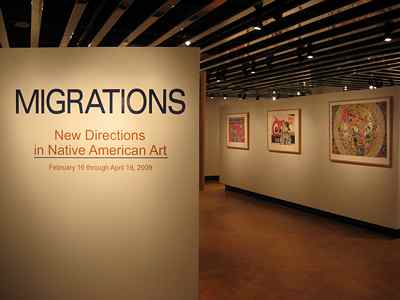
(above: gallery image for Migrations:
New Directions in Native American Art. Photo courtesy of Hillstrom Museum
of Art)
This exhibition included
close to fifty works by six different Native American artists from six different
cultures from across the U.S. The six are artists who, 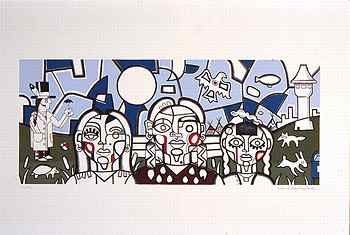 in their work, migrate
between Native American cultures, traditional and contemporary aesthetics,
and media, to represent the Native American experience. The aim of
the exhibit was to support innovative, emerging Native American artists
who, while exploring their experience as a Native American, are engaged
in work of a more experimental nature than what is generally thought of
as "Native American Art." (right: Star Wallowing Bull,
My Three Sisters, 2004, lithograph, 22 x 29 inches)
in their work, migrate
between Native American cultures, traditional and contemporary aesthetics,
and media, to represent the Native American experience. The aim of
the exhibit was to support innovative, emerging Native American artists
who, while exploring their experience as a Native American, are engaged
in work of a more experimental nature than what is generally thought of
as "Native American Art." (right: Star Wallowing Bull,
My Three Sisters, 2004, lithograph, 22 x 29 inches)
Artists included in the exhibition were Star Wallowing
Bull, of the Chippewa Nation from the White Earth Reservation in Minnesota;
Marie Watt, of the Seneca Nation, in Oregon; Steven Deo, of the Creek Nation,
in New Mexico; Tom Jones, of the Ho Chunk Nation, in Wisconsin; Larry McNeil,
of the Tlingit/Nisgaa Nation, in Idaho; and Ryan Lee Smith, of the Cherokee
Nation, in Louisiana.
The artists were chosen by a distinguished national jury
that included Jaune Quick-to-See Smith, a member of the Flathead Salish
Nation and a prominent artist, curator, educator, and activist; Truman Lowe,
an artist and member of the Winnebago Nation, and a Professor of Art and
curator at the National Museum of the American Indian, Smithsonian Institution;
Deborah Wye, a curator at the Museum of Modern Art, New York; Siri Engberg,
a curator at the Walker Art Center, Minneapolis; and Marjorie Devon, Director
of the Tamarind Institute, Albuquerque.
The exhibition, which is being circulated by the University
of New Mexico Art Museum, is accompanied by a catalogue, published by the
University of New Mexico Press. The catalogue includes essays by major
scholars including Lucy Lippard, who is one of the most prominent art critics
today and a specialist in Native American and Feminist art and related issues.
Related programming
Related programming for the Migrations exhibition
included a public lecture on March 8, 2009 by Jaune Quick-to-See Smith,
titled "A Survey of Contemporary American Indian Art." Quick-to-See
Smith, who, as noted, served as a juror for the Migrations exhibit, is
considered one of the foremost Native American artists today. Her
works are found in the collections of the Smithsonian Institution, the Museum
of Modern Art in New York, and the National Museum of Women in the Arts
in Washington, D.C. She has lectured widely, and, among many
other honors, was given a Lifetime Achievement Award from the Women's Caucus
for the Arts. Quick-to-See Smith calls herself a "cultural art
worker." Elaborating on her Native American worldview, her
work addresses human rights and environmental issues, as well as today's
tribal politics, with a keen sense of humor and insight. Her lecture
was presented by the Hillstrom Museum of Art with support from the Lecture
Series, the Women's Studies Program, the Department of Art and Art History,
and the Ethel and Edgar Johnson Endowment for the Arts, all of Gustavus
Adolphus College; and the Shakopee Mdewakanton Sioux Community, headquartered
in Prior Lake, Minnesota, and the Lower Sioux Indian Community, headquartered
in Morton, Minnesota.
Other related programming included a group of choreographic
performances by Gustavus Adolphus College dance students in the Dance Composition
course taught by faculty member, Melissa Rolnick, held in the Hillstrom
Museum of Art on April 5 and 7, 2009. The student dancers/choreographers
for the program, which was titled Migrations: Moving Installations, included
Marissa Augustin, Emily Bulling, Shawn Grygo, Sarah Jabar, Patrick Jeffrey,
Denise Stein, Jill Van Osdol. The program was created under the
artistic direction of Rolnick, who noted that the gifted dance students
were given the charge to create a "site-specific" dance for the
Museum that was inspired by a particular artwork and that was also sensitive
to the configurations of space and place in the Museum exhibition.
Wall text from the exhibition
- Migrations: New Directions in Native American Art
-
- Steven Deo
- Tom Jones
- Larry McNeil
- Ryan Lee Smith
- Star Wallowing Bull
- Marie Watt
-
- The six artists represented in Migrations: New Directions in Native
American Art, like all of us, are defined by the multiple influences
in their environments, which together paint a composite image of each individual's
identity. Each of the Migrations artists has experienced the fluid boundaries
of culture, and their work embraces both the modern and the traditional.
In fact, we selected the title for its diverse implications of movement
-- between one time and another, between cultures, between places, between
artistic mediums, between obscurity and the limelight.
-
- The impetus for Migrations was rooted in Tamarind Institute's decades-long
commitment to working with artists from varied backgrounds. These artists
have infused our programs with energy and curiosity. While a handful of
artists of Native descent have achieved national and international recognition,
Indian artists have largely been ignored by the power brokers of the art
world. We wanted to identify and showcase lesser-known artists not "Native
artists"-who engage in contemporary dialogue in a meaningful way.
The six artists chosen -- Steven Deo, Tom Jones, Larry McNeil, Ryan Lee
Smith, Star Wallowing Bull, and Marie Watt -- represent a range of stylistic
approaches, tribal affiliations, and media.
-
- Three artists made prints at Tamarind Institute, and three at Crow's
Shadow Press, part of the Crow's Shadow Institute of the Arts located in
southeastern Oregon on the Umatilla Reservation near Pendleton. This exhibition
presents those prints, along with other works by each artist that further
explore creative themes and concepts. As Jo Ortel notes in her essay in
the Migrations catalog, "Certainly, for the six individuals selected
. . . the migrations are multidirectional and multidimensional. They encompass
psychological as well as physical journeys. They enfold art and life, individual
and community. Most importantly, they involve a deepening of cultural understanding
and self-knowledge." We greatly appreciate the opportunity to present
this work.
-
- Marjorie Devon
- Director, Tamarind Institute
- University of New Mexico, Albuquerque
-
-
-
- This exhibition is organized by the University of New Mexico Art Museum,
Albuquerque, in collaboration with the Tamarind Institute, a division of
the College of Fine Arts, UNM. Support for this project was provided by
TREX (Traveling Exhibitions Program of the Museum of New Mexico), the Andy
Warhol Foundation for the Visual Arts, and the National Endowment for the
Arts. Artists' statements included in the exhibition are taken from the
book Migrations: New Directions in Native American Art, edited by
Marjorie Devon and published by the University of New Mexico Press (2006).
-
- The appearance of Migrations at the Hillstrom Museum of Art
is presented with assistance from the Lower Sioux Indian Community, headquartered
in Morton, Minnesota; from the Shakopee Mdewakanton Sioux Community, headquartered
in Prior Lake, Minnesota; and from the Diversity Center of Gustavus Adolphus
College.
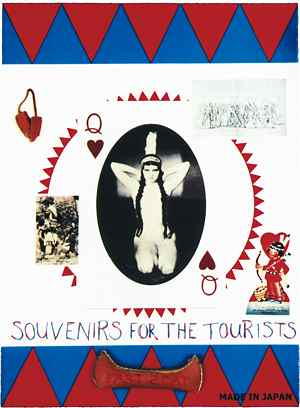
(above: Tom Jones, Commodity II, 2004, lithograph,
30 x 22 inches)
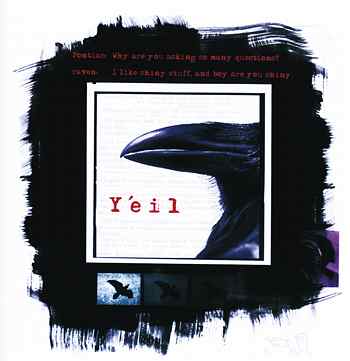
(above: Larry McNeil, Y'eil (Pontiac Series), 1998,
digital print, 24 x 24 inches)
Biographies of the artists and object labels
- Steven Deo
- Born1956, Claremore, Oklahoma
- Member of the Creek Nation, Euchee Tribe
-
- Studied at:
- ·Institute of American Indian Arts, Santa Fe, New Mexico: AFA
in Three-Dimensional Art, 1991; AFA, Two-Dimensional Art, 1992
- ·San Francisco Art Institute: BFA, 1994
- ·Purdue University, West Lafayette, Indiana
- ·University of Oklahoma, Norman
-
- As a contemporary artist of Native American descent, identity has been
a constant point of reference. Often, I've looked into the past through
the eyes of the camera at images of my family, or at images reproduced
in Western histories. Then, nature was our environment: we looked to the
sky and made kinship with the stars, the moon, and the sun. The earth lived
under our bare feet and rivers flowed through our bodies and minds. Our
environment has changed and our "nature" replaced with concrete,
steel, and asphalt. We have been relocated and dislocated, grouped and
regrouped. Our communality is an extended family called "Indian."
-
- Although I grew up in an urban environment in Tulsa, Oklahoma . . .
I had other experiences that centered on native religion and ceremony that
were very much part of the fiber of my life.
-
- For as long as I can remember, I was sent to stay with my paternal
grandparents, who had retired on land that was our Indian allotment. They
owned a television, but the reception was not very good, so at night Grandma
Deo would teach me the language, tell us stories. During the days, I would
ride their old plow horse, day in and day out.
-
- I also had a relationship with my mother's family. Her mother was a
full blood Creek Indian, and her father a full blood Euchee. He was a hereditary
chief, a Bear Clan member. When I was very small, I would sit next to him
during our dances. They would begin at midnight and last until sunrise,
and I would often fall asleep and wake up in his pickup truck. Whenever
I can, I still participate in the Greencorn ceremony during the summer
solstice, dancing and taking medicine all day.
-
- I continually think about the people I came from, although the language
they spoke becomes clouded by time and daily life. The songs from the beginning
of creation resonate in my daydreams, and I find solace in that sacred
place called art.
-
- Steven Deo
- Principle of Identity, 2004
- Lithograph, 22 1/2 x 30 inches
-
- Steven Deo
- Alluvium, 2004
- Lithograph, 22 1/2 x 30 inches
-
- Steven Deo
- Perpetual Stream, 2004
- Mixed media, 60 x 21 x 14 inches (large figure), 40 x 12 x 12 inches
(small figure)
-
- Steven Deo
- Child's Play, 2005
- Mixed media, 20 x 40 x 24 inches
-
Tom Jones
- Born 1964, Charlotte, North Carolina
- Member of the Ho-Chunk Nation
-
- Studied at:
- ·University of Wisconsin, Madison
- ·School of Visual Arts, New York City
- ·Columbia College, Chicago, Illinois: MA, Museum Studies, 2002;
- MFA, Photography, 2002
-
- I feel a responsibility to portray the Native American experience,
and the contributions to the history of the United States of Native peoples,
who have been largely without a voice in the documentation of this history.
For years, I have been collecting photographic postcards from the turn
of the last century. In my research, I came across an image of a beautiful
Native American woman with a child strapped to her back. Underneath the
image was the caption, "The White Man's Burden." This image has
remained with me, and was the catalyst for the series of images entitled
"Dear America," which ironically juxtapose the lines from the
song America with classic images from these postcards.
-
- Typically, photographs of the Native American Indians were taken by
outsiders. We have generally been represented with beads and feathers,
widely known through the extraordinary photographic portrayals of Edward
Curtis. Like many Native American Indians, the Ho-Chunk people still adhere
to traditional ways even as they have adapted to the white culture that
surrounds them. The emphasis of my photographic work is on the members
of my tribe and the environments in which they live, giving a name and
face to the individuals and their way of life in our own time. First and
foremost, I am mindful of my responsibility to the tribe to help carry
on a sense of pride about who and what we are as a people. I want the public
to see the strength and resilience of the Ho-Chunk people.
-
- Everything Ho-Chunks do in their traditional life is a form of art.
We have an eye for detail; we are taught as children to observe and to
pay close attention to everything around us. We are also asked, "What
are you going to do to improve the life of others?" Upon the passing
of my grandfather, I was asked to take his place in the Medicine Lodge.
I have chosen to follow in his footsteps to carry on the traditional ways
of our people; and I followed in my father's footsteps in photography,
creating a visual archive for future generations.
-
- Tom Jones
- Commodity I, 2004
- Lithograph and mixed media, 30 x 22 inches
-
- Tom Jones
- Commodity II, 2004
- Lithograph and mixed media, 30 x 22 inches
-
- Tom Jones
- Choka Watching Oprah/Jim Funmaker
- (The Ho Chunk People Series), 1998
- Gelatin silver print, 20 x 24 inches
-
- Tom Jones
- Nina Cleveland
- (The Ho Chunk People Series), 1998
- Gelatin silver print, 18 x 18 inches
-
- Tom Jones
- Ho Chunk Veterans, G. Stacey,
- E. Hall, and K. Snake
- (The Ho Chunk People Series), 2001
- Gelatin silver print
-
- Tom Jones
- Drummers
- (Honoring the Ho Chunk Warriors Series), 2003
- Chromogenic print, 28 x 36 inches
-
- Tom Jones
- My Country 'tis of Thee
- (Dear America Series), 2002
- Digital ink jet print, 22 x 36 inches
-
- Tom Jones
- Sweet Land of Liberty
- (Dear America Series), 2002
- Digital ink jet print, 36 x 24 inches
-
- Larry McNeil
- Born 1955, Juneau, Alaska
- Member of Tlingit and Nisga'a nations
-
- Studied at:
- ·School of Photographic Art and Science, Brooks Institute, Santa
Barbara, California: BA, Photographic Illustration, 1978
- ·Institute of American Indian Arts, Santa Fe, New Mexico
- ·University of New Mexico, Albuquerque: MFA, Photography, 1999
-
- Associate Professor of Photography, Boise State University, Idaho,
since 1999
-
- My place in our American culture is a bit off-center because I, like
many other Native Americans, really grew up outside of the mainstream while
simultaneously being immersed in it, which is a kind of paradox that confuses
the hell out of everyone, me included. As a kid I was likely to hear Roy
Orbison blasting Pretty Woman out of the jukeboxes in bars along the avenue,
and then go home to traditionally smoked salmon and hearing my grandma
talking to my mom in Tlingit.
-
- Being raised partly by our grandmother, who was born in the late 1800s,
gave my siblings and me an atypical worldview -- and an unusual strength
and deep connection to our identity. We were raised in turbulent times
that challenged our very existence as Tlingit people-from experiencing
racism in our everyday lives to having the government refuse claims to
our traditional homeland and our right to exist as a sovereign nation.
Our experiences are not unusual . . . many of our friends and relatives
have similar stories, and they continue to forge powerful bonds that go
deeper than blood.
-
- I see my work as a bridge between cultures that is satirical about
both. After finding our own mythological creature, the raven, to be very
relevant to the absurdities that we encounter every day in America, I drifted
toward the broader idea of myths and mythology and how it informs who we
are. The title of the series, "Fly by Night Mythology", seemed
perfect for everything that I have been making work about because it refers
to the Tlingit creation story in which Raven flew by night because in the
beginning there was no light. The raven from the Northwest Coast is also
a changeling or transformer and is a trickster. "Fly by night"
is also a colloquialism that alludes to being an undependable rascal, yet
Raven plays a key role in our creation story-which makes him an embodiment
of irony, as aspect that the Tlingit people are keenly aware of.
-
- I have always had an affinity for words and images. Language and stories
became a part of my art without much conscious thought. The use of language
is not necessarily literal; I like visual metaphors. Personally, the work
is very much a visual manifestation of Tlingit culture and identity, which
are comprised of both formal and informal language and stories. Someone
from my own Keet Hit (Killer Whale House) would understand the interaction
of text and image without having it described to them; I believe it is
very innate to us. The postmodern crowd gets it too, as do kids, which
is an aspect that I really love.
-
- Larry McNeil
- Native Epistemology, 2004
- Lithograph, 30 x 22 1/4 inches
-
- Larry McNeil
- Edward Curtis' Last Photograph, 2004
- Lithograph, 36 x 28 1/4 inches
-
- Larry McNeil
- Dad, 2002
- Digital print, 24 x 40 1/2 inches
-
- Larry McNeil
- Grandma, We Who are Your Children, 2002
- Digital print, 24 x 40 1/2 inches
-
- Larry McNeil
- Once Upon a Time in America, 2002
- Digital print, 24 x 37 inches
-
- Larry McNeil
- In the True Spirit of the White Man, 2002
- Digital print, 24 x 40 1/2 inches
-
- Larry McNeil
- Y'eil, (Pontiac Series), 1998
- Digital print, 24 x 24 inches
-
- Larry McNeil
- Tee Harbor Jackson, 2002
- Digital print
-
- Ryan Lee Smith
- Born 1972, Tahlequah, Oklahoma
- Member of the Cherokee Nation
-
- Studied at:
- ·Baylor University, Waco, Texas: BFA, 1997
- ·University of New Orleans, Louisiana
-
- As a child living in a small town in Oklahoma, my main interests were
rurally based. I enjoyed setting trot lines for catfish and seining creeks
for the bait. Venturing . . . far out into the country was always exciting,
sometimes scary. I would walk the woods and notice everything. After high
school, I went to Baylor University and worked with Karl Umlauf. There,
I decided that I wanted to paint, but I lacked discipline. I moved to Durango,
Colorado, in 1997, soon after graduation because I hadn't seen the mountains
before. It was in Colorado that I really focused on my work -- I did hundreds
of drawings and paintings in the mountains. I traded or sold them for a
few dollars just to make ends meet. I now regret that those paintings are
not accounted for, but those five years of just exercising my abilities
outside the context of contemporary art were vital to my work's evolution.
-
- I returned to Oklahoma with my soon-to-be wife, whom I met at a wood
mill where we were both working. I decided to apply to grad school in New
Orleans because I wanted to live near water, but more importantly, I wanted
to be back in an educational environment. I wanted to see what other artists
were doing. The University of New Orleans awarded me the Marcus B. Christian
Graduate Scholarship, so I went. The urban environment in New Orleans is
a big influence on my work and my life. I love the accessibility of everything
and am excited by the overall vibe of the city. Every time I see the streetcar
or drive by the Superdome, I am proud to be here. However, as Merle Haggard
says, "the roots of my raisin' run deep," and I plan to move
back to Oklahoma, to the country. I would like to do something for Native
arts in Oklahoma and other places. I want to erase the stereotype attached
to Native American art. I want to show the art world that Native art is
not solely about representation.
-
- There is a pulse or drumbeat that Native people have inside them. I
want to translate that feeling in my work. I work spontaneously, combining
everyday observations with past experiences and my thoughts or concerns
of the moment. I translate these with color, line, and form. I use music
to set a pulse -- many different rhythms and sounds occupy a single composition.
I want to make real, honest, and personal art.
Ryan Lee Smith
- Be Prepared to Stop, 2004
- Lithograph, 22 1/4 x 30 inches
-
- Ryan Lee Smith
- Bare Foot, 2004
- Lithograph, 22 1/4 x 30 inches
-
- Ryan Lee Smith
- What, 2004
- Mixed media, 32 x 40 inches
-
- Ryan Lee Smith
- Artificial Reef, 2005
- Mixed media, 22 x 25 inches
-
- Ryan Lee Smith
- Jack-o-Lantern, 2004
- Mixed media, 47 x 35 inches
-
- Ryan Lee Smith
- Lung Transplant, 2004
- Mixed media
-
- Ryan Lee Smith
- Push It, 2004
- Mixed media
-
Star Wallowing Bull
- Born 1973, Minneapolis, Minnesota
- Member of the Minnesota Chippewa Tribe, White Earth Reservation
-
- I spent most of my life in Southside Minneapolis, until I moved to
Fargo, North Dakota, in 2001. My mother is Arapaho, from the Wind River
Indian Reservation in Wyoming. My father, Frank Big Bear, is an artist
who is also a tribal member of the Minnesota Chippewa Tribe, White Earth
Reservation. Growing up, I watched him draw and paint. I was always fascinated
with his work. At a very early age, I was drawing faces and lines, and
people were amazed by my unique gift. My father smiles each time he speaks
of that. The greatest influence on me has been his art.
-
- When my sister and I were reunited with my father after living with
our mother in Denver for two years (I remember him crying when he saw us),
he continued to encourage my artistic skills. Throughout grade school and
junior high, my friends and teachers admired my work-especially my art
teacher, who gave me a bag full of art supplies on the last day of school
each year. He always told me I had a bright future.
-
- My art comes out of my personal life: it is grounded in my heritage
and my past. I am very attracted to bold, bright colors. Mostly I make
the colors harmonize, but sometimes I use random colors that are often
jarring. I am experimenting and exploring through the use of color. Like
other artists today, I use imagery from advertisements and popular culture
in my work. But it is from a Native American perspective, with a twist
that relates the imagery to Native American ideas and issues. Although
a person can enjoy my artwork without knowing anything about me or the
specific piece, a deeper appreciation of the work can be gained by learning
more about the images and symbols that I choose to depict.
-
- I am on a path of self-discovery and this informs my artwork: I hope
the viewers, through engagement with the work, can also learn and discover,
and thus enrich themselves.
Star Wallowing Bull
- A Moment of Silence, 2004
- Lithograph, 28 x 22 5/8 inches
-
- Star Wallowing Bull
- My Three Sisters, 2004
- Lithograph, 22 x 29 inches
-
- Star Wallowing Bull
- Twinkle, Twinkle Little Star,
- Now I Know Who You Really Are, 2003
- Prismacolor pencil on paper, collage, 30 1/4 x 44 inches
-
- Star Wallowing Bull
- Windigo versus the Cannibal Man, 2002
- Prismacolor pencil on paper, 12 x 30 1/4 inches
-
- Star Wallowing Bull
- Mind to Mind Combat, 2001
- Prismacolor pencil on paper, 22 1/4 x 30 inches
-
- Star Wallowing Bull
- Rising Star, 2006
- (left, on wall end)
- Prismacolor pencil on paper
-
- Star Wallowing Bull
- Custer's Last Stand, 2006
- Prismacolor pencil on paper
-
- Star Wallowing Bull
- Chippewa Medicine Bear, 2004
- Prismacolor pencil on paper
-
- Marie Watt
- Born 1967, Seattle, Washington
- Member of the Seneca Nation
-
- Studied at:
- ·Willamette University, Salem, Oregon: BS, Speech, 1990
- ·Institute of American Indian Arts, Santa Fe, New Mexico: AFA,
Museum Studies, 1992
- ·Skowhegan School of Painting and Sculpture, Maine
- ·Yale University School of Art, New Haven, Connecticut: MFA,
Painting and Printmaking, 1996
-
- When I was in kindergarten, our teacher asked us to share something
about our cultural backgrounds. I said that I was part cowboy and part
Indian-my way of saying that my mom is Seneca and grew up at the Cattaraugus
Reservation in upstate New York, and my dad, part German and part Scottish,
grew up in a family of educators and ranchers who originally homesteaded
ranchland in Wyoming. Like most children with rich imaginations and impressionable
minds, I was influenced by television, particularly John Wayne Westerns.
But I rooted for both sides. It was easy for me to ignore issues regarding
identity until kids began to tease me for being different, or until I left
home and suddenly questioned what "home" really was. When I went
to Yale School of Art, I felt very far away from home. I tried to compensate
by working with cornhusks, a material that was personally meaningful and
that metaphorically represented home. The values of community and family,
and a strong work ethic, were passed on to me from an early age.
-
- My work is about social and cultural histories embedded in commonplace
objects. Like Jasper Johns, I am interested in "things that the mind
already knows." Unlike Pop artists, however, I use a vocabulary of
natural materials (stone, cornhusks, wool, cedar) and forms (blankets,
pillows, bridges) that are universal to human experience (not uniquely
American) and noncommercial in nature. My approach to art making is shaped
by the protofeminism of Iroquois matrilineal custom, political work by
Native artists in the 1960s, a discourse on multiculturalism, as well as
Abstract Expressionism and Pop Art.
-
- Marie Watt
- Transit, 2004
- Lithograph, 22 x 30 inches
-
- Marie Watt
- Receive, 2004
- Lithograph, 17 1/8 x 20 1/8 inches