For the Love of Art: a Sonoran Journey
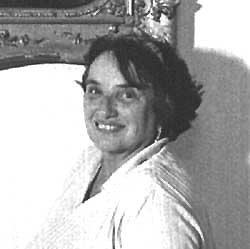
- Carolyn Nelson has recently
returned from another trip to Sonora, Mexico,
- where for the past three years, she has been restoring
important historical
- paintings for the Regional Museum, at the Univeristy
of Sonora, in
- Hermosillo, Sonora, Mexico. There are four that she has
been working with,
- three of which were painted and attributed to the painter
Narchoit, who was
- a young French adventurer during the Maximillian Campaine.
He was pardoned
- by General Ignacio Presquiera, who thought Narchoit was
far too young to
- die, at the end of the French/Mexican War in the year
of 1862. The paintings
- are from this time period.
-
- When Carolyn went to the Museum at the request of the
curator, Mr. Leo
- Sandoval, she noticed the condition of the paintings.
Advising Mr. Sandoval
- at the time that the paintings appeared quite important,
she asked why were
- they so badly damaged, and displayed damaged, and torn.
Mr. Sandoval
- told her that there was no one there that knew how to
repair these paintngs.
- She then took a closer inspection, and when Mr. Sandoval
asked if she knew
- how to do the repair, she said yes.
-
- The next day, she was invited to come to the museum and
work on the paintings.
- This was in the fall of 1993, and she went back down
to Hermosillo in
- January of 1994, where she started in on "El Nino
del los Borrago". While
- working on this painting, she was interviewed, and tested
on her abilities
- by INAH, which is the National Institute of Anthropology
and History for the
- country of Mexico, by their regional staff. Upon the
completion of their
- exam, she was granted permission by the government, through
INAH, to work on
- the artifacts. She is one of the few Americans that have
permission to work
- on the artifacts of Mexico.
-
- Here are notes from Carolyn's journal.
-
- It has been a difficult project,
because so many things that an art
- conservationist needs to have as equipment is not available
there. I mix my own emulsions, and many times it is hard to even find the
right forms of turpentine, or lineseed oil. One time I ordered some lineseed
oil, and got back a large bottle of dark brown liquid that was of no use
at all. There is no access to a hot table for lining the paintings, so
I have to use a lot of imagination to come up with enough weight to press
out the new liners.
- The liners were important to put on the paintings, as
this gives them reinforcement. I would make my own glue, using beeswax
as a base. This had to be heated, and there wasn't any access to any kitchen,
so I had to either borrow a hot plate from friends, or make a trip to Tucson,
Arizona to get one. My space there is actually sharing an office with the
curator, and it
- is pretty much that of a store room.
-
- The lighting is rather poor, and I have to bring in extra
lamps. To weight
- down the paintings, I am using whatever I can find in
the storeroom,
- that includes cannon balls, muskets, rifles, old clocks
and typewriters, books,
- whatever...on top of sheets of plexiglass. This tower
is utilitzed once I have
- taken an iron to the back and applied the liner.
-
- I will work and manipulate the painting, without making
changes, in order
- to get it to work. Sometimes extra weight, and more pressing
is necessary.
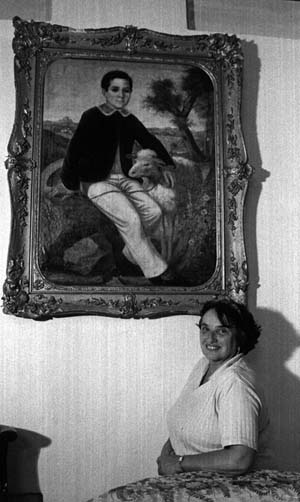
- INAH ran an inspection on the completition of "El
Nino del los Borrago"
- and exclaimed, "Perfecto" after inspecting
the area of which there was a
- large tear. This area is from the corner of the right
eye to the hip.
- There were also many other tears and holes. The painting,
before it became
- part of the museum collection, was found next to a dumpster.
"El Nino"
- now is displayed in the main salon of the museum.
-
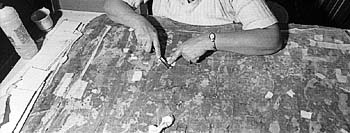
- I am currently working on another Narchoit, that is part
of the museum's
- collection. This one has taken many months so far, as
it was completely off
- the stretchers for a period of almost 40 years. You can
see me cleaning the
- back of this one. I will be returning in the fall to
continue the work.
- As the summer months in the desert area for which Hermosillo
is, is far too
- hot at this time.
-
-
- The project to complete these paintings has taken now
three years, and will
- continue. I am receiving very little in the way of money
for this project.
- The main focus is returning the culture back to the people
that live there
- and restoring their history. In 1994, my stay there was
extended to include
- a commission by a private client that supported my efforts
at that time.
- The client was the great grandson of General Ignacio
Presquiera, to which I
- give thanks, and indeed indebted to.
-
-
- While in the states, I continue to work on commissions
for conservation
- in fine art, as well as paint and weave.
-
-
About Resource Library:
Resource Library is a free online publication of nonprofit Traditional
Fine Arts Organization (TFAO). Since 1997, Resource Library and
its predecessor Resource Library Magazine have cumulatively
published online 1,300+ articles and essays written by hundreds of identified authors, thousands of other texts not attributable
to named authors, plus 22,500+ images, all providing educational and informational
content related to American representational
art. Texts and related images are provided almost exclusively by
nonprofit art museum, gallery and art center
sources.
All published materials provide educational and informational
content to students, scholars, teachers and others. Most published materials
relate to exhibitions. Materials
may include whole exhibition gallery guides, brochures or catalogues
or texts from them, perviously published magazine or journal articles, wall
panels and object labels, audio tour scripts, play scripts, interviews,
blogs, checklists and news releases, plus related images.
What you won't find:
User-tracking cookies are not installed on our website.
Privacy of users is very important
to us. You won't find annoying banners and pop-ups either. Also, our pages
are loaded faster without cookies. We want you to view Resource Library
content as quickly as possible. Resource Library contains no advertising
and is 100% non-commercial. .
(left: JP Hazeltine, founding editor, Resource Library)
rev. 11/22/10
This page was originally published in 1997 Resource
Library Magazine. Please see Resource Library's Overview section for more information.
rev. 10/28/11
Search Resource
Library for thousands of articles and essays on American art.
Copyright 2011 Traditional
Fine Arts Organization, Inc., an Arizona nonprofit
corporation. All rights reserved.