Currier Gallery of Art
Worlds of Beauty and Enchantment: The Henry Melville Fuller Collection of Paperweights
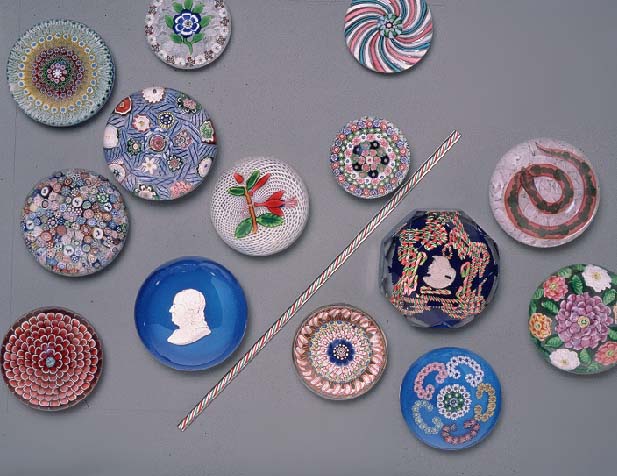
On March 13, 1999, The Currier Gallery of Art unveiled one of its most recent and important acquisitions, the Henry Melville Fuller collection of paperweights. The exhibition, Worlds of Beauty and Enchantment: The Henry Melville Fuller Collection of Paperweights, which is sponsored by Citizens Bank, includes over 300 rare historic and contemporary glass weights. The collection includes remarkable examples from the French glass houses of Clichy, Baccarat, and Saint-Louis, as well as very fine contemporary pieces from great twentieth-century glass artists such as Paul Ysart, Charles Kaziun, Rick Ayotte, Paul Stankard, and Delmo and Debbie Tarsitano.
 "This
is an extremely important collection," said Andrew Spahr, Curator for
The Currier Gallery of Art. "In terms of quantity, quality and variety
of paperweights and artists represented, the Fuller collection represents
one of the finest private collections ever assembled in this country. With
Mr. Fuller's gift to the museum, the Currier now has a collection that ranks
with renowned paperweight collections of The Smithsonian Institution, The
Art Institute of Chicago, and the Corning Museum of Glass," Spahr added."I'm
often asked how I began collecting paperweights," Mr. Fuller recently
recounted, "and it really was accidental. 1 happened to visit the Corning
Museum of Glass with a friend and was fascinated by the paperweight display.
While in Corning, I purchased a small paperweight at a gift shop in town...one
with a red swirl, I believe. It wasn't a very good weight...it had flaws
in it, but I liked the color, and at $10.00 it seemed like a bargain! At
that time I was living and working in New York City, and while taking my
daily morning walk 1 would often window shop at Leo Kaplan's, a seller of
fine paperweights on Madison Avenue. I must say," Mr. Fuller added
a little ruefully, "that trip to Corning, and the relatively modest
purchase I made, led to the acquisition of many finer paperweights that
were a little more expensive"
"This
is an extremely important collection," said Andrew Spahr, Curator for
The Currier Gallery of Art. "In terms of quantity, quality and variety
of paperweights and artists represented, the Fuller collection represents
one of the finest private collections ever assembled in this country. With
Mr. Fuller's gift to the museum, the Currier now has a collection that ranks
with renowned paperweight collections of The Smithsonian Institution, The
Art Institute of Chicago, and the Corning Museum of Glass," Spahr added."I'm
often asked how I began collecting paperweights," Mr. Fuller recently
recounted, "and it really was accidental. 1 happened to visit the Corning
Museum of Glass with a friend and was fascinated by the paperweight display.
While in Corning, I purchased a small paperweight at a gift shop in town...one
with a red swirl, I believe. It wasn't a very good weight...it had flaws
in it, but I liked the color, and at $10.00 it seemed like a bargain! At
that time I was living and working in New York City, and while taking my
daily morning walk 1 would often window shop at Leo Kaplan's, a seller of
fine paperweights on Madison Avenue. I must say," Mr. Fuller added
a little ruefully, "that trip to Corning, and the relatively modest
purchase I made, led to the acquisition of many finer paperweights that
were a little more expensive"
The Fuller Collection is made up of 335 paperweights, with over 200 dating from the nineteenth century. There are many fine examples from France, where starting in the mid 1840s and continuing through the 1860s, "millefiori" and "lampwork" techniques were perfected. These works, by the glass houses of Baccarat, Clichy, and Saint-Louis, heavily influenced glass artists in both England and the United States.
"One of my favorite weights from this period was made by Pantin, a factory near Paris" said Mr. Fuller. "The paperweight is somewhat unusual and features a gila monster...lizards and snakes being a favorite subject of the Pantin artists. But these weights are very scarce, for the factory was only in business for a short time."
In fact, the nineteenth-century popularity of paperweights in Europe and America was relatively short-lived, with the art form and its techniques almost totally forgotten by the turn of the century. However, in the mid 1900s, a renewed interest developed both in collecting paperweights and in trying to replicate or improve the production techniques of the previous century.
The Fuller Collection also surveys the twentieth-century
resurgence of glass paperweights, beginning in the 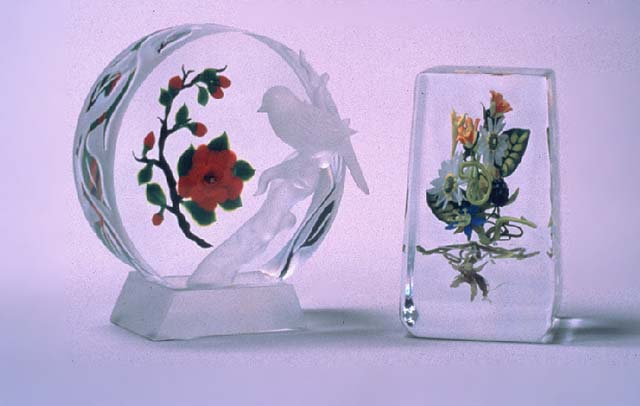 1950s with works by artists like Charles Kaziun and
Paul Ysart, to glass artists working today including Paul Stankard, Debbie
Tarsitano and Rick Ayotte.
1950s with works by artists like Charles Kaziun and
Paul Ysart, to glass artists working today including Paul Stankard, Debbie
Tarsitano and Rick Ayotte.
Brockton, Massachusetts resident Charles Kaziun, and Spanish born Paul Ysart, led the twentieth-century revival of the neglected art of glass paperweights. Both artists researched the techniques of the glass masters from a century earlier and incorporated many of the techniques of the French glass houses in their early work. Kaziun weights are noted for beautiful millefiori designs and a wide range of floral motifs, with his perfection of the "crimped flower" being a signature hallmark.
Ysart, the son of a Spanish glass blower, is considered
to be one of the most important contributors to the revival of paperweight
making in the twentieth century. Although born in Spain, Ysart was raised
in Scotland, and as a young adult worked in glass production at Moncrieff
Glassworks and later at Caithness Glass. Ysart's best known work includes
traditional millefiori set on clear, colored or lace backgrounds, and one
of his favorite motifs, the hovering butterfly.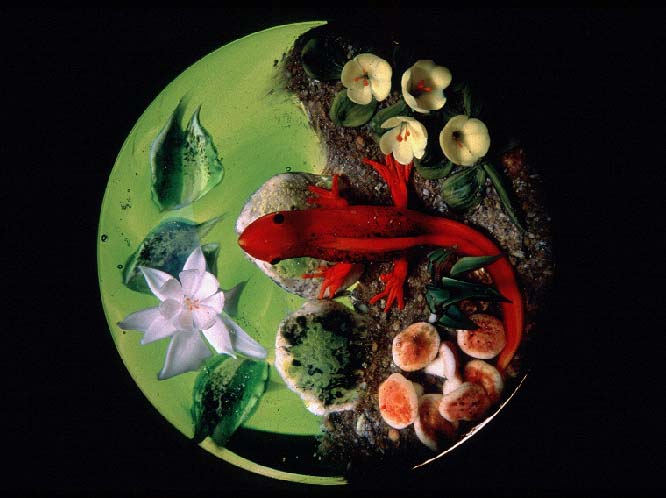
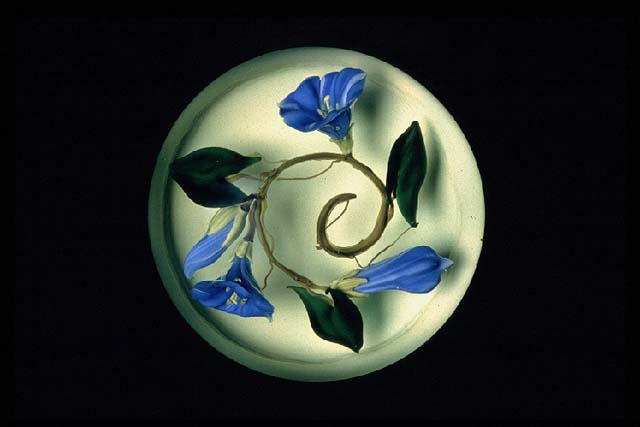
Paul Stankard is considered by many to be the most accomplished glass artist working today. His weights feature incredibly detailed, botanically accurate glass flowers, characterized by the inclusion of intricate root systems and an extraordinary focus on petal detail and coloration.The paperweights of New Hampshire resident Rick Ayotte, also known as "The Birdman" of glass, show a fascination with birds that developed early in his life. As a child growing up in Nashua, Ayotte charted migratory birds and carved life-size models of them out of wood. His early paperweights are characterized by highly detailed, "ornithologically correct" birds. His more recent paperweights are more complex with naturalistic settings that lend realism to the birds and other creatures they surround.
"1 was always interested in trying to have a wide variety of artists, styles and techniques in my paperweight collection," said Mr. Fuller. "But early on it was important to try to find pieces that were as flawless as possible...pieces made from the highest quality leaded glass and without excessive bubbles. It's easy, you know, for the uninitiated collector to purchase a piece that has flaws, hairline cracks or bubbles...although in some paperweights the bubbles are deliberate, the artists call them "Drops of Dew," Mr. Fuller added.
Worlds of Beauty and Enchantment: The Henry Melville Fuller Collection of Paperweights is on view to the public through June 21, 1999. The exhibition is sponsored by Citizens Bank. Additional funding was received from Leo Kaplan, Ltd. and William W. Upton, in honor of Henry M. Fuller and Richard F. Upton.
From top to bottom: Selections from the Henry Melville Fuller Collection of Paperweights; Paul Stankard, 1984, Blue Morning Glories on Green Ground, courtesy of the Currier Gallery; Paperweights by Victor Trabuco (left) and Paul Stankard (right), courtesy of the Currier Gallery: Rick Ayotte, 1990, Swamp Series with Red Salamander, courtesy of the Currier Gallery
Search for more articles and essays on American art in Resource Library. See America's Distinguished Artists for biographical information on historic artists.
This page was originally published in 1999 in Resource Library Magazine. Please see Resource Library's Overview section for more information.
Copyright 2012 Traditional Fine Arts Organization, Inc., an Arizona nonprofit corporation. All rights reserved.