Museum of Fine Arts, Houston
Houston, TX
(713) 639-7300
Exceptional Paintings by William Merritt
Chase, John Singer Sargent, and Georgia O'Keeffe; Furniture by Pottier and
Stymus, and Herter Brothers; and Silver by Tiffany & Co. on View in
American Art on Display at The Museum of Fine Arts, Houston
(click on images below to enlarge them)
American Art on Display, opening March 28, 1999, at the Museum of Fine Arts, Houston,
offers a glimpse of the museum's permanent collection of American painting,
sculpture, and decorative arts from the mid-19th century through the early
20th century.
The exhibition is organized into five major themes: "The
American Eden," "American Classicism," "The American
Aesthetic Movement," "American Impressionism" and "Early
20th Century American Art." The influences of other cultures on American
art, and the contributions of immigrant artists in American design are also
reflected in the exhibition, which continues through May 23, 1999, at the
Caroline Wiess Law Building of the MFAH, located at 1001 Bissonnet. Romantic
landscape paintings, including Indian Pass (1847) by Thomas Cole,
who is recognized as a founder of what became known as the Hudson River
School of landscape painting, are featured, as well as American portraiture,
exemplified by paintings by John Singer Sargent and William Merritt Chase.
Also included are examples of gilded-age cabinetmaking in New York with
pieces attributed to Pottier and Stymus, and the Herter Brothers; and examples
of early 20th-century American abstraction, including paintings by Marsden
Hartley and Georgia O'Keeffe.
American Art on Display offers
a preview of the pre-1945 American art collection that will be installed
in the permanent American art galleries of the Audrey Jones Beck Building
when it opens in March 2000. American Art on Display is organized by Emily
Ballew Neff, curator of American painting and sculpture, and Cindi Strauss,
assistant curator of decorative arts and Rienzi.
The exhibition opens with a group of 19th-century paintings
and decorative arts that depict the American landscape in diverse ways.
For many artists of the early 19th century, the American wilderness symbolized
 the
infinite possibilities of the nation's future. In this section of the exhibition
titled "The American Eden, " examples of painting demonstrate
a romantic reverence for the beauty and vastness of nature. Included are
paintings from the permanent collection which have not been on extended
view in years, including Indian Pass (1847) by Cole; A View of Mansfield
Mountain (1849) by John Frederick Kensett; and (see right) Frederic
Edwin Church's Catopaxi (1855), oil on canvas, 30 x 46 7/16
inches, The Museum of Fine Arts Houston, Museum purchase with funds provided
by Hogg Brothers Collection, gift of Miss Ima Hogg by exchange 74.58. Also on view is Douglas's Squirrel (c. 1841-43), a watercolor
by John James Audubon created for one of his books on the animal life of
North America.
the
infinite possibilities of the nation's future. In this section of the exhibition
titled "The American Eden, " examples of painting demonstrate
a romantic reverence for the beauty and vastness of nature. Included are
paintings from the permanent collection which have not been on extended
view in years, including Indian Pass (1847) by Cole; A View of Mansfield
Mountain (1849) by John Frederick Kensett; and (see right) Frederic
Edwin Church's Catopaxi (1855), oil on canvas, 30 x 46 7/16
inches, The Museum of Fine Arts Houston, Museum purchase with funds provided
by Hogg Brothers Collection, gift of Miss Ima Hogg by exchange 74.58. Also on view is Douglas's Squirrel (c. 1841-43), a watercolor
by John James Audubon created for one of his books on the animal life of
North America.
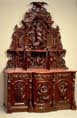 Complementing
the Hudson River School paintings is a (see left) dramatic Sideboard
(c. 1855), American, Middle Atlantic, probably New York, American
tulip wood, northeast white pine, black walnut and marble, 106 x 69 x 28
inches, The Museum of Fine Arts Houston, Museum purchase
with funds provided by Anaruth and Aron S. Gordon, 83.46.1 through .16,
by an unknown cabinetmaker from the Middle Atlantic region.
This opulent, elaborately carved sideboard features life-like depictions
of game, hounds, and lobsters, as well as plant forms and items from the
hunt including gun, powder horn, and pouch. It reinforces the focus on natural
images while also addressing man's conquest of nature.
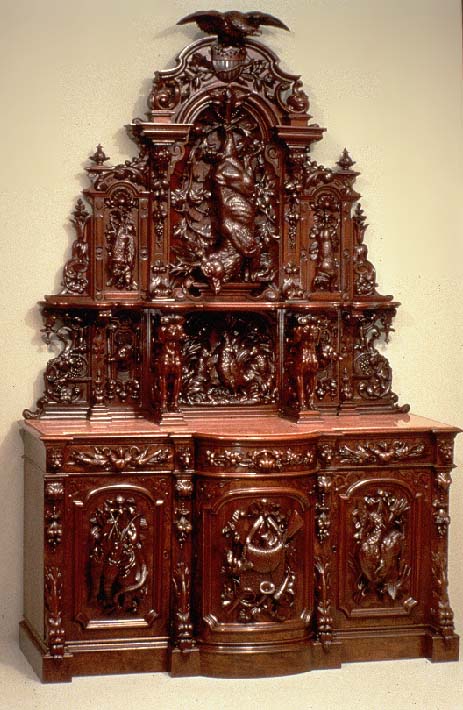
Complementing
the Hudson River School paintings is a (see left) dramatic Sideboard
(c. 1855), American, Middle Atlantic, probably New York, American
tulip wood, northeast white pine, black walnut and marble, 106 x 69 x 28
inches, The Museum of Fine Arts Houston, Museum purchase
with funds provided by Anaruth and Aron S. Gordon, 83.46.1 through .16,
by an unknown cabinetmaker from the Middle Atlantic region.
This opulent, elaborately carved sideboard features life-like depictions
of game, hounds, and lobsters, as well as plant forms and items from the
hunt including gun, powder horn, and pouch. It reinforces the focus on natural
images while also addressing man's conquest of nature.
Since before its founding as a republic, American artists
and architects looked to ancient Greece and Rome for inspiration, motivated
in part by the excavations at Pompeii and Herculaneum in the 1750s. In the
third quarter of the 19th century, this grand tradition of referencing ancient
styles once again came to the forefront of artistic influences. A new class
of skilled craftsmen, many of whom had immigrated to  America, influenced this revived interest in classicism.
A Parlor Cabinet (c. 1862) attributed (see right) to Pottier and
Stymus, New York, with marquetry attributed to Joseph Cremer of France,
Rosewood, burled ash, maple, eastern white pine, other woods, gilt
and bronze, 55 x 54 x 22 7/8 inches, The Museum of Fine Arts Houston, Museum
purchase with funds provided by the Agnes Cullen Arnoild Endowment fund,
91.1306.A, B, is included in this section of the exhibition
titled "American Classicism." The marquetry panel depicts Bacchus,
the Roman god of wine. Silver by both Tiffany & Co. and the Gorham Manufacturing
Company also demonstrates the influence of the ancient world on American
decorative arts during this period.
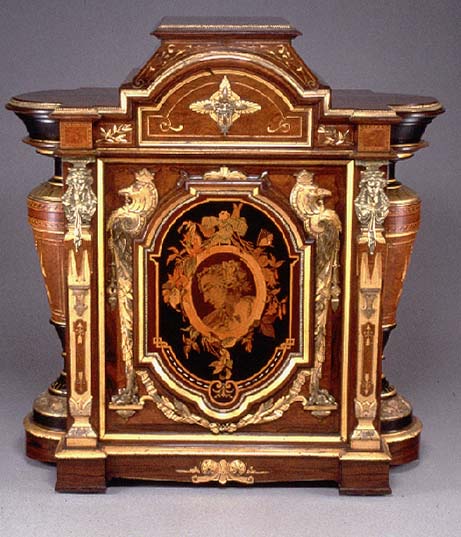
America, influenced this revived interest in classicism.
A Parlor Cabinet (c. 1862) attributed (see right) to Pottier and
Stymus, New York, with marquetry attributed to Joseph Cremer of France,
Rosewood, burled ash, maple, eastern white pine, other woods, gilt
and bronze, 55 x 54 x 22 7/8 inches, The Museum of Fine Arts Houston, Museum
purchase with funds provided by the Agnes Cullen Arnoild Endowment fund,
91.1306.A, B, is included in this section of the exhibition
titled "American Classicism." The marquetry panel depicts Bacchus,
the Roman god of wine. Silver by both Tiffany & Co. and the Gorham Manufacturing
Company also demonstrates the influence of the ancient world on American
decorative arts during this period.
Many American painters and sculptors of this time visited
or lived in Italy where they studied the work of  the Old Masters. Julius Montalant spent much of his
life in Italy painting historic sites and ancient ruins, and his painting
A View of Rome (1873) capsulizes the interest in classical subjects
among his wealthy patrons. Also featured in this section are many pieces
of sculpture, including (see left) William Henry Rinehart's marble nude
Thetis (c. 1861), 45 3/4 x 17 x 12 1/2 inches, The Museum
of Fine Arts Houston, Museum purchase with funds provided by "One Great
Night in November, 1996" .96.1702, a mythological figure
whose elegance and grace defines the classical style.
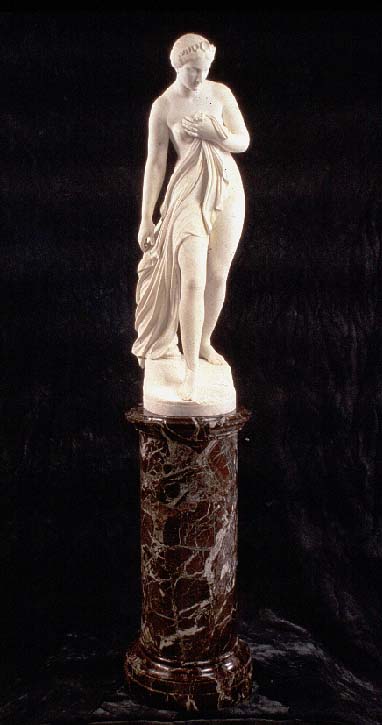
the Old Masters. Julius Montalant spent much of his
life in Italy painting historic sites and ancient ruins, and his painting
A View of Rome (1873) capsulizes the interest in classical subjects
among his wealthy patrons. Also featured in this section are many pieces
of sculpture, including (see left) William Henry Rinehart's marble nude
Thetis (c. 1861), 45 3/4 x 17 x 12 1/2 inches, The Museum
of Fine Arts Houston, Museum purchase with funds provided by "One Great
Night in November, 1996" .96.1702, a mythological figure
whose elegance and grace defines the classical style.
From the mid-1870s through the 1880s, America became fascinated
with foreign cultures, especially Japan's, whose doors opened to foreign
markets at mid-century. The 1876 Philadelphia Centennial Exposition launched
this interest on the American stage, sparking what became known as the Aesthetic
Movement in America. It was at this world's fair that the American public,
as well as artists and craftsmen, were able to see firsthand the art of
Japan and other "exotic" cultures. In response, they began incorporating
Japanese and Near Eastern ornamentation and patterns in their work. This
section of the exhibition titled "The American  Aesthetic Movement," includes such objects as
the Plaque (1889) by Union Porcelain Works, Greenpoint, New York,
which is decorated with tendrils, flowers, and birds, referencing the influence
of Near Eastern cultures, and a set of (see right) 8 Butterfly Napkin
Clips created by Tiffany & Co. in 1878, (from the John Mackay
silver service), silver, gilt, and enamel, 3/4 x 2 7/16 x 3 3/8 inches each, The Museum of Fine Arts Houston, Museum purchase with funds
provided by the Alice Pratt Brown Museum Fund, 91.1328.1 through 8. These silver, gilt, and enamel clips were made for Mr. and Mrs.
John W. Mackay, part owners of the Comstock Lode, a vast silver deposit
in Nevada. The napkin clips were part of a service for twenty-four persons
that took two years to make and required nearly one ton of silver.
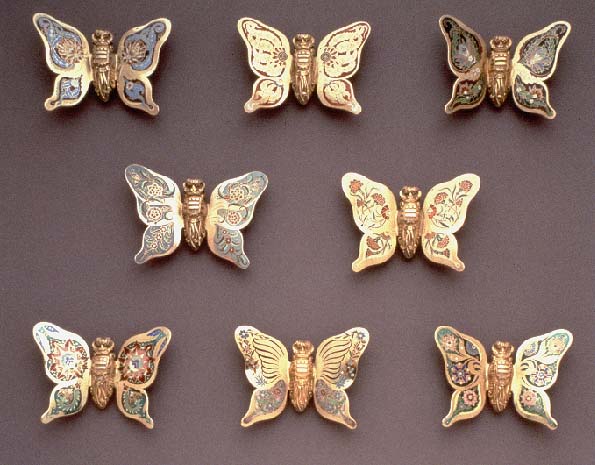
Aesthetic Movement," includes such objects as
the Plaque (1889) by Union Porcelain Works, Greenpoint, New York,
which is decorated with tendrils, flowers, and birds, referencing the influence
of Near Eastern cultures, and a set of (see right) 8 Butterfly Napkin
Clips created by Tiffany & Co. in 1878, (from the John Mackay
silver service), silver, gilt, and enamel, 3/4 x 2 7/16 x 3 3/8 inches each, The Museum of Fine Arts Houston, Museum purchase with funds
provided by the Alice Pratt Brown Museum Fund, 91.1328.1 through 8. These silver, gilt, and enamel clips were made for Mr. and Mrs.
John W. Mackay, part owners of the Comstock Lode, a vast silver deposit
in Nevada. The napkin clips were part of a service for twenty-four persons
that took two years to make and required nearly one ton of silver.
In the last quarter of the 19th century, a new generation
of American artists received their artistic inspiration from abroad, especially
from the work of French Impressionists, who came on the Paris art scene
in the 1870s. Examples of paintings and sketches by such American Impressionists
as Willard Metcalf, Childe Hassam, and William Merritt Chase illuminate
the late 19th-century American artist's interest in  capturing the light and atmosphere of the outdoors.
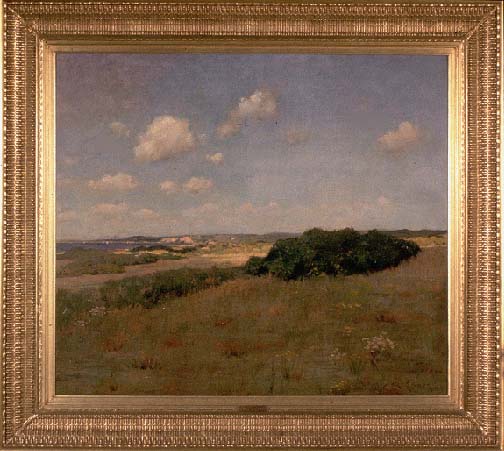
William Merritt Chase's (see right) Sunlight and Shadow, Shinnecock
Hills (c. 1895), oil on canvas, Museum of Fine arts Houston,
Partial gift of Mrs. James W. Glanville, 98.247, an important
recent acquisition of the MFAH, which is still housed in its original Stanford
White frame, is included in this section titled "American Impressionism."
Evening in New York (1890s) by Childe Hassam is also on view. Hassam
brought the techniques he learned and admired in Paris home to New York
where he created captivating paintings of ordinary scenes, such as New York
City in the rain.
capturing the light and atmosphere of the outdoors.
William Merritt Chase's (see right) Sunlight and Shadow, Shinnecock
Hills (c. 1895), oil on canvas, Museum of Fine arts Houston,
Partial gift of Mrs. James W. Glanville, 98.247, an important
recent acquisition of the MFAH, which is still housed in its original Stanford
White frame, is included in this section titled "American Impressionism."
Evening in New York (1890s) by Childe Hassam is also on view. Hassam
brought the techniques he learned and admired in Paris home to New York
where he created captivating paintings of ordinary scenes, such as New York
City in the rain.
The strength of the collection of American portraits at
the Museum of Fine Arts, Houston is demonstrated by four distinctive paintings
in this exhibition. Included are John Singer Sargent's Mrs. Joshua Montgomery
Sears (Sarah Choate Sears), 1899; and Mother and Child (The First
Portrait), c. 1888, by William Merritt Chase, featuring his wife--dressed
in a kimono, reflecting the interest in all things Japanese--and his eldest
daughter, Alice. The penetrating Portrait of John B. Gest (1905)
by Thomas Eakins and George Bellows'
 Portrait
of Florence Pierce (1914) are also included.
Portrait
of Florence Pierce (1914) are also included.
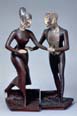
The last section of the exhibition spotlights American
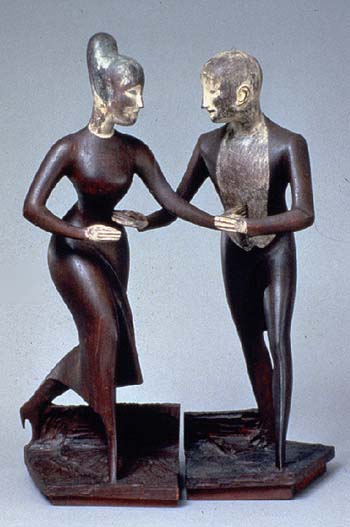
art in the early decades of the 20th century. Included in this section (see
left) is a sculpture by Elie Nadelman, The Tango, c. 1918-24 in cherry
wood and gesso, Museum of Fine arts Houston, Gift of Meredith J.
and Cornelia Long, 96.1751.A, B.
For further biographical information on selected artists
cited above please see America's Distinguished
Artists, a national registry of historic artists.
rev. 9/20/10
Search Resource
Library for thousands of articles and essays on American art.
Copyright 2010 Traditional Fine Arts Organization, Inc., an Arizona nonprofit corporation. All rights
reserved.
 the
infinite possibilities of the nation's future. In this section of the exhibition
titled "The American Eden, " examples of painting demonstrate
a romantic reverence for the beauty and vastness of nature. Included are
paintings from the permanent collection which have not been on extended
view in years, including Indian Pass (1847) by Cole; A View of Mansfield
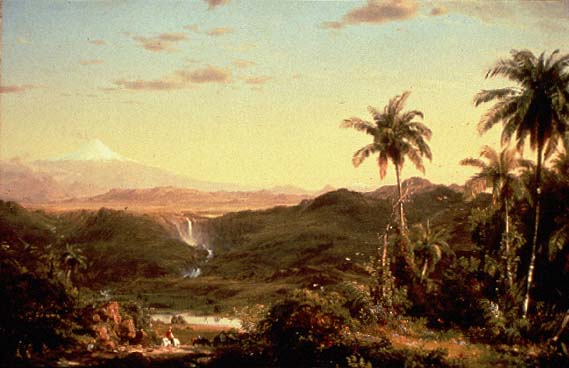
Mountain (1849) by John Frederick Kensett; and (see right) Frederic
Edwin Church's Catopaxi (1855), oil on canvas, 30 x 46 7/16
inches, The Museum of Fine Arts Houston, Museum purchase with funds provided
by Hogg Brothers Collection, gift of Miss Ima Hogg by exchange 74.58. Also on view is Douglas's Squirrel (c. 1841-43), a watercolor
by John James Audubon created for one of his books on the animal life of
North America.
the
infinite possibilities of the nation's future. In this section of the exhibition
titled "The American Eden, " examples of painting demonstrate
a romantic reverence for the beauty and vastness of nature. Included are
paintings from the permanent collection which have not been on extended
view in years, including Indian Pass (1847) by Cole; A View of Mansfield
Mountain (1849) by John Frederick Kensett; and (see right) Frederic
Edwin Church's Catopaxi (1855), oil on canvas, 30 x 46 7/16
inches, The Museum of Fine Arts Houston, Museum purchase with funds provided
by Hogg Brothers Collection, gift of Miss Ima Hogg by exchange 74.58. Also on view is Douglas's Squirrel (c. 1841-43), a watercolor
by John James Audubon created for one of his books on the animal life of
North America.