Mint Museum of Craft + Design
Mint Museum of Art
Mint Museum of Craft + Design
Charlotte, NC
704-337-2000
The Duke Energy Gallery: Tradition and
Change
The development of craft, from the
utilitarian objects of America' s 19th century rural economy to the contemporary
art that studio craft is considered today, is presented in the Duke Energy
Gallery, opened May 13, 1999 at Charlotte's Mint Museum of Craft + Design
(MMCD).
The debut of the second floor gallery completes the permanent
collection installation for the new museum. "Currents in Craft,"
which premiered at the January 10, 1999 opening of MMCD, features contemporary
studio craft. The Duke Energy Gallery traces the evolution of craft in four
stages: Rural and Farm Crafts (1800-1885), the Arts and Craft Movement (1888-1930),
Southern Appalachian Handicraft Revival (1930s) and Modernism (1940-1980).
Sub-themes include Carolina Craft, Cultural Identity, Anti-Esthetic, Naturalism,
Whimsy, Women's Work and Pattern and Decoration.
Early craft forms and rural economy crafts were utilitarian,
from Daniel Seagle's "Meat Storage Jar" (1830) to John A. Craven's
"15 Gallon Masonic Jar" (1855). Examples include European  influences
such as the "Moravian Plate" (1800) and craft forms that continued
from the colonial era. The extent of uses include a "Ring Jug"
(to carry drinking water) and a salt-glazed stoneware "Gravemarker"
(l885). While the wares were practical, they did not preclude artistry and
commentary as seen in Chester Webster's incised drawings of birds and fish
on his "4 Gallon Syrup Jug" (1845) and a "Political Pot Praising
North Carolina Governor Jonathan Worth" (1865) from an unknown Piedmont
potter.
influences
such as the "Moravian Plate" (1800) and craft forms that continued
from the colonial era. The extent of uses include a "Ring Jug"
(to carry drinking water) and a salt-glazed stoneware "Gravemarker"
(l885). While the wares were practical, they did not preclude artistry and
commentary as seen in Chester Webster's incised drawings of birds and fish
on his "4 Gallon Syrup Jug" (1845) and a "Political Pot Praising
North Carolina Governor Jonathan Worth" (1865) from an unknown Piedmont
potter.
The Arts and Craft movement that originated in England
sought to preserve the quality of hand-made design. Early 20th century art
pottery featured in the Duke Energy Gallery include vases from noted American
potteries Rookwood (Cincinnati), Newcomb (New Orleans), Grueby Faience (Boston)
and Weller (Zainesville, Ohio). Several George Ohr vases are featured. The
"mad potter of Biloxi" was one of the first artist-potters to
tear away at the boundaries of ceramic decorative arts.
Carolina traditional and folk craft comprise much of the
Southern Appalachian handicraft-revival material on display. Samples include
a J. Martin Woody "Setting Chair" (early 1930s), a Tallulah Falls
(Georgia) "'Lace' Basket" and an Enoch Reinhardt "Swirlware
Teapot" (1938). Appalachian crafts were associated with the tourist
trade and were often combined with local products, such as a Jugtown honey
pot.
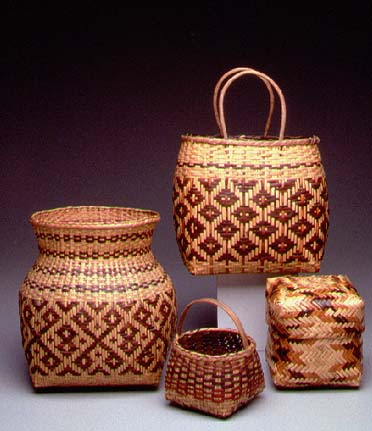
Federal programs, such as the Qualla Arts and Craft Mutual,
Inc. on the Cherokee Reservation, were established to preserve and promote
traditional craft, often as tools of rural economic development. A sculpture
by Qualla member and noted woodcarver, Amanda Crowe, from her student days
at the Art Institute of Chicago, is on display. So is a weaving by Crowe's
teaching colleague on the reservation, Doris Coulter, a graduate of the
Cranbrook Academy of Arts, who first studied weaving at Penland School in
the late 1940s. Both woman had solo exhibitions at the Mint in 1957.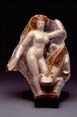
The influences of Modernism are readily found among North
Carolina potters between 1940 and 1970 in such examples as a C.C. Cole "Ring
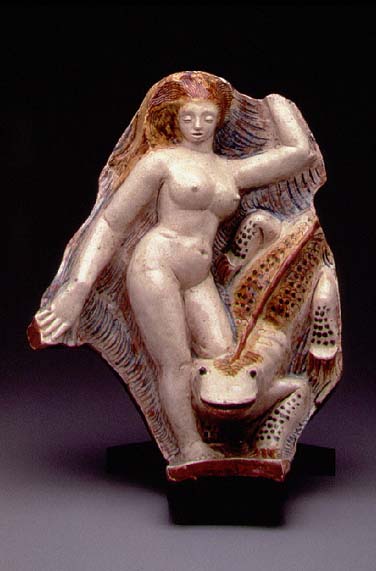
Handled Garden Urn" (1940). Henry Varnum Poor's ceramic "Untitled
Figure of Goddess and Alligator" (1940s) is a stunning example of the
artistic and sculptural properties craft assumed.
Craft in the 1960s reflects countercultural influences
in the use of material associated with indigenous cultures, like macrame,
beadwork and feathers. The back to the land movement coincided with the
identification of craft as an alternative lifestyle. In North Carolina,
art communities formed around Penland School, the land cooperative Celo
Community and Gypsy Hollingsworth's farm in Walnut Cove. In this cultural
climate of postwar America, the crafts field developed as a new art form,
leaving behind the traditional boundaries of utility and decoration.
One trend associated with craft material and processes
is naturalism, exemplified by Dempsy Calhoun's rustic bench and Silvia Heyden's
crocheted horsehair rug. Irreverence is also associated with the craft personality,
as seen in Bob Trotman's "Polkadot Chair" and Rob Levin's "Late
Venetian/Early Neurotic" glassware, both whimsical interpretations
of decorative art.
"The presentation found in the Duke Energy Gallery
is told largely through a Mint Museum collecting perspective," stated
MMCD curator Mary Douglas. "The historical North Carolina Pottery Collection
assembled by Dorothy and Waiter Auman of Seagrove and the purchase awards
from the Piedmont Craft Exhibitions held at the Mint from 1964-1982 provided
a regional view of the development of crafts that was taking place throughout
the country. Our goal is to expand the museum's historical material to include
the major centers of influence and the roles of individual craft pioneers
throughout the nation."
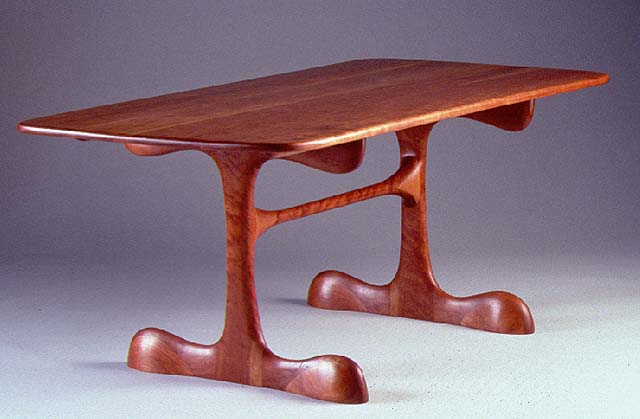
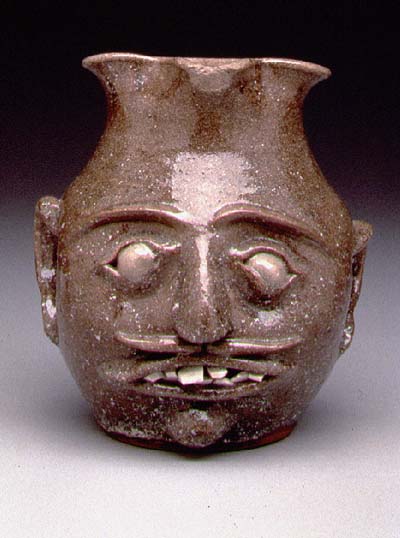
Images from top to bottom: Harvey F. Reinhardt, Face Pitcher,
1930s; Cherokee Baskets, River Cane, 1920-1970; Henry Varnum Poor,
Untitled Figure of Goddess and Alligator, 1940s; Robert Kopf, Trestle
Table, 1975
Read more Resource Library articles on Mint Museum of Art / Mint Museum of Craft+Design
For further biographical information on selected artists
cited above please see America's Distinguished
Artists, a national registry of historic artists.
rev. 10/18/10
Search Resource
Library for thousands of articles and essays on American art.
Copyright 2010 Traditional Fine Arts Organization, Inc., an Arizona nonprofit corporation. All rights
reserved.
 influences
such as the "Moravian Plate" (1800) and craft forms that continued
from the colonial era. The extent of uses include a "Ring Jug"
(to carry drinking water) and a salt-glazed stoneware "Gravemarker"
(l885). While the wares were practical, they did not preclude artistry and
commentary as seen in Chester Webster's incised drawings of birds and fish
on his "4 Gallon Syrup Jug" (1845) and a "Political Pot Praising
North Carolina Governor Jonathan Worth" (1865) from an unknown Piedmont
potter.
influences
such as the "Moravian Plate" (1800) and craft forms that continued
from the colonial era. The extent of uses include a "Ring Jug"
(to carry drinking water) and a salt-glazed stoneware "Gravemarker"
(l885). While the wares were practical, they did not preclude artistry and
commentary as seen in Chester Webster's incised drawings of birds and fish
on his "4 Gallon Syrup Jug" (1845) and a "Political Pot Praising
North Carolina Governor Jonathan Worth" (1865) from an unknown Piedmont
potter.