Laguna Art Museum
Laguna Beach, California
949.494.8971
www.lagunaartmuseum.org
an essay in connection with...
Art Colonies and American Impressionism
January 9 through April 11, 1999
What Made Laguna Beach Special
by Deborah Epstein Solon
Laguna Beach
The spread of the railroads ignited the interests of real estate speculators, who sought out picturesque locations on both coasts for economic development. While, like its Eastern counterparts, Laguna Beach was permanently affected by the expansion of the railways in nineteenth-century America, it was still not nearly as accessible as these other towns were. The Santa Fe Railway arrived in Los Angeles in 1885 and within two years the line extended to San Diego. Passengers bound for Laguna Beach could get off at the El Toro stop (in the present-day city of El Toro), and take a stagecoach through the twisting canyons to Laguna Beach. The trip by stagecoach was not easy. Hills, dirt, mud, even "critters" went along with the lack of a decent road. Furthermore, the stage was available regularly only during the summer months, generally from the Fourth of July through Labor Day. The rest of the year it made the trip only once a week. Consequently, until the turn of the century, Laguna maintained a geographic insularity that was not shared with other art colonies.
Laguna Beach and its environs, from Laguna Canyon Creek to Three Arch Bay, was not included in the early land grants from the Spanish and the Mexicans that the Moulton and Irvine families later owned. In 1850, when California achieved statehood, the territory that had not been granted became open to homesteaders. Homesteading began in Laguna during the 1870s and was completed by the 1880s.24 The 1880s were a period of economic boom in Southern California, but by 1889 the tide had turned radically, and, exacerbated by a national depression in 1893, nearly all of the original homesteaders were forced to sell their holdings.25
Laguna lore has it that the Los Angeles-based artist Norman St. Clair "discovered the colony" in 1900.26 While St. Chair was in Laguna by the turn of the century, and was catalyst for other artists to visit, he was not the first artist to succumb to the charms and pitfalls of life in Laguna. Several others preceded St. Clair, including Charles Walter Stetson (1858-1911), who visited in August 1889 and wrote letters to his parents describing the rather primitive conditions.27
Nevertheless, the beginning of the twentieth century also marks the beginning of Laguna Beach as an art colony. It was the site of individual summer classes possibly as early as 1903, although it did not have a formal, continuously operating summer school. A 1923 newspaper article states that
Judson himself produced some masterful works in Laguna,
such as Bluebird Canyon, Laguna Beach and Temple Hill, Laguna
Beach. James McBurney, an artist who taught in Los Angeles during the
second decade of the twentieth century, brought a sketching class to Laguna
in 1912. Anna Althea Hills, a resident beginning in 1913, taught summer
classes during the teens. William Cahill, an artist who ran an art school
in Los Angeles during the teens, offered summer classes in 1918. By the
1920s a number of artists were holding summer classes in Laguna including
Karl Yens and Clarence Hinkle, who was teaching during the summer months
under the aegis of the Chouinard School of Art.29
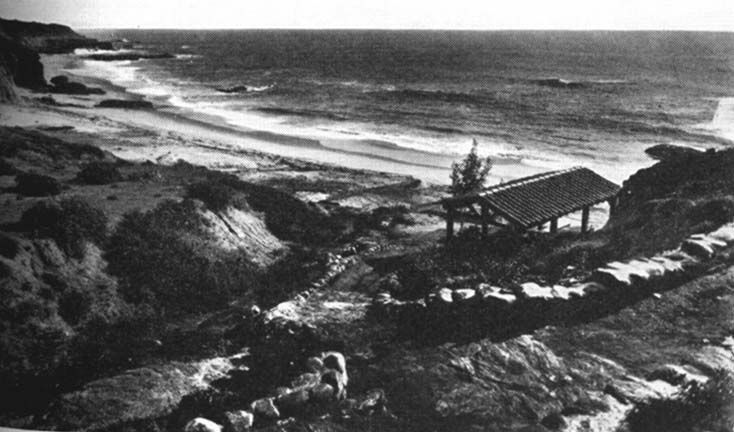
Right: Laguna Beach, c. 1930, photo from History of Orange County California, Vol. 1, J. E. Pleasants, 1931
Summer classes attracted a cross-section of individuals to Laguna: the amateur, the aspiring artist and the professional painter. The summer's labors often resulted in an exhibition, as was the case for McBurney's class in 1918, who had a show at the Walker Auditorium in Los Angeles that September. Included were figure studies by Mabel Alvarez, who became a noted painter in Southern California.30 Summer classes brought tourism and revenue to the city, forcing Lagunans to confront nagging issues. The town began experiencing distinct growing pains in the eatly teens. In 1917 Laguna had a little more than 2?5 residents (not including those living in Arch Beach).31 Telephone service was not introduced until 1923.32 Water, the most critical commodity, was expensive and difficult to obtain. Pacific Coast Boulevard (now Pacific Coast Highway), Laguna's main artery and access route, opened only in 1926, to both celebration and dissent. Nevertheless, when the city was incorporated in 1927, the population had mushroomed to 1,900. By omparison, Los Angeles, just fifty miles north of Laguna Beach, was one of the first cities to benefit from modern technology, including electric lights, telephones and automobiles, and "more miles of graded streets than any comparably sized city in the world." 33
As Laguna grew, local opinion was polarized on many issues, including real estate development, incorporation, and general civic improvements. The Chamber of Commerce, whose driving force was the real estate interests, saw tremendous commercial potential for the city. In 1921 a film about Laguna Beach was previewed by 10,000 delegates at a realtors' convention in Chicago. Organizers additionally had eighty boxes of oranges, representing "Orange County," thrown from the pitcher's mound at a Chicago Sox baseball game. 34 An editorial in the local tabloid Laguna Life, suggested that "any investment made in our community at this time is not only evidence of good judgment in property values, but assures the investor a profitable return." 35 Other citizens expressed the need for caution and due diligence in matters concerning growth, concluding that hasty choices could result in disastrous repercussions. 36
Artists actively voiced their opinions in the press. Anna Hills, in a letter to the editor, articulated a moderate viewpoint:
Other residents, such as Alice V. Fullerton, strongly opposed any hasty development of the town: "How many property owners or visitors would come here if this beach had all the earmarks of a city--or of other beaches." 38
As early as the late teens or early twenties, Laguna was well aware of its reputation as an artists' colony. Business interests considered how to parley the aura of an "art colony" into a financial windfall:
A seemingly minority faction believed that the business community was merely supporting a group of parasitic artists. To those detractors, one commentator firmly responded:
"What the artists do for the town, even if they do nothing else, is to attract to us the sort of people who are most desirable; and their work, going out from Laguna all over the country is certainly publicity of a higher class than any other community of this size in Southern California is able to put out."40
A major consideration was how to keep the most precious aspects of Laguna's geographical integrity intact, while still allowing the town to grow. In 1922 an editor for the Christian Science Monitor wrote a pleasant, if not flattering account of Laguna Beach. He acknowledged the importance of the art colony; he recognized the unique qualities of the landscape. He also described it as a "sleepy little village," comprised of a "mere handful of dwellings and rather primitive stores."41 The editorial response from Laguna Life was swift and cutting:
It is fair to conclude that in spite of their disparate
views, the artists, residents, and business community had a symbiotic relationship.
Artists wanted to live in Laguna Beach and the residents appreciated their
presence. Ultimately it was this understanding that helped foster the growing
community. 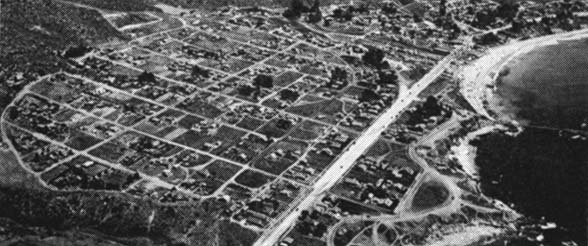
Leftt: Airplane View of Laguna Beach, c. 1930, photo from History of Orange County California, Vol. 1, J. E. Pleasants, 1931
One of the major differences between the colony at Laguna and other colonies was where artists lived once they arrived. Artists who came to Laguna in the earliest part of the twentieth century did not gravitate toward one central hotel or boarding house, although many artists drawn to colonies saw themselves as a "clubby breed." 43
Footnotes: 1 -9, 10-25, 26-38, 39-54, 55-72, 73-79
Please Note: RLM does not endorse sites behind external links. We offer them for your additional research; external links were chosen on the basis of being the most informative online source at the time of our search.
rev. 11/22/10
Search Resource Library for thousands of articles and essays on American art.
Copyright 2010 Traditional Fine Arts Organization, Inc., an Arizona nonprofit corporation. All rights reserved.