Sterling and Francine Clark Art Institute
Williamstown, Mass.
(413) 458-9545
The Painted Sketch: American Impressions from Nature
The Sterling
and Francine Clark Art Institute traces the emergence of the oil sketch
from a simple article of preparation to a work of art worthy of exhibition
and sale in The Painted Sketch. American Impressions from Nature, 1830-1880,
on view from February 14 through May 9, 1999.
As the first major exhibition on the subject, The Painted
Sketch offers a fresh interpretation of how, in the middle of the 19th
century, the smaller, more immediate oil sketch served both as a vivid record
of the painter's direct response to nature and as a work of art worthy of
appreciation in its own right. The exhibition features some 90 American
landscape paintings drawn from public and private collections, representing
nine leading American artists, including Thomas Cole, Frederic Edwin Church,
Albert Bierstadt, Asher B. Durand, John Frederick Kensett, and Sanford Robinson
Gifford. No fewer than 28 paintings by Church, arguably the greatest landscape
painter of the period, will be on view. The exhibition is organized by the
Dallas Museum of Art (DMA).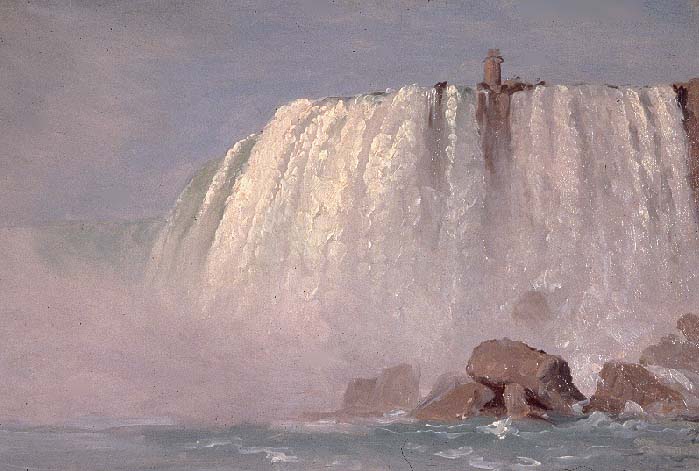
"It's instructive to look back over a century's divide
to gauge the moment when the oil sketch changed from being simply an aid
toward the completion of a finished painting to an independent work of art
in its own right, worthy of appreciation and exhibition," notes Michael
Conforti, director of the Clark. "Ironically, I believe that these
small works on canvas, board, and paper--with their spontaneous and virtuosic
brushwork--may appeal more to today's museum goers, who are accustomed to
Impressionist and modernist forms, than would many of the original, finished
studio paintings by these famous American artists."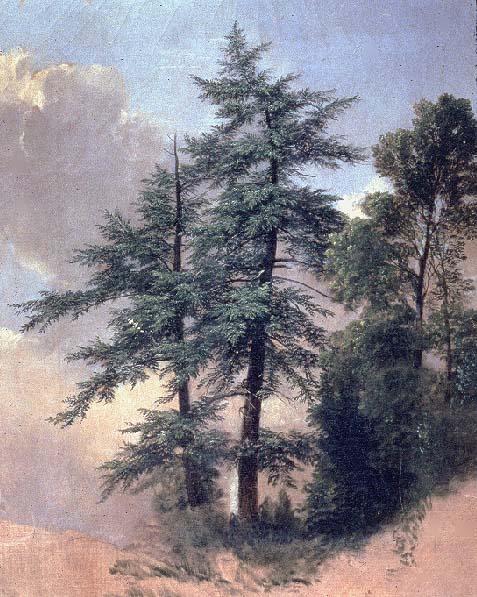
Plein-airists (open-air painters)
of the mid-19th century were so well rewarded for the freshness and verve
of their works that in time more and more of them--working in or out of
the studio--strove for the fashionable spontaneous effect. While many of
the earlier works in the exhibition, such as Church's Horseshoe Falls (1856-57),
were field sketches not intended for public display, a number of the later
works, such as Bierstadt's The Trapper's Camp (1861), were painted
with exhibition in mind. The Painted Sketch documents the 1880s art
market which enjoyed a surge of collectors eager to acquire paintings exhibiting
the vibrant handling of paint characteristic of the outdoor sketch.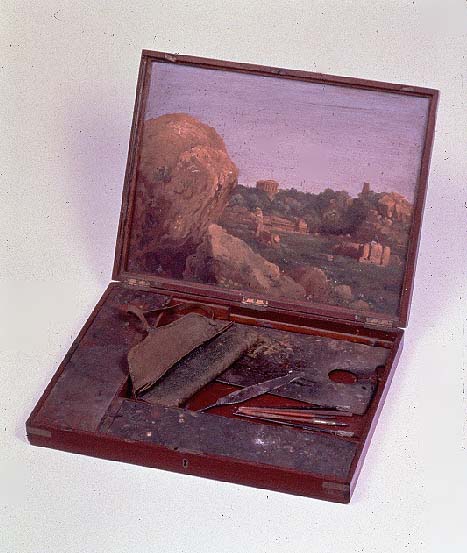
The Painted Sketch also reminds
viewers of the hazardous travels taken by 19th-century painters in order
to sketch grand landscapes. Dr. Eleanor Jones Harvey, Consulting Curator
of American Art at the DMA and organizer of the exhibition, says, "Armed
with their sketch boxes, leading artists traveled to remote locations in
North and South America and Europe to search out exotic landscape subjects.
The public came to equate their adventurous spirits and fortitude with the
American character, which gave added popularity to their small field sketches
of natural wonders. And the enthusiastic press coverage of the artists'
travels added to the painted sketches' values as works of art.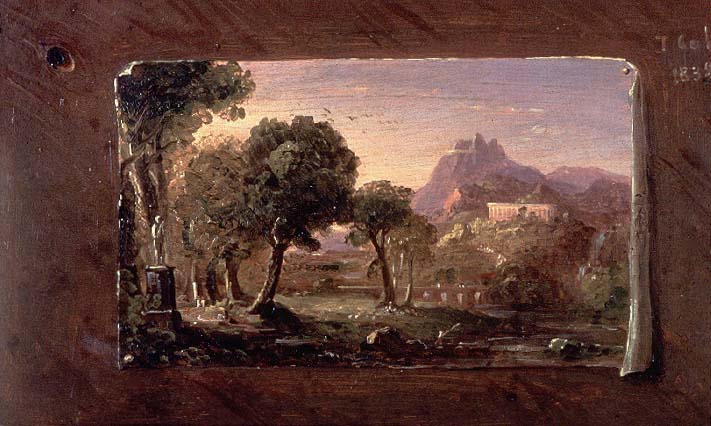
Among the highlights of the exhibition is Frederic Edwin Church's study for Under Niagra (1858). Sketched from the deck of the steamer Maid of the Mist, the novel vantage point captured the attention of the press; today, only the sketch exists, for the studio version of the painting has been lost. Also on view is Bierstadt's Cathedral Rocks (1872), a highly accomplished sketch that captures the snow-covered beauty and remote isolation of Yosemite Valley during the winter months.
Funding for the exhibition has been provided by the Henry
Luce Foundation, Inc.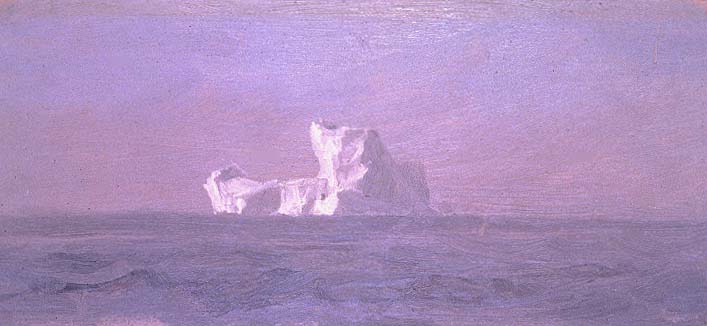
Catalogue
Accompanying the exhibition is a 300-page catalogue with essays and descriptive text by Dr. Harvey, as well as color plates of the paintings and objects included in the exhibition.
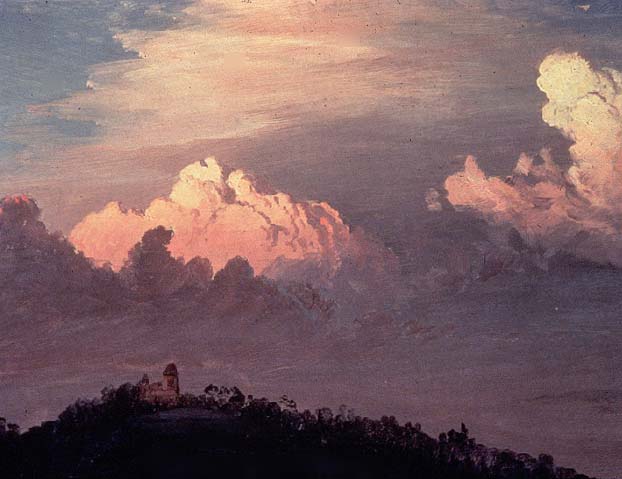
From top to bottom: Frederic Edwin Church, Clouds
Over Olana, August, 1872, Oil on paper, 8 11/16 x 12 1/8 in., Olana
State Historic Site, New York State Office of Parks, Recreation, and Historic
Preservation; Frederic Edwin Church, Study for Under Niagara, September,
1872, Oil on paper, 11 3/4 x 17 1/2 in., Olana State Historic Site, New
York State Office of Parks, Recreation, and Historic Preservation; Asher
B. Durand, Nature Study, Trees, Newburgh, NY, 1849, Oil on canvas,
22 1/8 x 18 in., The New-York Historical Society, New York, Gift of Nora
Durand Woodman; Thomas Cole, Sketch box used by the artist, ca. 1840,
Mahagony with brass fittings, 2 1/2 x 17 x 13 in., Bronck Museum, Greene
County Historical Society, Coxsackie, NY, Gift of Edith Cole Silberstein;
Thomas Cole, Study for Dream of Arcadia, 1838, Oil on panel, 8 3/4
x 14 1/2 in., The New-York Historical Society, New York; Frederic Edwin
Church, Off lceburg, Newfoundland, June 1859, Oil and graphite on
thin board, 4 15/16 x 11 1/8 in., Cooper-Hewitt National Design Museum,
Smithsonian Institution, New York
For further biographical information on selected artists cited above please see America's Distinguished Artists, a national registry of historic artists.
rev. 9/20/10
Search Resource Library for thousands of articles and essays on American art.
Copyright 2010 Traditional Fine Arts Organization, Inc., an Arizona nonprofit corporation. All rights reserved.