Indianapolis, IN
(317) 636-9378
Splendid Heritage: Masterpieces of the Masco Collection
Oct. 24, 1998, through Oct. 3, 1999
Imagine a country in which the people of each region spoke a different language. Imagine that none of them had a written alphabet or any other means of recording words. How would those people communicate with each other?
That world was North America in the 17th century, when Native American cultural groups were spread from coast to coast. A "language" evolved that relied on symbols, colors, materials and designs to communicate information.
That language is indecipherable to many - but a visit to a traveling exhibition at the Eiteljorg Museum could enlighten you.
Splendid Heritage: Masterpieces of Native American Art
from the Masco Collection is an exhibition of true
art treasures, drawn from one of the most impressive collections of Native
American material in private hands today. The exhibition opens at the Eiteljorg
Museum in Indianapolis on Oct. 24, 1998.
The 42 objects are spectacularly preserved. But the major draw of the exhibition may be the opportunity to learn about the objects, rather than simply to view them.
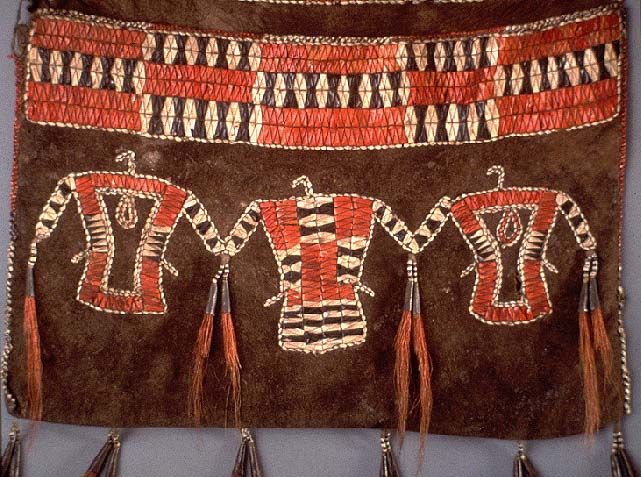
Left: Bandolier Bag, c. 1750-1800, Eastern Great Lakes region, Ojibwa or Ottawa. Native tanned and dyed deerskin, natural and dyed porcupine quills, dyed deer hair, wool yarn, glass trade beads, tin cones, sewn with sinew. The Masco Collection.
Ray Gonyea, the museum's curator of Native American art
and culture and himself a Native American (Onondaga), wrote explanatory
labels for each piece that go beyond the usual name, artist and date labels.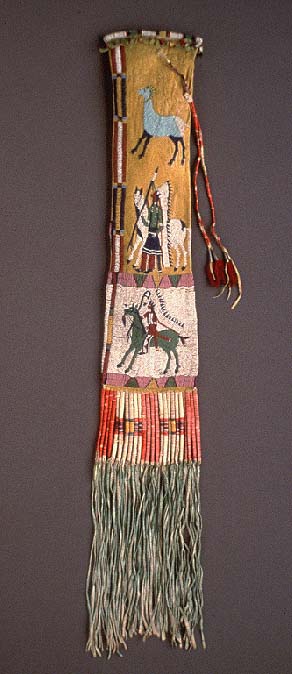
"When visitors leave this exhibition, we want them to be able to tell the difference between items that come from Plains and those that come from Woodland peoples," Gonyea said.
Right: Pipe Bag, c. 1890-1910, Lakota, Pine Ridge Reservation, S.D. Native tanned hide, rawhide, dyed porcupine quills, wool yarn, pigment, glass trade beads, tin cones, sewn with sinew. The Masco Collection.
The objects will be grouped into four chronological periods that illustrate the pattern of contact between Native Americans and Europeans and the pattern of settlement from the East Coast to the West. The object labels will explain the meaning of the colors, materials and designs used in each piece.
For example, Woodland natives wore clothing and accessories
close to the body so they wouldn't snag on the trees and plants in the dense
forests. Plains tribes could wear long fringe on their clothing, because
they lived in vast, open spaces.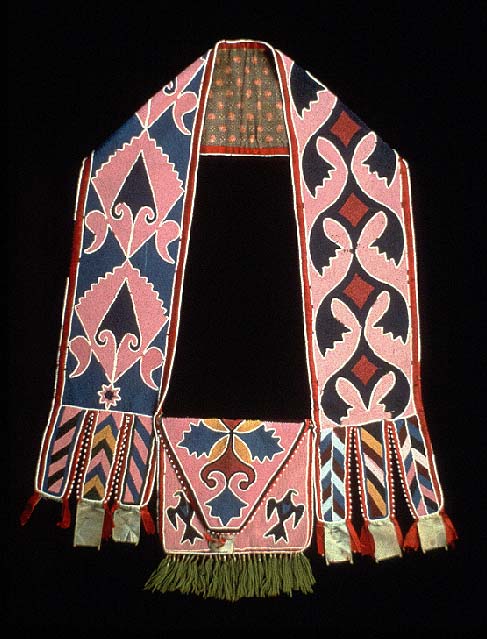
Similarly, Woodland natives decorated their clothing and accessories with small, detailed designs, which were best viewed at close range. Plains tribes used large, bold designs that could be recognized from a distance.
Right: Bandolier Bag, c. 1850-1875, Delaware. Cotton cloth, silk ribbon, wool yarn, glass trade beads, sewn with thread. The Masco Collection.
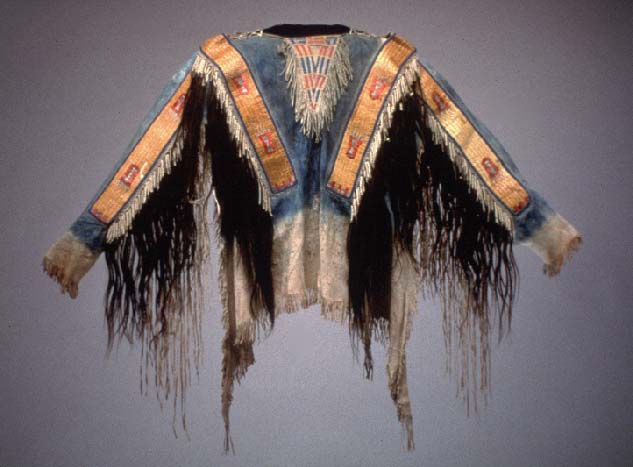 Man 's Shirt, c. 1870, Lakota, Native tanned hide, natural and dyed porcupine
quills, human hair, pigment, glass trade beads, sewn with sinew. The Masco
Collection. This Plains hairlock shirt, typically painted blue and yellow
or red and green, was worn by a Sioux "Shirt Wearer." Chosen by
tribal councils for their leadership skills, "Shirt Wearers" were
responsible for the welfare of the people, who donated the human hair that
represents them. Symbolically, "Shirt Wearers" carried the people.
The red tracks along the sleeve imply the great spiritual power of the grizzly
bear, the most feared and venerated bear. Leading toward and away from the
wearer, the tracks suggest the receiving and the giving of spiritual power.
The yellow, representing rock, symbolizes the bear's cave.
Man 's Shirt, c. 1870, Lakota, Native tanned hide, natural and dyed porcupine
quills, human hair, pigment, glass trade beads, sewn with sinew. The Masco
Collection. This Plains hairlock shirt, typically painted blue and yellow
or red and green, was worn by a Sioux "Shirt Wearer." Chosen by
tribal councils for their leadership skills, "Shirt Wearers" were
responsible for the welfare of the people, who donated the human hair that
represents them. Symbolically, "Shirt Wearers" carried the people.
The red tracks along the sleeve imply the great spiritual power of the grizzly
bear, the most feared and venerated bear. Leading toward and away from the
wearer, the tracks suggest the receiving and the giving of spiritual power.
The yellow, representing rock, symbolizes the bear's cave.
The exhibition is sponsored by Delta Faucet, a division of Masco Corp.
rev. 11/22/10
Search Resource Library for thousands of articles and essays on American art.
Copyright 2010 Traditional Fine Arts Organization, Inc., an Arizona nonprofit corporation. All rights reserved.