
California Art History
with an emphasis on representational art
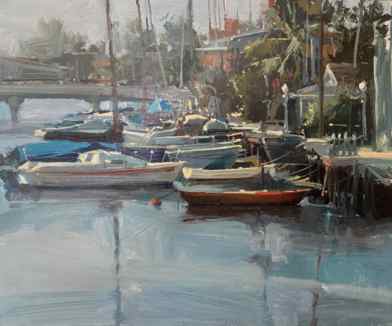
(above: Ken Auster, Balboa Island Bridge, c. 2008, oil on canvas,18 x 24 inches. Private collection)
Articles contained in Resource Library without named authors listed by article name in alphabetical order: E-I
also see: A-B California Car-CSU L-O P-Z
Departures: 11 Artists at the Getty is a 2000 exhibit at the J. Paul Getty Museum, presenting a major contemporary art exhibition of commissioned works in a variety of media by 11 outstanding Los Angeles-area artists responding to the Getty's collections.
Do You Like Green Eggs and Ham? Drawings by Dr. Seuss is a 2000 exhibit at the Akron Art Museum, offering a unique opportunity to get a behind-the-scenes glimpse at Geisel's creative process and a close-up look at his amazing sense of line and color. The show features around eighteen drawings, sketches and layouts from seven of his books:McElligot's Pool (1947), Horton Hears a Who (1954), The Cat in the Hat (1957), Green Eggs and Ham (1960), One Fish Two Fish Red Fish Blue Fish (1960), I Can Lick 30 Tigers Today! and Other Stories (1969) and The Butter Battle Book (1964). The artwork is on loan from the largest and most important archive of Geisel's work, the Dr. Seuss Collection of the Mandeville Special Collections Library, University of California, San Diego.
Early California Impressionists: The Ronald E. Walker Collection, hosted in 1997 by Saint Mary's College Museum of Art, is an opportunity for visitors to see exceptional works by Southern California plein air painters including Maurice Braun, Franz Bischoff, Edgar Payne, Donna Schuster and William Wendt. Many are associated with the art colony in and around Laguna Beach, where Hawaii collector Ronald Walker formerly lived.
A Federal Art Project: Posters for Indian Court is a 2012 exhibit at the Memphis Brooks Museum of Art. Louis Siegriest supervised stencil cutting and printing of the posters in the lower level of a boat anchored off Treasure Island. While Siegriest received credit for the promotional material, the designs were adapted from work produced by Native American artists in the 1930's. The artists who contributed resource material received little recognition and some remain unknown.
Feminine Visions: Women of the California School 1890-1930s, a 2001 exhibit at the Fleischer Museum, spotlights female artists of American Impressionism California School, featuring work by women who enriched the American art heritage with their achievements and contributions. The California School of Design opened in San Francisco in 1874 and nearly fifty of the sixty students were women. These artists from Northern and Southern California became known as the California School of American Impressionism. Artists included in this exhibition are:Jessie Arms Botke, Alice Brown Chittenden, Anna Althea Hills, Isabel Hunter, Mary DeNeale Morgan, Mary H. Ross, Donna Norine Schuster, Marion Kavanagh Wachtel and Nell Walker Warner.
The1999 Festival of Arts in Laguna Beach, California, a Southern California tradition since 1932, displays and offers for sale original works of art by 160 of the area's most accomplished artists. The exhibit covers many artistic mediums such as painting, sculpture, photography, jewelry, scrimshaw, woodworking & furniture building, glass and fiber arts.
The Fieldstone Collection: Impressionism in Southern California, a 1999 exhibit at the the William D. Cannon Art Gallery, includes approximately 40 works, created between the late 1800s and early 1900s, depict the natural landscapes of the region in the "plein air" style of the French Impressionists.
The Final Eden: Early Images
of the Santa Barbara Region 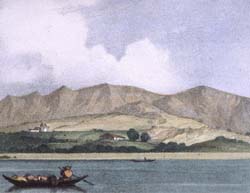 is a 2002 Wildling Art Museum exhibit of paintings, watercolors
and prints depicting the Central Coast of California between 1836 and 1960
and celebrating "its rural pristine and fertile nature," selected
by guest curator, Frank Goss. It is his thesis that the paradise that once
was California, a land of boundless resources and unlimited opportunities,
has shrunk through urbanization and exploitation, and the Central Coast,
not yet paved over, is "the Final Eden." (left: John Hall
Esq. (1808 - ?), "Santa Barbara-Upper California," 1836, hand-colored
lithograph.. Lent by Eric Hvolboi)
is a 2002 Wildling Art Museum exhibit of paintings, watercolors
and prints depicting the Central Coast of California between 1836 and 1960
and celebrating "its rural pristine and fertile nature," selected
by guest curator, Frank Goss. It is his thesis that the paradise that once
was California, a land of boundless resources and unlimited opportunities,
has shrunk through urbanization and exploitation, and the Central Coast,
not yet paved over, is "the Final Eden." (left: John Hall
Esq. (1808 - ?), "Santa Barbara-Upper California," 1836, hand-colored
lithograph.. Lent by Eric Hvolboi)
The First Annual Laguna Beach Plein Air Painting Invitational Competition is a 1999 event hosted by the Laguna Art Museum and the Laguna Plein Air Painters Association. In the grand tradition of the Impressionists who brought their easels and palettes to Laguna some 100 years ago, and the master artists who founded the Laguna Art Museum 81 years ago, plein air artists packing paintbrushes again capture the area's scenic canyons, beaches, and overlooks.
First Generation: Art in Claremont, 1907-1957 is a 2008 exhibit at the Claremont Museum of Art, which traces the art history of Claremont and the region in the first 50 years after the city's incorporation in 1907.
On a clear day a century ago, one could see the peak of Mt. Baldy from virtually every corner of the Los Angeles basin, from ocean to desert. The original inhabitants of this area, the Tongva/Gabrielino Indians, called the mountain "Yoát," or snow. Its siren song has drawn generations of settlers to its shadow. Since the late 19th century, prominent artists have been among those attracted to the foothills of Mt. Baldy and its neighboring peaks-and the city of Claremont, in particular.The exhibit traces the art history of the region, from the work of such artists as Hannah Tempest Jenkins, Emil Kosa, Jr., and William Manker to that of Millard Sheets and his circle in the 1930s. Sheets's influence as artist and teacher extended as well to bringing artists such as Henry Lee McFee, Phil Dike, and Jean Ames to Scripps College, thereby enhancing the existing art community and assuring its lasting influence.
Four Montalvo Artists Reflect on Organic Forms is a 2000 exhibit at the Gallery at Villa Montalvo, featuring work that represents a new direction or clarifies an established direction of four former Artist Residents. Working essentially unencumbered in a setting known for it's natural beauty has for some artists created a turn around moment, for others solidified a direction. The exhibit offers the public a glimpse into the essence of what it means to come to Montalvo for a residency.
Gold Rush to Pop is a 1998 exhibit at the Orange County Museum of Art, guest-curated by art historian Nancy D. W. Moure. This comprehensive examination of California art history includes seaside and desert landscapes, scenes of immigration, urban development, World War II, technology, the civil rights movement, and commercial culture.
Greetings from Laguna Beach: Our Town in the Early 1900s is a 2000 Laguna Art Museum exhibit which illustrates Laguna's early history through 20 landscapes painted by some of the town's earliest artist residents as well as historical photos and a room-sized installation of a typical period cottage. The paintings include works by Franz A. Bischoff, Conway Griffith , Clarence Kaiser Hinkle, Joseph Kleitsch Millard Sheets, William Wendt, and Karl Yens.
High Society: Psychedelic Rock Posters of Haight-Ashbury is a 2002 exhibit at the Hood Museum of Art which presents selections from the extensive collection of Paul Prince who has been collecting psychedelic graphic design for more than thirty years. Featured in the show are important examples by each of the "Big Five" artists of psychedelic poster design: Wes Wilson, Rick Griffin, Victor Moscoso, Stanley Mouse, and Alton Kelley. These works, intended to serve as ephemeral street advertisements, present a unique opportunity to observe the evolution of a psychedelic art form during a turning point in American consciousness.
In and Out of California: Travels of American Impressionists is a 2003 exhibit at the Laguna Art Museum. Artists in California during the late nineteenth and early twentieth century suffered from a two-pronged disadvantage: either they were glorified, occasionally unjustly, by Western critics, or summarily dismissed by the Eastern art establishment in an equally unwarranted fashion. An underlying, if not explicitly articulated position has been that Western painting -- and not just Impressionism -- was merely a footnote to American art history. The exhibit presents the work of Maurice Braun, Alson Clark, Colin Campbell Cooper, E. Charlton Fortune, William Ritschel, and many others, as a part of the locus of American painting and as a thread in the greater fabric and appeal of Impressionism.
Island Passages: Artists Celebrate the Channel Islands is a 2006 exhibit at the Ventura County Museum of History & Art. Twenty-seven artists who spent the prior year hiking, diving, and wandering California's rugged Channel Islands for inspiration are featured in the show.
Just Another Poster? Chicano Graphic Arts in California is a 2000 exhibit at the Jack S. Blanton Museum of Art, University of Texas at Austin, TX. Bold, intense, and colorful, the art of posters has long been used to express the Chicano experience. These powerful graphic messages, originally transmitted from building walls, telephone poles, and other surfaces on the urban landscape, are created by artists to raise awareness and rouse conscience. This is the first exhibition to explore in depth the role graphic arts have played in building community, stimulating political action, and impacting social and cultural consciousness within Chicano communities in California. Artists represented include Lalo Alcaraz, Leonard Castellanos, Yreina Cervantez, Richard Duardo, Ricardo Favela, Rupert Garcia, Louie 'The Foot' Gonzalez, Ester Hernandez, Ralph Maradiaga, José Montoya, Malaquias Montoya, Herbert Siguenza, and John Valadez.
Just Another Poster? Chicano Graphic Arts in California is a 2003 exhibit at the Crocker Art Museum, in conjunction with La Raza/Galeria Posada. Both venues combined will feature nearly 100 works representing the rich tradition of Chicano artists and activism. The exhibition comprehensively explores, for the first time, the role Chicano posters and other graphic materials play in California's Chicano communities. Once displayed on building walls, telephone poles, and any available surface, Chicano posters have typically been powerful graphic works created by artists seeking to raise awareness and consciousness of social issues critical to Chicano communities. Artists included in the exhibition have embraced the poster format to confront negative stereotypes, alert workers to unsafe working conditions and protest unfair immigration policies. These artists have imbued the poster with striking imagery and symbolism to vividly communicate social messages and cultural pride.
Kaleidoscope is a 2000 exhibit at The Irvine Museum. The word "Kaleidoscope" signifies a brilliant and interesting image arising from a multitude of individual bits of delightful, colorful and unusual fragments. The Irvine Museum's Summer 2000 exhibition is called "Kaleidoscope" because it too is a brilliant and wonderful show made up of unique and varied works of art, representing a multitude of artistic styles.
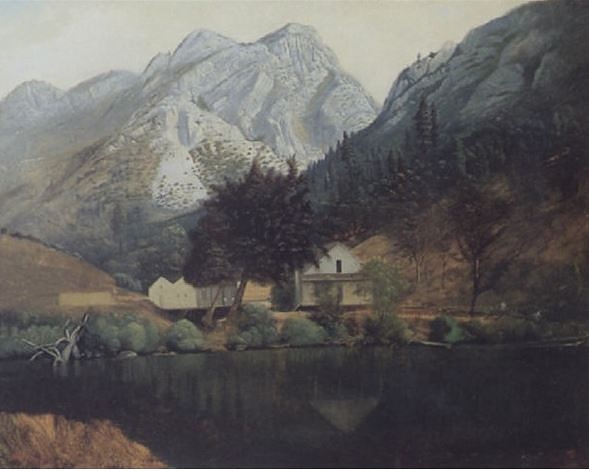
(above: Samuel Marsden Brooks (1816-1892), Mount Saint Helena [?], Sonoma County CA, before 1892. Public domain, via Wikimedia Commons*)
Articles contained in Resource Library without named authors listed by article name in alphabetical order:A-B Cal Car-CSU E-I L-O P-Z
Also see: Pacific Coast Painting: Alaska, California, Hawaii, Oregon, Washington: 19th-21st Century
Resource Library articles and essays devoted to individual artists and institutions may not be listed in California Art History.
TFAO's Distinguished Artists catalogue provides online access to biographical information for artists associated with California. Also, Search Resource Library for online articles and essays concerning both individual artists associated with this state's history and the history of art centers and museums in California.
 Return to California Art History
Return to Individual States Art History Project
Links to sources of information outside of our web site are provided only as referrals for your further consideration. Please use due diligence in judging the quality of information contained in these and all other web sites. Information from linked sources may be inaccurate or out of date. TFAO neither recommends or endorses these referenced organizations. Although TFAO includes links to other web sites, it takes no responsibility for the content or information contained on those other sites, nor exerts any editorial or other control over them. For more information on evaluating web pages see TFAO's General Resources section in Online Resources for Collectors and Students of Art History.
*Tag for expired US copyright of object image:

Copyright 2022 Traditional Fine Arts Organization, Inc., an Arizona nonprofit corporation. All rights reserved.