Editor's note: The James A. Michener Art Museum
provided source material to Resource Library for the following article
and essay. If you have questions or comments regarding the source material,
please contact the James A. Michener Art Museum directly through either
this phone number or web address:
Ansel Adams: Celebration
of Genius
February 18 - May 14, 2006
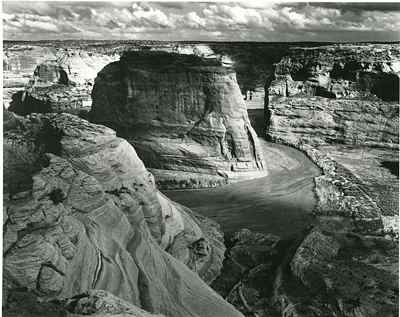
(above: Ansel Adams, Canyon de
Chelly, Arizona, 1942, gelatin silver print on paper, H. 37.5 x W. 47.2
centimeters. George Eastman House Collection, Gift of the photographer.
(c) 2003 by the Trustees of the Ansel Adams Publishing Rights Trust)
The James A. Michener
Art Museum in Doylestown is presenting Ansel Adams: Celebration of Genius,
on view at the Doylestown location from February 18 through May 14, 2006.
Ansel Adams is among the few photographers in history whose name and work
enjoy world-wide recognition. The Michener is 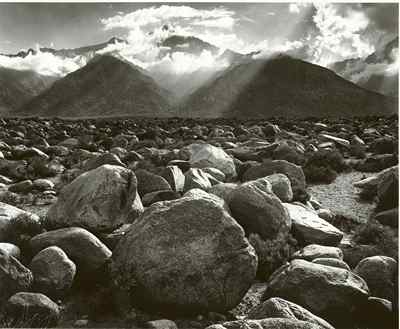 the
only venue in the mid-Atlantic states to host this spectacular exhibition. (right:
Ansel Adams, Mount Williamson from Manzanar, California, ca. 1944,
gelatin silver print on paper, George Eastman House Collection, Gift ofthephotographerH.
39.2 x W. 48.2 centimeters. (c) 2003 by the Trustees of the Ansel Adams
Publishing Rights Trust)
the
only venue in the mid-Atlantic states to host this spectacular exhibition. (right:
Ansel Adams, Mount Williamson from Manzanar, California, ca. 1944,
gelatin silver print on paper, George Eastman House Collection, Gift ofthephotographerH.
39.2 x W. 48.2 centimeters. (c) 2003 by the Trustees of the Ansel Adams
Publishing Rights Trust)
Inspired by the 100th anniversary of Adams's birth in 2002,
George Eastman House International Museum of Photography and Film revisited
its extensive collection of Adams's work, creating a new exhibition of 150
photographs that reflects Adams's full career. While many come to know Adam's
work through widely published books, postcards, posters and calendars, relatively
few have actually seen his lushly printed original images. His stunning
landscapes and intimate still lifes of nature continue to captivate viewers.
Ansel Adams: Celebration of Genius
presents work from the 1920s through the 1960s, including an early 1927
portfolio (one of only fifty produced) of Parmelian prints (gelatin silver
emulsion on parchment paper). For the first time, George Eastman House
is pleased to include this portfolio from its collection in this exhibition.
Featured are many of Adams's most famous images of the American West --
Moonrise, Hernandez, New Mexico, 1941; Mount Williamson from Manzanar,
California, ca. 1944; and Monolith, the Face of Half Dome, 1927.
But prepare to discover equally stupendous (if less well-known), images
such as Mud Hills, Arizona or Water and Foam, or the wonderful
abstract titled simply, Stained Wallpaper Near Alturas, Calif. Many
will be surprised to see that Adams did not confine himself to landscapes,
but also made portraits and other subjects as humble as fence posts into
images nearly as monumental as his beloved mountain ranges.
Adams's life story is as varied as his work. His
role as an artist, ardent conservationist, writer and educator all had their
roots in Yosemite. This is where he came to create, seek solace in difficult
times, and where he met his wife, Virginia Best -- along with other artists,
mountaineers and Sierra Club activists. Yosemite and the Sierra Nevada
were the subjects of his first portfolio, "Parmelian Prints of the
High Sierras" (sic) in 1927, a portfolio of prints on view for the
first time as part of this exhibition.
A gifted musician with ambitions to be a concert pianist,
Adams struggled with which career to follow: music or photography. In 1930
he acceded to the lure of a life outdoors in pursuit of photography and
gave up the serious study of music; however throughout his life he would
credit music for teaching him the discipline, patience, and perseverance
he needed in photography.
From 1930 until the early 1970s, Adams like many of his
contemporaries - including Edward Weston and Paul Strand - accepted commercial
assignments to support his family. These ranged from department store
catalogs, car advertisements and marketing brochures to giant Coloramas
for Eastman Kodak Company, murals for the Department of the Interior, LIFE
and FORTUNE magazine work, and testing film for the Polaroid
Corporation. Adams worked in color and black and white, but he never considered
his commercial work part of his art.
In the course of his long life, he would produce eight
portfolios and have work in more than 500 exhibitions. A prolific
writer, he published thirty-seven books and hundreds of articles about photography.
Adams cared deeply about the wilderness and was an ardent environmental
conservationist. His first job was as custodian of the Sierra Club lodge
in Yosemite Valley, which led him to many friendships within the conservation
movement. He would serve on the Sierra Club board of directors for
thirty-seven years and was active in the Wilderness Society. His photographs
were used in support of many environmental issues. Adams personally
lobbied several presidents and Congress on behalf of wilderness preservation.
In 1932, Adams was instrumental in the founding of Group
f/64, a short-lived but influential group of California photographers who
brought artistic legitimacy to "straight" photography. Later in
life he organized the Friends of Photography, a non-profit organization
dedicated to the study and promotion of art photography. He received many
national and international awards, honorary degrees, three Guggenheim Fellowships,
and had a wilderness area and a mountain named after him. He is the only
photographer to be given the Presidential Medal of Freedom, the highest
civilian honor, which he received in 1980. Ansel Adams died in Carmel, California,
on April 22, 1984.
In connection with the exhibition, the Museum will present
a number of programs including special lecture "Ansel Adams: An Adventure
for the Eye and Mind," on Sunday, February 13 at 3 pm, presented by
Anthony Bannon, Director, George Eastman House, the International Museum
of Photography and Film.
On Tuesday, March 7, a lecture series held on three consecutive
Tuesday afternoons, from 1 to 2 pm, commences with the curator's exhibition
lecture, "Ansel Adams: A Biographical Sketch," presented
by Jeanne Verhulst, associate curator of exhibitions, George Eastman House,
and exhibition curator. On March 14, Brian Peterson, senior curator,
Michener Art Museum leads an in-depth lecture and tour the exhibition. "The
View Camera," the final lecture and demonstration on Tuesday, March
21, presented by Bruce Katsiff, director and chief executive officer, Michener
Art Museum. Additional programs will be organized by the Bucks County
Free Library.
This project is supported by a grant from the Pennsylvania
Historical and Museum Commission. Ansel Adams: Celebration of Genius
is sponsored by Anthony & Sylvan Pools, Thomas L. Newman, Wachovia Securities,
Sylvan Properties, Inc., Heath's Service, Inc., and Wetherill Opticians,
Inc.
Wall text from the exhibition:
-
- On a summer day in 1916, at the age of fourteen, Ansel
Adams saw the breathtaking Yosemite Valley, for the first time. With a
Kodak No. 1 Box Brownie, he proceeded to make pictures. Perhaps he had
an inkling then that this magical place would be forever entwined in his
destiny.
-
- Ansel Adams (American, 19021984) is among the few
photographers in all the history of photography whose name and work enjoy
worldwide recognition. His stunning landscapes and intimate still lifes
of nature continue to enthrall viewers. Adams's ability to convey the power
and grandeur of nature in a black-and-white photograph is astounding. Adams
is the master. This exhibition honors the man and celebrates his genius.
-
- Many come to know Adams's work through widely published
books, note cards, posters, and calendars. Relatively few have actually
seen his lushly printed images in the original. This exhibition provides
an opportunity to take a close look at a full range of his work. Favorites
such as "Moonrise Hernandez, New Mexico" or "Monolith, the
Face of Half Dome" can be scrutinized for their subtlety of tones
and quiet beauty. But prepare to discover equally stupendous images such
as "Mud Hills, Arizona" or "Water and Foam," or the
wonderful abstract titled simply "Stained Wallpaper Near Alturas,
Calif." Many will be surprised to see that Adams did not confine himself
to landscapes, but made subjects as humble as fence posts into images nearly
as monumental as his beloved mountain ranges.
-
- Ansel Adams's life story is as varied as his work. His
role as artist, ardent conservationist, writer, and educator all had their
roots in Yosemite. This is where he came to create, seek solace in difficult
times, and where he met his wife, Virginia Best, other artists, mountaineers,
and Sierra Club activists. Yosemite and the Sierra Nevada were the subjects
of his first portfolio "Parmelian Prints of the High Sierras"
(sic) in 1927. The portfolio of eighteen prints is on view here for the
first time in its entirety. (Note: Gelatin silver images were printed on
Kodak Vitava Athena grade T, Parchment paper available from 1925 to 1928.
This matte, translucent, cream-colored paper formed intense, velvety blacks.
The word Parmelian is a constructed name by the publisher Jean Chambers
Moore to increase sales appeal. At that time, the portfolio sold for $50.00.
Sierra Club members could purchase a "Parchment" print for $2.50.)
-
- A gifted musician with ambitions to be a concert pianist
from age twelve, Adams struggled with which career to follow: music or
photography. In 1930, he acceded to the lure of a life outdoors in pursuit
of photography and gave up serious study of the piano. However, he credited
music for teaching him the discipline, patience, and perseverance he needed
in photography.
-
- Adams realized he could not earn a living from art photography
alone. From 1930 until the early 1970s like many of his contemporaries-including
Edward Weston and Paul Strand-Adams accepted commercial assignments to
support his family which included his wife and two children Michael (b.
1933) and Anne (b. 1935). His commercial work ranged from mundane department
store catalogues, car advertisements, and marketing booklets to giant Coloramas
for Eastman Kodak Company, murals for the Department of Interior, LIFE
and FORTUNE magazine work, and testing film for his friend, Dr.
Edwin Land of the Polaroid Corporation. Adams worked in color and in black
and white, but he never considered his commercial work part of his art.
-
- In the course of his long life, he would produce eight
portfolios and have work in more than 500 exhibitions. A prolific writer,
he published thirty-seven books and hundreds of articles on and about photography.
A generous nature compelled him to share his photographic knowledge in
detailed descriptions and workshops on how, why, when, and with what equipment
and film he used to make many of his photographs. His book, Examples:
The Making of Forty Photographs is a window into Adams's love for and
sheer perseverance to his art. Among his technical achievements is his
development of the revolutionary Zone System a "pre-exposure"
system, he developed wherein values from black to pure white in eleven
gradations are applied to a scene to predetermine the resulting print tones.
The Zone System is still taught in photography classes today.
-
- Adams cared deeply about the wilderness and was an ardent
environmental conservationist. His first job in 1919 was as custodian of
the Sierra Club Lodge in Yosemite Valley. This association led him to many
friendships within the conservation movement. He would serve on the Sierra
Club board of directors for thirty-seven years and was active in the Wilderness
Society. His photographs were used in support of many environmental issues.
He personally lobbied several presidents and Congress on behalf of wilderness
preservation.
-
- In 1932, Adams was instrumental in the founding of Group
f/64, a short-lived, but influential group of California photographers
who brought artistic legitimacy to "straight" photography. Later
in life he organized the Friends of Photography, a non-profit organization
dedicated to the study and promotion of art photography. Adams also helped
establish the Center for Creative Photography at the University of Arizona
in Tucson to house his archives. He received many national and international
awards, honorary degrees, three Guggenheim Fellowships, and had a wilderness
area and mountain named after him. He is also the only photographer to
be given the Presidential Medal of Freedom, the highest civilian honor,
which he received in 1980. Ansel Adams died in Carmel, California on April
22, 1984.
-
- George Eastman House is fortunate to have had a friend
in Ansel Adams through his longtime friendship with Beaumont Newhall, George
Eastman House's first curator and second director. Nancy Newhall, Beaumont's
wife, often collaborated on writing books and articles with Adams. Through
gifts or purchases, the Museum holds more than 270 prints and numerous
letters and artifacts in its collections, including the Kodak Box Brownie
camera that Adams used on his first and ultimately life-changing visit
to Yosemite in 1916.
-
- Jeanne Verhulst, Associate Curator of Exhibitions
- George Eastman House, Rochester, New York
Traveling exhibition piece labels:
-
- 1.
- IRON AND STONE-SHIPWRECK SERIES SAN FRANCISCO
- ca. 1931
- Gelatin silver print
- Gift of the photographer
-
- 2.
- BOARDS AND THISTLES, SAN FRANCISCO, CALIFORNIA
- ca. 1932
- Gelatin silver print
- Gift of the photographer
-
- 3.
- LEAVES, MILLS COLLEGE CAMPUS, CALIFORNIA
- ca. 1931
- Gelatin silver print
- Gift of the photographer
-
- 4.
- LEAVES, STUMP, FROST, YOSEMITE VALLEY
- ca. 1932
- Gelatin silver print
- Gift of the photographer
-
- 5.
- REAR, RANCHOS DE TAOS CHURCH, NEW MEXICO
- ca. 1937
- Gelatin silver print
- Gift of the photographer
-
- 6.
- GRASS AND BURNED STUMP, SIERRA NEVADA, CALIFORNIA
- ca. 1935
- Gelatin silver print
- Gift of the photographer
-
- 7.
- LAKE CLIFFS, KAWEAH GAP, SIERRA NEVADA
- ca. 1932
- Gelatin silver print
- George Eastman House collection
-
- 8.
- POINT SUR, CALIFORNIA
- ca. 1950
- Gelatin silver print
- Gift of the photographer
-
- 9.
- ROCK FORMS, NEAR TUBA CITY, ARIZONA
- ca. 1950
- Gelatin silver print
- Gift of the photographer
-
- 10.
- HALF DOME, MOONRISE, YOSEMITE VALLEY
- 1945
- Gelatin silver print
- Gift of the photographer
-
- 11.
- WINTER STORM, YOSEMITE NATIONAL PARK, CALIFORNIA
- 1944
- Gelatin silver print
- Gift of the photographer
-
- 12.
- MONO LAKE, CALIFORNIA
- ca. 1947
- Gelatin silver print
- Gift of the photographer
-
- 13.
- PINNACLES, ALABAMA HILLS, OWENS VALLEY, CALIFORNIA
- 1945/print ca. 1970
- From portfolio: Portfolio V, New York: Parasol Press, Ltd.,
1970, pl. 1
- Gelatin silver print
- George Eastman House purchase
-
- 14.
- MUDHILLS, ARIZONA
- 1947/print ca. 1970
- From portfolio: Portfolio V, New York: Parasol Press, Ltd.,
1970, pl. 2
- Gelatin silver print
- George Eastman House purchase
-
- 15.
- LONE PINE PEAK, SIERRA NEVADA, CALIFORNIA
- ca. 1960/print ca. 1970
- From: Portfolio V, New York: Parasol Press, Ltd., 1970, pl.
3
- Gelatin silver print
- George Eastman House purchase
-
- 16.
- PETROGLYPHS, MONUMENT VALLEY, UTAH
- 1958/print ca. 1970
- From portfolio: Portfolio V, New York: Parasol Press, Ltd.,
1970, pl. 6
- Gelatin silver print
- George Eastman House purchase
-
- 17.
- THE BLACK SUN, TUNGSTEN HILLS, OWENS VALLEY, CALIFORNIA
- 1939/print ca. 1970
- From: Portfolio V, New York: Parasol Press, Ltd., 1970, pl.
7
- Gelatin silver print
- George Eastman House purchase
-
- 18.
- WHITE STUMP, SIERRA NEVADA, CALIFORNIA
- ca. 1936/print ca. 1970
- From: Portfolio V, New York: Parasol Press, Ltd., 1970, pl.
9
- Gelatin silver print
- George Eastman House purchase
-
- 19.
- PIPES AND GAUGES, WEST VIRGINIA
- 1945/print ca. 1970
- From portfolio: Portfolio V, New York: Parasol Press, Ltd.,
1970, pl. 10
- Gelatin silver print
- George Eastman House purchase
-
- 20.
- NEW CHURCH, TAOS PUEBLO, NEW MEXICO
- ca. 1929
- Gelatin silver (Parmelian) print
- George Eastman House collection
-
- 21.
- SALT FLATS NEAR WENDOVER, UTAH
- 1953
- Gelatin silver print
- George Eastman House collection
-
- 22.
- ANCHORS, SAN FRANCISCO
- ca. 1931
- Gelatin silver print
- George Eastman House collection
-
- 23.
- DODY
- ca. 1950
- Gelatin silver print
- George Eastman House collection
-
- 24.
- CAROLYN ANSPACHER
- 1933
- Gelatin silver print
- George Eastman House collection
-
- 25.
- ARROWHEAD, YOSEMITE VALLEY
- ca. 1923
- Gelatin silver print
- George Eastman House collection
-
- 26.
- WINNOWING GRAIN, TAOS PUEBLO, NEW MEXICO
- ca. 1929
- Gelatin silver (Parmelian) print
- George Eastman House collection
-
- 27.
- DETAIL, PICKET FENCE
- ca. 1936
- Gelatin silver print
- George Eastman House collection
-
- 28.
- ANTONIO LUJAN-TAOS PUEBLO, N.M.
- ca. 1930
- Gelatin silver (Parmelian) print
- George Eastman House collection
-
- 29.
- CHARIS WILSON WESTON
- 1938
- Gelatin silver print
- George Eastman House collection
-
- 30.
- SURF SEQUENCE I, CALIFORNIA COAST
- ca. 1940
- Gelatin silver print
- George Eastman House collection
-
- 31.
- SURF SEQUENCE II, CALIFORNIA COAST
- ca. 1940
- Gelatin silver print
- George Eastman House collection
-
- 32.
- SURF SEQUENCE III, CALIFORNIA COAST
- ca. 1940
- Gelatin silver print
- George Eastman House collection
-
- 33.
- [Window and door, northern New Mexico]
- 19281929
- Gelatin silver print
- George Eastman House collection
-
- 34.
- CHURCH, MARIPOSA, CALIFORNIA
- 1934
- Gelatin silver print
- George Eastman House collection
-
- 35.
- LAKE TAHOE THUNDER STORM
- 1937
- Gelatin silver print
- George Eastman House collection
-
- 36.
- DEVIL'S POSTPILE
- 1946
- Gelatin silver print
- George Eastman House collection
-
- 37.
- BASE AT UPPER YOSEMITE FALLS, YOSEMITE VALLEY, CALIFORNIA
- ca. 1950
- Gelatin silver print
- George Eastman House collection
-
- 38.
- DETAIL, OLD WOODEN CROSS, TRAMPAS CHURCH, NORTH NEW MEXICO
- 1951
- Gelatin silver print
- George Eastman House collection
-
- 39.
- MOONRISE FROM GLACIER POINT
- ca. 1953
- Gelatin silver print
- George Eastman House collection
-
- 40.
- ALFRED STIEGLITZ
- ca. 1939
- Gelatin silver print
- George Eastman House collection
-
- 41.
- ASPENS, DAWN, DOLORES RIVER VALLEY, COLORADO
- 1937
- Gelatin silver print