Editor's note: The Norman Rockwell Museum provided
source material to Resource Library for the following article. If
you have questions or comments regarding the source material, please contact
The Norman Rockwell Museum directly through either this phone number or
web address:
Frederic Remington and
the American Civil War: A Ghost Story
June 10 - October 29, 2006
An exhibition on view
June 10 through October 29, 2006, at the Norman Rockwell Museum, Frederic
Remington and the American Civil War: A Ghost Story, explores an unusual
and significant aspect of the artist's career: his ongoing fascination with
the American Civil War. Although Remington rarely painted Civil War scenes,
his legendary depictions of the American West echo the gripping themes and
images of this bloody conflict that both inspired and haunted him.
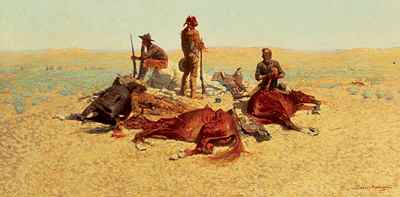
(above: " Frederic Remington, The Last Lull in the
Fight, 1903. Oil on canvas. Courtesy of the Manoogian Collection.)
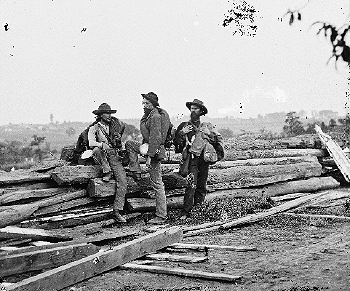
(above: Compare with Last Lull: Three Confederate
Prisoners, Gettysburg, 1863. Courtesy of the Prints and Photographs
Division, Library of Congress, Washington, D.C.)
Frederic Remington (1861-1909), noted illustrator, painter,
sculptor, and author, started making western art in the mid-1880s, just
when two dominant attitudes emerged nationally about the Civil War: Reconciliation
and the Lost Cause. "It was a time when Southerners were viewed increasingly
-- even in the North -- as glorious heroes fighting against all odds for
their homes and honor," says exhibition curator Alexander Nemerov,
Ph.D. "It was a time when former enemies shook hands and the war's
enormous bloodshed became increasingly repressed and romanticized."
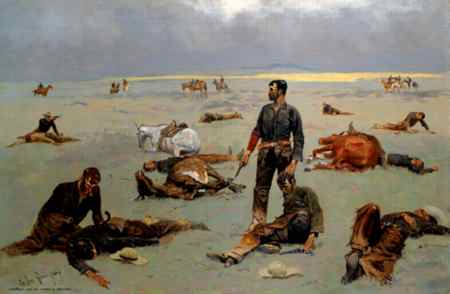
(above: Frederic Remington, What an Unbranded Cow Has
Cost, 1895. Oil on canvas. Collection of Yale University Art Gallery.)
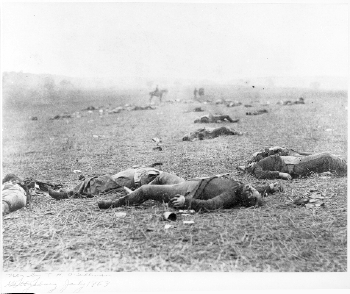
(above: Compare with What an Unbranded Cow Has Cost:
Timothy O'Sullivan, Harvest of Death, Gettysburg, July 1863. Gardner's
Photographic Sketch Book of the War, 1866. Courtesy of the National
Archives and Records Administration.)
During his career Remington produced more than 3,000 drawings
and paintings, 22 bronze sculptures, a novel, a Broadway play, and over
100 articles and stories. At the end of the 19th century, Remington immortalized
the Western experience. His romanticized vision of the heroic nature of
American settlers defined a nation's character as one of independence, individualism,
and stoic heroism, qualities that still resonate in American popular culture.
"A consummate reporter-artist, Frederic Remington
became best known for the vigor and authenticity of his illustrations which
appeared in the periodicals of his day," notes Curator of Illustration
Art Stephanie Plunkett. "While he defined national sensibilities through
romanticized images of the cowboy on the American frontier, Frederic
Remington and the American Civil War: A Ghost Story brings together
a rich tapestry of visual materials and cultural artifacts that invite a
new understanding of Remington's West."
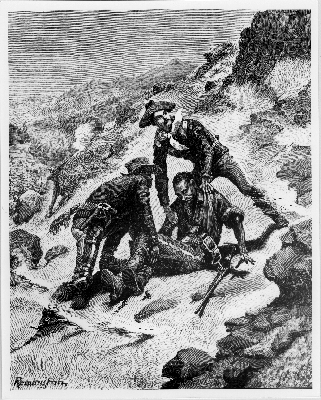
(above: Frederic Remington, The Rescue of Corporal Scott,
1886. Engraving. Harper's Weekly, August 21, 1886. Collection of
the Frederic Remington Art Museum.)
Original Remington paintings, drawings, and sculptures
from public and private collections, archival Civil War photography, and
select books and periodicals are included in this absorbing exhibition that
sheds an entirely new light on a great American illustrator and artist.
The Cavalryman's Breakfast on the Plains (c 1892, Amon Carter Museum)
and A New Year on the Cimarron (1903, Museum of Fine Arts, Houston)
are among the master works featured. What an Unbranded Cow Has Cost
(1895, Yale University Art Gallery), one of five illustrations created for
The Evolution of the Cow Puncher by Owen Wister, author of The
Virginian (1902), provides a central focus for this groundbreaking exhibition,
which invites a reconsideration of Remington's artistic contributions.
"Frederic Remington and Norman Rockwell created influential
visual cultural legacies that defined our nation for eager mass media audiences.
Remington invented our 19th century cultural understanding of the American
West and Rockwell created our cultural understanding of the 20th century.
Each remains a heroic figure of their time," said Museum Director Laurie
Norton Moffatt.
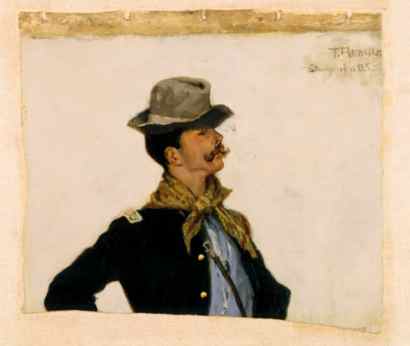
(above: Frederic Remington, Lieutenant Powhatan H. Clarke,
Tenth Cavalry, 1888. Oil on canvas (fragment). Collection of the
Frederic Remington Art Museum.)
Guest curator Alexander Nemerov, Ph.D., is a professor
of art history at Yale University and the author of The Body of Raphaelle
Peale: Still Life and Selfhood, 1812-1824; Frederic Remington and Turn-of-the-Century
America; and Icons of Grief: Val Lewton's Home Front Pictures.
He has also written essays on Norman Rockwell, N.C. Wyeth, Arthur Putnam,
Abbott Thayer and Charles Russell. A 60-page illustrated catalogue, written
by Dr. Nemerov to accompany the exhibition, will be available for purchase
at the Museum Store and online at www.nrm.org.
About Frederic Sackrider Remington (1861-1909)
Frederic Remington was born in 1861 in Canton, New York,
near the St. Lawrence River. When he was just two months old, his father,
newspaper owner and editor, Seth Remington, set out to participate in the
Civil War, which was then in force. After raising a squadron of cavalry
in the well-known Eleventh New York Cavalry, he returned home four year
later with a distinguished military record to resume his work and to get
to know his young son.
An active, strong-willed boy, Frederic Remington enjoyed
athletics and drawing, and his school books were filled with sketches of
soldiers, horses, and Native Americans. At Yale University's School of Fine
Arts, which he attended briefly, he endured the academic rigors of his art
classes, but had a passion for football and boxing. In the middle of his
second year, after his father died, he left Yale and accepted a clerical
position at the Governor's office in Albany, for which he was not well suited.
In 1881, lured by the mystique of the American West, he
set out to retrace the steps of his heroes, Lewis and Clark and George Catlin.
A few months later, he returned home with a sack full of rough, robust drawings
gleaned from first-hand experience. Harper's Weekly purchased one
of these, which was redrawn by William A. Rogers and published on a full
page. After a second trip, he invested in a Kansas sheep ranch, and his
art began to appear regularly in the popular periodicals of the day, including
Harper's Weekly, St. Nicholas, and Outing, bringing
him great success. His love of the West was evident, as he returned there
frequently, collecting new material for illustrations and reporting on current
events from the Indian Wars to wagon trains, trappers, buffalo hunters,
cattle ranchers, and the establishment of settlements. Until the early 20th
century, when his paintings became more lyrical, he objectively recorded
and documented the rapidly disappearing American frontier.
In 1898, urged by artist Frederic Ruckstull, Remington
began to experiment with sculpture, for which he was naturally talented.
His first attempt resulted in The Bronco Buster, a noted work charged
with movement, energy, and a sense of authenticity. "I always had a
feeling for mud," he said, "and I wanted to do something a burglar
wouldn't have, moths eat, or time blacken." He continued to captivate
American audiences with his published illustrations until 1903, when he
began painting and sculpting solely for exhibition. Unconcerned with literal
reporting, his gallery paintings emphasized a more romanticized, reflective
approach to Western subjects.
Frederic Remington interrupted his work with Western themes
in 1898 when he went to Cuba as a war correspondent and illustrator during
the Spanish Civil War. There he met and developed a life-long friendship
with Teddy Roosevelt. When Remington died of appendicitis in 1909 at the
age of 48, Roosevelt's eloquent eulogy read, "The soldier, the cowboy
and rancher, the Indian, the horse and the cattle of the plains will live
in his pictures, I verily believe, for all time."
Exhibition description
- A hallmark exhibition and the first of its kind, Frederic
Remington and the American Civil War: A Ghost Story will examine an
overlooked but significant aspect of Frederic Remington's celebrated career
the great Western artist's ongoing engagement with the American Civil
War.
-
- Frederic Remington rarely painted Civil War scenes, but
the war haunts his depiction of the West, as reflected in his portrayals
of cowboys and troopers. Just as the most famous turn-of-the-century novel
about the West is called The Virginian, so Remington's art, like
the western literature of Owen Wister, examines the West through the lens
of North and South. Organized by the Norman Rockwell Museum and developed
by guest curator Alexander Nemerov, a noted author and professor of art
history at Yale University, this important exhibition promises to present
Remington in an entirely new light.
-
- What an Unbranded Cow Has Cost
(1895), one of five illustrations that Remington created for Owen Wister's
story, The Evolution of the Cow Puncher, provides a central focus
for the exhibition and for a scholarly catalogue essay that presents Alexander
Nemerov's groundbreaking thesis for the first time. The painting fits Wister's
purpose to chronicle the cowboy of Texas in his heyday during the late
1860s and 1870s, when "battle and murder and sudden death," as
Wister wrote, were "every-day matters." Yet the author poses
a compelling question. "What if this picture is not about the American
West?" "What if," he asks, "the painting's view of
the Old West relies heavily on the imagery of another conflict namely,
the American Civil War?" This important exhibition and its accompanying
catalogue essay ask us to consider how this would change our understanding
of Remington's West, not just in this What an Unbranded Cow Has Cost,
but in the artist's larger body of work as well.
-
- Frederic Remington and the American Civil War: A Ghost
Story illuminates these considerations by bringing
together a rich tapestry of visual materials and cultural artifacts, including
original paintings, drawings, and sculptures from public and private collections,
archival Civil War photography, and select books and periodicals of the
artist's day. Though Remington's art was not overtly about the Civil War,
the new ideas of Reconciliation and the Lost Cause permeate his art, just
as they are reflected in Wister's literature. This thesis, put forth by
one of the most highly regarded art historians of our times, will serve
as a lasting record that will serve scholars across the disciplines of
art, history, and visual culture studies for generations to come.
-
Introduction and label text
- To this day, Frederic Remington remains the most famous
artist of the Old West. Born in Canton, New York, in 1861, Remington lived
and worked in New York State and Connecticut, but his paintings and sculptures
of cowboys, Indians, and troopers still stand out as vivid portrayals of
the western frontier. In a career that spanned some twenty-five years,
from the mid-1880s until his death in 1909, Remington made thousands of
illustrations for Harper's Weekly, Harper's Monthly, and
other periodicals. He also made sculptures and avidly sought a reputation
as a fine-art painter. In all this work his depictions of the army, Indian,
and ranching life of the West gave imaginative expression to a passing
phase of American history. By the time he died, Remington's art was widely
accepted as a visual record of a lost era-a guide to the gore and the glory,
the blazing guns and the blazing suns, of the Old West.
-
- Another moment of American history, however, somehow
intrudes in Remington's art-the American Civil War. Remington rarely depicted
the Civil War explicitly. His father had been a distinguished Union officer,
but the childhood drawings to your right, together with two more pictures
elsewhere in this gallery, are among Remington's only direct Civil War
subjects. Yet Civil War imagery haunts his art of the West, informing his
depictions of stalwart troopers, dejected cowboys, and battlefield carnage.
This exhibition explores these ghostly echoes of North and South in Remington's
art of the West.
-
- These two works, one known now only in reproduction,
are some of Remington's few explicit Civil War scenes. Note the similarities
between the untitled image of Union troopers dazed, wounded, and dead and
the western painting What an Unbranded Cow Has Cost, elsewhere in
this gallery.
-
- What an Unbranded Cow Has Cost,
one of Remington's vivid scenes of the Old West, shows the aftermath of
a gun battle between warring factions of cowboys on the Texas frontier
some time in the late 1860s or 1870s. In ways difficult to explain, the
painting with its flat array of dead men and story of fraternal strife
seems haunted by the most famous of Civil War battlefield photographs,
Timothy O'Sullivan's A Harvest of Death, Gettysburg, July 1863.
-
-
- The Red Badge
-
- Remington made his paintings of battlefield destruction
at a time when various writers graphically depicted Civil War casualties.
Most famous of these was Stephen Crane in his novel The Red Badge of
Courage. Crane's descriptions borrow from photographs such as A
Harvest of Death and The Field Where General Reynolds Fell (to
your right) in ways that echo Remington's own references to these images.
Crane published The Red Badge of Courage in October 1895, one month
after Remington's What an Unbranded Cow Has Cost appeared in Harper's
Monthly. Independently, the two men became equally fixated on these
stark photographs.
-
- Remington's early drawing of sleeping soldiers innocently
shows the boredom or exhaustion of soldierly life, but it also oddly calls
to mind the clumped bodies of Timothy O'Sullivan's Field Where General
Reynolds Fell.
-
- Remington's depiction of Native American casualties alludes
to photographs of the aftermath of the Battle of Wounded Knee (1890) but
also back to the burial parties and cluttered corpses of the Civil War,
such as those in two photographs taken at Antietam in 1862.
-
- The relation of Remington's images to Civil War photographs
is always indirect. Never explicit, it is almost certainly never intentional.
In The Two Men Climbed Slowly, an 1897 reproduction of a lost Remington
original, the dead Indian warrior slumped at the base of rocks differs
from the lone rebel in Alexander Gardner's Home of a Rebel Sharpshooter,
yet seems haunted by this well-known photograph. Arthur Keller's illustration
for The Virginian, the famous western novel published by Remington's
friend Owen Wister in 1902, seems also derived from photographs such as
Gardner's.
-
-
- Last Stand and Lost Cause
-
- Remington made many paintings of Last Stands -- groups
of brave frontiersmen stoically fighting to the end against overwhelming
odds. These pictures allude to former Civil War hero George Armstrong Custer's
defeat at the Little Big Horn on June 25, 1876, but they also suggest the
southern side of the Civil War. Remington painted these works when the
Confederacy was increasingly -- and romantically -- understood as a Lost
Cause: as a belief, a way of life, defended by a few outnumbered men, rough
and undaunted. The echoes of Civil War photography in Remington's Last
Lull in the Fight intensify this connection, suggesting that at the
turn of the century the West became a place to re-imagine the values of
the Old South.
-
- Remington's Episode in the Opening Up of a Cattle
Country calls to mind illustrations of brave Confederate soldiers in
Century magazine's immensely popular series Battles and Leaders
of the Civil War (1884-1887), which appeared in the same years as this
early Remington work.
-
- Remington made his first and most famous bronze, The
Bronco Buster, after watching the sculptor Frederick Ruckstull create
a large Civil War equestrian monument of Union Major General John F. Hartranft
(inset). The Bronco Buster is a totally different work -- much smaller,
with a western theme -- yet connections to the Civil War remain. Specifically,
Remington transformed the Union general into a figure with Confederate
connotations. When Remington made his one large-scale sculpture, The
Cowboy (reproduced on the wall in front of you), he called the figure
a "good type of the old Texas cowboys" of the 1880s. For Remington's
friend Owen Wister, too, cowboys were typically southerners and even sometimes
explicitly ex-Confederate soldiers who had gone West after the war.
-
- Remington's heroic Texan is located in Philadelphia's
Fairmount Park, not far from Ruckstull's sculpture in Harrisburg, suggesting
that in an era of Civil War Reconciliation, when former foes shook hands
at battlefield reunions, all regions of the nation could be celebrated,
a Texan no less than a native northerner, even in the vital Union state
of Pennsylvania.
-
- The most famous western novel of Remington's time or
any time has a southern name. The Virginian was written by Remington's
friend Owen Wister and published in 1902. Set in Wyoming Territory, the
novel is explicitly about North-South Reconciliation, with the Virginia-born
hero courting and marrying the Vermont schoolteacher Molly Stark. The novel
is also about the West as a place where the Virginian's and the author's
conservative social philosophies can manifest themselves anew. A huge seller,
The Virginian was later made into an early sound movie starring
Gary Cooper. Wister wrote the novel in Charleston, South Carolina, where
the Civil War began.
-
- John Massey Rhind's Calhoun Monument (1894-1896),
in Charleston, South Carolina, where Owen Wister wrote The Virginian
(1902).
-
-
- Two Works of 1903
-
- Remington painted the elegiac New Year on the Cimarron
the same year that W. E. B. Du Bois published his famous book The Souls
of Black Folk. Each is a response to the aftermath of the Civil War.
Remington's melancholy Texas frontiersmen, their way of life evaporating
like the nearly dry riverbed, evoke comparable figures of Last Stands and
Lost Causes elsewhere in this gallery. (See for example the photograph
of Confederate prisoners on the wall behind you.) Du Bois, meanwhile, lamented
the failure of Reconstruction, which left emancipated African Americans
as high and dry, as lonely and dispirited, as Remington's forgotten outcasts.
-
- Remington's famous painting The Stampede, shown
here in a 1913 reproduction, strangely evokes the thousand-gun clamor of
war. The deafening noise, the bright flash, the terror of a lone man in
a chaotic situation -- the image suggests Henry Fleming's panic-stricken
flight in Stephen Crane's Red Badge of Courage. Remington's cowboy,
though, is recognizably one of his southern types, a version of "the
adventurous sons of Kentucky and Tennessee," in Wister's words, who
abandoned soldiering and became cowboys after the war. Unintentionally
-- but with great vividness -- Remington's West became a place where heroic
southern defeat could be played out again and again.
-
- Remington's Cavalryman's Breakfast on the Plains
unmistakably echoes Winslow Homer's Civil War scenes of camp life like
the two engraved illustrations before you. The allusion to Homer gives
Remington's troopers a Yankee pedigree and a Union association.
-
- Not all Remington's allusions to Confederates are sympathetic,
as they are elsewhere in this exhibition. Lieutenant Sherer, Seventh
Cavalry, Standing Off a Mob at the Stock-Yards, part of Remington's
coverage of the 1894 Pullman Strike in Chicago, casts the strikers in the
position of Homer's Rebels, matching newspaper coverage that likened the
strikers to seceding southerners.
-
- Remington, whose father was a Union officer and a staunch
Lincoln supporter, sometimes made western art strongly supporting the policies
of Reconstruction. The Rescue of Corporal Scott, showing Lieutenant
Powhatan Clarke valiantly saving a wounded member of the all-black Tenth
Cavalry, calls to mind Thomas Ball's well-known sculpture, The Emancipation
Group -- with Clarke in Lincoln's position of savior. That Clarke was
from Virginia only emphasized Remington's view of a post-Civil War America
where citizens of all regions might help a black person rise up.
-
- Leaving the Canyon, another
of Remington's Reconstruction scenes, shows members of the Tenth Cavalry
working efficiently to lift a wounded Apache prisoner up a cliff. The black
men operate with dignity, and the white officer presiding above seems almost
like an afterthought. Remington's scene is a direct contrast to crude racist
stereotypes of those same years, such as Currier and Ives's popular Darktown
series.
-
- The Return of Gomez to Havana,
a scene based on Remington's experience covering the Spanish-American War
in Cuba in 1898, shows the liberation of a black populace in a way that
illustrates popular slogans about that war -- Cuba Libre -- even
as it also conjures racial emancipation in the Civil War. In his other
Cuban work Remington linked the two conflicts as wars of liberation. The
Battle of San Juan Hill, the most famous fight in the Spanish-American
War, took place on July 1, 1898, the thirty-fifth anniversary of the first
day of the Battle of Gettysburg.
-
- Remington's western art grew out of the Civil War in
unexpected fashion. When fabled Union general and ex-President Ulysses
S. Grant died in 1885, journals such as Harper's Weekly devoted
lavish attention to this great Civil War figure. Soon after, Remington's
West emerged as a place of thrilling adventure in the pages of the same
journal. The vibrant energy of Indian Scouts on Geronimo's Trail
replaced the somber procession of Grant's funeral, and the West rose out
of the Civil War's ashes as a new topic of public fascination. Yet Remington's
West also became a place where the traumas and ideologies of the Civil
War-the ongoing, lasting effects of that vast conflict -- could live on
in strange and surprising ways.
-
- Remington's image depicting army training exercises in
Florida prior to the Spanish-American War represents the strange spectacle
of American servicemen marching through the South again, not so many years
after Sherman's March across similar Palmetto lands. The uniforms are different
but the presence of blue-clad soldiers on southern land was not. The thinness
and paleness of the watercolor wash gives the picture an unintended ghostliness
even though Remington's aim was strictly journalistic: he made the painting
for reproduction in the New York Journal.
Checklist for the exhibition
- Thomas Ball
- Emancipation Group 1865
- Bronze
- Collection of the Montclair Art Museum
- 34 _ x 21 x 13
-
- Frederic Remington
- The Color Sarg't ca.1876
- Pen and ink with watercolor on paper
- Collection of R.W. Norton Art Foundation
- 9 _ x 6 _
-
- Frederic Remington
- The Captain ca.1876
- Pen and ink with watercolor on paper
- Collection of R.W. Norton Art Foundation
- 7 _ x 6 _
-
- Frederic Remington
- A Battle Scene ca.1876
- Pencil and watercolor on lined paper
- Collection of the Frederic Remington Art Museum
- 7 _ x 13
-
- Frederic Remington
- On the Evening of the 4th of May ca.1876-1877
- Pencil and crayon on paper
- Collection of R.W. Norton Art Foundation
- 7 _ x 7 _
-
- Frederic Remington
- Civil War Battle Scene ca.1885
- Ink on paper
- Collection of the Frederic Remington Art Museum
- 14 _ x 22 _
-
- Frederic Remington
- The Noonday Halt 1887
- Ink on paper
- Collection of the Frederic Remington Art Museum
- 8 _ x 13 3/8
-
- Frederic Remington
- Lieutenant Powhatan H. Clarke, Tenth Cavalry 1888
- Oil on canvas (fragment)
- Collection of the Frederic Remington Art Museum
- 10 _ x 12 _
-
- Frederic Remington
- An Episode in the Opening up of a Cattle Country 1887
- Oil on board
- Collection of the Autry National Center, Museum of the American West
- 17 _ x 24 7/8
-
- Frederic Remington
- A Cavalryman's Breakfast on the Plains ca. 1892
- Oil on canvas
- Collection of the Amon Carter Museum
- 22 x 32 1/8
-
- Frederic Remington
- The Coffee Call 1893
- Lithograph
- Collection of the Amon Carter Museum
-
- Frederic Remington
- Leaving the Canyon ca.1894
- Watercolor on paper
- Collection of the Autry National Center, Museum of the American West
- 25 _ x 20
-
- Frederic Remington
- The Bronco Buster 1895
- Bronze
- Collection of the Frederic Remington Art Museum
- Height 22 1/8 x base 21 _ x width 10 _
-
- Frederic Remington
- What an Unbranded Cow Has Cost 1895
- Oil on canvas
- Collection of Yale University Art Gallery
- 28 1/16 x 35 1/8
-
- Frederic Remington
- After the Dull Knife Fight (Battle of War Bonnet Creek) ca.1897
- Oil on canvas
- Collection of The Thomas Gilcrease Institute of American History and
Art
- 27 _ x 40 _
-
- Frederic Remington
- U.S Troops Practicing Marching in Palmettos 1898
- Pen and ink wash on paper
- Collection of the Frederic Remington Art Museum
- 19 _ x 29 _
-
- Frederic Remington
- Return of Gomes to Havana 1899
- Oil on canvas
- Collection of The Museum of Fine Arts, Houston
- 27 x 40
-
- Frederic Remington
- A New Year on the Cimarron (A Courier's Halt to Feed) 1903
- Oil on canvas
- Collection of The Museum of Fine Arts, Houston
- 27 x 40
-
- Frederic Remington
- The Last Lull in the Fight 1903
- Oil on canvas
- Courtesy of the Manoogian Collection
- 30 _ x 61
-
- Frederic Remington
- The Virginian 1929
- Lithograph
- Collection of the Autry National Center, Museum of the American West
- 42 _ x 28 _
-
-
Supporting Material
-
- Alexander Gardner
- Burying the Dead after the Battle of Antietam 1862
- Courtesy of the Prints and Photographs Division, Library of Congress,
Washington, D.C.
-
- Timothy O'Sullivan
- A Harvest of Death, Gettysburg, July 1863
- Gardner's Photographic Sketch Book of the War, 1866
- Courtesy of the National Archives and Records Administration
-
- Alexander Gardner
- Home of a Rebel Sharpshooter, Gettysburg, July 1863 1863
- Gardner's Photographic Sketch Book of the War, 1866
- Courtesy of the National Archives and Records Administration
-
- Alexander Gardner
- Field Where General Reynolds Fell, Gettysburg, July 1863
1863
- Gardner's Photographic Sketch Book of the Civil War, 1866
- Courtesy of the National Archives and Records Administration
-
- Anonymous Photographer
- Three Confederate Prisoners, Gettysburg 1863
- Courtesy of the Prints and Photographs Division, Library of Congress,
Washington, D.C.
-
- A.C. Redwood
- Cobb's and Kershaw's Troops Behind the Stone-Wall
- Century 32, August 1886
- Courtesy of the Beinecke Rare Book and Manuscript Library,
- Yale University
-
- T. de Thulstrup
- General Grant's Funeral The Procession Passing Up Fifth Avenue
1885
- Harper's Weekly, August 15, 1885
- Collection of William and Penny Hargreaves
-
- Frederic Remington
- The Rescue of Corporal Scott 1886
- Harper's Weekly, August 21, 1886
- Collection of the Frederic Remington Art Museum
-
- Frederic Remington
- The Apache War Indian Scouts on Geronimo's Trail 1886
- Harper's Weekly, January 9, 1886
- Collection of the Frederic Remington Art Museum
-
- Ambrose Bierce
- Tales of Soldiers and Civilians 1891
- San Francisco: E.L.G. Steele, 1891
- Collection of the Abernathy Collection of American Literature,
- Middlebury College Library
-
- Harold Frederic
- Marsena and Other Stories of Wartime 1894
- New York: Charles Scribner's Sons, 1894
- Collection of Amherst College Library
-
- Frederic Remington
- Lieutenant Sherer, Seventh Cavalry, Standing Off a Mob at the Stock-Yards
1894
- Harper's Weekly 38, July 28, 1894
- Courtesy of Stanford University Libraries
-
- Anonymous Photographer
- Calhoun Monument, Charleston 1894-96
- Courtesy of the Prints and Photographs Division, Library of Congress,
Washington, D.C.
-
- Stephen Crane
- The Red Badge of Courage 1895
- First edition
- Collection of the Abernathy Collection of American Literature
- at Middlebury College Library
-
- Anonymous Photographer
- Photograph of Frederick Wellington Ruckstull posing with clay model
of sculpture of Major General John F. Hartranft ca. 1895
- Great Works of Art and What Makes Them Great by F.W. Ruckstull
- New York: G.P. Putnams Sons, 1925
- Courtesy of the Sterling Memorial Library, Yale University
-
- Frederick Wellington Ruckstull
- Equestrian Sculpture of Major General John F. Hartranft ca.1895
- Great Works of Art and What Makes Them Great by F.W. Ruckstull
- New York: G.P. Putnam's Sons, 1925
- Capitol Building in Harrisburg, Pennsylvania
- Courtesy of the Pennsylvania Capitol Preservation Committee
-
- Frederic Remington
- The Two Men Climbed Slowly 1897
- Harper's New Monthly Magazine, August 1897
- Collection of William & Penny Hargreaves
-
- Owen Wister
- The Virginian 1902
- New York: Macmillan 1902
- Collection of the Buffalo Bill Historical Center
-
- W.E.B. Du Bois
- The Souls of Black Folk 1903
- First edition, third printing
- Inscribed and autographed
- Collection of the University of Massachusetts
-
- Frederic Remington
- Cutting Out Pony Herds
- Collier's Weekly, February 1, 1913
- Collection of the University of Massachusetts
Editor's note: RL readers may also enjoy:
- "They Are a Fine Outfit
Those Blackfeet": Frederic Remington in Western Canada; essay
by Peter H. Hassrick (1/19/05)
- Capturing Western Legends:
Russell and Remington's Canadian Frontier (1/5/05)
- Frederic Remington: Illustrator,
Sculptor, Painter (2/20/02)
- Remington, Russell and the
Language of Western Art (11/22/00)
- Charles M. Russell at Stark
Museum of Art (11/3/00)
- Remington and Russell: Masterpieces
of the American West from the Amon Carter Museum (5/23/00)
- C. M. Russell Home and Log
Cabin Studio: National Historic Landmark (5/13/00)
- Charles Russell and
Maynard Dixon Paintings Given to the Utah Museum of Fine Arts Collection
(2/27/99)
- Sid Richardson Collection of
Western Art (2/21/99)
- The Art of Western
Artist Charles M. Russell (9/21/98)
- From Art Journal Frederic
Remington: A Catalogue Raisonne of Paintings, Watercolors, and Drawings,
2 vols. - book reviews, Fall, 1997 by Roberta K. Tarbell; Icons
of the West: Frederic Remington's Sculpture. - book reviews, Fall, 1997
by Roberta K. Tarbell
- from Magazine Antiques Frederic
Remington's studio: a reflection, Nov, 1994 by Peter H. Hassrick
and these articles and essays on Western genre art:
and this video on Frederic Remington:
Frederic Remington: The Truth of Other Days is a 58 minute American Masters series 1991 video filmed in high
definition format. It was directed by Thomas L. Neff and produced by Home
Vision Entertainment.
This program traces the career of the brilliant painter,
sculptor and author Frederic Remington. Hundreds of original artworks are
showcased while narration by Gregory Peck, interviews. Location footage,
archival footage and period photographs create an illuminating frame around
the works of one of America's finest artists. Frederic Remington: The
Truth of Other Days also explores Remington's direct influence on filmmakers
such as John Ford and his continuing influence on today's popular culture.
Read more articles and essays concerning this institutional
source by visiting the sub-index page for the Norman
Rockwell Museum in Resource Library.
Visit the Table
of Contents for Resource Library for thousands
of articles and essays on American art.
Copyright 2005 Traditional Fine Arts Organization,
Inc., an Arizona nonprofit corporation. All rights reserved.