
Editor's note: The Detroit Institute of Arts provided source material to Resource Library for the following article. If you have questions or comments regarding the source material, please contact the Detroit Institute of Arts directly through either this phone number or web address:
American Chronicles: The Art of Norman Rockwell
March 8 - May 31, 2009
Family -- innocence
-- heroism. These are the core themes interwoven throughout the work of
Norman Rockwell, one of America's most recognized and 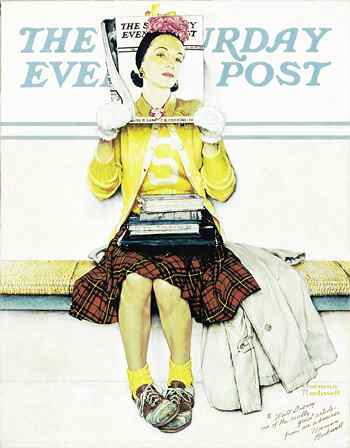 beloved
artists. American Chronicles: The Art of Norman Rockwell, on view
at the Detroit Institute of Arts March 8 - May 31, 2009, explores Rockwell
the artist, his images, and their impact and influence on American culture.
(right: Norman Rockwell, Girl Reading the Post, 1941,
Painting for The Saturday Evening Post cover, March 1, 1941, Oil
on board. Norman Rockwell Museum Collection. Gift of the Walt Disney Family)
beloved
artists. American Chronicles: The Art of Norman Rockwell, on view
at the Detroit Institute of Arts March 8 - May 31, 2009, explores Rockwell
the artist, his images, and their impact and influence on American culture.
(right: Norman Rockwell, Girl Reading the Post, 1941,
Painting for The Saturday Evening Post cover, March 1, 1941, Oil
on board. Norman Rockwell Museum Collection. Gift of the Walt Disney Family)
From idyllic childhood scenes to commentaries on the post-war era and segregation, many paintings in Rockwell's six decades of work have become American icons. A number of Rockwell's signature works are among the 44 paintings and 323 original Saturday Evening Post covers in the exhibition: No Swimming (1921); Four Freedoms (1942); Christmas Homecoming (1948); Triple Self Portrait (1959) and the famous The Problem We All Live With (1963), dealing with school desegregation, and was painted to mark the 10th anniversary of Brown v. Board of Education.
American Chronicles explores the themes of family, innocence and heroism that permeate Rockwell's work. His paintings of families include storylines filled with love, affection and humor, and are free of difficulties such as disease, loneliness, and death. Rockwell knew that uplifting sentiments appealed to people's emotions, and he used them effectively in his commercial and advertising work during his 47 years with the Saturday Evening Post.
When Rockwell wanted to express innocence, he painted children, portraying American childhood as carefree and charming. His cheerful pictures of happy kids untouched by hard realities prompted viewers to recall similar feelings -- if not similar scenes -- from their own childhoods. These desirable, happy scenes were ones people wanted to associate themselves with, and the images were advertising gold for products like cereal and magazines. However, some of Rockwell's most poignant and affecting images portray innocence lost, where the idealization of childhood is contrasted against the far more complicated world of adults. Girl at Mirror (1954) shows a young girl tentatively applying make-up with a celebrity magazine on her lap. Another moment of lost innocence is seen in The Discovery (1956), which shows a little boy with a shocked expression who has just found a Santa suit in his father's dresser drawer.
When depicting heroism, Rockwell focused on reassuring
images of leaders, such as President Dwight D. Eisenhower or John F. Kennedy,
but he also cast everyday Americans as heroes, focusing on their personal
sacrifice and duty to the nation. Some of his most powerful images are those
made in support of America's involvement in World War II. Rockwell's heroes
are rarely shown on the front-line; he preferred to portray the quiet heroism
of those who waited for loved ones left 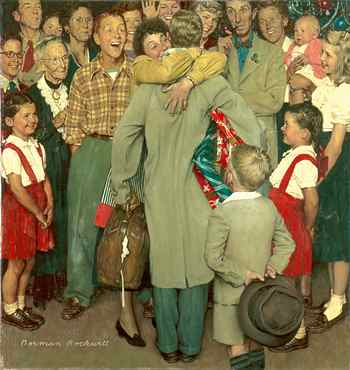 behind,
such as the miner with two sons in the military featured in the poster Mine
America's Coal (1945). When Rockwell created images for the extremely
successful war bond posters Four Freedoms, he shows citizens at home
enjoying the liberties that America fought to preserve. (left: Norman
Rockwell, Christmas Homecoming, 1948, Painting for The Saturday
Evening Post cover, December 25, 1948, Oil on canvas. Norman Rockwell
Museum Collection)
behind,
such as the miner with two sons in the military featured in the poster Mine
America's Coal (1945). When Rockwell created images for the extremely
successful war bond posters Four Freedoms, he shows citizens at home
enjoying the liberties that America fought to preserve. (left: Norman
Rockwell, Christmas Homecoming, 1948, Painting for The Saturday
Evening Post cover, December 25, 1948, Oil on canvas. Norman Rockwell
Museum Collection)
At the height of his fame and recognition, Rockwell sought out difficult themes of the day in what he referred to as "big pictures." Up until the early 1960s, Rockwell's illustrations served the needs of the conservative Saturday Evening Post, which during the early- and mid- 20th century celebrated white, middle class, small hometown values to the exclusion of many other kinds of American experience. Rockwell left The Post for Look magazine in 1964, where he was able to take on issues of social consciousness, such as war, racism, poverty and injustice. He used his illustrative and storytelling skills to make injustice visible. His image of Ruby Bridges in The Problem We All Live With (1963) or three civil rights workers in Murder in Mississippi (1965) are still powerful reminders of America's struggle for civil rights for all.
The exhibition will also display photo murals of one of Rockwell's studios and his working process. He often posed for his own paintings and viewers will get a glimpse into his technique of preparing to create a painting.
"Rockwell's pictures grow in meaning and significance because of his profound impact on American culture," said Graham W. J. Beal, Detroit Institute of Ar director. "As part of the mass media for decades, Rockwell's images have come to be seen as defining the core American experience. To our 21st-century eyes, they present complex questions about who and what is American. We invite you to take another look at one of America's most well-known artists."
American Chronicles: The Art of Norman Rockwell has been organized by the Norman Rockwell Museum in Stockbridge, Massachusetts. American Chronicles has been made possible by a grant from the National Endowment for the Arts, American Masterpieces Program. Publication support has been provided by the Henry Luce Foundation. Media sponsorship has been provided by the Curtis Publishing Company and by the Norman Rockwell Estate Licensing Company. A fully illustrated catalog is available in the Detroit Institute of Art Museum Shop.
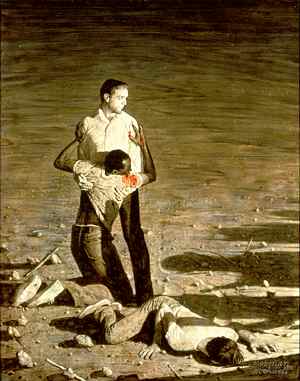
(above: Norman Rockwell, Murder in Mississippi, April 6-13, 1965, Painting intended as the final illustration for Look story, "Southern Justice" by Charles Morgan, Jr., June 29, 1965. Unpublished, Oil on canvas. Norman Rockwell Museum Collection)
Go to:
Wall labels for the exhibition
Additional images for the exhibition
Editor's note: RL readers may also enjoy:
From The Art Bulletin:
This online video:
 AOL Television offers Biography: Norman
Rockwell, [47:00] via truveo.com
which says of the video: "It is a source of fury to the formal art
world that Norman Rockwell was and remains the most visible and beloved
of the American painters of this century. His name has come to symbolize
the best of an era when American had a single clean, shining patriotic vision.
A time when God, country and goodness meant not just something, but everything.
While the 320 Rockwell covers for the "Saturday Evening Post"
are part of the past, his happy fame lives on in the collections of people
as diverse as Richard Nixon, Johnny Carson, Steven Spielberg, Andy Warhol
and Ringo Starr. This biography uncovers the complicated man who produced
the glorious and uncomplicated paintings that thrilled America for sixty
years--from his deathless "Four Freedoms" and "Willie Gillis
G.I." series to h is panoply of civil rights, baseball, young love
and Christmas classics. This biogrpahy illustrates not only the artist and
his paintings, but the nation as Rockwell helped shape it. Filled with the
insights of experts and the people who knew Rockwell. A perfect delight.".
Distributed by Lou Reda Productions.
AOL Television offers Biography: Norman
Rockwell, [47:00] via truveo.com
which says of the video: "It is a source of fury to the formal art
world that Norman Rockwell was and remains the most visible and beloved
of the American painters of this century. His name has come to symbolize
the best of an era when American had a single clean, shining patriotic vision.
A time when God, country and goodness meant not just something, but everything.
While the 320 Rockwell covers for the "Saturday Evening Post"
are part of the past, his happy fame lives on in the collections of people
as diverse as Richard Nixon, Johnny Carson, Steven Spielberg, Andy Warhol
and Ringo Starr. This biography uncovers the complicated man who produced
the glorious and uncomplicated paintings that thrilled America for sixty
years--from his deathless "Four Freedoms" and "Willie Gillis
G.I." series to h is panoply of civil rights, baseball, young love
and Christmas classics. This biogrpahy illustrates not only the artist and
his paintings, but the nation as Rockwell helped shape it. Filled with the
insights of experts and the people who knew Rockwell. A perfect delight.".
Distributed by Lou Reda Productions.
These DVD-VHS videos:
Norman Rockwell: An American Portrait is a 60 minute 2002 video from V.I.E.W. Video is a PBS special,
narrated by 3-time Emmy  Award nominee
Mason Adams. Norman Rockwell had a love affair with America. His poignant
paintings captured the truths of daily life with a simple humane grace and
greeted Americans from the cover of The Saturday Evening Post for
over five decades. This documentary celebrates Rockwell's life and art,
with interviews and commentary by art historians, close friends and the
artist himself. "This notable documentary shows Rockwell was a perceptive
social commentator of exceptional artistic skill and narrative power"
(Entertainment Weekly). DVD: Bonus features include a Norman Rockwell
biography, an art gallery and more.
Award nominee
Mason Adams. Norman Rockwell had a love affair with America. His poignant
paintings captured the truths of daily life with a simple humane grace and
greeted Americans from the cover of The Saturday Evening Post for
over five decades. This documentary celebrates Rockwell's life and art,
with interviews and commentary by art historians, close friends and the
artist himself. "This notable documentary shows Rockwell was a perceptive
social commentator of exceptional artistic skill and narrative power"
(Entertainment Weekly). DVD: Bonus features include a Norman Rockwell
biography, an art gallery and more.
Norman Rockwell. "Norman
Rockwell's distinctive illustrations, glowing with the simple, noble character
of average citizens, crystallized an image of 20th  century
American life." This 50 minute 1994 A&E Biography video
"provides an intimate portrait of the artist and the man with interviews
of friends and people he used as models and takes us on a tour of the Norman
Rockwell Museum and his best-known images."
century
American life." This 50 minute 1994 A&E Biography video
"provides an intimate portrait of the artist and the man with interviews
of friends and people he used as models and takes us on a tour of the Norman
Rockwell Museum and his best-known images."
Norman Rockwell: Painting America is
an 86 minute 1999 American Masters Production from Winstar Home Entertainment.based
on the award-winning  PBS series.
Norman Rockwell: Painting in America looks at the life and art of
one of America's most celebrated illustrators. Best known for his memorable
covers of The Saturday Evening Post, Rockwell achieved unprecedented
fame for masterfully showing warmth and humor in his renderings of everyday
life. This program includes interviews with artists, critics, historians,
friends and admirers, as well as archival newsreel and television footage
of the artist himself. VHS/DVD. Click
here to view an extended clip of the video.
PBS series.
Norman Rockwell: Painting in America looks at the life and art of
one of America's most celebrated illustrators. Best known for his memorable
covers of The Saturday Evening Post, Rockwell achieved unprecedented
fame for masterfully showing warmth and humor in his renderings of everyday
life. This program includes interviews with artists, critics, historians,
friends and admirers, as well as archival newsreel and television footage
of the artist himself. VHS/DVD. Click
here to view an extended clip of the video.
Norman Rockwell's World: An American Dream is a 24 minute 1972 video directed by Robert Deubel that presents
the world of American illustrator Norman Rockwell (1894-1978) through reenactment,
stills, paintings, and old film footage. Rockwell himself narrates this
Academy Award®-winning film. Using the artwork
and the commentary of Rockwell himself in  combination
with old film footage and staged reenactments, the Saturday Evening Post
covers once again come alive.
combination
with old film footage and staged reenactments, the Saturday Evening Post
covers once again come alive.
 Click here for information on how to borrow or purchase copies of
VHS videos and DVDs listed above. TFAO does not maintain a lending library
of videos or sell videos.
Click here for information on how to borrow or purchase copies of
VHS videos and DVDs listed above. TFAO does not maintain a lending library
of videos or sell videos.
Links to sources of information outside of our web site
are provided only as referrals for your further consideration. Please use
due diligence in judging the quality of information contained in these and
all other web sites. Information from linked sources may be inaccurate or
out of date. TFAO neither recommends or endorses these referenced organizations.
Although TFAO includes links to other web sites, it takes no responsibility
for the content or information contained on those other sites, nor exerts
any editorial or other control over them. For more information on evaluating
web pages see TFAO's General Resources
section in Online Resources for Collectors and Students of Art History.
Read more articles and essays concerning this institutional source by visiting the sub-index page for the Detroit Institute of Arts in Resource Library.
Search Resource Library for thousands of articles and essays on American art.
Copyright 2009 Traditional Fine Arts Organization, Inc., an Arizona nonprofit corporation. All rights reserved.