Editor's note: The Denver Art Museum provided source material to Resource Library for the following article or essay. If you have questions or comments regarding the source material, please contact the Denver Art Museum directly through either this phone number or web address:
The Psychedelic Experience: Rock Posters from the San Francisco Bay Area, 1965-71
March 21 - July 19, 2009
Are you experienced?
Take a trip back in time with 300 psychedelic rock posters -- as well as
album covers, underground newspapers, and other items -- 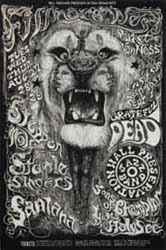 from the late 1960s and early '70s, an era of free love,
rock music, and experimental design. (right: Lee Conklin, Steppenwolf,
Grateful Dead, Fillmore West, San Francisco, 1968. Partial gift of David
and Sheryl Tippit; partial purchase with Architecture, Design & Graphics
Department Acquisition Funds; and Volunteer Endowment Funds in honor of
R. Craig Miller; © Bill Graham Archives, LLC. www.Wolfgangsvault.com)
from the late 1960s and early '70s, an era of free love,
rock music, and experimental design. (right: Lee Conklin, Steppenwolf,
Grateful Dead, Fillmore West, San Francisco, 1968. Partial gift of David
and Sheryl Tippit; partial purchase with Architecture, Design & Graphics
Department Acquisition Funds; and Volunteer Endowment Funds in honor of
R. Craig Miller; © Bill Graham Archives, LLC. www.Wolfgangsvault.com)
The Psychedelic Experience includes selections from our own collection of vibrant, colorful works by the psychedelic poster movement's major contributors. Whether you were part of the vibrant San Francisco scene or just a twinkle in your mama's eye, you'll recognize these iconic images.
Once you've experienced the art, explore the scene with the Psychedelic Side Trip. Transport yourself back to the sights and sounds of the era through video, music and interactive activities. Freak out to our wall of sound. Make your own groovy light show, or try your hand designing your own psychedelic poster.
Beginning in 1965, a critical mass of young people congregated in San Francisco's Haight-Ashbury neighborhood. Lured by a burgeoning music scene, drugs, and the promise of like-minded idealists, this hippie subculture found expression of their spirit in the dynamic visual language developed by a group of poster artists, many of them with little formal training.
Between 1966 and 1971, two influential event promoters, Bill Graham and Chet Helms, commissioned some 500 posters announcing weekly dance concerts at their rock emporiums: the Fillmore Auditorium and the Avalon Ballroom. Artists such as Wes Wilson, Victor Moscoso, and Lee Conklin captured the essence of these "happenings" in wildly experimental advertisements. Through a melting pot of hallucinatory imagery and illegible lettering, often in unorthodox juxtapositions of electric colors, their posters recreated the mind-altering experiences induced by hallucinogenic drugs. Additionally, these artists adopted graphic facsimiles for the barrage of sound and imagery experienced within the dancehall environment, from liquid light shows to dancing to the Grateful Dead.
The resulting psychedelic posters dramatically contrast with the clarity and legibility that were the norm for graphic designs. Yet they communicated well enough to fill auditoriums with a younger generation who deciphered, rather than read, the message. Posters were designed to promote bands, appeal to aficionados, and offend everyone else. These announcements serve as stunning reminders of an era that espoused free love, drugs, and the hard-edged rock music known as the San Francisco Sound.
The Artists
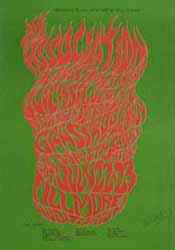 The first artist to consistently
create posters for the Avalon and Fillmore, Wilson's designs set the style,
capturing the full sensory experience of the dancehall environment and
effects of psychedelic drugs. Veering away from clear, utterly readable
design, Wilson hand-lettered his posters to create three-dimensional, undulating
shapes. (left: Wes Wilson, Association, Quicksilver Messenger
Service, Fillmore Auditorium, San Francisco, 1966. Collection of David
and Sheryl Tippit; © 1966 Wes Wilson)
The first artist to consistently
create posters for the Avalon and Fillmore, Wilson's designs set the style,
capturing the full sensory experience of the dancehall environment and
effects of psychedelic drugs. Veering away from clear, utterly readable
design, Wilson hand-lettered his posters to create three-dimensional, undulating
shapes. (left: Wes Wilson, Association, Quicksilver Messenger
Service, Fillmore Auditorium, San Francisco, 1966. Collection of David
and Sheryl Tippit; © 1966 Wes Wilson)
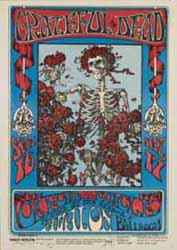
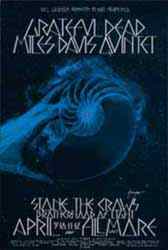 David Singer's creations stemmed
from his interest in collage: his restrained style avoided the vibrant
color, decorative lettering, and patterns that defined earlier psychedelic
posters. Singer designed more posters for the Fillmore than any other artist,
creating 67 examples between 1969 and 1971. (left: David Singer,
Grateful Dead, Miles Davis Quintet, Fillmore West, San Francisco,
1970. Partial gift of David and Sheryl Tippit; partial purchase with Architecture,
Design & Graphics Department Acquisition Funds; and Volunteer Endowment
Funds in honor of R. Craig Miller; © Bill Graham Archives, LLC. www.Wolfgangsvault.com)
David Singer's creations stemmed
from his interest in collage: his restrained style avoided the vibrant
color, decorative lettering, and patterns that defined earlier psychedelic
posters. Singer designed more posters for the Fillmore than any other artist,
creating 67 examples between 1969 and 1971. (left: David Singer,
Grateful Dead, Miles Davis Quintet, Fillmore West, San Francisco,
1970. Partial gift of David and Sheryl Tippit; partial purchase with Architecture,
Design & Graphics Department Acquisition Funds; and Volunteer Endowment
Funds in honor of R. Craig Miller; © Bill Graham Archives, LLC. www.Wolfgangsvault.com)
Please click here to view the exhibition checklist
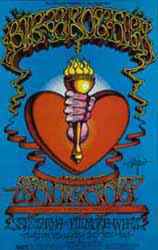
(above; Rick Griffin, Heart and Torch/Big Brother and the Holding Company, Santana, Fillmore West, San Francisco, 1968. Partial gift of David and Sheryl Tippit; partial purchase with Architecture, Design & Graphics Department Acquisition Funds; and Volunteer Endowment Funds in honor of R. Craig Miller; © Bill Graham Archives, LLC. www.Wolfgangsvault.com)
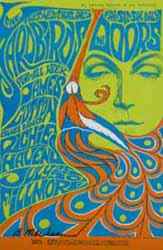
(above; Bonnie MacLean, Yardbirds, Doors, Fillmore Auditorium, San Francisco, 1967. Partial gift of David and Sheryl Tippit; partial purchase with Architecture, Design & Graphics Department Acquisition Funds; and Volunteer Endowment Funds in honor of R. Craig Miller; © Bill Graham Archives, LLC. www.Wolfgangsvault.com)
Editor's note: RL readers may also enjoy:
and biographical information on artists cited in this article in America's Distinguished Artists, a national registry of historic artists.
Read more articles and essays concerning this institutional source by visiting the sub-index page for the Denver Art Museum in Resource Library.
Search Resource Library for thousands of articles and essays on American art.
Copyright 2009 Traditional Fine Arts Organization, Inc., an Arizona nonprofit corporation. All rights reserved.