Distinguished Artist Series
Franz A. Bischoff
1864-1929
by Jean Stern
The gallery measured 36 feet by 40
feet. It had high, concave ceilings lighted by several half-circle skylights.
The floors were of solid oak covered by old Turkish rugs and polar bear
skins. All interior doors and paneling were of natural redwood in the Gothic
style. The furniture was of massive oak in the Mission style. At the west
end of the gallery was a huge tile-covered fireplace. The wall space throughout
was covered with paintings of flowers and landscapes, and in one corner
were several oak display cases containing examples of Bischoff's painted
ceramics.
The painting studio had a large picture window that overlooked
the Arroyo Seco, with a wide vista of the distant mountains. The studio
furniture consisted of an easel, several easy chairs and low divans, all
of Flemish oak. The basement housed a complete ceramic studio with a kiln,
and a complete laboratory where Bischoff prepared his colors.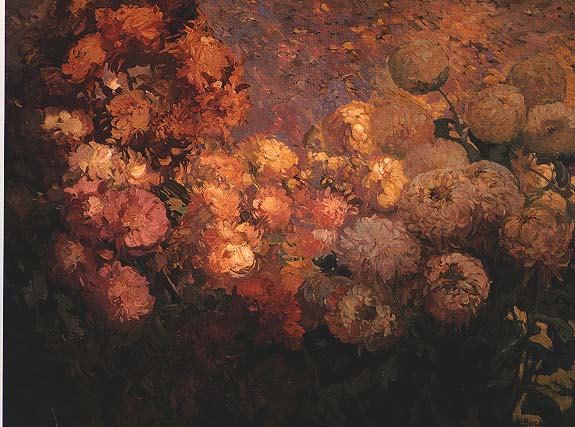
Bischoff's paintings were immediately well received by
the public and the art critics. He loved to paint the Arroyo Seco from the
vicinity of his home. His favorite sketching method was to take several
small board panels, about 13 inches by 19 inches, and quickly paint the
view first-hand. These numerous panels were used later to compose the large
canvas paintings. Bischoff always displayed these small sketches in his
gallery and visitors admired their "...broad, free way. They give us
many aspects of nature with compelling truth. California's gray days as
well as her sunshine..." 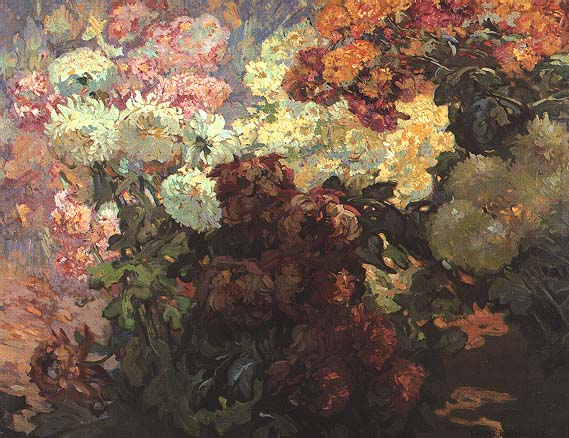 In
addition to the local landscape, Bischoff painted many aspects of everyday
life about him: the farms and pastures with their cows and sheep; the busy
docks of San Pedro with fishermen unloading their catch; relaxed groups
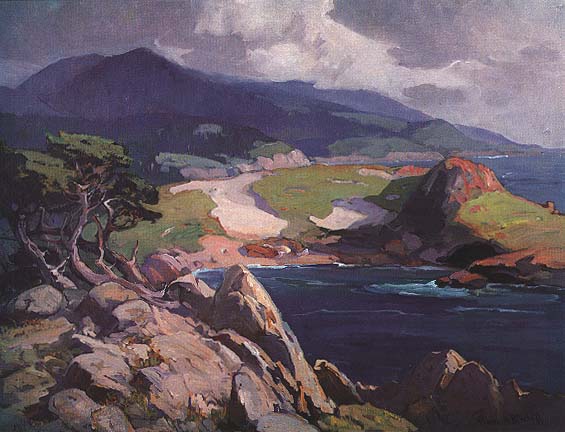
of people picnicking or picking flowers on the lawn. Bischoff also traveled
up the coast to Monterey, Carmel and Cambria. He painted in the Sierras
and in the desert near Palm Springs. Late in his life, he visited Utah and
produced several outstanding scenes of the sandstone cliffs of Zion National
Park. But above all, he was a flower painter, and he continued to paint
flowers throughout his life.
In
addition to the local landscape, Bischoff painted many aspects of everyday
life about him: the farms and pastures with their cows and sheep; the busy
docks of San Pedro with fishermen unloading their catch; relaxed groups
of people picnicking or picking flowers on the lawn. Bischoff also traveled
up the coast to Monterey, Carmel and Cambria. He painted in the Sierras
and in the desert near Palm Springs. Late in his life, he visited Utah and
produced several outstanding scenes of the sandstone cliffs of Zion National
Park. But above all, he was a flower painter, and he continued to paint
flowers throughout his life.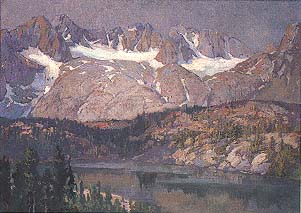
Bischoff continued to teach after he came to Los Angeles. In addition to holding classes in Los Angeles, he periodically traveled to San Francisco and Seattle to hold courses during the summer months. On February 5, 1929, Franz Bischoff died of heart failure at his home in his beloved Arroyo Scco. For many years thereafter, Bertha and their son Oscar kept the gallery open to visitors and occasionally sold some paintings and ceramics. Upon Bertha's death in 1966, Oscar Bischoff continued the practice until his death in 1967. Frances Bischoff Mace died in 1979.
From top to bottom: Cypress Point, oil on canvas, 30 x 40 inches; Flower Arrangement, Mums, oil on canvas, 30 x 40 inches; Peonies, oil on canvas, 30 x 40 inches; Palisades Glacier, oil on canvas, 24 x 34 inches.
Go to page 1 / 2 / 3 / 4 / 5 / 6 / 7
This is page 3
Search Resource Library for thousands of articles and essays on American art.
Copyright 2010 Traditional Fine Arts Organization, Inc., an Arizona nonprofit corporation. All rights reserved.